Idaho: Right-of-way and turning — Part 1 Practice Test
Questions in this part include: “What is the most common sign seen when approaching a roundabout?” · “What is a thru-turn?”
Independent educational site · not affiliated with any government agency or DMV
Ready? Test yourself
- Instant feedback with an explanation
- Every answer cites its source in the manual
- Your best score is saved on this device
Questions are original and based on the official manual "Idaho Driver's Handbook" (July 2026), Idaho Transportation Department.
All 16 questions in this practice test
Take the test above first, then use this list to study. Tap “Show answer” to see the correct answer and explanation.
Show the questions and answersHide the questions
-
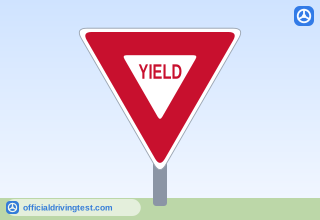
What must you do when you approach a yield sign?
- Stop completely every time, then proceed when the way is clear
- Slow down and yield to other vehicles and pedestrians, stopping if necessary
- Keep your speed and let other vehicles yield to you
- Slow down and yield only to vehicles, since pedestrians must wait
Show answer
Correct answer: Slow down and yield to other vehicles and pedestrians, stopping if necessary
You must slow down and yield the right-of-way to other vehicles and pedestrians, and stop if necessary.
Source: Idaho Driver's Handbook (July 2026), page 44 · Open this page in the manual (Manual page 44)
-
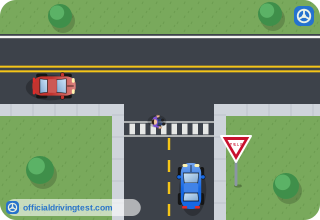
At a yield sign, pedestrians are in or about to enter the crosswalk. What must you do?
- Slow down and pass behind the pedestrians
- Stop only if they are already in your lane
- Proceed carefully once the first pedestrian has passed
- Stop until they have crossed the highway, then proceed
Show answer
Correct answer: Stop until they have crossed the highway, then proceed
If pedestrians are in or about to enter the crosswalk, you stop until they have crossed the highway and then proceed.
Source: Idaho Driver's Handbook (July 2026), page 45 · Open this page in the manual (Manual page 45)
-
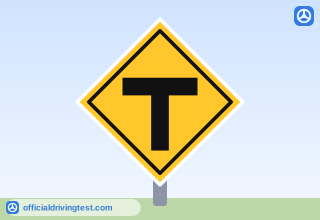
At a 3-way T intersection marked by the 3-way Intersection warning sign, what must you do?
- Stop and yield only to drivers approaching from your right
- Slow down, sound your horn, and then proceed through the intersection
- Speed up to clear the intersection before cross traffic arrives
- Stop and yield to drivers approaching from the other two directions
Show answer
Correct answer: Stop and yield to drivers approaching from the other two directions
The manual says you must stop and yield to drivers approaching from the other two directions.
Source: Idaho Driver's Handbook (July 2026), page 49 · Open this page in the manual (Manual page 49)
-
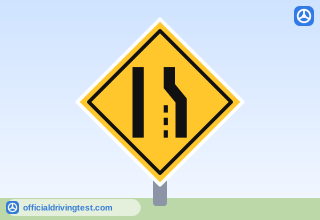
Where a Lane Ends/Merge Left sign shows two lanes becoming one, who must yield?
- Traffic in the through lane
- Merging traffic
- Drivers in the faster moving lane
- Trucks and other large vehicles
Show answer
Correct answer: Merging traffic
At a Lane Ends/Merge Left sign, merging traffic must yield.
Source: Idaho Driver's Handbook (July 2026), page 50 · Open this page in the manual (Manual page 50)
-
Which way must you turn to enter and to exit a roundabout?
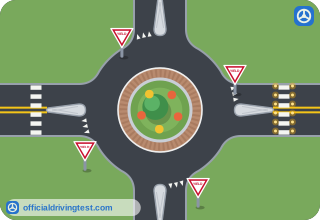
- Left
- Right
- Left to enter and right to exit
- Right to enter and left to exit
Show answer
Correct answer: Right
A roundabout is a one-way circular intersection where you must always turn right to enter and exit.
Source: Idaho Driver's Handbook (July 2026), page 62 · Open this page in the manual (Manual page 62)
-
What is the most common sign seen when approaching a roundabout?
- A regulatory sign with a large letter R
- A stop sign with a circular arrow below it
- A warning sign with an arrow in a circle pattern
- A guide sign with a round green border
Show answer
Correct answer: A warning sign with an arrow in a circle pattern
The most common sign seen when approaching a roundabout is a warning sign with an arrow in a circle pattern.
Source: Idaho Driver's Handbook (July 2026), page 62 · Open this page in the manual (Manual page 62)
-
In a roundabout, who must yield the right-of-way?
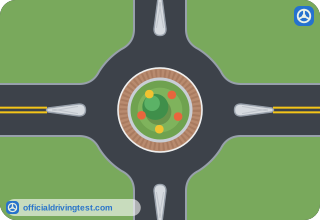
- All drivers must yield to vehicles already in the circle
- Drivers already in the circle must yield to those entering
- Larger vehicles have the right-of-way over smaller ones
- Drivers turning right must yield to those going straight
Show answer
Correct answer: All drivers must yield to vehicles already in the circle
All drivers must yield the right-of-way to vehicles already in the roundabout circle.
Source: Idaho Driver's Handbook (July 2026), page 62 · Open this page in the manual (Manual page 62)
-
In which direction must drivers enter a roundabout, even when they plan a left turn or a U-turn?
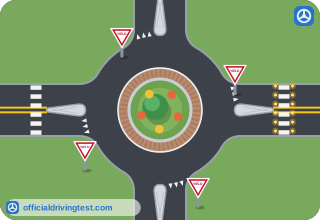
- Counter-clockwise
- Clockwise
- Clockwise for a left turn, counter-clockwise for a right turn
- Straight across the center island
Show answer
Correct answer: Counter-clockwise
Drivers must enter counter-clockwise and merge into the circle whatever their intended movement.
Source: Idaho Driver's Handbook (July 2026), page 62 · Open this page in the manual (Manual page 62)
-
Who must you yield to when entering and exiting a roundabout, besides vehicles already in the circle?
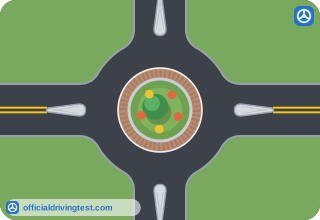
- Parked vehicles
- Vehicles waiting behind you
- Pedestrians and bicyclists
- Only vehicles that are exiting
Show answer
Correct answer: Pedestrians and bicyclists
Drivers should yield to pedestrians and bicyclists when entering and exiting the roundabout.
Source: Idaho Driver's Handbook (July 2026), page 62 · Open this page in the manual (Manual page 62)
-
What should you do with your speed in a roundabout?
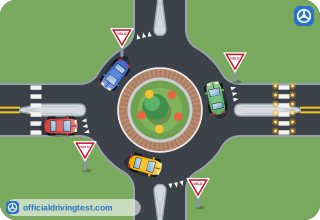
- Keep up with the traffic ahead of you
- Slow down and keep your speed low
- Speed up to merge into the circle
- Stop in the circle to let others enter
Show answer
Correct answer: Slow down and keep your speed low
Drivers should slow down and keep their speed low in a roundabout.
Source: Idaho Driver's Handbook (July 2026), page 62 · Open this page in the manual (Manual page 62)
-
As you approach your exit from a roundabout, which signal should you turn on?
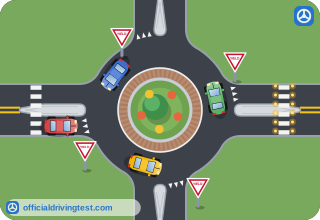
- Your left turn signal
- Your hazard lights
- No signal is needed
- Your right turn signal
Show answer
Correct answer: Your right turn signal
Turn your right turn signal on as you approach your exit.
Source: Idaho Driver's Handbook (July 2026), page 62 · Open this page in the manual (Manual page 62)
-
What is a thru-turn?
- A lane for turning right without stopping at the signal
- A circular intersection with a large central island
- A method of managing traffic by prohibiting direct left turns
- An intersection where all U-turns are prohibited
Show answer
Correct answer: A method of managing traffic by prohibiting direct left turns
A thru-turn manages intersection traffic by prohibiting direct left turns.
Source: Idaho Driver's Handbook (July 2026), page 63 · Open this page in the manual (Manual page 63)
-
How do you complete a left turn at a thru-turn intersection?
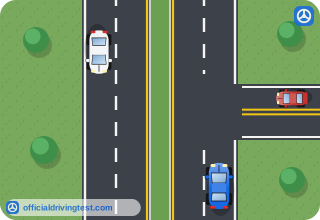
- Continue through, make a U-turn at the next signal, return and turn right
- Wait in the center lane and turn left when traffic is clear
- Turn right, then make a U-turn at the next block
- Make a U-turn before the intersection, then continue straight
Show answer
Correct answer: Continue through, make a U-turn at the next signal, return and turn right
At a thru-turn you continue through, U-turn downstream at the next signal, head back and turn right.
Source: Idaho Driver's Handbook (July 2026), page 63 · Open this page in the manual (Manual page 63)
-
You must stop at an intersection that has no marked stop line and no crosswalk. Where do you stop?
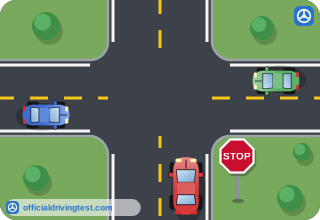
- Exactly 50 feet before the edge of the intersection
- Even with the stop sign, wherever it stands
- At the point nearest the crossing road, before entering it
- Just inside the intersection, to see cross traffic
Show answer
Correct answer: At the point nearest the crossing road, before entering it
Idaho law requires you to stop at a marked stop line, or before the crosswalk on the near side, or at the point nearest the intersecting highway before entering it.
Source: Idaho Driver's Handbook (July 2026), page 69 · Open this page in the manual (Manual page 69)
-
You are entering a street from an alley, driveway, or private road. Where must you stop?
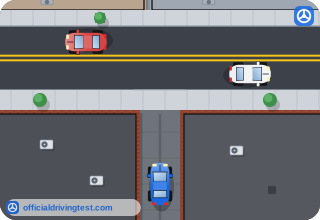
- Just past the sidewalk, at the curb
- Only when a vehicle is approaching
- Before crossing the sidewalk
- At the center line of the street
Show answer
Correct answer: Before crossing the sidewalk
When entering a street from an alley, building, driveway, or private road, stop before crossing the sidewalk and yield to pedestrians and traffic.
Source: Idaho Driver's Handbook (July 2026), page 70 · Open this page in the manual (Manual page 70)
-
How should you approach an intersection to make a right turn?
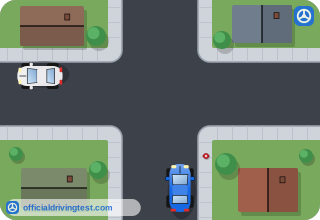
- From the center of the lane, then swing wide to the left
- In the left-hand lane, so you have room to swing wide
- Straddling two lanes so no one passes you on the right
- In the right-hand lane, as close to the right curb as is reasonable
Show answer
Correct answer: In the right-hand lane, as close to the right curb as is reasonable
For a right turn, signal and approach the intersection in the right-hand lane, staying as close to the right curb as is reasonable.
Source: Idaho Driver's Handbook (July 2026), page 73 · Open this page in the manual (Manual page 73)