Idaho: Right-of-way and turning — Part 2 Practice Test
Questions in this part include: “U-turns are not legal where which signs are posted?” · “Which of these is an exception to the rule to stay as far to the right as possible?”
Independent educational site · not affiliated with any government agency or DMV
Ready? Test yourself
- Instant feedback with an explanation
- Every answer cites its source in the manual
- Your best score is saved on this device
Questions are original and based on the official manual "Idaho Driver's Handbook" (July 2026), Idaho Transportation Department.
All 16 questions in this practice test
Take the test above first, then use this list to study. Tap “Show answer” to see the correct answer and explanation.
Show the questions and answersHide the questions
-
When you complete a right turn, which lane of the cross street should you turn into?
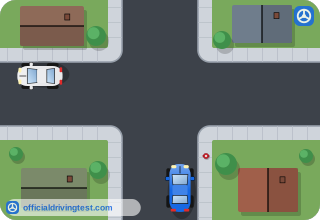
- The left-hand lane
- Any open lane
- The right-hand lane
- The center lane
Show answer
Correct answer: The right-hand lane
After yielding, turn into the right-hand lane of the cross street; do not swing wide.
Source: Idaho Driver's Handbook (July 2026), page 73 · Open this page in the manual (Manual page 73)
-
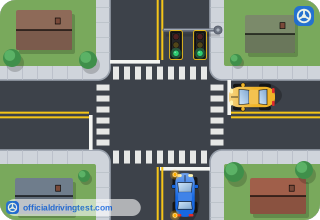
When preparing to turn left, in which lane should you approach the intersection?
- The right-hand lane, so faster traffic can pass on the left
- The lane closest to the left that is open to your direction
- Any lane, as long as you signal at least 100 feet ahead
- The center of the road, straddling the center line
Show answer
Correct answer: The lane closest to the left that is open to your direction
For a left turn, signal and approach the intersection in the lane closest to the left that is open to traffic going your direction.
Source: Idaho Driver's Handbook (July 2026), page 73 · Open this page in the manual (Manual page 73)
-
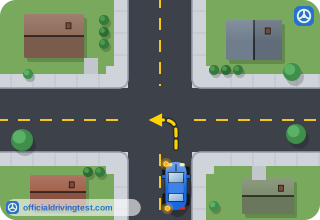
On a two-lane road, where in your lane should you position your vehicle before turning left?
- On the right side of your lane
- Centered, away from both edges
- Partly over the center line
- On the left side of your lane
Show answer
Correct answer: On the left side of your lane
If you are on a two-lane road, you should move to the left side of your lane before turning left.
Source: Idaho Driver's Handbook (July 2026), page 73 · Open this page in the manual (Manual page 73)
-
When making a left turn, to whom must you yield the right-of-way?
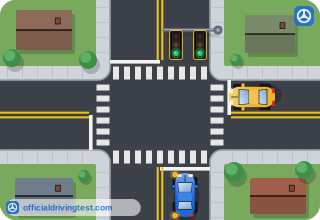
- Pedestrians and oncoming vehicles
- Only vehicles waiting behind you
- No one, once your signal is on
- Only pedestrians, never vehicles
Show answer
Correct answer: Pedestrians and oncoming vehicles
When turning left, yield the right-of-way to pedestrians and oncoming vehicles.
Source: Idaho Driver's Handbook (July 2026), page 73 · Open this page in the manual (Manual page 73)
-
When it is safe to complete a left turn, which lane should you turn into?
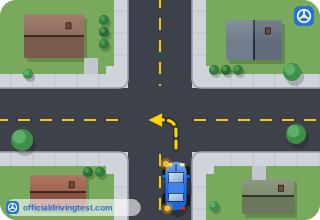
- Any lane, if you signal first
- The oncoming lane, then move over later
- The nearest lane going in your direction
- The lane farthest from the center line
Show answer
Correct answer: The nearest lane going in your direction
When safe, turn into the nearest lane where traffic moves in the direction you want to go, and do not cut the corner.
Source: Idaho Driver's Handbook (July 2026), page 73 · Open this page in the manual (Manual page 73)
-
Vehicles turning left must remain in their lane of travel until when?
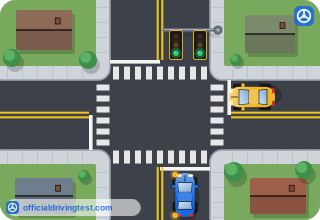
- Until they reach the center of the intersection
- Until after completing the turn
- Until the signal turns yellow
- Until they pass the first crosswalk
Show answer
Correct answer: Until after completing the turn
Vehicles turning left must remain in their lane of travel until after completing the turn.
Source: Idaho Driver's Handbook (July 2026), page 73 · Open this page in the manual (Manual page 73)
-
U-turns are not legal where which signs are posted?
- Yield signs
- Speed limit signs
- One way signs
- “No U-turn” signs
Show answer
Correct answer: “No U-turn” signs
U-turns are not legal where “No U-turn” signs are posted.
Source: Idaho Driver's Handbook (July 2026), page 73 · Open this page in the manual (Manual page 73)
-
U-turns may not be made on a curve or near the crest of a hill where approaching vehicles from either direction cannot see your vehicle within what distance?
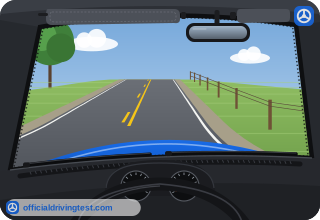
- 500 feet
- 100 feet
- 200 feet
- 1,000 feet
Show answer
Correct answer: 500 feet
U-turns may not be made on any curve, or the approach of or near the crest of a hill, where the vehicle cannot be seen by approaching vehicles from either direction within 500 feet.
Source: Idaho Driver's Handbook (July 2026), page 73 · Open this page in the manual (Manual page 73)
-
May you make a U-turn in a no passing zone?
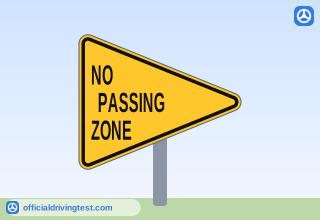
- Yes, if no traffic is in sight
- Yes, if you signal for five seconds
- No, U-turns are not allowed there
- Yes, but only during daylight
Show answer
Correct answer: No, U-turns are not allowed there
The handbook lists a no passing zone among the places where U-turns may not be made.
Source: Idaho Driver's Handbook (July 2026), page 73 · Open this page in the manual (Manual page 73)
-
What must you do before completing a U-turn?
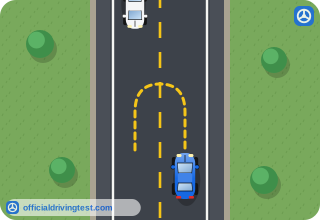
- Sound your horn twice
- Stop and yield to all traffic
- Turn on your hazard lights
- Flash your headlights
Show answer
Correct answer: Stop and yield to all traffic
Stop and yield to all traffic before completing a U-turn.
Source: Idaho Driver's Handbook (July 2026), page 73 · Open this page in the manual (Manual page 73)
-
When making a U-turn, what is the first step?
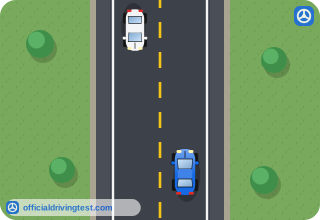
- Move into the left lane and signal for five seconds
- Slow down and turn from the center of the road
- Pull to the far right edge of the road and stop
- Stop on the left edge of the road and turn on your hazard lights
Show answer
Correct answer: Pull to the far right edge of the road and stop
The first step is to pull to the far right edge of the road and stop.
Source: Idaho Driver's Handbook (July 2026), page 74 · Open this page in the manual (Manual page 74)
-
When making a U-turn, which blind spot do you check before you signal and turn sharply left?
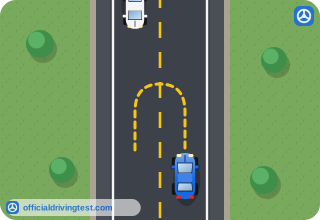
- Your right-rear blind spot
- Your left-rear blind spot
- Your right-front blind spot
- No blind spot; only the mirrors are checked
Show answer
Correct answer: Your left-rear blind spot
The second step is to check the front and rear of the vehicle and your left-rear blind spot, then signal and turn sharply left while moving slowly.
Source: Idaho Driver's Handbook (July 2026), page 74 · Open this page in the manual (Manual page 74)
-
During a U-turn, what do you do once your vehicle is headed toward the target area?
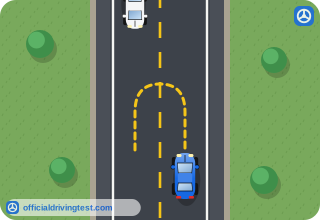
- Stop again and wait for the traffic to clear
- Turn on your hazard lights and continue slowly
- Sound your horn and stay at a slow speed
- Recheck the rear and accelerate to traffic speed
Show answer
Correct answer: Recheck the rear and accelerate to traffic speed
Once the vehicle is headed toward the target area, you recheck to the rear and accelerate to the speed of the traffic.
Source: Idaho Driver's Handbook (July 2026), page 74 · Open this page in the manual (Manual page 74)
-
In most cases, where does the law require you to stay on the road?
- As far to the right side of the road as possible
- In the middle of the road
- Next to the center line
- In whichever lane has the faster traffic
Show answer
Correct answer: As far to the right side of the road as possible
In most cases the law requires you to stay as far to the right side of the road as possible.
Source: Idaho Driver's Handbook (July 2026), page 74 · Open this page in the manual (Manual page 74)
-
Which of these is an exception to the rule to stay as far to the right as possible?
- When approaching a crosswalk
- When driving below the speed limit
- When preparing to make a left turn
- When driving in rain or snow
Show answer
Correct answer: When preparing to make a left turn
Preparing to make a left turn is one of the listed exceptions to keeping to the right.
Source: Idaho Driver's Handbook (July 2026), page 74 · Open this page in the manual (Manual page 74)
-
You may enter the left lane temporarily, even when you should keep right, in order to avoid which of these?
- A yellow traffic light turning red ahead
- An obstruction, a pedestrian, or an animal
- A stop sign at the next intersection
- A railroad crossing sign on the right
Show answer
Correct answer: An obstruction, a pedestrian, or an animal
The manual lists entering the left lane temporarily to avoid an obstruction, a pedestrian, or an animal as an exception.
Source: Idaho Driver's Handbook (July 2026), page 74 · Open this page in the manual (Manual page 74)