Washington, D.C.: Vehicle controls and signals — Part 2 Practice Test
Questions in this part include: “For at least how far before turning must you use a turn signal, or an arm or hand signal?” · “What does the manual say about using your directional signals to tell drivers behind you that they can pass?”
Independent educational site · not affiliated with any government agency or DMV
Ready? Test yourself
Answer to start, or tap Start below:
For at least how far before turning must you use a turn signal, or an arm or hand signal?
- Instant feedback with an explanation
- Every answer cites its source in the manual
- Your best score is saved on this device
- Keyboard: press 1 to 4 to answer and Enter for the next question
Questions are original and based on the official manual "District of Columbia Driver Manual" (Updated January 2024), District of Columbia Department of Motor Vehicles (DC DMV).
All 22 questions in this practice test
Take the test above first, then use this list to study. Tap “Show answer” to see the correct answer and explanation.
Show the questions and answersHide the questions
-
For at least how far before turning must you use a turn signal, or an arm or hand signal?
- 25 feet
- 100 feet
- 50 feet
- 200 feet
Show answer
Correct answer: 100 feet
A turn signal or hand signal must be given continuously for at least 100 feet before the turn.
Source: District of Columbia Driver Manual (Updated January 2024), page 41
-
How should you signal when you are traveling at a high speed?
- For the same distance and time as at low speeds
- For a shorter distance, because you will arrive sooner
- With a hand signal instead of a turn signal
- For a much greater distance and a longer time interval
Show answer
Correct answer: For a much greater distance and a longer time interval
At high speed you should signal for a much greater distance and a longer time than the minimum.
Source: District of Columbia Driver Manual (Updated January 2024), page 41
-
When you make a turn just past an intersection, when should you signal?
- Once you are in the intersection
- As soon as you see the intersection ahead
- Only after you finish the turn
- Wait until you are past the intersection
Show answer
Correct answer: Once you are in the intersection
For a turn just past an intersection, you signal once you are in the intersection.
Source: District of Columbia Driver Manual (Updated January 2024), page 41
-
While passing a vehicle on a two-lane highway, which signal should you turn on?
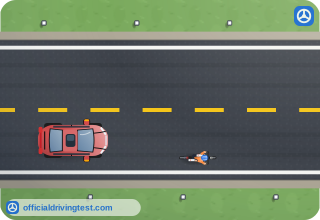
- Left signal only
- Right signal only
- Left or right, depending on which lane you are entering
- No signal, because the passed driver can see you
Show answer
Correct answer: Left or right, depending on which lane you are entering
You signal left or right depending on which lane you are entering, to inform drivers behind and ahead.
Source: District of Columbia Driver Manual (Updated January 2024), page 41
-
When must you always turn on your headlights?
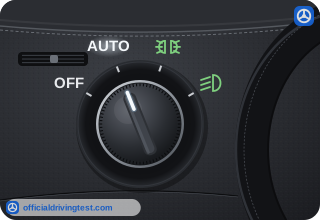
- When the windshield wipers are on
- Only after dark
- Only when driving on a freeway
- Only when a police officer asks you to
Show answer
Correct answer: When the windshield wipers are on
Headlights must always be on whenever the windshield wipers are in use.
Source: District of Columbia Driver Manual (Updated January 2024), page 42
-
Which situation calls for low beams?
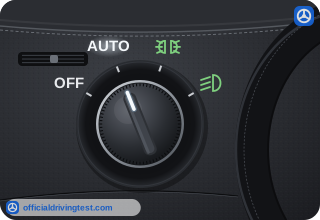
- Driving on a dark road with no other traffic
- Driving on an empty rural road at night
- Approaching or closely following other vehicles
- Parking on a dark street
Show answer
Correct answer: Approaching or closely following other vehicles
Low beams are used when approaching or closely following other vehicles.
Source: District of Columbia Driver Manual (Updated January 2024), page 42
-
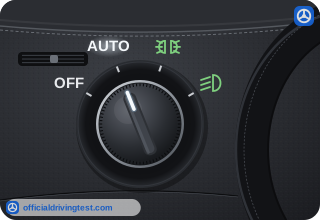
Low beams should be used with streetlights and in what other condition?
- In bright sunshine
- In fog
- On an empty dark road
- When parked at night
Show answer
Correct answer: In fog
Low beams should also be used with streetlights and in fog.
Source: District of Columbia Driver Manual (Updated January 2024), page 42
-
How soon after sunset must you turn on your headlights?
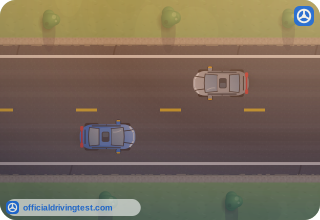
- Fifteen minutes after sunset
- One hour after sunset
- Two hours after sunset
- One-half hour after sunset
Show answer
Correct answer: One-half hour after sunset
Headlights must be on one-half hour after sunset and one-half hour before sunrise.
Source: District of Columbia Driver Manual (Updated January 2024), page 42
-
When driving in a tunnel, what must you turn on?
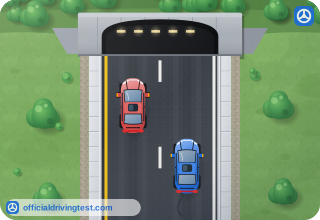
- Your hazard lights
- Your high beams
- Your headlights
- Your parking lights
Show answer
Correct answer: Your headlights
Headlights must be on in a tunnel.
Source: District of Columbia Driver Manual (Updated January 2024), page 42
-
On a dark road, when must you use high beams?
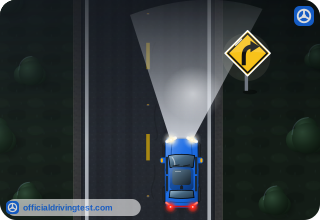
- Only when no other vehicle is within one mile of you and the road is dark
- Whenever needed to see persons or vehicles ahead of you, with some exceptions
- Only after midnight
- Only on interstate highways
Show answer
Correct answer: Whenever needed to see persons or vehicles ahead of you, with some exceptions
High beams must be used whenever needed to see persons or vehicles ahead, except when meeting or closely following a vehicle.
Source: District of Columbia Driver Manual (Updated January 2024), page 42
-
At least how far before meeting oncoming vehicles must you change to low beams?
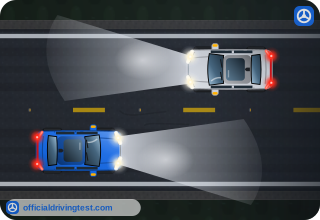
- 100 feet
- 200 feet
- 250 feet
- 500 feet
Show answer
Correct answer: 500 feet
You must switch from high to low beams at least 500 feet before meeting oncoming vehicles.
Source: District of Columbia Driver Manual (Updated January 2024), page 42
-
You must change to low beams when following a vehicle at what distance or less?
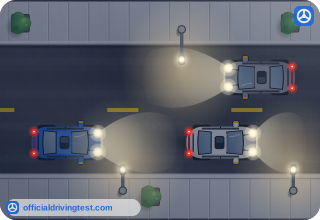
- 300 feet
- 100 feet
- 500 feet
- 1,000 feet
Show answer
Correct answer: 300 feet
You must use low beams when following another vehicle at a distance of 300 feet or less.
Source: District of Columbia Driver Manual (Updated January 2024), page 42
-
How long may you drive with the gears in neutral or the clutch pedal depressed?
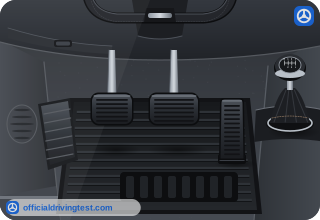
- Up to ten seconds on a downhill grade
- As long as you are below the speed limit
- No longer than is needed to shift gears
- Until you reach the next intersection
Show answer
Correct answer: No longer than is needed to shift gears
Never coast with the gears in neutral or the clutch pedal down longer than needed to shift gears.
Source: District of Columbia Driver Manual (Updated January 2024), page 47
-
Under federal and District of Columbia motor vehicle laws, what is it unlawful to do?
- Remove or alter safety equipment installed on a vehicle to comply with the law
- Install safety equipment beyond what the law requires on a vehicle
- Sell a vehicle that is equipped with the emission control devices the law requires
- Drive a vehicle that is equipped with a gasoline tank filler inlet
Show answer
Correct answer: Remove or alter safety equipment installed on a vehicle to comply with the law
It is unlawful to remove or alter any safety device placed on a vehicle to comply with a law, rule, or regulation.
Source: District of Columbia Driver Manual (Updated January 2024), page 47
-
What must you use to show that you are about to turn?
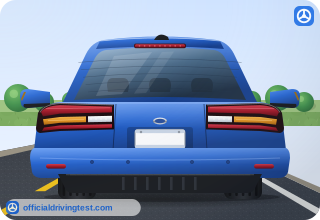
- Your horn and your headlights
- Your brake lights only
- Your hazard lights and horn
- Hand or directional signals
Show answer
Correct answer: Hand or directional signals
You must use hand signals or directional signals to show that you are about to turn.
Source: District of Columbia Driver Manual (Updated January 2024), page 55
-
Besides turning, when are turn signals required?
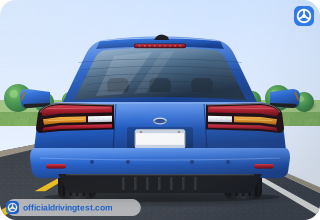
- When changing lanes or overtaking a vehicle
- Only when driving on a freeway
- Only when a police officer is nearby
- Only after dark
Show answer
Correct answer: When changing lanes or overtaking a vehicle
Turn signals are required when changing lanes or overtaking a vehicle.
Source: District of Columbia Driver Manual (Updated January 2024), page 55
-
What does the manual say about using your directional signals to tell drivers behind you that they can pass?
- It is allowed on two-lane roads
- It is allowed when the road is clear
- It is against the law
- It is required when you slow down
Show answer
Correct answer: It is against the law
Using your directional signals to wave drivers behind you past is against the law.
Source: District of Columbia Driver Manual (Updated January 2024), page 55
-
When should hazard lights be used?
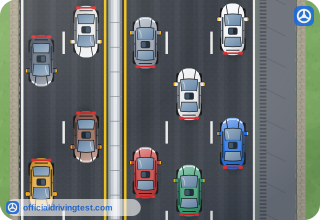
- Whenever you are driving slowly in heavy traffic on a highway road
- Whenever you are looking for a parking space on a busy city street
- While your vehicle is stopped or disabled on the highway in an emergency
- Whenever you are being passed by a faster vehicle on a two-lane road
Show answer
Correct answer: While your vehicle is stopped or disabled on the highway in an emergency
Hazard lights are for a vehicle that is stopped or disabled on the highway or shoulder in an emergency.
Source: District of Columbia Driver Manual (Updated January 2024), page 55
-
Who uses hand signals to notify other drivers of their maneuvers?
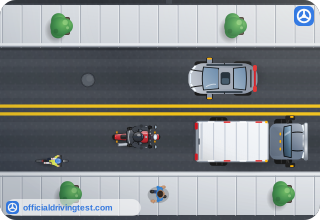
- Bicyclists
- Only motorcyclists
- Only pedestrians
- Only truck drivers
Show answer
Correct answer: Bicyclists
Bicyclists use hand signals to tell other drivers what they are about to do.
Source: District of Columbia Driver Manual (Updated January 2024), page 55
-
When using hand signals, how is the arm held to signal Slow or Stop?
- Extended straight out to the side
- Bent with the hand pointing upward
- Held straight up over the head
- Extended downward
Show answer
Correct answer: Extended downward
In the hand signals for drivers, the arm pointing downward is the signal for slow or stop.
Source: District of Columbia Driver Manual (Updated January 2024), page 55
-
When using hand signals, how is the arm held to signal a left turn?
- Extended downward
- Extended straight out to the side
- Bent with the hand pointing upward
- Held straight up over the head
Show answer
Correct answer: Extended straight out to the side
In the hand signals for drivers, the arm extended straight out to the side is the signal for a left turn.
Source: District of Columbia Driver Manual (Updated January 2024), page 55
-
When using hand signals, how is the arm held to signal a right turn?
- Bent with the hand pointing upward
- Extended straight out to the side
- Extended downward
- Crossed over the chest
Show answer
Correct answer: Bent with the hand pointing upward
In the hand signals for drivers, the arm bent with the hand pointing upward is the signal for a right turn.
Source: District of Columbia Driver Manual (Updated January 2024), page 55