Washington, D.C.: Interstate and highway driving Practice Test
Entering and leaving limited access highways, merging, changing lanes, blind spots and roundabouts.
Independent educational site · not affiliated with any government agency or DMV
Ready? Test yourself
Answer to start, or tap Start below:
How are High Occupancy Vehicle (HOV) lanes marked on highways?
- Instant feedback with an explanation
- Every answer cites its source in the manual
- Your best score is saved on this device
- Keyboard: press 1 to 4 to answer and Enter for the next question
Questions are original and based on the official manual "District of Columbia Driver Manual" (Updated January 2024), District of Columbia Department of Motor Vehicles (DC DMV).
All 22 questions in this practice test
Take the test above first, then use this list to study. Tap “Show answer” to see the correct answer and explanation.
Show the questions and answersHide the questions
-
Before starting a trip on an interstate, what does the manual say to ask about your tires?
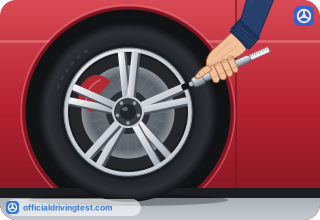
- Are your tires in condition for high speeds?
- Are your tires new enough to carry a heavy load?
- Are your tires fitted with snow chains?
- Are your tires the same brand on all four wheels?
Show answer
Correct answer: Are your tires in condition for high speeds?
Sustained high speeds are hard on tires, so the manual lists their condition for high speeds as a pre-trip check.
Source: District of Columbia Driver Manual (Updated January 2024), page 30
-
What is the purpose of the acceleration lane at an interstate entrance?
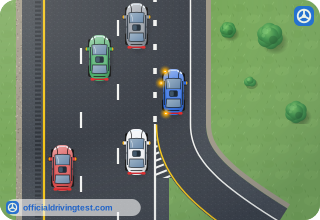
- It lets you stop and rest before you merge onto the interstate
- It lets you pass slower traffic that is on the entrance ramp
- It gives you the opportunity to get up to the speed of traffic
- It gives you a place to check your tires before you merge
Show answer
Correct answer: It gives you the opportunity to get up to the speed of traffic
The entrance ramp points you in the desired direction, and the acceleration lane is where you build up to the speed of traffic.
Source: District of Columbia Driver Manual (Updated January 2024), page 30
-
When entering an interstate, what should you do about the solid painted lines that divide the entrance from the interstate?
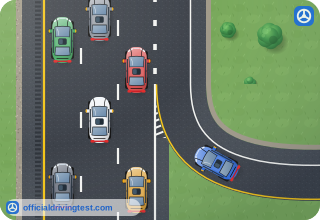
- Cross them as soon as you see a gap
- Not cross them
- Cross them once you reach the speed limit
- Cross them only at night
Show answer
Correct answer: Not cross them
The manual says the solid painted lines dividing the entrance and the interstate should not be crossed.
Source: District of Columbia Driver Manual (Updated January 2024), page 30
-
An interstate entrance is short and has no acceleration lane. When should you speed up on the entrance?
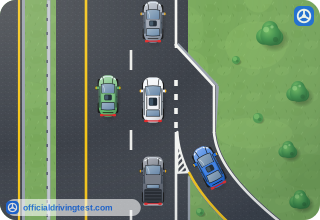
- As soon as you reach the end of the ramp
- Before you reach the end of the ramp, to force a gap
- Only after you have stopped on the shoulder
- Only after you have found a gap in the traffic
Show answer
Correct answer: Only after you have found a gap in the traffic
With no acceleration lane, you should speed up only once you have found a gap in the traffic to enter.
Source: District of Columbia Driver Manual (Updated January 2024), page 30
-
If you enter an interstate from the left entrance, what should you do?
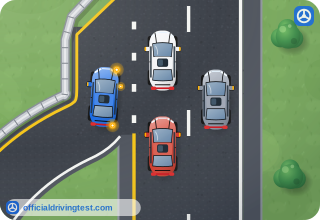
- Compare your mirror view with what you see looking over your shoulder
- Rely on your mirrors alone, because the left side is clear
- Sound your horn to warn the traffic that is already there
- Use only your right outside mirror to judge the gap
Show answer
Correct answer: Compare your mirror view with what you see looking over your shoulder
Mirrors can miss vehicles, so the manual says to compare your mirror view with a glance over your shoulder.
Source: District of Columbia Driver Manual (Updated January 2024), page 30
-
When you leave an interstate and the exit is on the right, what should you do well before reaching the exit?
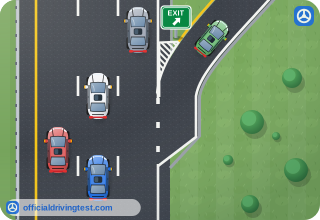
- Move into the left lane
- Slow to a stop on the shoulder
- Get into the right lane
- Turn on your hazard lights
Show answer
Correct answer: Get into the right lane
You should be in the right lane well before the exit when it is on the right side of the highway.
Source: District of Columbia Driver Manual (Updated January 2024), page 30
-
When leaving an interstate, where should you start slowing down?
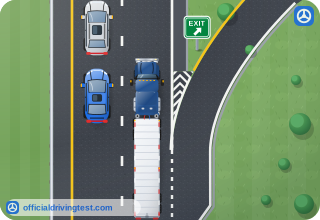
- On the main highway, well before the exit
- As soon as you get into the deceleration lane
- Only after you reach the end of the exit ramp
- Only when you see the exit ramp curve
Show answer
Correct answer: As soon as you get into the deceleration lane
You should not slow down on the main highway; slowing starts once you are in the deceleration lane.
Source: District of Columbia Driver Manual (Updated January 2024), page 30
-
What speed should you slow down to on an exit ramp, or you may have trouble getting around curves?
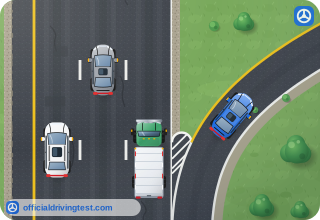
- The speed of the traffic on the highway
- The speed limit of the highway you just left
- Your speed when you started the ramp
- The posted advisory speed for the ramp
Show answer
Correct answer: The posted advisory speed for the ramp
The manual says to slow to the posted advisory speed for the ramp so you can get around its curves.
Source: District of Columbia Driver Manual (Updated January 2024), page 30
-
You exit an interstate at the wrong place. What does the manual say to do?
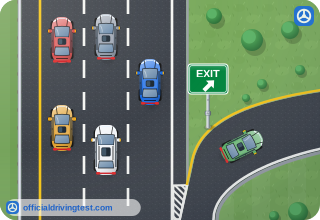
- Leave the exit ramp, then look for a way to re-enter
- Cross the painted area back onto the interstate
- Stop on the shoulder and wait for traffic to clear
- Turn around on the ramp and drive back
Show answer
Correct answer: Leave the exit ramp, then look for a way to re-enter
Finish the exit, then look for a way back onto the interstate.
Source: District of Columbia Driver Manual (Updated January 2024), page 30
-
What does the manual say about passing on the shoulder of the road?
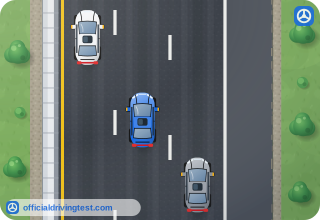
- You may pass on the shoulder if the right lane is slow
- You may pass on the shoulder at night only
- You cannot pass on the shoulder
- You may pass on the shoulder if you signal first
Show answer
Correct answer: You cannot pass on the shoulder
Passing on the shoulder is not allowed, even on an interstate or other limited access highway.
Source: District of Columbia Driver Manual (Updated January 2024), page 30
-
On an interstate or other limited access highway in the District, which lane must slow-moving vehicles stay in?
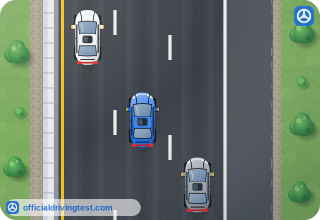
- The left lane
- The right lane
- The center lane
- Any lane
Show answer
Correct answer: The right lane
Slow-moving vehicles must stay in the right lane.
Source: District of Columbia Driver Manual (Updated January 2024), page 30
-
What should you do when another driver is passing you on an interstate?
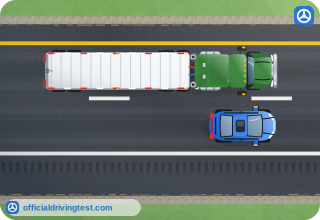
- Speed up to stay even with the passing driver
- Move onto the shoulder to give room
- Flash your headlights at the passing driver
- Not speed up
Show answer
Correct answer: Not speed up
Safe passing depends on cooperation, and speeding up while being passed works against it.
Source: District of Columbia Driver Manual (Updated January 2024), page 30
-
After passing on an interstate, when should you change back into the lane?
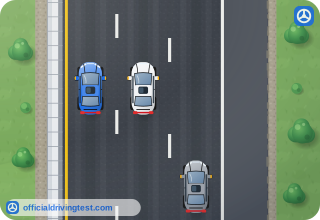
- When the passed vehicle’s headlights show in your rearview mirror
- As soon as your car is a few feet ahead of the passed vehicle
- Once the passed vehicle has slowed down behind you
- After you pass the next exit sign on the interstate
Show answer
Correct answer: When the passed vehicle’s headlights show in your rearview mirror
Quick moves at high speed can be fatal, so wait until the passed vehicle's headlights show in your rearview mirror.
Source: District of Columbia Driver Manual (Updated January 2024), page 31
-
How does the manual say to check your blind spots before a lane change?
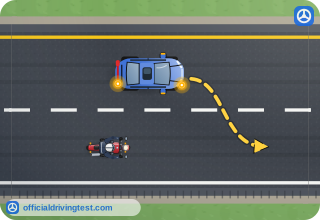
- By using the rearview mirror alone
- By sounding your horn
- By glancing over your shoulder
- By slowing to a stop first
Show answer
Correct answer: By glancing over your shoulder
Mirrors do not show everything, so a glance over your shoulder checks the blind spot.
Source: District of Columbia Driver Manual (Updated January 2024), page 31
-
What does the manual say about stopping on the traveled portion of the highway?
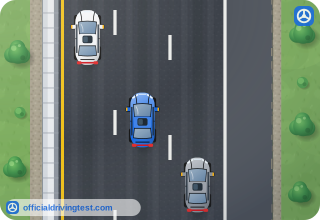
- It is prohibited
- It is allowed for up to five minutes
- It is allowed if you use your flashers
- It is allowed in the right lane only
Show answer
Correct answer: It is prohibited
Stopping on the traveled part of the highway is prohibited.
Source: District of Columbia Driver Manual (Updated January 2024), page 31
-
When is stopping on the shoulder of a highway permitted?
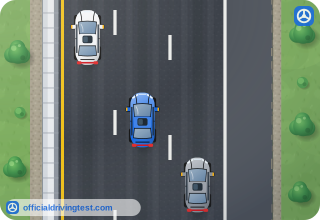
- Whenever you need to stop to read a map or use a phone
- Whenever you feel tired and want to rest for a while
- Only when your car won’t run or in other emergencies
- Whenever traffic is heavy on the traveled lanes ahead
Show answer
Correct answer: Only when your car won’t run or in other emergencies
The shoulder is for breakdowns and other emergencies only.
Source: District of Columbia Driver Manual (Updated January 2024), page 31
-
After your car stops on the shoulder of an interstate, what should you do?
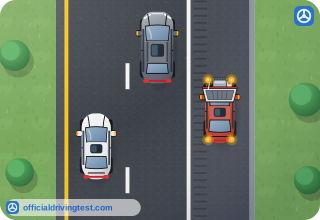
- Walk along the shoulder to the next exit to call for help
- Walk against the traffic until you find a working phone
- Wait in the left lane beside the car until help comes
- Stay with your vehicle and never walk along the highway
Show answer
Correct answer: Stay with your vehicle and never walk along the highway
The manual says to stay with your vehicle and never walk along an interstate or other limited access highway.
Source: District of Columbia Driver Manual (Updated January 2024), page 31
-
How are High Occupancy Vehicle (HOV) lanes marked on highways?
- By a bicycle symbol in the center of the lane
- By a green arrow in the center of the lane
- By a diamond shape in the center of the lane
- By a row of white triangles across the lane
Show answer
Correct answer: By a diamond shape in the center of the lane
HOV lanes are marked on highways by a diamond shape in the center of the lane.
Source: District of Columbia Driver Manual (Updated January 2024), page 58
-
How may HOV lanes be separated from other lanes?
- By a barrier or solid double white lines
- By a single broken yellow line
- By a row of red reflectors on the road
- By a solid green stripe on the pavement
Show answer
Correct answer: By a barrier or solid double white lines
HOV lanes may be special lanes separated by a barrier or solid double white lines.
Source: District of Columbia Driver Manual (Updated January 2024), page 58
-
Which of these may use HOV lanes during heavy traffic periods?
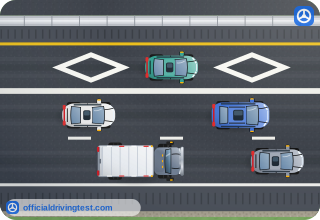
- Tractor-trailers
- Motorcycles
- Delivery trucks
- Cars carrying only the driver
Show answer
Correct answer: Motorcycles
During heavy traffic periods HOV lanes are reserved for buses, vanpools, carpools, other high occupancy vehicles, motorcycles, and certain clean special fuel vehicles.
Source: District of Columbia Driver Manual (Updated January 2024), page 58
-
What is true of HOV lanes that are separated by a barrier?
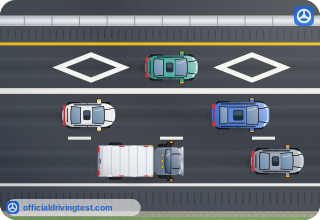
- They are reversible
- They are open to all vehicles at all times
- They are for buses only
- They are for bicycles only
Show answer
Correct answer: They are reversible
HOV lanes separated by a barrier are reversible, with traffic flowing one way at certain times and the other way at other times.
Source: District of Columbia Driver Manual (Updated January 2024), page 58
-
What does it mean when an HOV lane is reversible?
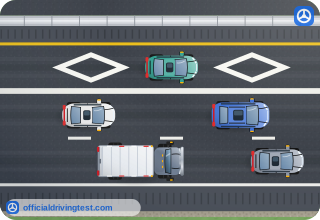
- Traffic may travel in both directions at the very same time
- Vehicles may reverse along the lane whenever they need to
- Traffic flows one way at some times and the opposite way at others
- The lane is open to all traffic on weekends and holidays
Show answer
Correct answer: Traffic flows one way at some times and the opposite way at others
A reversible lane carries traffic one way during certain times of day and the opposite way at other times.
Source: District of Columbia Driver Manual (Updated January 2024), page 58