Pavement markings in Delaware
The Delaware Driver Manual shows or names everything on this page: 15 in all, on pages 84–85, 87, 92, 96, 99.
Independent educational site · not affiliated with any government agency or DMV
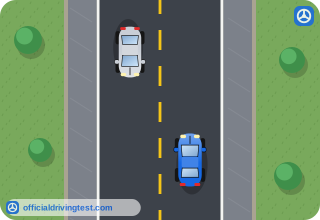
Solid White Edge Line
Edge Lines - Solid white lines along the side of the road show you where the outside edge of the travel lane is located.
Manual page 84 · Open this page in the manual (Manual page 84)
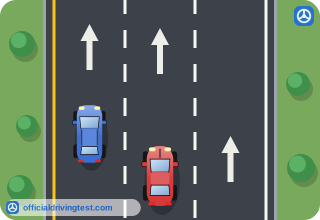
Broken White Line
A broken white line between lanes of traffic means that you may cross it to change lanes if it is safe to do so.
Manual page 84 · Open this page in the manual (Manual page 84)
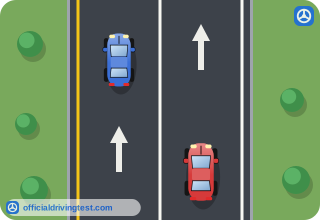
Solid White Line
A solid white line between lanes of traffic means that you are discouraged from changing lanes.
Manual page 84 · Open this page in the manual (Manual page 84)
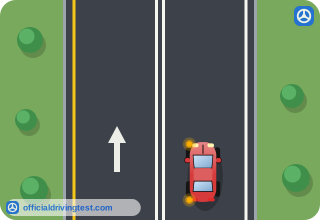
Double Solid White Lines
Double solid white lines prohibit lane-changing.
Manual page 84 · Open this page in the manual (Manual page 84)
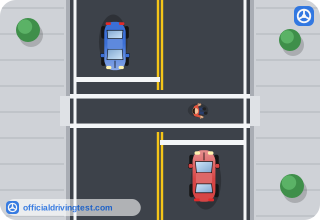
PEDESTRIAN CROSSING
Crosswalks and stop lines - When required to stop because of a sign or signal, you must stop before your vehicle reaches the stop line or if there is one, a crosswalk. Crosswalks define the area where pedestrians may cross the roadway. You must yield to pedestrians in a crosswalk. Not all crosswalks are marked.
Manual page 84 · Open this page in the manual (Manual page 84)
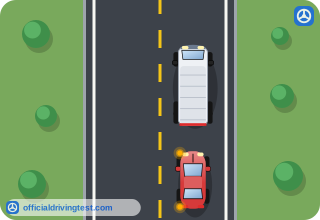
Broken Yellow Center Line
A broken yellow line between opposing lanes of traffic means that you may cross it to pass if it is safe to do so.
Manual page 85 · Open this page in the manual (Manual page 85)
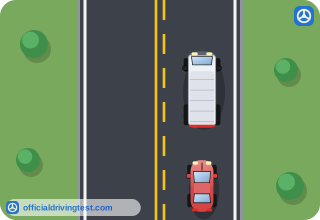
Solid and Broken Yellow Center Lines
Where there is both a solid and a broken yellow line between opposing lanes of traffic, you may not pass if the solid yellow line is on your side. If the broken line is on your side, you may pass if it is safe to do so.
Manual page 85 · Open this page in the manual (Manual page 85)
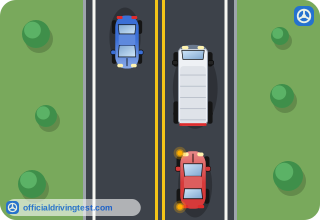
Two Solid Yellow Center Lines
Two solid yellow lines between lanes of traffic means neither side can pass. You may cross a solid yellow line to turn into a driveway, if it is safe to do so.
Manual page 85 · Open this page in the manual (Manual page 85)
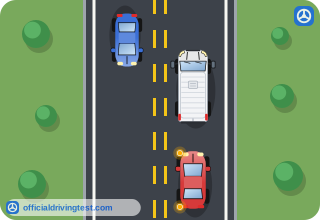
Double Broken Yellow Lines
Although not common in Delaware, you may find some travel lanes are designed to carry traffic in one direction at certain times and in the opposite direction at other times. These lanes are usually marked by double-broken yellow lines.
Manual page 85 · Open this page in the manual (Manual page 85)
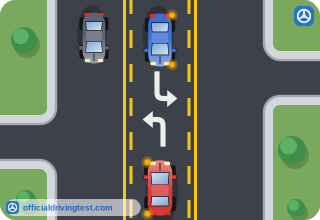
Two-Way Left-Turn Lane
These center lanes are reserved for making left turns (or U-turns when they are permitted) but can be used by vehicles traveling in both directions. On the pavement, left-turn arrows for traffic in one direction alternate with left-turn arrows for traffic coming from the opposite direction. These lanes are marked on each side by a solid yellow and broken yellow lines.
Manual page 87 · Open this page in the manual (Manual page 87)
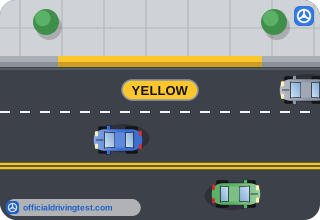
Yellow Curb
Unless otherwise posted, ordered to do so by a police officer, or to avoid a crash, you must not stop or park your vehicle in any of the following places even if someone is left in the car: ... Whenever a curb is painted yellow or a yellow line is placed at the edge of a roadway.
Manual page 92 · Open this page in the manual (Manual page 92)
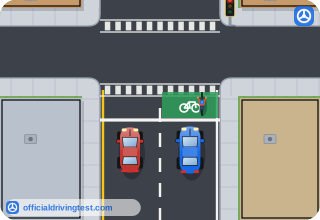
Bike Box
A bike box is a designated area at the head of a traffic lane at intersections that provides bicyclists with a safe way to turn and a visible way to get ahead of traffic. The benefits to a bike box is that it increases the visibility of bicyclists, helps prevent 'right-hook' conflicts with turning vehicles, provides priority of bicyclists at signalized crossing at major intersections and bicyclists can avoid breathing exhaust fumes. Pedestrians also benefit from a bike box as it reduces vehicle encroachment into the crosswalk.
Manual page 96 · Open this page in the manual (Manual page 96)
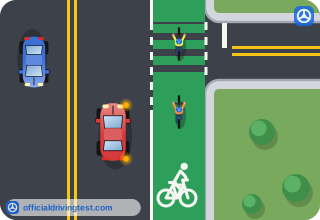
BICYCLE CROSSING
The manual does not state it
Manual page 96 · Open this page in the manual (Manual page 96)
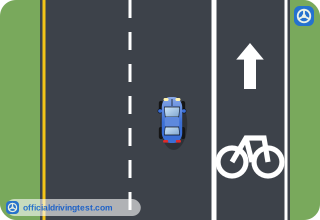
Bike Lane Marking
The manual does not state it
Manual page 96 · Open this page in the manual (Manual page 96)
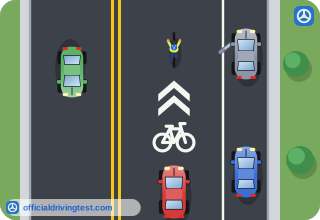
Shared Lane Marking
The shared lane marking may be used on some roadways to assist bicyclists in lateral positioning, to encourage safe passing of cyclists by motorists, to reduce the incidence of wrong way bicycling, and as a reminder that the lane may be legally used by both cyclists and motor vehicles.
Manual page 99 · Open this page in the manual (Manual page 99)