Delaware: Pavement markings Practice Test
Yellow and white lines, crosswalks, reversible and reserved lanes, bike lanes and the other markings in the Delaware manual.
Independent educational site · not affiliated with any government agency or DMV
Ready? Test yourself
- Instant feedback with an explanation
- Every answer cites its source in the manual
- Your best score is saved on this device
Questions are original and based on the official manual "Delaware Driver Manual" (July 2026), Delaware Division of Motor Vehicles (DMV).
All 14 questions in this practice test
Take the test above first, then use this list to study. Tap “Show answer” to see the correct answer and explanation.
Show the questions and answersHide the questions
-
What do solid white lines along the side of the road show you?
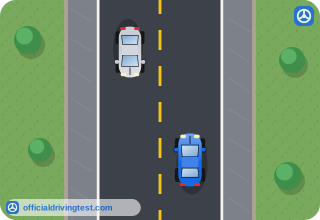
- That parking is allowed along the road
- Where the road changes direction
- The outside edge of the travel lane
- That passing is prohibited ahead
Show answer
Correct answer: The outside edge of the travel lane
The manual says solid white edge lines show the outside edge of the travel lane.
Source: Delaware Driver Manual (July 2026), page 84 · Open this page in the manual (Manual page 84)
-
What separates multiple lanes of travel in the same direction?
- Yellow lane markings
- White lane markings
- Red lane markings
- Blue lane markings
Show answer
Correct answer: White lane markings
The manual says multiple lanes of travel in the same direction are separated by white lane markings.
Source: Delaware Driver Manual (July 2026), page 84 · Open this page in the manual (Manual page 84)
-
What does a broken white line between lanes of traffic mean?
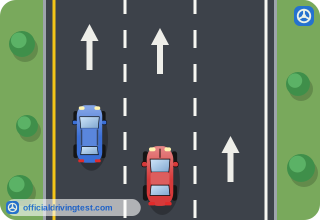
- You may not change lanes
- Traffic on both sides is moving in opposite directions
- You must stop before crossing it
- You may cross it to change lanes if it is safe to do so
Show answer
Correct answer: You may cross it to change lanes if it is safe to do so
The manual says you may cross a broken white line to change lanes if it is safe.
Source: Delaware Driver Manual (July 2026), page 84 · Open this page in the manual (Manual page 84)
-
What does a solid white line between lanes of traffic mean?
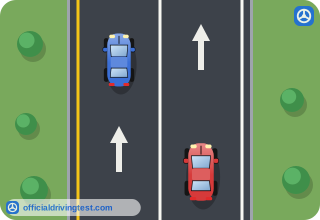
- You are discouraged from changing lanes
- You may pass other vehicles freely
- You must stop at the line
- Changing lanes is prohibited
Show answer
Correct answer: You are discouraged from changing lanes
The manual says a solid white line means you are discouraged from changing lanes.
Source: Delaware Driver Manual (July 2026), page 84 · Open this page in the manual (Manual page 84)
-
What do double solid white lines mean?
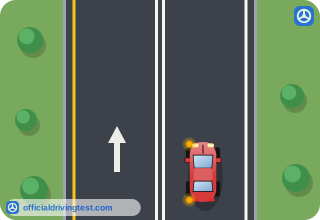
- They allow lane-changing if it is safe
- They discourage lane-changing
- They prohibit lane-changing
- They mark the edge of the road
Show answer
Correct answer: They prohibit lane-changing
The manual says double solid white lines prohibit lane-changing.
Source: Delaware Driver Manual (July 2026), page 84 · Open this page in the manual (Manual page 84)
-
What color are the lines that separate traffic moving in opposite directions?
- Yellow
- White
- Red
- Blue
Show answer
Correct answer: Yellow
The manual says lines separating traffic moving in opposite directions are yellow.
Source: Delaware Driver Manual (July 2026), page 85 · Open this page in the manual (Manual page 85)
-
What does a broken yellow line between opposing lanes of traffic mean?
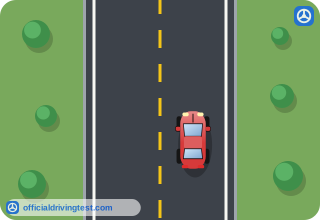
- You may never cross it
- Neither side can pass
- You may cross it to pass if it is safe to do so
- Traffic on both sides moves in the same direction
Show answer
Correct answer: You may cross it to pass if it is safe to do so
The manual says you may cross a broken yellow line to pass if it is safe.
Source: Delaware Driver Manual (July 2026), page 85 · Open this page in the manual (Manual page 85)
-
There is a solid yellow line and a broken yellow line between opposing lanes. The solid line is on your side. May you pass?
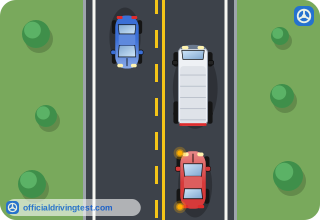
- Yes, if it is safe to do so
- No, you may not pass
- Yes, if no vehicle is oncoming
- Yes, but only on a straight road
Show answer
Correct answer: No, you may not pass
The manual says you may not pass if the solid yellow line is on your side; you may pass if the broken line is on your side and it is safe.
Source: Delaware Driver Manual (July 2026), page 85 · Open this page in the manual (Manual page 85)
-
What do two solid yellow lines between lanes of traffic mean?
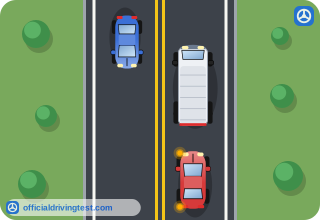
- Only the side with the right-hand line may pass
- Both sides may pass if it is safe
- Traffic moves in one direction only
- Neither side can pass
Show answer
Correct answer: Neither side can pass
The manual says two solid yellow lines mean neither side can pass.
Source: Delaware Driver Manual (July 2026), page 85 · Open this page in the manual (Manual page 85)
-
When may you cross a solid yellow line?
- To turn into a driveway, if it is safe to do so
- To pass a slow vehicle on a hill
- To change lanes on a road with four lanes
- To move around a stopped bus
Show answer
Correct answer: To turn into a driveway, if it is safe to do so
The manual says you may cross a solid yellow line to turn into a driveway if it is safe.
Source: Delaware Driver Manual (July 2026), page 85 · Open this page in the manual (Manual page 85)
-
How are reversible lanes usually marked?
- By solid white lines
- By double-broken yellow lines
- By a single broken white line
- By double solid yellow lines
Show answer
Correct answer: By double-broken yellow lines
The manual says these lanes are usually marked by double-broken yellow lines.
Source: Delaware Driver Manual (July 2026), page 85 · Open this page in the manual (Manual page 85)
-
How is a shared center lane marked on each side?
- By a solid white line and a broken white line
- By two solid yellow lines
- By a solid yellow line and a broken yellow line
- By a broken yellow line and a solid white line
Show answer
Correct answer: By a solid yellow line and a broken yellow line
A shared center lane is marked on each side by solid yellow and broken yellow lines.
Source: Delaware Driver Manual (July 2026), page 87 · Open this page in the manual (Manual page 87)
-
A marking on the pavement shows two chevrons above a cyclist with a helmet. What is it?
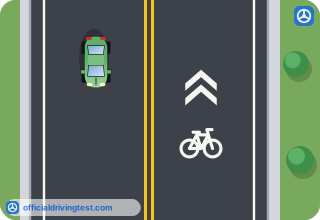
- A marking that closes the lane to all motor vehicles and keeps it for cyclists only
- A bike box that shows where cyclists turning left wait for the green light
- A marking that shows cyclists where they must park their bicycles at the curb
- A shared lane marking: both cyclists and motor vehicles may legally use the lane
Show answer
Correct answer: A shared lane marking: both cyclists and motor vehicles may legally use the lane
The shared lane marking reminds everyone that the lane may be legally used by both cyclists and motor vehicles.
Source: Delaware Driver Manual (July 2026), page 99 · Open this page in the manual (Manual page 99)
-
What is one purpose of the shared lane marking?
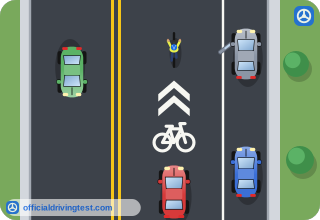
- To encourage safe passing of cyclists by motorists
- To allow motorists to park in the bike lane
- To tell cyclists to ride on the sidewalk
- To stop all vehicles at the marking
Show answer
Correct answer: To encourage safe passing of cyclists by motorists
The shared lane marking assists lateral positioning, encourages safe passing and reduces wrong way bicycling.
Source: Delaware Driver Manual (July 2026), page 99 · Open this page in the manual (Manual page 99)