Delaware: Emergency vehicles, work zones and traffic stops
Yielding to emergency vehicles, the move over law, work zones and flaggers, and what to expect when an officer stops you. Split into 4 shorter tests so you're not stuck in one long quiz.
Independent educational site · not affiliated with any government agency or DMV
Choose a part
Emergency vehicles, work zones and traffic stops — Part 1
Questions in this part include: “What is a work zone?”
StartEmergency vehicles, work zones and traffic stops — Part 2
Questions in this part include: “What may happen to speed limits in work areas?”
StartEmergency vehicles, work zones and traffic stops — Part 3
Questions in this part include: “Which signal on a stationary tow truck requires you to proceed with caution and yield or reduce speed?”
StartEmergency vehicles, work zones and traffic stops — Part 4
Questions in this part include: “How will an officer initiate a traffic stop?”
StartAll 68 Emergency vehicles, work zones and traffic stops questions with answers
Choose a part above to take a practice test, or study every question and answer here.
Show the questions and answersHide the questions
-
What is a work zone?
- An area where construction, maintenance or utility work occurs
- An area along a highway where a railroad crosses the roadway
- An area along a highway where a crash has blocked the lanes
- An area near a school where the speed limit is reduced
Show answer
Correct answer: An area where construction, maintenance or utility work occurs
The manual defines a work zone as an area along a highway where construction, maintenance or utility work is occurring.
Source: Delaware Driver Manual (July 2026), page 78 · Open this page in the manual (Manual page 78)
-
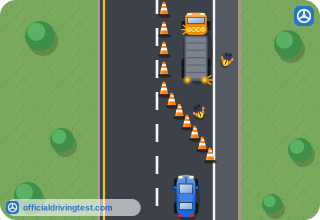
What must drivers use when approaching and passing work zones, for their own safety and for the safety of pedestrians and workers?
- Their horns
- Their high beams
- Great care
- Their cruise control
Show answer
Correct answer: Great care
It is important for the driver’s own safety and the safety of pedestrians and workers that drivers use great care in work zones.
Source: Delaware Driver Manual (July 2026), page 78 · Open this page in the manual (Manual page 78)
-
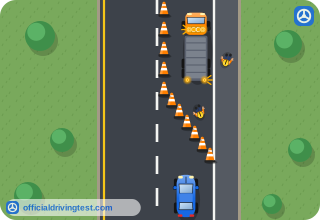
Where are special work zone traffic signs and devices set up?
- Only at the point where the work is taking place
- In advance of the work, continuing beyond the work area
- Only after the work area has ended
- Only on the side of the road where workers are standing
Show answer
Correct answer: In advance of the work, continuing beyond the work area
Signs and devices are set up in advance of the work and continue beyond the work area.
Source: Delaware Driver Manual (July 2026), page 78 · Open this page in the manual (Manual page 78)
-
A work zone may be what two kinds of operation?
- Daytime only, or nighttime only
- Permanent, or limited to a single lane only
- Marked by cones only, or by signs only
- Stationary, or a slowly moving mobile operation
Show answer
Correct answer: Stationary, or a slowly moving mobile operation
The zone may be stationary, like a bridge being widened, or mobile, like pavement striping or patching.
Source: Delaware Driver Manual (July 2026), page 78 · Open this page in the manual (Manual page 78)
-
What color are traffic warning signs in work zones usually?
- Orange
- Yellow
- Green
- White
Show answer
Correct answer: Orange
The manual says traffic warning signs in work zones usually are orange.
Source: Delaware Driver Manual (July 2026), page 79 · Open this page in the manual (Manual page 79)
-
What happens to fines for exceeding the speed limit in a work zone?
- They are cut in half
- They stay the same as elsewhere
- They are doubled
- They are waived for a first offense
Show answer
Correct answer: They are doubled
The manual states that fines for exceeding the speed limit in a work zone are doubled.
Source: Delaware Driver Manual (July 2026), page 79 · Open this page in the manual (Manual page 79)
-
Where may stopped traffic be hidden as you approach a work zone?
- Only inside the work area itself
- Around a curve or over a hill
- Behind a freeway sign
- In the left lane only
Show answer
Correct answer: Around a curve or over a hill
The manual warns that stopped traffic may be hidden around a curve or over a hill.
Source: Delaware Driver Manual (July 2026), page 79 · Open this page in the manual (Manual page 79)
-
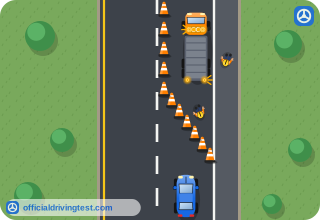
When you see signs indicating lane closures ahead, what should you do?
- Speed up to pass the slower traffic
- Stop and wait for a flagger to wave you
- Stay in your lane until the lane ends
- Prepare to move from the closed lane
Show answer
Correct answer: Prepare to move from the closed lane
The manual says to prepare to move from the closed lane when you see lane closure signs.
Source: Delaware Driver Manual (July 2026), page 79 · Open this page in the manual (Manual page 79)
-
Besides traffic signs and devices, whose directions must you obey in a work zone?
- The police and flaggers
- Other drivers who know the area
- Only the driver ahead of you
- Passengers riding with you
Show answer
Correct answer: The police and flaggers
Drivers must obey the directions of the police and flaggers in a work zone.
Source: Delaware Driver Manual (July 2026), page 79 · Open this page in the manual (Manual page 79)
-
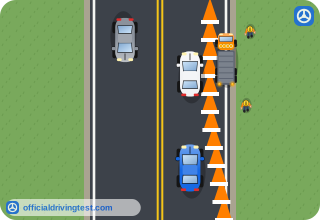
Why should you brake gradually when driving through a work zone?
- To warn the flaggers that you are approaching
- To keep your tires from wearing unevenly
- To give drivers behind you ample time to slow down
- To avoid setting off temporary traffic signals
Show answer
Correct answer: To give drivers behind you ample time to slow down
The manual says to brake gradually to give drivers behind you ample time to slow down.
Source: Delaware Driver Manual (July 2026), page 79 · Open this page in the manual (Manual page 79)
-
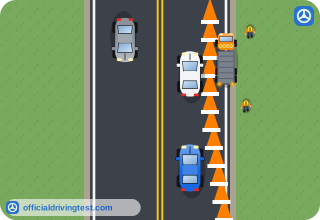
Which driving habit does the manual tell you to avoid in a work zone?
- Keeping up with the flow of traffic
- Weaving from lane to lane
- Watching what other drivers are doing
- Braking gradually
Show answer
Correct answer: Weaving from lane to lane
The manual says not to weave from lane to lane in a work zone.
Source: Delaware Driver Manual (July 2026), page 79 · Open this page in the manual (Manual page 79)
-
What kind of movements are best when the pavement in a work zone is rough or uneven, or has metal plates or drop-offs at the edge?
- Quick braking to a full stop
- Sharp steering around each bump
- Speeding up to cross them fast
- Gradual, controlled movements
Show answer
Correct answer: Gradual, controlled movements
The manual says gradual, controlled movements are best on unusual pavement surfaces.
Source: Delaware Driver Manual (July 2026), page 79 · Open this page in the manual (Manual page 79)
-
Why should you keep a reasonable speed and spacing between vehicles in a work zone?
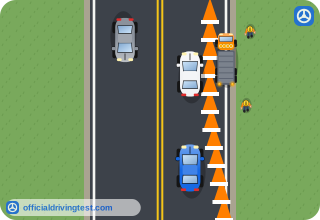
- You may have nowhere to go if the vehicle ahead stops
- Lanes in a work zone are always wider than normal
- The vehicle behind you is unable to stop quickly
- Police watch only the lead vehicle in a line
Show answer
Correct answer: You may have nowhere to go if the vehicle ahead stops
Driving too fast or following too closely leaves you nowhere to go if the vehicle in front suddenly slows or stops.
Source: Delaware Driver Manual (July 2026), page 79 · Open this page in the manual (Manual page 79)
-
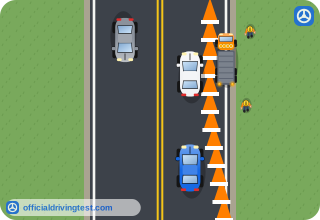
How does the manual tell you to treat workers and other road users in a work zone?
- Stay ahead of the traffic flow
- Be firm and keep your place in line
- Be patient and considerate
- Sound your horn to warn them
Show answer
Correct answer: Be patient and considerate
The manual asks drivers to be patient and considerate to workers and other road users.
Source: Delaware Driver Manual (July 2026), page 79 · Open this page in the manual (Manual page 79)
-
In which situation must traffic in a work zone usually be stopped?
- Whenever the speed limit has been reduced for the work area
- When opposite traffic takes turns using a single lane
- Whenever an orange warning sign is posted along the road
- Whenever an arrow panel is flashing on the roadway
Show answer
Correct answer: When opposite traffic takes turns using a single lane
Traffic usually must stop when opposite-direction traffic takes turns using a single lane, or when workers or equipment must enter the lane.
Source: Delaware Driver Manual (July 2026), page 79 · Open this page in the manual (Manual page 79)
-
What is more often used than temporary signals or police to stop, slow and direct traffic through work zones?
- Cones and barricades placed across the travel lane
- Flashing arrow panels with no people present
- Recorded messages from changeable message signs
- Trained and certified flaggers with stop/slow paddles
Show answer
Correct answer: Trained and certified flaggers with stop/slow paddles
The manual says more often, trained and certified flaggers with stop/slow paddles direct traffic through work zones.
Source: Delaware Driver Manual (July 2026), page 79 · Open this page in the manual (Manual page 79)
-
What do regulatory signs in a work zone tell drivers?
- The speed limit and other laws and regulations
- Where the nearest detour route begins ahead
- How far away the next exit is
- Which lanes flaggers are guarding
Show answer
Correct answer: The speed limit and other laws and regulations
Regulatory signs tell drivers of the speed limit and other laws and regulations.
Source: Delaware Driver Manual (July 2026), page 79 · Open this page in the manual (Manual page 79)
-
What may happen to speed limits in work areas?
- They are always raised
- They are suspended
- They may be reduced
- They stay unchanged
Show answer
Correct answer: They may be reduced
The manual says speed limits may be reduced in work areas.
Source: Delaware Driver Manual (July 2026), page 79 · Open this page in the manual (Manual page 79)
-
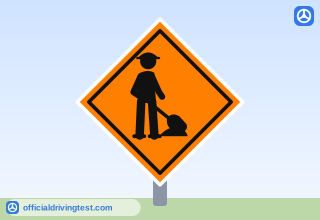
What are warning signs in or near work zones used for?
- To state the speed limit and other laws and regulations
- To alert drivers to unusual or potentially hazardous conditions
- To replace flaggers at the work site
- To list the services at the next exit
Show answer
Correct answer: To alert drivers to unusual or potentially hazardous conditions
Warning signs alert drivers to unusual or potentially hazardous conditions in or near work zones.
Source: Delaware Driver Manual (July 2026), page 80 · Open this page in the manual (Manual page 80)
-
What are the usual color and shape of most signs used in highway and street work areas?
- Yellow and round
- Orange and octagonal
- Green and rectangular
- Orange and diamond shaped
Show answer
Correct answer: Orange and diamond shaped
Most signs used in highway and street work areas are orange and diamond shaped, with a few rectangular.
Source: Delaware Driver Manual (July 2026), page 80 · Open this page in the manual (Manual page 80)
-
Which of these are the devices most commonly used to alert drivers and guide them through a work zone?
- Barricades, drums, cones, and tubular markers
- Rumble strips, speed humps, mirrors, and bollards
- Reflector posts, guard rails, curbs, and median barriers
- Traffic lights, stop signs, yield signs, and flares
Show answer
Correct answer: Barricades, drums, cones, and tubular markers
Barricades, drums, cones, and tubular markers are the most commonly used channelizing devices in work zones.
Source: Delaware Driver Manual (July 2026), page 80 · Open this page in the manual (Manual page 80)
-
How are guiding or channelizing devices often equipped at night?
- With bells that ring continuously
- With extra orange flags
- With flashing or steady burn lights
- With red reflective tape only
Show answer
Correct answer: With flashing or steady burn lights
At night they are often equipped with flashing or steady burn lights for improved visibility.
Source: Delaware Driver Manual (July 2026), page 80 · Open this page in the manual (Manual page 80)
-
What are large flashing or sequencing arrow panels used for in work zones?
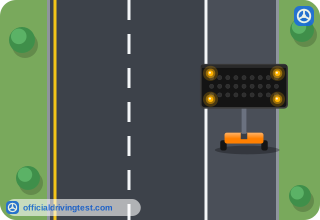
- To mark where flaggers stand and tell drivers when they may speed up
- To guide drivers into certain lanes and tell them part of the road ahead is closed
- To show the speed limit inside the work zone and where the zone ends
- To tell drivers a new detour has opened and that signs are not needed
Show answer
Correct answer: To guide drivers into certain lanes and tell them part of the road ahead is closed
Arrow panels guide drivers into certain traffic lanes and inform them that part of the road ahead is closed.
Source: Delaware Driver Manual (July 2026), page 80 · Open this page in the manual (Manual page 80)
-
When may large flashing or sequencing arrow panels be used in work zones?
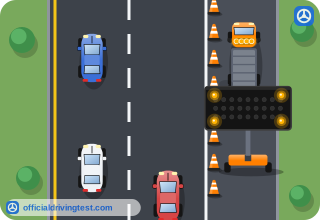
- Only at night
- Only in daylight
- Only on freeways
- Both day and night
Show answer
Correct answer: Both day and night
The manual says arrow panels may be used in work zones both day and night.
Source: Delaware Driver Manual (July 2026), page 80 · Open this page in the manual (Manual page 80)
-
What color vests, shirts, or jackets do flaggers wear?
- Yellow-green
- Bright red
- Dark blue
- White
Show answer
Correct answer: Yellow-green
Flaggers wear yellow-green vests, shirts, or jackets.
Source: Delaware Driver Manual (July 2026), page 80 · Open this page in the manual (Manual page 80)
-
What do flaggers use to direct traffic through work zones?
- Green flags or yield paddles
- Whistles and blue lanterns
- Red flags or stop/slow paddles
- Hand-held spotlights and horns
Show answer
Correct answer: Red flags or stop/slow paddles
Flaggers use red flags or stop/slow paddles to direct traffic through work zones.
Source: Delaware Driver Manual (July 2026), page 80 · Open this page in the manual (Manual page 80)
-
What is the job of flaggers in highway and street work zones?
- To issue speeding tickets to passing drivers
- To stop, slow, or guide traffic safely
- To repair damaged pavement near the lanes
- To measure the speed of passing vehicles
Show answer
Correct answer: To stop, slow, or guide traffic safely
Flaggers are provided to stop, slow, or guide traffic safely through the work area.
Source: Delaware Driver Manual (July 2026), page 80 · Open this page in the manual (Manual page 80)
-
A flagger in a work zone holds up a paddle with the word SLOW. What does this mean for traffic?
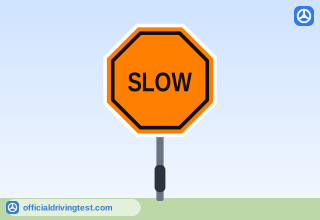
- Traffic must stop
- The road is closed ahead of you
- Traffic must turn around
- Traffic may proceed with caution
Show answer
Correct answer: Traffic may proceed with caution
The manual's picture pairs the flagger's SLOW paddle with the meaning Traffic Proceed with Caution.
Source: Delaware Driver Manual (July 2026), page 80 · Open this page in the manual (Manual page 80)
-
What must you do when an authorized emergency vehicle approaches using a siren or flashing lights?
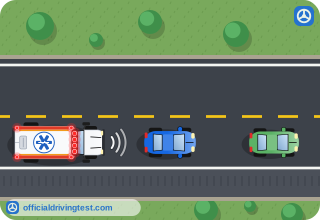
- Stop in your lane where you are, even in an intersection
- Drive to the left edge of the roadway
- Yield and pull to the right edge or curb, clear of intersections
- Speed up to clear the road ahead of it
Show answer
Correct answer: Yield and pull to the right edge or curb, clear of intersections
Every other vehicle shall yield and immediately drive to the right-hand edge or curb clear of any intersections until the emergency vehicle has passed.
Source: Delaware Driver Manual (July 2026), page 82 · Open this page in the manual (Manual page 82)
-
Who may direct you to do something other than pulling to the right when an authorized emergency vehicle approaches?
- Any other driver
- A police officer
- A passenger in your vehicle
- A pedestrian on the sidewalk
Show answer
Correct answer: A police officer
The yield-to-the-right rule applies except when otherwise directed by a police officer.
Source: Delaware Driver Manual (July 2026), page 82 · Open this page in the manual (Manual page 82)
-
Which flashing light pattern on an approaching authorized emergency vehicle is named in Delaware law, together with a siren, as requiring you to yield?
- Alternately flashing green and white lights
- Alternately flashing amber and white lights
- Steady purple lights
- Alternately flashing red and white lights
Show answer
Correct answer: Alternately flashing red and white lights
The law names alternately flashing red, red and white, red and blue, or red, white and blue lights.
Source: Delaware Driver Manual (July 2026), page 82 · Open this page in the manual (Manual page 82)
-
Besides authorized emergency vehicles, whose vehicle operators does the law on yielding to approaching emergency vehicles extend to?
- DelDOT vehicle operators
- Tow truck operators only
- School bus operators
- Private security patrol operators
Show answer
Correct answer: DelDOT vehicle operators
The manual says this law extends to DelDOT vehicle operators.
Source: Delaware Driver Manual (July 2026), page 82 · Open this page in the manual (Manual page 82)
-
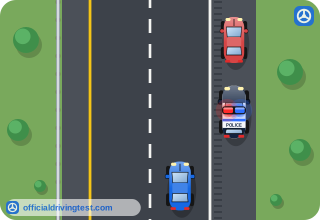
What should you do on a multi-lane roadway when approaching a stopped emergency vehicle?
- Stop behind it until it pulls away
- Stay in your lane and sound your horn
- Move over a lane until you are safely past
- Pull to the right shoulder and wait
Show answer
Correct answer: Move over a lane until you are safely past
On a multi-lane roadway, move over a lane from the stopped vehicle(s) until you are safely past.
Source: Delaware Driver Manual (July 2026), page 82 · Open this page in the manual (Manual page 82)
-
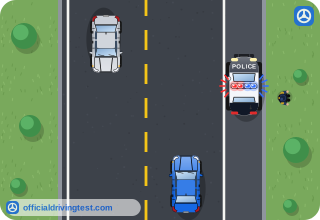
What should you do on a two-lane roadway when approaching a stopped emergency vehicle?
- Stop and wait for the vehicle to leave the road
- Slow down below the posted speed limit until past it
- Pass it at the posted speed limit without braking
- Move onto the shoulder and stop until it leaves
Show answer
Correct answer: Slow down below the posted speed limit until past it
On a two-lane roadway, slow down below the posted speed limit until you have completely passed the stopped vehicle(s).
Source: Delaware Driver Manual (July 2026), page 82 · Open this page in the manual (Manual page 82)
-
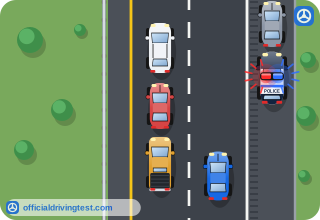
When you approach a stationary emergency vehicle giving a signal, what must you do if changing lanes would be impossible or unsafe?
- Stop and wait until the vehicle leaves
- Change lanes anyway, even if unsafe
- Proceed at the posted speed limit unchanged
- Proceed with caution and reduce to a safe speed
Show answer
Correct answer: Proceed with caution and reduce to a safe speed
If changing lanes is impossible or unsafe, you must proceed with caution and reduce to a safe speed.
Source: Delaware Driver Manual (July 2026), page 82 · Open this page in the manual (Manual page 82)
-
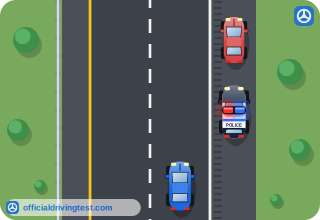
When you approach a stationary vehicle giving a warning signal, how must you yield the right-of-way when possible?
- Proceed with caution and make appropriate lane changes
- Stop completely and wait until it leaves the area
- Honk to warn the workers nearby
- Drive to the right-hand curb and stop
Show answer
Correct answer: Proceed with caution and make appropriate lane changes
The driver shall proceed with caution and yield the right-of-way by making appropriate lane changes when possible.
Source: Delaware Driver Manual (July 2026), page 82 · Open this page in the manual (Manual page 82)
-
Which signal on a stationary tow truck requires you to proceed with caution and yield or reduce speed?
- Alternately flashing green, white, or green and white lights
- Solid blue lights
- Alternately flashing amber, white, or amber and white lights
- Alternately flashing red and green lights
Show answer
Correct answer: Alternately flashing amber, white, or amber and white lights
The law covers a stationary tow truck displaying alternately flashing amber, white, or amber and white lights.
Source: Delaware Driver Manual (July 2026), page 82 · Open this page in the manual (Manual page 82)
-
Which signal on a stationary authorized DelDOT vehicle requires you to proceed with caution and yield or reduce speed?
- Alternately flashing green or green and amber lights
- Alternately flashing amber or red and amber lights
- Alternately flashing blue and white lights only
- Solid white lights
Show answer
Correct answer: Alternately flashing amber or red and amber lights
The law covers a stationary authorized DelDOT vehicle displaying alternately flashing amber or red and amber lights.
Source: Delaware Driver Manual (July 2026), page 82 · Open this page in the manual (Manual page 82)
-
Which of these displays on a stationary vehicle requires you to proceed with caution and yield or slow down?
- A parked vehicle with its windows rolled down
- A parked vehicle with its engine running
- A vehicle with its headlights on low beam
- Road flares, traffic cones or caution signs
Show answer
Correct answer: Road flares, traffic cones or caution signs
The law lists vehicle hazard warning lights, road flares, traffic cones, caution signs, or any non-vehicular warning signs.
Source: Delaware Driver Manual (July 2026), page 82 · Open this page in the manual (Manual page 82)
-
According to the manual, whom do move over laws help protect from serious injuries and death?
- Public servants who are working in harm's way
- Only drivers of authorized emergency vehicles
- Only workers in highway work zones
- Only pedestrians along the roadside
Show answer
Correct answer: Public servants who are working in harm's way
Move over laws help reduce risk of serious injuries and death to all public servants who are working in harm's way.
Source: Delaware Driver Manual (July 2026), page 82 · Open this page in the manual (Manual page 82)
-
When you see or hear an emergency vehicle approaching from any direction, what should you do?
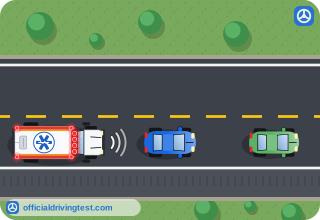
- Pull over to the left edge of the road
- Stop where you are in the lane
- Pull over to the right edge of the road
- Speed up to clear the lane
Show answer
Correct answer: Pull over to the right edge of the road
The manual says to pull over to the right edge of the road, or as near to the right as possible.
Source: Delaware Driver Manual (July 2026), page 89 · Open this page in the manual (Manual page 89)
-
If you are in an intersection when an emergency vehicle approaches, what should you do?
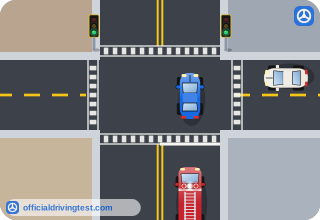
- Stop immediately where you are
- Drive through the intersection before you pull over
- Back out of the intersection
- Pull over to the left inside the intersection
Show answer
Correct answer: Drive through the intersection before you pull over
The manual says to drive through the intersection before you pull over.
Source: Delaware Driver Manual (July 2026), page 89 · Open this page in the manual (Manual page 89)
-
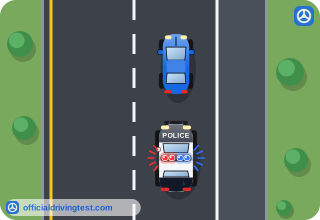
What should you do when an emergency vehicle gives instructions over its loudspeaker?
- Ignore them if you are in an intersection
- Follow them only if a police officer is present
- Follow them only if you are driving a commercial vehicle
- Follow any instructions given
Show answer
Correct answer: Follow any instructions given
The manual says to follow any instructions given over the emergency vehicle’s loudspeaker.
Source: Delaware Driver Manual (July 2026), page 89 · Open this page in the manual (Manual page 89)
-
What must an individual provide during a traffic stop, according to the law cited in the manual?
- Only their driver license number and vehicle registration number
- Only their name, because the address may be withheld
- Their name, address, and why they are driving and where they are going
- Their name, address, and the name of their employer
Show answer
Correct answer: Their name, address, and why they are driving and where they are going
The manual cites 11 Del. C. §1902: a driver must give a name, an address and an explanation of why they are driving and where they are going.
Source: Delaware Driver Manual (July 2026), page 112 · Open this page in the manual (Manual page 112)
-
What must passengers do during a traffic stop if the officer requests it?
- Provide their information and/or exit the vehicle
- Show the officer the vehicle's registration
- Hand over their cell phones to the officer
- Take over driving if the driver is detained
Show answer
Correct answer: Provide their information and/or exit the vehicle
Passengers must also provide their information and/or exit the vehicle if the officer requests it.
Source: Delaware Driver Manual (July 2026), page 112 · Open this page in the manual (Manual page 112)
-
What may an individual ask an officer to do during a traffic stop?
- Provide a copy of the law for the alleged violation
- Waive the traffic violation if it was minor
- Identify themself and the agency that employs them
- Show a written record of their years of service
Show answer
Correct answer: Identify themself and the agency that employs them
An individual may ask the officer to identify themself and the agency that employs them.
Source: Delaware Driver Manual (July 2026), page 112 · Open this page in the manual (Manual page 112)
-
In which situation may an officer search a vehicle on-scene?
- When the driver gives the officer consent
- Whenever the driver is stopped at night
- Whenever the driver cannot find the insurance card
- Only when a passenger asks to leave the vehicle
Show answer
Correct answer: When the driver gives the officer consent
A vehicle may be searched on-scene with consent, with probable cause, or as an inventory of a vehicle being towed.
Source: Delaware Driver Manual (July 2026), page 112 · Open this page in the manual (Manual page 112)
-
What does the manual say about the right to an attorney during roadside investigations?
- A person may refuse all questions until an attorney arrives
- The right applies as soon as the officer turns on emergency lights
- The right applies only to drivers and not to passengers
- A person does not have that right then; it will present itself later
Show answer
Correct answer: A person does not have that right then; it will present itself later
During roadside investigations a person does not have a right to an attorney, though that right will present itself later.
Source: Delaware Driver Manual (July 2026), page 112 · Open this page in the manual (Manual page 112)
-
What may happen to a person who fails to provide identification or explain their actions to the officer's satisfaction?
- The person must be arrested and charged with a crime on the spot
- The person may be detained, further questioned, and investigated
- The person will be released with a written warning only
- The person will be required to take a new written test
Show answer
Correct answer: The person may be detained, further questioned, and investigated
Such a person may be detained, further questioned, and investigated.
Source: Delaware Driver Manual (July 2026), page 112 · Open this page in the manual (Manual page 112)
-
According to the manual, what is true of a detention?
- The person is formally under arrest and charged
- The person has already been convicted of a violation
- The person's driver license is automatically suspended
- It does not mean the person is under arrest
Show answer
Correct answer: It does not mean the person is under arrest
The manual states that a detention does not mean a person is under arrest.
Source: Delaware Driver Manual (July 2026), page 112 · Open this page in the manual (Manual page 112)
-
What is the longest a detention period may last?
- Two hours
- Thirty minutes
- One hour
- Four hours
Show answer
Correct answer: Two hours
The detention period may not exceed two hours; the person is then released, or arrested and charged with a crime.
Source: Delaware Driver Manual (July 2026), page 112 · Open this page in the manual (Manual page 112)
-
How will an officer initiate a traffic stop?
- By blocking your vehicle in with the patrol car and approaching
- By sending a written notice to the registered owner
- With a visible or audible signal such as emergency lights or sirens
- By calling the driver's cell phone and asking them to stop
Show answer
Correct answer: With a visible or audible signal such as emergency lights or sirens
An officer initiates a stop with a visible or audible signal, which could include emergency lights or sirens.
Source: Delaware Driver Manual (July 2026), page 112 · Open this page in the manual (Manual page 112)
-
From which side may an officer approach your vehicle during a traffic stop?
- Either the driver side or the passenger side
- Only from the driver side of the vehicle
- Only from the passenger side of the vehicle
- Only from directly in front of the vehicle
Show answer
Correct answer: Either the driver side or the passenger side
The officer may approach from either the driver or passenger side, identify themself and their agency, and state the reason for the stop.
Source: Delaware Driver Manual (July 2026), page 112 · Open this page in the manual (Manual page 112)
-
Which items will an officer ask for during a traffic stop?
- Driver license, birth certificate, and proof of residency
- Driver license, vehicle title, and an inspection report
- Driver license, proof of insurance, and vehicle registration
- Proof of insurance, vehicle title, and a Social Security card
Show answer
Correct answer: Driver license, proof of insurance, and vehicle registration
The officer will ask for your driver license, proof of insurance, and vehicle registration.
Source: Delaware Driver Manual (July 2026), page 112 · Open this page in the manual (Manual page 112)
-
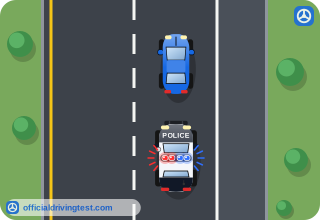
Where should you and your passengers stay during a traffic stop unless the officer instructs otherwise?
- Standing at the rear of your vehicle
- In your vehicle at all times
- Inside the patrol car
- Standing on the nearest sidewalk or shoulder
Show answer
Correct answer: In your vehicle at all times
You and your passengers should remain in your vehicle at all times unless the officer instructs otherwise.
Source: Delaware Driver Manual (July 2026), page 112 · Open this page in the manual (Manual page 112)
-
Why do law enforcement officers conduct traffic stops?
- Only when a vehicle displays an expired registration sticker
- Only when the officer has received a complaint about the driver
- Only during holiday checkpoints set up by the DMV
- They see a traffic violation or are conducting an investigation
Show answer
Correct answer: They see a traffic violation or are conducting an investigation
Officers conduct stops because they observe a traffic violation or are conducting a police investigation.
Source: Delaware Driver Manual (July 2026), page 112 · Open this page in the manual (Manual page 112)
-
What should you do when you see emergency lights behind you?
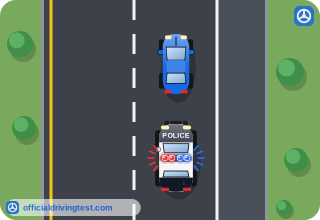
- Speed up to the next exit, then stop with hazard lights on
- Stay calm, use your turn signal, and pull to the side safely
- Stop in your lane right away and turn on your hazard lights
- Slow down, keep driving, and wait for the officer to pass
Show answer
Correct answer: Stay calm, use your turn signal, and pull to the side safely
Stay calm, activate your turn signal, and pull off or to the side of the roadway as soon and safely as possible.
Source: Delaware Driver Manual (July 2026), page 112 · Open this page in the manual (Manual page 112)
-
When pulling over for an emergency vehicle, to which side of the roadway should you move whenever possible?
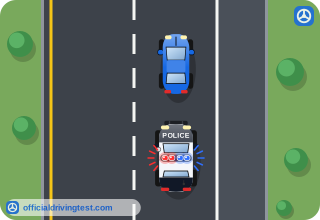
- The left side
- The median
- The right side
- Whichever side has more room
Show answer
Correct answer: The right side
Movements should be made to the right side of the roadway whenever possible.
Source: Delaware Driver Manual (July 2026), page 112 · Open this page in the manual (Manual page 112)
-
What should you do with the ignition and radio when an officer stops you?
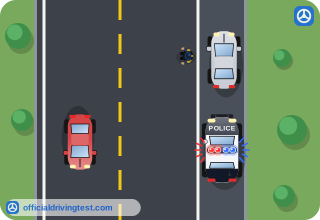
- Turn both off and stay in the vehicle unless told to exit
- Turn off the radio but leave the engine running
- Leave both on so you can hear the officer's instructions
- Turn off the ignition and step out of the vehicle at once
Show answer
Correct answer: Turn both off and stay in the vehicle unless told to exit
Turn off the ignition and radio and stay in your vehicle unless the officer directs you to exit.
Source: Delaware Driver Manual (July 2026), page 112 · Open this page in the manual (Manual page 112)
-
Where should you keep your hands during a traffic stop?
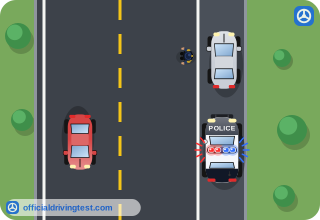
- In your lap, below the level of the window
- Hanging out the window with palms facing up
- On the steering wheel, where they are easily observable
- Reaching toward the glove box for your documents
Show answer
Correct answer: On the steering wheel, where they are easily observable
Keep your hands on the steering wheel so they are easily observable.
Source: Delaware Driver Manual (July 2026), page 112 · Open this page in the manual (Manual page 112)
-
What should you ask your passengers to do during a traffic stop?
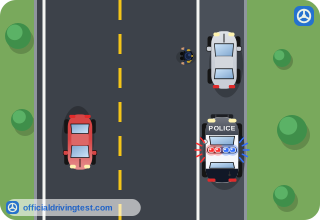
- Remain calm, stay in the vehicle, and keep hands in plain view
- Exit the vehicle and wait beside the road until released
- Look away from the officer and avoid speaking
- Record the stop on their phones for safety
Show answer
Correct answer: Remain calm, stay in the vehicle, and keep hands in plain view
You should ask your passengers to remain calm and stay in the vehicle with their hands in plain view.
Source: Delaware Driver Manual (July 2026), page 113 · Open this page in the manual (Manual page 113)
-
What does the manual say about cell phones and mobile devices during a traffic stop?
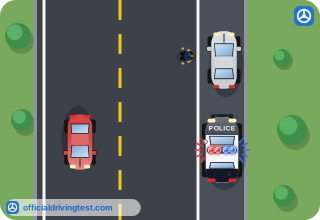
- The driver may use one to call a lawyer
- Passengers may use them to film the officer's actions
- They may be used if held below the window
- Neither you nor your passengers should use them
Show answer
Correct answer: Neither you nor your passengers should use them
Cell phones and mobile devices should not be used by you or any of your passengers.
Source: Delaware Driver Manual (July 2026), page 113 · Open this page in the manual (Manual page 113)
-
During a traffic stop, what should you do instead of searching for your license or vehicle documents?
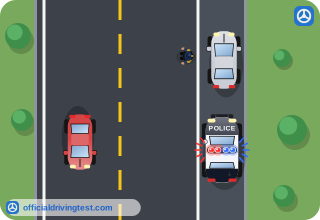
- Hold your documents out the window as the officer walks up
- Wait for the officer to give you instructions
- Get out your license and registration right after you stop
- Exit the vehicle and walk back to the patrol car
Show answer
Correct answer: Wait for the officer to give you instructions
Do not make sudden moves or search for documents; wait for the officer to give you instructions.
Source: Delaware Driver Manual (July 2026), page 113 · Open this page in the manual (Manual page 113)
-
When should you tell the officer that you have a weapon in the vehicle?
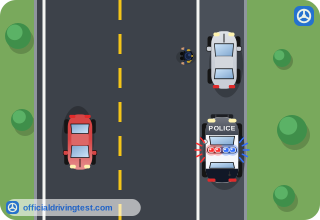
- Only if the officer asks to search
- Upon first contact
- Only after you hand over your license
- Only if the weapon is loaded
Show answer
Correct answer: Upon first contact
If you have a weapon in the vehicle, inform the officer upon first contact.
Source: Delaware Driver Manual (July 2026), page 113 · Open this page in the manual (Manual page 113)
-
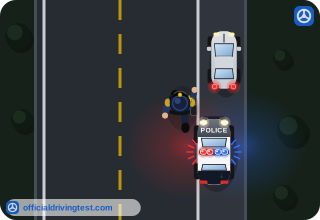
What may an officer do at night once your vehicle is stopped?
- Ask you to switch to high beam headlights
- Require you to stand in front of your headlights
- Turn off your vehicle's engine from outside
- Direct a spotlight at your vehicle
Show answer
Correct answer: Direct a spotlight at your vehicle
At night the officer may direct a spotlight at your vehicle once it is stopped.
Source: Delaware Driver Manual (July 2026), page 113 · Open this page in the manual (Manual page 113)
-
Where should you go to file a compliment or a complaint about a law-enforcement officer?
- The officer's own agency, by the means the agency determines
- The Division of Motor Vehicles driver services office
- The nearest county courthouse clerk's office
- The hotline of the Office of Highway Safety
Show answer
Correct answer: The officer's own agency, by the means the agency determines
You should contact the officer's agency by the means that agency determines; most have a website with contact information.
Source: Delaware Driver Manual (July 2026), page 113 · Open this page in the manual (Manual page 113)
-
What is the best way to ensure everyone's safety during a traffic stop?
- Getting out to speak with the officer face to face
- Recording the stop with your phone
- Your cooperation with law enforcement
- Waiting for a second patrol car to arrive
Show answer
Correct answer: Your cooperation with law enforcement
Your cooperation with law enforcement is the best way to ensure safety is not compromised during the stop.
Source: Delaware Driver Manual (July 2026), page 113 · Open this page in the manual (Manual page 113)
-
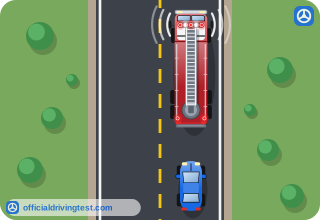
Why should you leave extra room when following police vehicles, ambulances and fire trucks?
- They always stop without warning
- They are exempt from all traffic signs
- They cannot be seen in your mirrors
- They need more room to operate
Show answer
Correct answer: They need more room to operate
The manual says police vehicles, ambulances and fire trucks need more room to operate.
Source: Delaware Driver Manual (July 2026), page 128 · Open this page in the manual (Manual page 128)