Delaware: Emergency vehicles, work zones and traffic stops — Part 4 Practice Test
Questions in this part include: “How will an officer initiate a traffic stop?” · “Why do law enforcement officers conduct traffic stops?”
Independent educational site · not affiliated with any government agency or DMV
Ready? Test yourself
- Instant feedback with an explanation
- Every answer cites its source in the manual
- Your best score is saved on this device
Questions are original and based on the official manual "Delaware Driver Manual" (July 2026), Delaware Division of Motor Vehicles (DMV).
All 17 questions in this practice test
Take the test above first, then use this list to study. Tap “Show answer” to see the correct answer and explanation.
Show the questions and answersHide the questions
-
How will an officer initiate a traffic stop?
- By blocking your vehicle in with the patrol car and approaching
- By sending a written notice to the registered owner
- With a visible or audible signal such as emergency lights or sirens
- By calling the driver's cell phone and asking them to stop
Show answer
Correct answer: With a visible or audible signal such as emergency lights or sirens
An officer initiates a stop with a visible or audible signal, which could include emergency lights or sirens.
Source: Delaware Driver Manual (July 2026), page 112 · Open this page in the manual (Manual page 112)
-
From which side may an officer approach your vehicle during a traffic stop?
- Either the driver side or the passenger side
- Only from the driver side of the vehicle
- Only from the passenger side of the vehicle
- Only from directly in front of the vehicle
Show answer
Correct answer: Either the driver side or the passenger side
The officer may approach from either the driver or passenger side, identify themself and their agency, and state the reason for the stop.
Source: Delaware Driver Manual (July 2026), page 112 · Open this page in the manual (Manual page 112)
-
Which items will an officer ask for during a traffic stop?
- Driver license, birth certificate, and proof of residency
- Driver license, vehicle title, and an inspection report
- Driver license, proof of insurance, and vehicle registration
- Proof of insurance, vehicle title, and a Social Security card
Show answer
Correct answer: Driver license, proof of insurance, and vehicle registration
The officer will ask for your driver license, proof of insurance, and vehicle registration.
Source: Delaware Driver Manual (July 2026), page 112 · Open this page in the manual (Manual page 112)
-
Where should you and your passengers stay during a traffic stop unless the officer instructs otherwise?
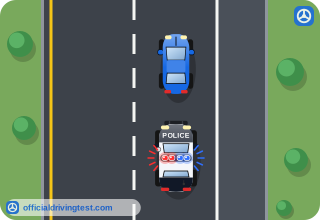
- Standing at the rear of your vehicle
- In your vehicle at all times
- Inside the patrol car
- Standing on the nearest sidewalk or shoulder
Show answer
Correct answer: In your vehicle at all times
You and your passengers should remain in your vehicle at all times unless the officer instructs otherwise.
Source: Delaware Driver Manual (July 2026), page 112 · Open this page in the manual (Manual page 112)
-
Why do law enforcement officers conduct traffic stops?
- Only when a vehicle displays an expired registration sticker
- Only when the officer has received a complaint about the driver
- Only during holiday checkpoints set up by the DMV
- They see a traffic violation or are conducting an investigation
Show answer
Correct answer: They see a traffic violation or are conducting an investigation
Officers conduct stops because they observe a traffic violation or are conducting a police investigation.
Source: Delaware Driver Manual (July 2026), page 112 · Open this page in the manual (Manual page 112)
-
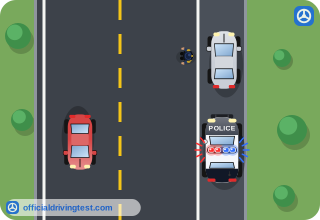
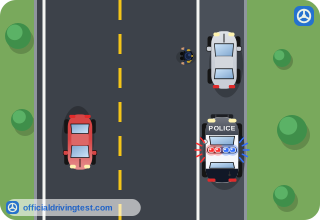
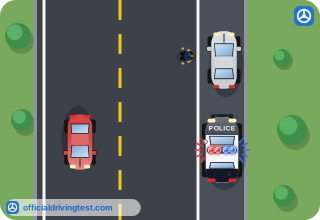
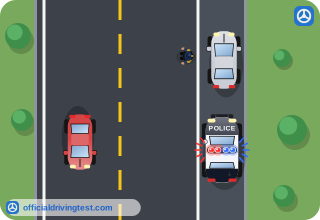
What should you do when you see emergency lights behind you?
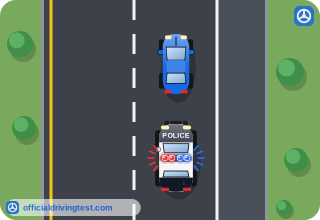
- Speed up to the next exit, then stop with hazard lights on
- Stay calm, use your turn signal, and pull to the side safely
- Stop in your lane right away and turn on your hazard lights
- Slow down, keep driving, and wait for the officer to pass
Show answer
Correct answer: Stay calm, use your turn signal, and pull to the side safely
Stay calm, activate your turn signal, and pull off or to the side of the roadway as soon and safely as possible.
Source: Delaware Driver Manual (July 2026), page 112 · Open this page in the manual (Manual page 112)
-
When pulling over for an emergency vehicle, to which side of the roadway should you move whenever possible?
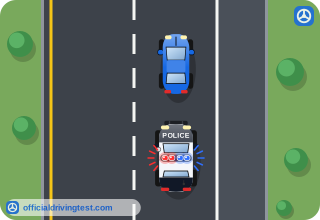
- The left side
- The median
- The right side
- Whichever side has more room
Show answer
Correct answer: The right side
Movements should be made to the right side of the roadway whenever possible.
Source: Delaware Driver Manual (July 2026), page 112 · Open this page in the manual (Manual page 112)
-
What should you do with the ignition and radio when an officer stops you?
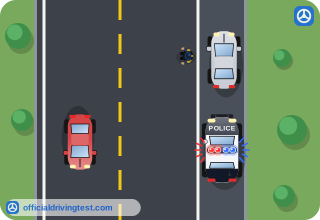
- Turn both off and stay in the vehicle unless told to exit
- Turn off the radio but leave the engine running
- Leave both on so you can hear the officer's instructions
- Turn off the ignition and step out of the vehicle at once
Show answer
Correct answer: Turn both off and stay in the vehicle unless told to exit
Turn off the ignition and radio and stay in your vehicle unless the officer directs you to exit.
Source: Delaware Driver Manual (July 2026), page 112 · Open this page in the manual (Manual page 112)
-
Where should you keep your hands during a traffic stop?
- In your lap, below the level of the window
- Hanging out the window with palms facing up
- On the steering wheel, where they are easily observable
- Reaching toward the glove box for your documents
Show answer
Correct answer: On the steering wheel, where they are easily observable
Keep your hands on the steering wheel so they are easily observable.
Source: Delaware Driver Manual (July 2026), page 112 · Open this page in the manual (Manual page 112)
-
What should you ask your passengers to do during a traffic stop?
- Remain calm, stay in the vehicle, and keep hands in plain view
- Exit the vehicle and wait beside the road until released
- Look away from the officer and avoid speaking
- Record the stop on their phones for safety
Show answer
Correct answer: Remain calm, stay in the vehicle, and keep hands in plain view
You should ask your passengers to remain calm and stay in the vehicle with their hands in plain view.
Source: Delaware Driver Manual (July 2026), page 113 · Open this page in the manual (Manual page 113)
-
What does the manual say about cell phones and mobile devices during a traffic stop?
- The driver may use one to call a lawyer
- Passengers may use them to film the officer's actions
- They may be used if held below the window
- Neither you nor your passengers should use them
Show answer
Correct answer: Neither you nor your passengers should use them
Cell phones and mobile devices should not be used by you or any of your passengers.
Source: Delaware Driver Manual (July 2026), page 113 · Open this page in the manual (Manual page 113)
-
During a traffic stop, what should you do instead of searching for your license or vehicle documents?
- Hold your documents out the window as the officer walks up
- Wait for the officer to give you instructions
- Get out your license and registration right after you stop
- Exit the vehicle and walk back to the patrol car
Show answer
Correct answer: Wait for the officer to give you instructions
Do not make sudden moves or search for documents; wait for the officer to give you instructions.
Source: Delaware Driver Manual (July 2026), page 113 · Open this page in the manual (Manual page 113)
-
When should you tell the officer that you have a weapon in the vehicle?
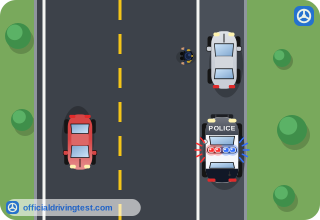
- Only if the officer asks to search
- Upon first contact
- Only after you hand over your license
- Only if the weapon is loaded
Show answer
Correct answer: Upon first contact
If you have a weapon in the vehicle, inform the officer upon first contact.
Source: Delaware Driver Manual (July 2026), page 113 · Open this page in the manual (Manual page 113)
-
What may an officer do at night once your vehicle is stopped?
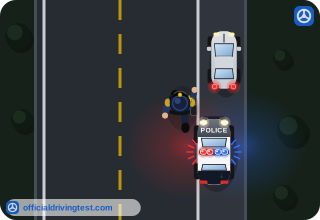
- Ask you to switch to high beam headlights
- Require you to stand in front of your headlights
- Turn off your vehicle's engine from outside
- Direct a spotlight at your vehicle
Show answer
Correct answer: Direct a spotlight at your vehicle
At night the officer may direct a spotlight at your vehicle once it is stopped.
Source: Delaware Driver Manual (July 2026), page 113 · Open this page in the manual (Manual page 113)
-
Where should you go to file a compliment or a complaint about a law-enforcement officer?
- The officer's own agency, by the means the agency determines
- The Division of Motor Vehicles driver services office
- The nearest county courthouse clerk's office
- The hotline of the Office of Highway Safety
Show answer
Correct answer: The officer's own agency, by the means the agency determines
You should contact the officer's agency by the means that agency determines; most have a website with contact information.
Source: Delaware Driver Manual (July 2026), page 113 · Open this page in the manual (Manual page 113)
-
What is the best way to ensure everyone's safety during a traffic stop?
- Getting out to speak with the officer face to face
- Recording the stop with your phone
- Your cooperation with law enforcement
- Waiting for a second patrol car to arrive
Show answer
Correct answer: Your cooperation with law enforcement
Your cooperation with law enforcement is the best way to ensure safety is not compromised during the stop.
Source: Delaware Driver Manual (July 2026), page 113 · Open this page in the manual (Manual page 113)
-
Why should you leave extra room when following police vehicles, ambulances and fire trucks?
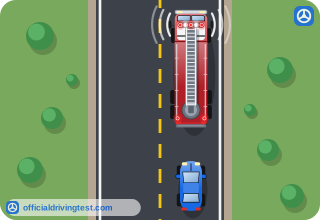
- They always stop without warning
- They are exempt from all traffic signs
- They cannot be seen in your mirrors
- They need more room to operate
Show answer
Correct answer: They need more room to operate
The manual says police vehicles, ambulances and fire trucks need more room to operate.
Source: Delaware Driver Manual (July 2026), page 128 · Open this page in the manual (Manual page 128)