Delaware: Emergency vehicles, work zones and traffic stops — Part 2 Practice Test
Questions in this part include: “What may happen to speed limits in work areas?” · “What color vests, shirts, or jackets do flaggers wear?”
Independent educational site · not affiliated with any government agency or DMV
Ready? Test yourself
- Instant feedback with an explanation
- Every answer cites its source in the manual
- Your best score is saved on this device
Questions are original and based on the official manual "Delaware Driver Manual" (July 2026), Delaware Division of Motor Vehicles (DMV).
All 17 questions in this practice test
Take the test above first, then use this list to study. Tap “Show answer” to see the correct answer and explanation.
Show the questions and answersHide the questions
-
What may happen to speed limits in work areas?
- They are always raised
- They are suspended
- They may be reduced
- They stay unchanged
Show answer
Correct answer: They may be reduced
The manual says speed limits may be reduced in work areas.
Source: Delaware Driver Manual (July 2026), page 79 · Open this page in the manual (Manual page 79)
-
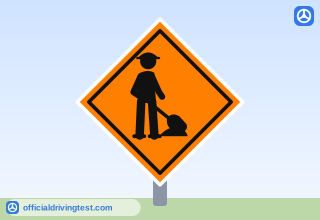
What are warning signs in or near work zones used for?
- To state the speed limit and other laws and regulations
- To alert drivers to unusual or potentially hazardous conditions
- To replace flaggers at the work site
- To list the services at the next exit
Show answer
Correct answer: To alert drivers to unusual or potentially hazardous conditions
Warning signs alert drivers to unusual or potentially hazardous conditions in or near work zones.
Source: Delaware Driver Manual (July 2026), page 80 · Open this page in the manual (Manual page 80)
-
What are the usual color and shape of most signs used in highway and street work areas?
- Yellow and round
- Orange and octagonal
- Green and rectangular
- Orange and diamond shaped
Show answer
Correct answer: Orange and diamond shaped
Most signs used in highway and street work areas are orange and diamond shaped, with a few rectangular.
Source: Delaware Driver Manual (July 2026), page 80 · Open this page in the manual (Manual page 80)
-
Which of these are the devices most commonly used to alert drivers and guide them through a work zone?
- Barricades, drums, cones, and tubular markers
- Rumble strips, speed humps, mirrors, and bollards
- Reflector posts, guard rails, curbs, and median barriers
- Traffic lights, stop signs, yield signs, and flares
Show answer
Correct answer: Barricades, drums, cones, and tubular markers
Barricades, drums, cones, and tubular markers are the most commonly used channelizing devices in work zones.
Source: Delaware Driver Manual (July 2026), page 80 · Open this page in the manual (Manual page 80)
-
How are guiding or channelizing devices often equipped at night?
- With bells that ring continuously
- With extra orange flags
- With flashing or steady burn lights
- With red reflective tape only
Show answer
Correct answer: With flashing or steady burn lights
At night they are often equipped with flashing or steady burn lights for improved visibility.
Source: Delaware Driver Manual (July 2026), page 80 · Open this page in the manual (Manual page 80)
-
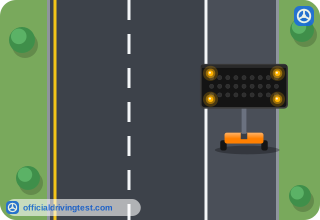
What are large flashing or sequencing arrow panels used for in work zones?
- To mark where flaggers stand and tell drivers when they may speed up
- To guide drivers into certain lanes and tell them part of the road ahead is closed
- To show the speed limit inside the work zone and where the zone ends
- To tell drivers a new detour has opened and that signs are not needed
Show answer
Correct answer: To guide drivers into certain lanes and tell them part of the road ahead is closed
Arrow panels guide drivers into certain traffic lanes and inform them that part of the road ahead is closed.
Source: Delaware Driver Manual (July 2026), page 80 · Open this page in the manual (Manual page 80)
-
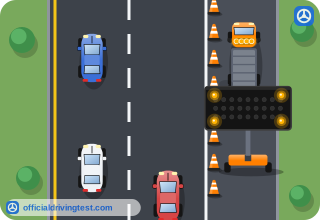
When may large flashing or sequencing arrow panels be used in work zones?
- Only at night
- Only in daylight
- Only on freeways
- Both day and night
Show answer
Correct answer: Both day and night
The manual says arrow panels may be used in work zones both day and night.
Source: Delaware Driver Manual (July 2026), page 80 · Open this page in the manual (Manual page 80)
-
What color vests, shirts, or jackets do flaggers wear?
- Yellow-green
- Bright red
- Dark blue
- White
Show answer
Correct answer: Yellow-green
Flaggers wear yellow-green vests, shirts, or jackets.
Source: Delaware Driver Manual (July 2026), page 80 · Open this page in the manual (Manual page 80)
-
What do flaggers use to direct traffic through work zones?
- Green flags or yield paddles
- Whistles and blue lanterns
- Red flags or stop/slow paddles
- Hand-held spotlights and horns
Show answer
Correct answer: Red flags or stop/slow paddles
Flaggers use red flags or stop/slow paddles to direct traffic through work zones.
Source: Delaware Driver Manual (July 2026), page 80 · Open this page in the manual (Manual page 80)
-
What is the job of flaggers in highway and street work zones?
- To issue speeding tickets to passing drivers
- To stop, slow, or guide traffic safely
- To repair damaged pavement near the lanes
- To measure the speed of passing vehicles
Show answer
Correct answer: To stop, slow, or guide traffic safely
Flaggers are provided to stop, slow, or guide traffic safely through the work area.
Source: Delaware Driver Manual (July 2026), page 80 · Open this page in the manual (Manual page 80)
-
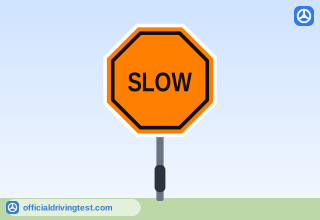
A flagger in a work zone holds up a paddle with the word SLOW. What does this mean for traffic?
- Traffic must stop
- The road is closed ahead of you
- Traffic must turn around
- Traffic may proceed with caution
Show answer
Correct answer: Traffic may proceed with caution
The manual's picture pairs the flagger's SLOW paddle with the meaning Traffic Proceed with Caution.
Source: Delaware Driver Manual (July 2026), page 80 · Open this page in the manual (Manual page 80)
-
What must you do when an authorized emergency vehicle approaches using a siren or flashing lights?
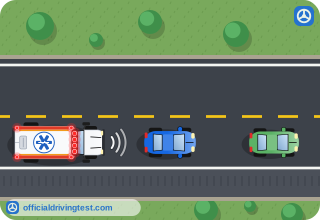
- Stop in your lane where you are, even in an intersection
- Drive to the left edge of the roadway
- Yield and pull to the right edge or curb, clear of intersections
- Speed up to clear the road ahead of it
Show answer
Correct answer: Yield and pull to the right edge or curb, clear of intersections
Every other vehicle shall yield and immediately drive to the right-hand edge or curb clear of any intersections until the emergency vehicle has passed.
Source: Delaware Driver Manual (July 2026), page 82 · Open this page in the manual (Manual page 82)
-
Who may direct you to do something other than pulling to the right when an authorized emergency vehicle approaches?
- Any other driver
- A police officer
- A passenger in your vehicle
- A pedestrian on the sidewalk
Show answer
Correct answer: A police officer
The yield-to-the-right rule applies except when otherwise directed by a police officer.
Source: Delaware Driver Manual (July 2026), page 82 · Open this page in the manual (Manual page 82)
-
Which flashing light pattern on an approaching authorized emergency vehicle is named in Delaware law, together with a siren, as requiring you to yield?
- Alternately flashing green and white lights
- Alternately flashing amber and white lights
- Steady purple lights
- Alternately flashing red and white lights
Show answer
Correct answer: Alternately flashing red and white lights
The law names alternately flashing red, red and white, red and blue, or red, white and blue lights.
Source: Delaware Driver Manual (July 2026), page 82 · Open this page in the manual (Manual page 82)
-
Besides authorized emergency vehicles, whose vehicle operators does the law on yielding to approaching emergency vehicles extend to?
- DelDOT vehicle operators
- Tow truck operators only
- School bus operators
- Private security patrol operators
Show answer
Correct answer: DelDOT vehicle operators
The manual says this law extends to DelDOT vehicle operators.
Source: Delaware Driver Manual (July 2026), page 82 · Open this page in the manual (Manual page 82)
-
What should you do on a multi-lane roadway when approaching a stopped emergency vehicle?
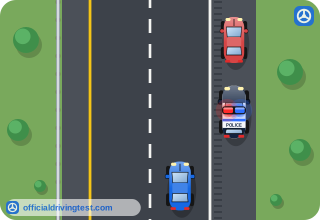
- Stop behind it until it pulls away
- Stay in your lane and sound your horn
- Move over a lane until you are safely past
- Pull to the right shoulder and wait
Show answer
Correct answer: Move over a lane until you are safely past
On a multi-lane roadway, move over a lane from the stopped vehicle(s) until you are safely past.
Source: Delaware Driver Manual (July 2026), page 82 · Open this page in the manual (Manual page 82)
-
What should you do on a two-lane roadway when approaching a stopped emergency vehicle?
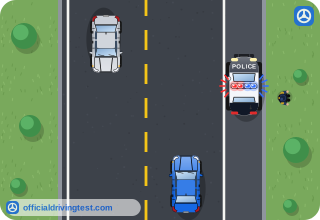
- Stop and wait for the vehicle to leave the road
- Slow down below the posted speed limit until past it
- Pass it at the posted speed limit without braking
- Move onto the shoulder and stop until it leaves
Show answer
Correct answer: Slow down below the posted speed limit until past it
On a two-lane roadway, slow down below the posted speed limit until you have completely passed the stopped vehicle(s).
Source: Delaware Driver Manual (July 2026), page 82 · Open this page in the manual (Manual page 82)