Delaware: Emergency vehicles, work zones and traffic stops — Part 1 Practice Test
Questions in this part include: “What is a work zone?” · “Where may stopped traffic be hidden as you approach a work zone?”
Independent educational site · not affiliated with any government agency or DMV
Ready? Test yourself
- Instant feedback with an explanation
- Every answer cites its source in the manual
- Your best score is saved on this device
Questions are original and based on the official manual "Delaware Driver Manual" (July 2026), Delaware Division of Motor Vehicles (DMV).
All 17 questions in this practice test
Take the test above first, then use this list to study. Tap “Show answer” to see the correct answer and explanation.
Show the questions and answersHide the questions
-
What is a work zone?
- An area where construction, maintenance or utility work occurs
- An area along a highway where a railroad crosses the roadway
- An area along a highway where a crash has blocked the lanes
- An area near a school where the speed limit is reduced
Show answer
Correct answer: An area where construction, maintenance or utility work occurs
The manual defines a work zone as an area along a highway where construction, maintenance or utility work is occurring.
Source: Delaware Driver Manual (July 2026), page 78 · Open this page in the manual (Manual page 78)
-
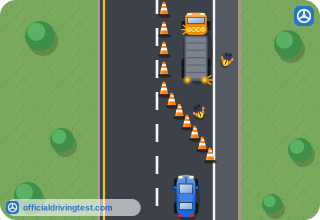
What must drivers use when approaching and passing work zones, for their own safety and for the safety of pedestrians and workers?
- Their horns
- Their high beams
- Great care
- Their cruise control
Show answer
Correct answer: Great care
It is important for the driver’s own safety and the safety of pedestrians and workers that drivers use great care in work zones.
Source: Delaware Driver Manual (July 2026), page 78 · Open this page in the manual (Manual page 78)
-
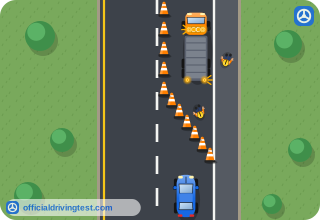
Where are special work zone traffic signs and devices set up?
- Only at the point where the work is taking place
- In advance of the work, continuing beyond the work area
- Only after the work area has ended
- Only on the side of the road where workers are standing
Show answer
Correct answer: In advance of the work, continuing beyond the work area
Signs and devices are set up in advance of the work and continue beyond the work area.
Source: Delaware Driver Manual (July 2026), page 78 · Open this page in the manual (Manual page 78)
-
A work zone may be what two kinds of operation?
- Daytime only, or nighttime only
- Permanent, or limited to a single lane only
- Marked by cones only, or by signs only
- Stationary, or a slowly moving mobile operation
Show answer
Correct answer: Stationary, or a slowly moving mobile operation
The zone may be stationary, like a bridge being widened, or mobile, like pavement striping or patching.
Source: Delaware Driver Manual (July 2026), page 78 · Open this page in the manual (Manual page 78)
-
What color are traffic warning signs in work zones usually?
- Orange
- Yellow
- Green
- White
Show answer
Correct answer: Orange
The manual says traffic warning signs in work zones usually are orange.
Source: Delaware Driver Manual (July 2026), page 79 · Open this page in the manual (Manual page 79)
-
What happens to fines for exceeding the speed limit in a work zone?
- They are cut in half
- They stay the same as elsewhere
- They are doubled
- They are waived for a first offense
Show answer
Correct answer: They are doubled
The manual states that fines for exceeding the speed limit in a work zone are doubled.
Source: Delaware Driver Manual (July 2026), page 79 · Open this page in the manual (Manual page 79)
-
Where may stopped traffic be hidden as you approach a work zone?
- Only inside the work area itself
- Around a curve or over a hill
- Behind a freeway sign
- In the left lane only
Show answer
Correct answer: Around a curve or over a hill
The manual warns that stopped traffic may be hidden around a curve or over a hill.
Source: Delaware Driver Manual (July 2026), page 79 · Open this page in the manual (Manual page 79)
-
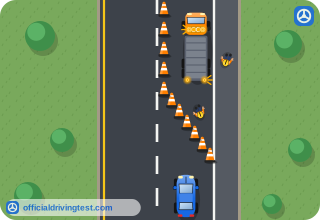
When you see signs indicating lane closures ahead, what should you do?
- Speed up to pass the slower traffic
- Stop and wait for a flagger to wave you
- Stay in your lane until the lane ends
- Prepare to move from the closed lane
Show answer
Correct answer: Prepare to move from the closed lane
The manual says to prepare to move from the closed lane when you see lane closure signs.
Source: Delaware Driver Manual (July 2026), page 79 · Open this page in the manual (Manual page 79)
-
Besides traffic signs and devices, whose directions must you obey in a work zone?
- The police and flaggers
- Other drivers who know the area
- Only the driver ahead of you
- Passengers riding with you
Show answer
Correct answer: The police and flaggers
Drivers must obey the directions of the police and flaggers in a work zone.
Source: Delaware Driver Manual (July 2026), page 79 · Open this page in the manual (Manual page 79)
-
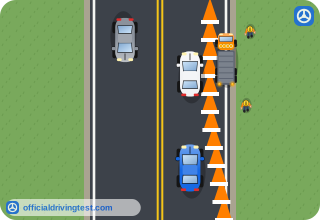
Why should you brake gradually when driving through a work zone?
- To warn the flaggers that you are approaching
- To keep your tires from wearing unevenly
- To give drivers behind you ample time to slow down
- To avoid setting off temporary traffic signals
Show answer
Correct answer: To give drivers behind you ample time to slow down
The manual says to brake gradually to give drivers behind you ample time to slow down.
Source: Delaware Driver Manual (July 2026), page 79 · Open this page in the manual (Manual page 79)
-
Which driving habit does the manual tell you to avoid in a work zone?
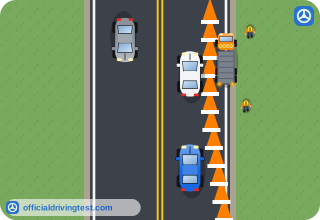
- Keeping up with the flow of traffic
- Weaving from lane to lane
- Watching what other drivers are doing
- Braking gradually
Show answer
Correct answer: Weaving from lane to lane
The manual says not to weave from lane to lane in a work zone.
Source: Delaware Driver Manual (July 2026), page 79 · Open this page in the manual (Manual page 79)
-
What kind of movements are best when the pavement in a work zone is rough or uneven, or has metal plates or drop-offs at the edge?
- Quick braking to a full stop
- Sharp steering around each bump
- Speeding up to cross them fast
- Gradual, controlled movements
Show answer
Correct answer: Gradual, controlled movements
The manual says gradual, controlled movements are best on unusual pavement surfaces.
Source: Delaware Driver Manual (July 2026), page 79 · Open this page in the manual (Manual page 79)
-
Why should you keep a reasonable speed and spacing between vehicles in a work zone?
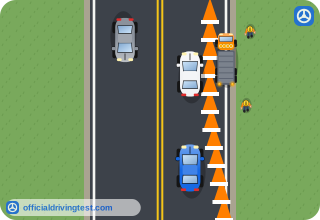
- You may have nowhere to go if the vehicle ahead stops
- Lanes in a work zone are always wider than normal
- The vehicle behind you is unable to stop quickly
- Police watch only the lead vehicle in a line
Show answer
Correct answer: You may have nowhere to go if the vehicle ahead stops
Driving too fast or following too closely leaves you nowhere to go if the vehicle in front suddenly slows or stops.
Source: Delaware Driver Manual (July 2026), page 79 · Open this page in the manual (Manual page 79)
-
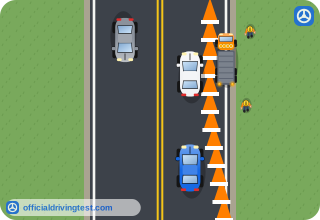
How does the manual tell you to treat workers and other road users in a work zone?
- Stay ahead of the traffic flow
- Be firm and keep your place in line
- Be patient and considerate
- Sound your horn to warn them
Show answer
Correct answer: Be patient and considerate
The manual asks drivers to be patient and considerate to workers and other road users.
Source: Delaware Driver Manual (July 2026), page 79 · Open this page in the manual (Manual page 79)
-
In which situation must traffic in a work zone usually be stopped?
- Whenever the speed limit has been reduced for the work area
- When opposite traffic takes turns using a single lane
- Whenever an orange warning sign is posted along the road
- Whenever an arrow panel is flashing on the roadway
Show answer
Correct answer: When opposite traffic takes turns using a single lane
Traffic usually must stop when opposite-direction traffic takes turns using a single lane, or when workers or equipment must enter the lane.
Source: Delaware Driver Manual (July 2026), page 79 · Open this page in the manual (Manual page 79)
-
What is more often used than temporary signals or police to stop, slow and direct traffic through work zones?
- Cones and barricades placed across the travel lane
- Flashing arrow panels with no people present
- Recorded messages from changeable message signs
- Trained and certified flaggers with stop/slow paddles
Show answer
Correct answer: Trained and certified flaggers with stop/slow paddles
The manual says more often, trained and certified flaggers with stop/slow paddles direct traffic through work zones.
Source: Delaware Driver Manual (July 2026), page 79 · Open this page in the manual (Manual page 79)
-
What do regulatory signs in a work zone tell drivers?
- The speed limit and other laws and regulations
- Where the nearest detour route begins ahead
- How far away the next exit is
- Which lanes flaggers are guarding
Show answer
Correct answer: The speed limit and other laws and regulations
Regulatory signs tell drivers of the speed limit and other laws and regulations.
Source: Delaware Driver Manual (July 2026), page 79 · Open this page in the manual (Manual page 79)