Delaware: Emergency vehicles, work zones and traffic stops — Part 3 Practice Test
Questions in this part include: “Which signal on a stationary tow truck requires you to proceed with caution and yield or reduce speed?” · “What may an individual ask an officer to do during a traffic stop?”
Independent educational site · not affiliated with any government agency or DMV
Ready? Test yourself
- Instant feedback with an explanation
- Every answer cites its source in the manual
- Your best score is saved on this device
Questions are original and based on the official manual "Delaware Driver Manual" (July 2026), Delaware Division of Motor Vehicles (DMV).
All 17 questions in this practice test
Take the test above first, then use this list to study. Tap “Show answer” to see the correct answer and explanation.
Show the questions and answersHide the questions
-
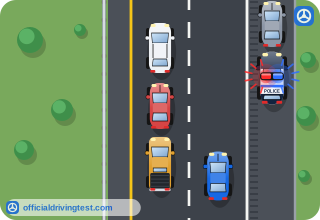
When you approach a stationary emergency vehicle giving a signal, what must you do if changing lanes would be impossible or unsafe?
- Stop and wait until the vehicle leaves
- Change lanes anyway, even if unsafe
- Proceed at the posted speed limit unchanged
- Proceed with caution and reduce to a safe speed
Show answer
Correct answer: Proceed with caution and reduce to a safe speed
If changing lanes is impossible or unsafe, you must proceed with caution and reduce to a safe speed.
Source: Delaware Driver Manual (July 2026), page 82 · Open this page in the manual (Manual page 82)
-
When you approach a stationary vehicle giving a warning signal, how must you yield the right-of-way when possible?
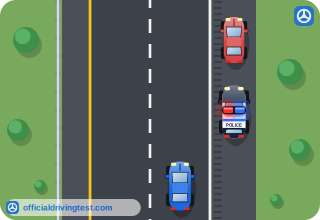
- Proceed with caution and make appropriate lane changes
- Stop completely and wait until it leaves the area
- Honk to warn the workers nearby
- Drive to the right-hand curb and stop
Show answer
Correct answer: Proceed with caution and make appropriate lane changes
The driver shall proceed with caution and yield the right-of-way by making appropriate lane changes when possible.
Source: Delaware Driver Manual (July 2026), page 82 · Open this page in the manual (Manual page 82)
-
Which signal on a stationary tow truck requires you to proceed with caution and yield or reduce speed?
- Alternately flashing green, white, or green and white lights
- Solid blue lights
- Alternately flashing amber, white, or amber and white lights
- Alternately flashing red and green lights
Show answer
Correct answer: Alternately flashing amber, white, or amber and white lights
The law covers a stationary tow truck displaying alternately flashing amber, white, or amber and white lights.
Source: Delaware Driver Manual (July 2026), page 82 · Open this page in the manual (Manual page 82)
-
Which signal on a stationary authorized DelDOT vehicle requires you to proceed with caution and yield or reduce speed?
- Alternately flashing green or green and amber lights
- Alternately flashing amber or red and amber lights
- Alternately flashing blue and white lights only
- Solid white lights
Show answer
Correct answer: Alternately flashing amber or red and amber lights
The law covers a stationary authorized DelDOT vehicle displaying alternately flashing amber or red and amber lights.
Source: Delaware Driver Manual (July 2026), page 82 · Open this page in the manual (Manual page 82)
-
Which of these displays on a stationary vehicle requires you to proceed with caution and yield or slow down?
- A parked vehicle with its windows rolled down
- A parked vehicle with its engine running
- A vehicle with its headlights on low beam
- Road flares, traffic cones or caution signs
Show answer
Correct answer: Road flares, traffic cones or caution signs
The law lists vehicle hazard warning lights, road flares, traffic cones, caution signs, or any non-vehicular warning signs.
Source: Delaware Driver Manual (July 2026), page 82 · Open this page in the manual (Manual page 82)
-
According to the manual, whom do move over laws help protect from serious injuries and death?
- Public servants who are working in harm's way
- Only drivers of authorized emergency vehicles
- Only workers in highway work zones
- Only pedestrians along the roadside
Show answer
Correct answer: Public servants who are working in harm's way
Move over laws help reduce risk of serious injuries and death to all public servants who are working in harm's way.
Source: Delaware Driver Manual (July 2026), page 82 · Open this page in the manual (Manual page 82)
-
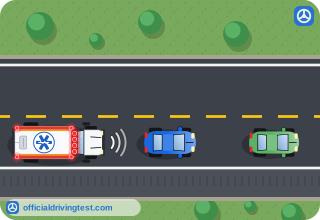
When you see or hear an emergency vehicle approaching from any direction, what should you do?
- Pull over to the left edge of the road
- Stop where you are in the lane
- Pull over to the right edge of the road
- Speed up to clear the lane
Show answer
Correct answer: Pull over to the right edge of the road
The manual says to pull over to the right edge of the road, or as near to the right as possible.
Source: Delaware Driver Manual (July 2026), page 89 · Open this page in the manual (Manual page 89)
-
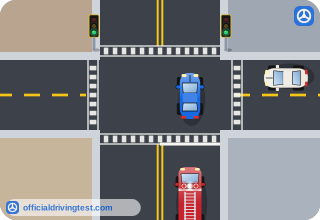
If you are in an intersection when an emergency vehicle approaches, what should you do?
- Stop immediately where you are
- Drive through the intersection before you pull over
- Back out of the intersection
- Pull over to the left inside the intersection
Show answer
Correct answer: Drive through the intersection before you pull over
The manual says to drive through the intersection before you pull over.
Source: Delaware Driver Manual (July 2026), page 89 · Open this page in the manual (Manual page 89)
-
What should you do when an emergency vehicle gives instructions over its loudspeaker?
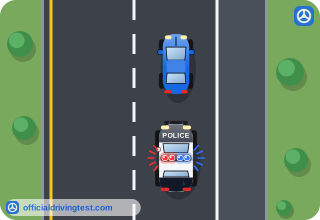
- Ignore them if you are in an intersection
- Follow them only if a police officer is present
- Follow them only if you are driving a commercial vehicle
- Follow any instructions given
Show answer
Correct answer: Follow any instructions given
The manual says to follow any instructions given over the emergency vehicle’s loudspeaker.
Source: Delaware Driver Manual (July 2026), page 89 · Open this page in the manual (Manual page 89)
-
What must an individual provide during a traffic stop, according to the law cited in the manual?
- Only their driver license number and vehicle registration number
- Only their name, because the address may be withheld
- Their name, address, and why they are driving and where they are going
- Their name, address, and the name of their employer
Show answer
Correct answer: Their name, address, and why they are driving and where they are going
The manual cites 11 Del. C. §1902: a driver must give a name, an address and an explanation of why they are driving and where they are going.
Source: Delaware Driver Manual (July 2026), page 112 · Open this page in the manual (Manual page 112)
-
What must passengers do during a traffic stop if the officer requests it?
- Provide their information and/or exit the vehicle
- Show the officer the vehicle's registration
- Hand over their cell phones to the officer
- Take over driving if the driver is detained
Show answer
Correct answer: Provide their information and/or exit the vehicle
Passengers must also provide their information and/or exit the vehicle if the officer requests it.
Source: Delaware Driver Manual (July 2026), page 112 · Open this page in the manual (Manual page 112)
-
What may an individual ask an officer to do during a traffic stop?
- Provide a copy of the law for the alleged violation
- Waive the traffic violation if it was minor
- Identify themself and the agency that employs them
- Show a written record of their years of service
Show answer
Correct answer: Identify themself and the agency that employs them
An individual may ask the officer to identify themself and the agency that employs them.
Source: Delaware Driver Manual (July 2026), page 112 · Open this page in the manual (Manual page 112)
-
In which situation may an officer search a vehicle on-scene?
- When the driver gives the officer consent
- Whenever the driver is stopped at night
- Whenever the driver cannot find the insurance card
- Only when a passenger asks to leave the vehicle
Show answer
Correct answer: When the driver gives the officer consent
A vehicle may be searched on-scene with consent, with probable cause, or as an inventory of a vehicle being towed.
Source: Delaware Driver Manual (July 2026), page 112 · Open this page in the manual (Manual page 112)
-
What does the manual say about the right to an attorney during roadside investigations?
- A person may refuse all questions until an attorney arrives
- The right applies as soon as the officer turns on emergency lights
- The right applies only to drivers and not to passengers
- A person does not have that right then; it will present itself later
Show answer
Correct answer: A person does not have that right then; it will present itself later
During roadside investigations a person does not have a right to an attorney, though that right will present itself later.
Source: Delaware Driver Manual (July 2026), page 112 · Open this page in the manual (Manual page 112)
-
What may happen to a person who fails to provide identification or explain their actions to the officer's satisfaction?
- The person must be arrested and charged with a crime on the spot
- The person may be detained, further questioned, and investigated
- The person will be released with a written warning only
- The person will be required to take a new written test
Show answer
Correct answer: The person may be detained, further questioned, and investigated
Such a person may be detained, further questioned, and investigated.
Source: Delaware Driver Manual (July 2026), page 112 · Open this page in the manual (Manual page 112)
-
According to the manual, what is true of a detention?
- The person is formally under arrest and charged
- The person has already been convicted of a violation
- The person's driver license is automatically suspended
- It does not mean the person is under arrest
Show answer
Correct answer: It does not mean the person is under arrest
The manual states that a detention does not mean a person is under arrest.
Source: Delaware Driver Manual (July 2026), page 112 · Open this page in the manual (Manual page 112)
-
What is the longest a detention period may last?
- Two hours
- Thirty minutes
- One hour
- Four hours
Show answer
Correct answer: Two hours
The detention period may not exceed two hours; the person is then released, or arrested and charged with a crime.
Source: Delaware Driver Manual (July 2026), page 112 · Open this page in the manual (Manual page 112)