Hazardous Materials: Hazardous materials rules and who does what
What the rules are for (contain the material, communicate the risk, assure safe drivers and equipment) and the duties of the shipper, the carrier and the driver. Split into 2 shorter tests so you're not stuck in one long quiz.
Independent educational site · not affiliated with any government agency or DMV
Choose a part
Hazardous materials rules and who does what — Part 1
Questions in this part include: “What makes a product a hazardous material?”
Hazardous materials rules and who does what — Part 2
Questions in this part include: “What are the rules called that tell shippers how to package and drivers how to load, move and unload hazmat?”
Questions are written in our own words from the CDL manual; they are not the real test's questions. With your state chosen, every answer gives its page in your state's CDL manual. Without a state, answers cite the CDL manual, national model as printed by New Jersey (July 2017).
All 33 Hazardous materials rules and who does what questions with answers
Choose a part above to take a practice test, or study every question and answer here.
Show the questions and answersHide the questions
1Part 117 questions
-
What makes a product a hazardous material?
- It is carried in a tank of any size or kind
- It poses a risk to health, safety and property
- It is shipped by more than one carrier
Show answer
Correct answer: It poses a risk to health, safety and property
Hazardous materials are products that can endanger health, safety and property while being transported.
Source: CDL manual, national model as printed by New Jersey, Section 9 (July 2017)
-
How do government regulations usually shorten the term hazardous materials?
- HZ
- HM
- HX
Show answer
Correct answer: HM
Road signs may say HAZMAT, while the regulations use HM.
Source: CDL manual, national model as printed by New Jersey, Section 9 (July 2017)
-
In which parts of 49 CFR are the Hazardous Materials Regulations found?
- Parts 100 - 110
- Parts 171 - 180
- Parts 390 - 399
Show answer
Correct answer: Parts 171 - 180
The federal hazmat rules sit in 49 CFR parts 171 through 180.
Source: CDL manual, national model as printed by New Jersey, Section 9 (July 2017)
-
A product is missing from the Hazardous Materials Table. What does that tell you?
- It is safe to treat it as an ordinary load
- It is hazmat only if the driver decides so
- It can still be hazmat if a definition fits it
Show answer
Correct answer: It can still be hazmat if a definition fits it
The table does not list everything. A material counts as hazardous when its characteristics fit a definition in the regulations.
Source: CDL manual, national model as printed by New Jersey, Section 9 (July 2017)
-
What shape is a hazardous materials placard?
- A round disc shape
- A diamond, square on point
- A tall rectangle shape
Show answer
Correct answer: A diamond, square on point
Placards are warning signs shaped like a square standing on one corner.
Source: CDL manual, national model as printed by New Jersey, Section 9 (July 2017)
-
Which printed material is essential for a hazmat driver to have?
- A catalog of the shipper's products
- A current copy of the complete regulations
- A copy of the carrier's insurance policy
Show answer
Correct answer: A current copy of the complete regulations
Government rules keep changing, so the driver needs a current copy of the full regulations.
Source: CDL manual, national model as printed by New Jersey, Section 9 (July 2017)
-
For which vehicles must you hold a CDL with a hazardous materials endorsement?
- Any size vehicle hauling hazardous material
- Only bulk tank trucks of any weight
- Only combination vehicles of any kind
Show answer
Correct answer: Any size vehicle hauling hazardous material
The endorsement is needed whatever the size of the vehicle, as long as it carries hazardous material.
Source: CDL manual, national model as printed by New Jersey, Section 9 (July 2017)
-
What must you pass to get the hazardous materials endorsement?
- A written test on the regulations
- A road test with a loaded tanker
- A yearly physical performance test
Show answer
Correct answer: A written test on the regulations
Getting the endorsement requires a written test on the hazmat regulations and requirements.
Source: CDL manual, national model as printed by New Jersey, Section 9 (July 2017)
-
How long must an employer keep a hazmat employee's training record after the employee stops working with hazardous materials?
- 90 days
- 30 days
- One year
Show answer
Correct answer: 90 days
The record is kept for the whole time the person does hazmat work and for 90 days after it ends.
Source: CDL manual, national model as printed by New Jersey, Section 9 (July 2017)
-
How often must hazmat employees be trained and tested again?
- At least every three years
- At least every year
- At least every five years
Show answer
Correct answer: At least every three years
Training and testing must be repeated at least once in each three-year period.
Source: CDL manual, national model as printed by New Jersey, Section 9 (July 2017)
-
What must security training for hazmat drivers teach them to do?
- Repair locks and seals on cargo doors
- Recognize and respond to security threats
- Choose the shortest route to the shipper
Show answer
Correct answer: Recognize and respond to security threats
Every driver is trained in the security risks of hazmat transport, including spotting and answering possible threats.
Source: CDL manual, national model as printed by New Jersey, Section 9 (July 2017)
-
A driver is about to haul highway route controlled quantities of radioactive material. What must the driver have first?
- A second driver riding along
- Special training for that cargo
- A reduced weight limit for the load
Show answer
Correct answer: Special training for that cargo
Certain flammable gases and highway route controlled radioactive loads call for special training on top of the usual hazmat training.
Source: CDL manual, national model as printed by New Jersey, Section 9 (July 2017)
-
What training must a driver who hauls cargo tanks or portable tanks receive?
- A yearly defensive driving course
- Specialized training for that kind of tank
- The same general training, nothing more
Show answer
Correct answer: Specialized training for that kind of tank
Cargo tank and portable tank drivers must get specialized training beyond the general hazmat training.
Source: CDL manual, national model as printed by New Jersey, Section 9 (July 2017)
-
Who has to provide the special hazmat training a driver needs?
- The driver's employer or its representative
- The shipper of the load or its agent
- The state licensing office or its agent
Show answer
Correct answer: The driver's employer or its representative
The driver's employer, or someone the employer designates, is responsible for giving the training.
Source: CDL manual, national model as printed by New Jersey, Section 9 (July 2017)
-
For which kinds of cargo do some locations require a permit?
- Certain explosives or bulk hazardous wastes
- Certain corrosive or toxic liquids
- Certain flammable gases in cylinders
Show answer
Correct answer: Certain explosives or bulk hazardous wastes
Some places ask for a permit before certain explosives or bulk hazardous wastes are hauled.
Source: CDL manual, national model as printed by New Jersey, Section 9 (July 2017)
-
Besides permits, what may a state or county require of a hazmat driver?
- Driving only during night hours
- Following special hazmat routes
- Using an escort vehicle at all times
Show answer
Correct answer: Following special hazmat routes
Some states and counties set special routes for hazmat vehicles, so find out about the places you drive.
Source: CDL manual, national model as printed by New Jersey, Section 9 (July 2017)
-
Which level of government may require a permit or exemption for special cargo such as rocket fuel?
- The local county only
- The carrier's insurer
- The federal government
Show answer
Correct answer: The federal government
Special cargo such as rocket fuel can need a federal permit or exemption.
Source: CDL manual, national model as printed by New Jersey, Section 9 (July 2017)
2Part 216 questions
-
What are the rules called that tell shippers how to package and drivers how to load, move and unload hazmat?
- Containment rules
- Routing rules
- Placement rules
Show answer
Correct answer: Containment rules
The packaging, loading, transport and unloading rules are known as containment rules, and they protect people and the environment.
Source: CDL manual, national model as printed by New Jersey, Section 9 (July 2017)
-
Under the intent of the regulations, who must warn drivers and others about a material's hazards?
- The carrier
- The shipper
- The driver
Show answer
Correct answer: The shipper
Shippers carry the duty to communicate the risk, using labels, papers, emergency response information and placards.
Source: CDL manual, national model as printed by New Jersey, Section 9 (July 2017)
-
Which of these must a shipper provide to communicate the hazard?
- Hazard warning labels on the packages
- A cargo insurance certificate
- A weight ticket from a certified scale
Show answer
Correct answer: Hazard warning labels on the packages
Shippers put warning labels on packages and also supply shipping papers, emergency response information and placards.
Source: CDL manual, national model as printed by New Jersey, Section 9 (July 2017)
-
What can happen to a driver who breaks the hazmat regulations?
- Only a written warning
- Loss of the shipment only
- Fines and jail
Show answer
Correct answer: Fines and jail
Breaking the rules is unsafe and can lead to fines and even jail time.
Source: CDL manual, national model as printed by New Jersey, Section 9 (July 2017)
-
When should a hazmat driver inspect the vehicle?
- Only before leaving the yard
- Before and during each trip
- Only when an officer asks
Show answer
Correct answer: Before and during each trip
The vehicle is checked before the trip starts and again while the trip is under way.
Source: CDL manual, national model as printed by New Jersey, Section 9 (July 2017)
-
An officer stops your hazmat vehicle. Which of these may be checked?
- Your fuel purchase receipts
- Your company insurance policy
- Your shipping papers and placards
Show answer
Correct answer: Your shipping papers and placards
Officers may look at the shipping papers, the placards, your hazmat endorsement and what you know about hazardous materials.
Source: CDL manual, national model as printed by New Jersey, Section 9 (July 2017)
-
Who uses the regulations to work out a product's shipping name, hazard class and packing group?
- The carrier
- The shipper
- The driver
Show answer
Correct answer: The shipper
The shipper looks up the identification number, shipping name, hazard class, packing group, packaging, labels, markings and placards.
Source: CDL manual, national model as printed by New Jersey, Section 9 (July 2017)
-
What does the shipper certify on the shipping paper?
- That the vehicle passed its inspection
- That the shipment was prepared per the rules
- That the driver holds an endorsement
Show answer
Correct answer: That the shipment was prepared per the rules
By certifying, the shipper states the shipment was prepared as the regulations require.
Source: CDL manual, national model as printed by New Jersey, Section 9 (July 2017)
-
When is the shipper's certification on the shipping paper not required?
- You pull cargo tanks you or your employer supplied
- The load is small enough for one trip
- The carrier has hauled for that shipper before
Show answer
Correct answer: You pull cargo tanks you or your employer supplied
The certification step is skipped if the cargo tanks you pull come from you or your employer.
Source: CDL manual, national model as printed by New Jersey, Section 9 (July 2017)
-
Before a shipment moves, what must the carrier check?
- That the shipper described and labeled it correctly
- That the receiver is ready to unload the cargo
- That the road ahead is free of other hazmat trucks
Show answer
Correct answer: That the shipper described and labeled it correctly
The carrier confirms that the shipper prepared the shipment correctly before it travels.
Source: CDL manual, national model as printed by New Jersey, Section 9 (July 2017)
-
What should a carrier do with an improperly prepared shipment?
- Refuse it
- Haul it and fix it on the way
- Haul it if the driver agrees
Show answer
Correct answer: Refuse it
A carrier does not accept a shipment that is not properly prepared.
Source: CDL manual, national model as printed by New Jersey, Section 9 (July 2017)
-
You see a package leaking at pickup. What is your job as the driver?
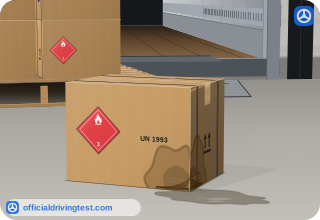
- Load it last and keep it near the door
- Refuse the leaking package
- Wrap it and continue the trip
Show answer
Correct answer: Refuse the leaking package
A driver does not accept leaking packages or shipments.
Source: CDL manual, national model as printed by New Jersey, Section 9 (July 2017)
-
When does the driver put placards on the vehicle, if they are required?
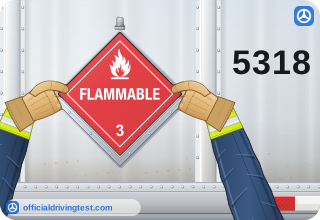
- At the first fuel stop
- While the vehicle is being loaded
- Once the vehicle reaches the destination
Show answer
Correct answer: While the vehicle is being loaded
Required placards go on during loading, before the vehicle leaves.
Source: CDL manual, national model as printed by New Jersey, Section 9 (July 2017)
-
How must a driver carry a hazmat shipment to its destination?
- Safely and without delay
- Stopping often to let the load settle
- Waiting for the shipper to approve each leg
Show answer
Correct answer: Safely and without delay
The driver moves the shipment safely and does not hold it up along the way.
Source: CDL manual, national model as printed by New Jersey, Section 9 (July 2017)
-
What must the driver keep in the proper place in the vehicle besides the shipping papers?
- The emergency response information
- The shipper's invoice copy for the load
- The load's weight ticket from the scale
Show answer
Correct answer: The emergency response information
Hazmat shipping papers and the emergency response information both have to be kept where the rules say.
Source: CDL manual, national model as printed by New Jersey, Section 9 (July 2017)
-
When is a driver responsible for reporting a hazmat accident to the proper government agency?
- Whenever it happens while the driver controls the load
- Any accident on the route, even far from the load
- Only if someone is injured in the accident
Show answer
Correct answer: Whenever it happens while the driver controls the load
The driver reports hazmat accidents and incidents that happen while the shipment is in the driver's physical control.
Source: CDL manual, national model as printed by New Jersey, Section 9 (July 2017)
-
Only in Arizona's manual
Where in federal law (Title 49, CFR) should a driver look for the full hazardous materials transport rules?
- Parts 1-99
- Parts 200-299
- Parts 100-185
Show answer
Correct answer: Parts 100-185
The complete federal rules for moving hazardous materials are in 49 CFR, Parts 100-185.
Source: CDL manual, national model as printed by New Jersey, Section 9 (July 2017)