Hazardous Materials: Hazard classes, package labels and the lists of regulated products — Part 1
Questions in this part include: “What does a material's hazard class tell you about it?” · “Corrosives, such as battery fluid, belong to which class?”
Independent educational site · not affiliated with any government agency or DMV
Ready? Test yourself
Answer to start, or tap Start below:
What does a material's hazard class tell you about it?
- Instant feedback with an explanation
- Every answer cites its source in the manual
- Your best score is saved on this device
- Keyboard: press 1 to 3 to answer and Enter for the next question
Questions are written in our own words from the CDL manual; they are not the real test's questions. With your state chosen, every answer gives its page in your state's CDL manual. Without a state, answers cite the CDL manual, national model as printed by New Jersey (July 2017).
All 19 questions in this practice test
Take the test above first, then use this list to study. Tap “Show answer” to see the correct answer and explanation.
Show the questions and answersHide the questions
-
What does a material's hazard class tell you about it?
- The name its shipper uses on the papers
- The order it is listed in the table
- The risks that go with the material
Show answer
Correct answer: The risks that go with the material
A material's hazard class shows the risks that come with it.
Source: CDL manual, national model as printed by New Jersey, Section 9 (July 2017)
-
How many hazard classes are used to sort hazardous materials?
- Nine
- Seven
- Twelve
Show answer
Correct answer: Nine
Hazardous materials are sorted into nine hazard classes, and each class groups materials with similar risks.
Source: CDL manual, national model as printed by New Jersey, Section 9 (July 2017)
-
In the hazard class table, what is the name of Division 1.1?
- Fire Hazard
- Mass Explosion
- Very Insensitive
Show answer
Correct answer: Mass Explosion
Division 1.1 of the explosives class is called Mass Explosion, and dynamite is the example listed for it.
Source: CDL manual, national model as printed by New Jersey, Section 9 (July 2017)
-
In the hazard class table, what is the name of Division 1.4?
- Minor Explosion
- Projection Hazard
- Fire Hazard
Show answer
Correct answer: Minor Explosion
Division 1.4 of the explosives class is called Minor Explosion, and ammunition is the example listed for it.
Source: CDL manual, national model as printed by New Jersey, Section 9 (July 2017)
-
Propane is a flammable gas. Which class number holds gases such as propane?
- Class 2
- Class 1
- Class 3
Show answer
Correct answer: Class 2
Gases make up Class 2; Division 2.1 is flammable gases, with propane as the example.
Source: CDL manual, national model as printed by New Jersey, Section 9 (July 2017)
-
Gasoline is a flammable liquid. Which class number holds flammable liquids?
- Class 2
- Class 3
- Class 4
Show answer
Correct answer: Class 3
Flammable liquids make up Class 3, with gasoline as the example. Class 2 is gases, and Class 4 includes flammable solids.
Source: CDL manual, national model as printed by New Jersey, Section 9 (July 2017)
-
What kind of material is in Division 5.1?
- Corrosives
- Flammable Solids
- Oxidizers
Show answer
Correct answer: Oxidizers
Division 5.1 is the oxidizers division, and ammonium nitrate is the example given.
Source: CDL manual, national model as printed by New Jersey, Section 9 (July 2017)
-
What is Division 6.1 called in the hazard class table?
- Infectious Substances
- Flammable Solids
- Poison (Toxic Material)
Show answer
Correct answer: Poison (Toxic Material)
Division 6.1 is Poison (Toxic Material), and potassium cyanide is the example given.
Source: CDL manual, national model as printed by New Jersey, Section 9 (July 2017)
-
Radioactive materials, such as uranium, belong to which class?
- Class 6
- Class 7
- Class 8
Show answer
Correct answer: Class 7
Class 7 is the radioactive class; uranium is its listed example.
Source: CDL manual, national model as printed by New Jersey, Section 9 (July 2017)
-
Corrosives, such as battery fluid, belong to which class?
- Class 7
- Class 8
- Class 9
Show answer
Correct answer: Class 8
Class 8 is the corrosives class, and battery fluid is its listed example.
Source: CDL manual, national model as printed by New Jersey, Section 9 (July 2017)
-
In the hazard class table, fuel oil is listed as which kind of material?
- Flammable Liquids
- Corrosives
- Combustible Liquids
Show answer
Correct answer: Combustible Liquids
The table lists fuel oil as the example of combustible liquids, which have no class number.
Source: CDL manual, national model as printed by New Jersey, Section 9 (July 2017)
-
Which of these papers counts as a shipping paper?
- A pre-trip inspection report
- A bill of lading
- A driver's trip log
Show answer
Correct answer: A bill of lading
A bill of lading is one kind of shipping paper, along with shipping orders and manifests.
Source: CDL manual, national model as printed by New Jersey, Section 9 (July 2017)
-
Why must hazmat shipping papers be quick to find after a crash?
- Responders must count packages to weigh the load
- The driver may be too hurt to tell responders what the load is
- Police need them to check the driver's hours of service
Show answer
Correct answer: The driver may be too hurt to tell responders what the load is
After a crash or spill the driver may not be able to speak, so the papers tell responders what is aboard and can reduce harm.
Source: CDL manual, national model as printed by New Jersey, Section 9 (July 2017)
-
Besides describing the material correctly, what must shippers put on the shipping papers?
- The receiving dock's telephone number
- The carrier's insurance policy number
- An emergency response telephone number
Show answer
Correct answer: An emergency response telephone number
The number goes on the shipping papers so responders can learn what hazard is aboard.
Source: CDL manual, national model as printed by New Jersey, Section 9 (July 2017)
-
Which is one way the rules allow a driver to keep hazmat papers among other shipping papers?
- At the bottom, in order of delivery
- In a sealed envelope in the cargo area
- On top of the other shipping papers
Show answer
Correct answer: On top of the other shipping papers
Putting the hazmat papers on top of the pile is one allowed way; they may instead be marked clearly so they are quick to identify. The emergency response information stays with them.
Source: CDL manual, national model as printed by New Jersey, Section 9 (July 2017)
-
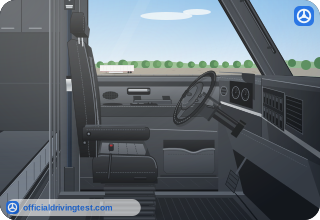
If the papers are not in the door pouch while you drive, where must they be?
- Behind the seat in a closed bag
- In clear view and within immediate reach
- In the cargo area near the shipment
Show answer
Correct answer: In clear view and within immediate reach
While driving, the papers may sit where you can see them and grab them without leaving your seat belt.
Source: CDL manual, national model as printed by New Jersey, Section 9 (July 2017)
-
Where do hazmat papers go when the driver steps out of the vehicle?
- In the glove box
- On the driver's seat
- In the trailer
Show answer
Correct answer: On the driver's seat
When you leave the cab, put the papers on the driver's seat so anyone reaching the vehicle can find them.
Source: CDL manual, national model as printed by New Jersey, Section 9 (July 2017)
-
What shape are the warning labels shippers put on most hazmat packages?
- Octagon
- Triangle
- Diamond
Show answer
Correct answer: Diamond
Package hazard labels are diamonds, and they warn other people about the hazard inside.
Source: CDL manual, national model as printed by New Jersey, Section 9 (July 2017)
-
A hazard label cannot fit on a package, such as a gas cylinder. What may the shipper do?
- Leave it unlabeled because it is small
- Put the label on a tag fixed firmly to it
- Mark the class number on the side
Show answer
Correct answer: Put the label on a tag fixed firmly to it
A label that will not fit may go on a tag that is attached securely to the package.
Source: CDL manual, national model as printed by New Jersey, Section 9 (July 2017)