General Knowledge: Transporting cargo safely — Part 3
Questions in this part include: “A very small piece of cargo is on your flatbed. How many tie-downs should it have at the least?” · “You cannot look inside a sealed load. What should you still check before driving?”
Independent educational site · not affiliated with any government agency or DMV
Ready? Test yourself
Answer to start, or tap Start below:
A very small piece of cargo is on your flatbed. How many tie-downs should it have at the least?
- Instant feedback with an explanation
- Every answer cites its source in the manual
- Your best score is saved on this device
- Keyboard: press 1 to 3 to answer and Enter for the next question
Questions are written in our own words from the CDL manual; they are not the real test's questions. With your state chosen, every answer gives its page in your state's CDL manual. Without a state, answers cite the CDL manual, national model as printed by New Jersey (July 2017).
All 18 questions in this practice test
Take the test above first, then use this list to study. Tap “Show answer” to see the correct answer and explanation.
Show the questions and answersHide the questions
-
A very small piece of cargo is on your flatbed. How many tie-downs should it have at the least?
- One
- Three
- Two
Show answer
Correct answer: Two
Even tiny cargo needs at least two tie-downs, whatever its size.
Source: CDL manual, national model as printed by New Jersey, Sections 1 to 3 (July 2017)
-
You are asked to haul heavy pieces of metal. What should you do before taking the job?
- Use one extra tie-down beyond the usual count
- Rely on blocking alone for metal pieces
- Learn the special requirements for such loads
Show answer
Correct answer: Learn the special requirements for such loads
Heavy metal pieces have their own securing requirements, so learn them before taking such a load.
Source: CDL manual, national model as printed by New Jersey, Sections 1 to 3 (July 2017)
-
What is the job of the front-end header board behind the cab?
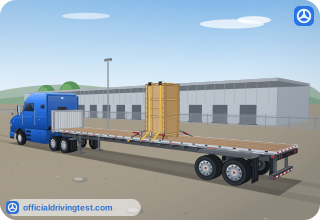
- It protects you if the cargo moves forward in a stop
- It keeps rain and snow from reaching the cargo
- It keeps spilled cargo from hitting cars behind
Show answer
Correct answer: It protects you if the cargo moves forward in a stop
The header board is a barrier between the cargo and the cab. It blocks cargo from moving forward onto the driver.
Source: CDL manual, national model as printed by New Jersey, Sections 1 to 3 (July 2017)
-
Besides keeping weather off the load, why do drivers cover cargo?
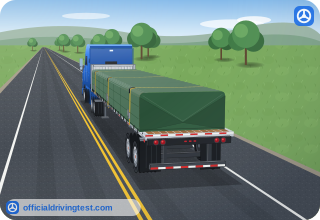
- To hide the cargo from theft
- To keep the load from shifting in curves
- So fallen cargo cannot hurt people
Show answer
Correct answer: So fallen cargo cannot hurt people
A cover keeps pieces of cargo from spilling onto other people, and it also protects the load from the weather.
Source: CDL manual, national model as printed by New Jersey, Sections 1 to 3 (July 2017)
-
Rules about covering a load to stop spills are a safety requirement in many states. What should a driver do about this?
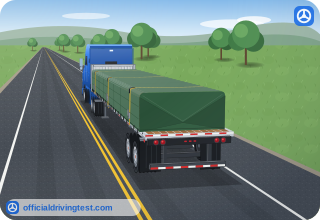
- Follow only the laws of the home state
- Learn the laws of each state you drive in
- Assume one national rule is the same everywhere
Show answer
Correct answer: Learn the laws of each state you drive in
Spill protection is required in many states, and the laws differ, so the driver must know the rules where he or she drives.
Source: CDL manual, national model as printed by New Jersey, Sections 1 to 3 (July 2017)
-
Why should you glance at your cargo cover in the mirrors while you drive?
- The cover shrinks as it dries and makes the tie-downs slack
- A flapping cover can tear loose and block someone's view
- The cover shows if the load weighs too much for the axles
Show answer
Correct answer: A flapping cover can tear loose and block someone's view
A cover that flaps may rip free, expose the load, and block the view of you or other drivers.
Source: CDL manual, national model as printed by New Jersey, Sections 1 to 3 (July 2017)
-
Containerized loads are generally used when freight also travels part of its trip in what way?
- By airplane or pipeline
- By rail or ship
- On the same truck for the whole route
Show answer
Correct answer: By rail or ship
Containers are common when freight goes part of the way by rail or ship, with trucks making the delivery at the start or end.
Source: CDL manual, national model as printed by New Jersey, Sections 1 to 3 (July 2017)
-
Some containers come with built-in fastening devices. Where do these attach?
- To the tractor's rear bumper
- Only to the cab's header board
- Directly to a special frame
Show answer
Correct answer: Directly to a special frame
Certain containers carry their own tie-down devices or locks, and these fasten straight to a special frame.
Source: CDL manual, national model as printed by New Jersey, Sections 1 to 3 (July 2017)
-
A container has been loaded onto a flatbed trailer. How must it be handled?
- It must be secured like any other cargo
- It needs no securing because it is closed
- Only the front end of it must be fastened
Show answer
Correct answer: It must be secured like any other cargo
A container on a flatbed has to be secured properly, the same as any other load.
Source: CDL manual, national model as printed by New Jersey, Sections 1 to 3 (July 2017)
-
You cannot look inside a sealed load. What should you still check before driving?
- That the seal can be opened at each rest stop
- That the cargo is stacked low inside the box
- That you stay under gross and axle weight limits
Show answer
Correct answer: That you stay under gross and axle weight limits
You cannot inspect sealed cargo, but you can still make sure the vehicle is within its gross weight and axle weight limits.
Source: CDL manual, national model as printed by New Jersey, Sections 1 to 3 (July 2017)
-
Why do dry bulk tanks need special care?
- The load can shift and the center of gravity is high
- They have a low center of gravity that makes the steering light
- They cannot carry weight over the drive axles
Show answer
Correct answer: The load can shift and the center of gravity is high
A dry bulk tank sits high and its load can move, so go slowly and carefully around curves and sharp turns.
Source: CDL manual, national model as printed by New Jersey, Sections 1 to 3 (July 2017)
-
With a load of hanging meat, where is special caution needed, with a slow speed?
- Long, straight, flat highway sections
- Weigh stations and truck inspection lanes
- Sharp curves like off ramps and on ramps
Show answer
Correct answer: Sharp curves like off ramps and on ramps
Hanging meat is top-heavy and unsteady, so slow down on sharp curves such as ramps.
Source: CDL manual, national model as printed by New Jersey, Sections 1 to 3 (July 2017)
-
You are hauling livestock but the trailer is not full. What should you use?
- Tie-downs on each animal
- False bulkheads
- A header board at the rear
Show answer
Correct answer: False bulkheads
False bulkheads keep the animals bunched together so they cannot move around and upset handling.
Source: CDL manual, national model as printed by New Jersey, Sections 1 to 3 (July 2017)
-
Why must you take extra care on curves even when livestock are bunched together?
- The animals will panic from the engine noise
- The bulkheads lose their strength in a curve
- They can lean, shifting the center of gravity
Show answer
Correct answer: They can lean, shifting the center of gravity
Livestock lean on curves, which moves the center of gravity and makes a rollover more likely.
Source: CDL manual, national model as printed by New Jersey, Sections 1 to 3 (July 2017)
-
What do over-length, over-width or overweight loads need before they travel?
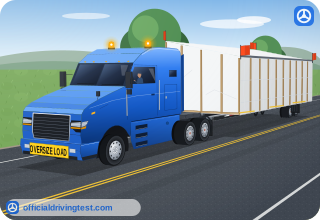
- Special transit permits
- A second CDL holder in the cab
- A weigh-station stamp at each state line
Show answer
Correct answer: Special transit permits
Loads that are too long, too wide or too heavy need special transit permits.
Source: CDL manual, national model as printed by New Jersey, Sections 1 to 3 (July 2017)
-
What limit usually applies to when an oversized load may be driven?
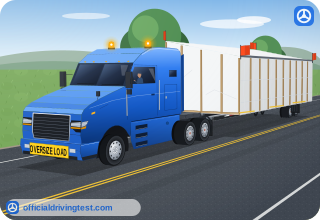
- Only on days with dry roads
- Only after a police inspection each day
- Only during certain times
Show answer
Correct answer: Only during certain times
Oversized loads can usually be driven only at certain times set for them.
Source: CDL manual, national model as printed by New Jersey, Sections 1 to 3 (July 2017)
-
Which equipment may a very large shipment need?
- A reflective rear bumper
- A "wide load" sign
- An extra spare tire
Show answer
Correct answer: A "wide load" sign
Oversized loads may need special equipment, such as signs saying wide load, flashing lights and flags.
Source: CDL manual, national model as printed by New Jersey, Sections 1 to 3 (July 2017)
-
What may be required to travel with an oversized load?
- A stop at every weigh station
- A police escort or pilot vehicles
- A second driver with a CDL
Show answer
Correct answer: A police escort or pilot vehicles
Some oversized loads must be accompanied by a police escort or by pilot vehicles with warning signs or flashing lights.
Source: CDL manual, national model as printed by New Jersey, Sections 1 to 3 (July 2017)