General Knowledge: Transporting cargo safely — Part 1
Questions in this part include: “What can happen to your own vehicle if it is carrying more than it should?” · “Who is responsible for making sure a commercial vehicle is not overloaded?”
Independent educational site · not affiliated with any government agency or DMV
Ready? Test yourself
Answer to start, or tap Start below:
What can happen to your own vehicle if it is carrying more than it should?
- Instant feedback with an explanation
- Every answer cites its source in the manual
- Your best score is saved on this device
- Keyboard: press 1 to 3 to answer and Enter for the next question
Questions are written in our own words from the CDL manual; they are not the real test's questions. With your state chosen, every answer gives its page in your state's CDL manual. Without a state, answers cite the CDL manual, national model as printed by New Jersey (July 2017).
All 19 questions in this practice test
Take the test above first, then use this list to study. Tap “Show answer” to see the correct answer and explanation.
Show the questions and answersHide the questions
-
What can happen to your own vehicle if it is carrying more than it should?
- The vehicle itself can be damaged
- Only the cargo can be damaged, not the truck
- Damage only happens to the trailer floor
Show answer
Correct answer: The vehicle itself can be damaged
An overloaded vehicle can suffer damage from the extra weight.
Source: CDL manual, national model as printed by New Jersey, Sections 1 to 3 (July 2017)
-
How can the way a truck is loaded affect your driving?
- It mainly changes how the mirrors must be set
- It can make steering and control more difficult
- It mostly changes how far the fuel will last
Show answer
Correct answer: It can make steering and control more difficult
Poor loading can affect steering and make the vehicle harder to control.
Source: CDL manual, national model as printed by New Jersey, Sections 1 to 3 (July 2017)
-
A warehouse crew loads and ties down your truck. Who is responsible for the safety of the cargo on the road?
- Only the crew that loaded and tied down the cargo
- You, as the driver, even though you did not load it
- The company that owns the goods being hauled
Show answer
Correct answer: You, as the driver, even though you did not load it
A driver stays responsible for the cargo no matter who loaded or secured it. That includes inspecting it and spotting problems.
Source: CDL manual, national model as printed by New Jersey, Sections 1 to 3 (July 2017)
-
Besides being secured, what must be true about your load as far as your vision is concerned?
- It must not hide the view through the rear window
- It must not hide what is ahead or beside you
- It must not reach higher than the top of the cab
Show answer
Correct answer: It must not hide what is ahead or beside you
The driver must know that the load does not block the view ahead or to the sides.
Source: CDL manual, national model as printed by New Jersey, Sections 1 to 3 (July 2017)
-
What must you make sure your cargo does not do with regard to emergency equipment?
- Make it hard to reach emergency equipment
- Add extra weight on top of the equipment box
- Cover the warning labels on the equipment
Show answer
Correct answer: Make it hard to reach emergency equipment
The cargo must never limit your access to emergency equipment on the vehicle.
Source: CDL manual, national model as printed by New Jersey, Sections 1 to 3 (July 2017)
-
What extra credential do you need to haul hazardous material that requires placards on the vehicle?
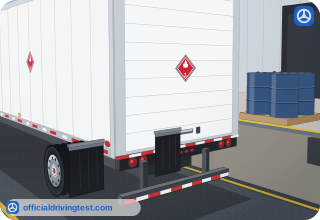
- A hazardous materials endorsement
- A tank vehicle endorsement
- A special oversize-load permit
Show answer
Correct answer: A hazardous materials endorsement
Carrying placarded hazardous material requires a hazardous materials endorsement on your CDL.
Source: CDL manual, national model as printed by New Jersey, Sections 1 to 3 (July 2017)
-
How often should you re-check your cargo and tie-downs during a trip, beyond the set times?
- Only at the 3-hour and 150-mile marks
- Only at the start and end of each day
- As often as needed to keep the load secure
Show answer
Correct answer: As often as needed to keep the load secure
Check as often as needed during the trip so that the load stays secure.
Source: CDL manual, national model as printed by New Jersey, Sections 1 to 3 (July 2017)
-
During a long trip, how often must you re-check the load and its securing devices, going by driving time or distance?
- After 3 hours or 150 miles of driving
- After 2 hours or 100 miles of driving
- After 5 hours or 250 miles of driving
Show answer
Correct answer: After 3 hours or 150 miles of driving
Re-inspect the cargo after every 3 hours or 150 miles of driving.
Source: CDL manual, national model as printed by New Jersey, Sections 1 to 3 (July 2017)
-
Besides time and distance on the road, what else is a reason to look at your cargo again?
- Each time you pass through a weigh station
- Each time you cross into a new state
- Each time you take a break from driving
Show answer
Correct answer: Each time you take a break from driving
You must inspect the cargo again after every break you take while driving.
Source: CDL manual, national model as printed by New Jersey, Sections 1 to 3 (July 2017)
-
The rules on cargo weight, covering loads and where big trucks may drive are not the same everywhere. What should you do?
- Follow the rules of the state that issued your CDL
- Follow only the federal rules on every route
- Learn the rules for every place you will be driving
Show answer
Correct answer: Learn the rules for every place you will be driving
Federal, state and local rules differ from place to place, so you must know the rules where you drive.
Source: CDL manual, national model as printed by New Jersey, Sections 1 to 3 (July 2017)
-
Who is responsible for making sure a commercial vehicle is not overloaded?
- The driver of the vehicle
- The shipper who prepared the freight
- The scale operator at the weigh station
Show answer
Correct answer: The driver of the vehicle
The driver is responsible for not driving an overloaded vehicle.
Source: CDL manual, national model as printed by New Jersey, Sections 1 to 3 (July 2017)
-
What does the GVWR of a vehicle measure?
- The weight one axle puts on the road
- The loaded weight set by its maker
- The empty weight of a single vehicle
Show answer
Correct answer: The loaded weight set by its maker
GVWR is the loaded weight of a single vehicle as specified by its manufacturer.
Source: CDL manual, national model as printed by New Jersey, Sections 1 to 3 (July 2017)
-
What is meant by axle weight?
- The total weight of the whole loaded vehicle
- The most weight a tire can safely carry
- The weight one axle puts on the ground
Show answer
Correct answer: The weight one axle puts on the ground
Axle weight is how much load one axle, or one group of axles, puts onto the road.
Source: CDL manual, national model as printed by New Jersey, Sections 1 to 3 (July 2017)
-
Where can you find the maximum safe load a tire can carry at a given pressure?
- On the side of the tire
- On the label inside the driver door
- On the tread surface of the tire
Show answer
Correct answer: On the side of the tire
The tire load rating is printed on the side of each tire.
Source: CDL manual, national model as printed by New Jersey, Sections 1 to 3 (July 2017)
-
What does a coupling device capacity rating tell you?
- The top speed the connection allows with a load
- The most weight the device can pull or carry
- The number of trailers that may be connected
Show answer
Correct answer: The most weight the device can pull or carry
A coupling device has a rating for the heaviest load it can tow or support.
Source: CDL manual, national model as printed by New Jersey, Sections 1 to 3 (July 2017)
-
Which weights have maximum limits set by the states?
- Cargo weight, tire weight and fuel weight
- Gross vehicle, combination and axle weights
- Gross vehicle weight and trailer length only
Show answer
Correct answer: Gross vehicle, combination and axle weights
States limit the gross vehicle weight rating, the gross combination weight rating and the axle weights, and you must stay within them.
Source: CDL manual, national model as printed by New Jersey, Sections 1 to 3 (July 2017)
-
Under a bridge formula, how much weight is allowed on axles that are close together?
- The same as for axles far apart
- Less than for axles far apart
- More than for axles far apart
Show answer
Correct answer: Less than for axles far apart
Axles that are closer together are allowed less maximum weight, which protects bridges and roadways from overloading.
Source: CDL manual, national model as printed by New Jersey, Sections 1 to 3 (July 2017)
-
What is a danger of an overloaded truck when going down a long hill?
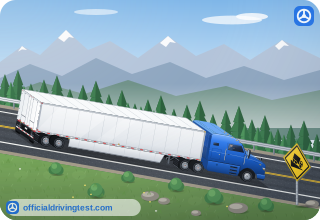
- Its trailer may lift off the fifth wheel
- It may slow down too much for traffic
- It may pick up too much speed
Show answer
Correct answer: It may pick up too much speed
An overloaded truck crawls up hills and can gain too much speed going down them.
Source: CDL manual, national model as printed by New Jersey, Sections 1 to 3 (July 2017)
-
How does an overloaded truck behave when climbing a hill?
- It climbs at normal speed in a lower gear
- It has to go very slowly
- It holds speed if the driver downshifts early
Show answer
Correct answer: It has to go very slowly
An overloaded truck has to crawl up grades.
Source: CDL manual, national model as printed by New Jersey, Sections 1 to 3 (July 2017)