General Knowledge: Transporting cargo safely — Part 2
Questions in this part include: “Which of these is an effect of overloading a truck?” · “On a flatbed vehicle, what extra problem can come from a load with a high center of gravity?”
Independent educational site · not affiliated with any government agency or DMV
Ready? Test yourself
Answer to start, or tap Start below:
Which of these is an effect of overloading a truck?
- Instant feedback with an explanation
- Every answer cites its source in the manual
- Your best score is saved on this device
- Keyboard: press 1 to 3 to answer and Enter for the next question
Questions are written in our own words from the CDL manual; they are not the real test's questions. With your state chosen, every answer gives its page in your state's CDL manual. Without a state, answers cite the CDL manual, national model as printed by New Jersey (July 2017).
All 18 questions in this practice test
Take the test above first, then use this list to study. Tap “Show answer” to see the correct answer and explanation.
Show the questions and answersHide the questions
-
Which of these is an effect of overloading a truck?
- The truck turns quicker in curves
- Hills can be climbed at the usual speed
- Stopping distance increases
Show answer
Correct answer: Stopping distance increases
Overloading makes the distance needed to stop longer.
Source: CDL manual, national model as printed by New Jersey, Sections 1 to 3 (July 2017)
-
Why can overloading lead to brake failure?
- The brake fluid cannot cope with extra weight
- The brakes are forced to work too hard
- The tires lose contact with the brake drums
Show answer
Correct answer: The brakes are forced to work too hard
With too much weight the brakes must work harder than they were built to, and they can fail.
Source: CDL manual, national model as printed by New Jersey, Sections 1 to 3 (July 2017)
-
In which conditions may it be unsafe to haul even the legal maximum weight?
- On flat roads in light traffic
- In bad weather or in the mountains
- On roads that are very new or recently paved
Show answer
Correct answer: In bad weather or in the mountains
Bad weather and mountain driving can make legal maximum weights unsafe, so think about this before driving.
Source: CDL manual, national model as printed by New Jersey, Sections 1 to 3 (July 2017)
-
When is a vehicle with a high center of gravity most in danger of tipping over?
- While parked on level ground
- During a long, straight highway run
- In curves or when swerving around a hazard
Show answer
Correct answer: In curves or when swerving around a hazard
A high load makes tipping more likely, and the risk is greatest in curves or sudden swerves.
Source: CDL manual, national model as printed by New Jersey, Sections 1 to 3 (July 2017)
-
How should you arrange parts of a load that differ in weight?
- Heaviest pieces go on top so they press down
- Pieces go in any order if tie-downs are used
- Heaviest pieces go beneath the lightest pieces
Show answer
Correct answer: Heaviest pieces go beneath the lightest pieces
Keeping the load low, with the heaviest pieces under the lighter ones, lowers the center of gravity.
Source: CDL manual, national model as printed by New Jersey, Sections 1 to 3 (July 2017)
-
What can happen when too much of the load sits on the steering axle?
- The engine overheats because the drive wheels carry too little
- The truck steers with difficulty and the axle and tires can be damaged
- The tie-downs stretch and the load slides toward the cab
Show answer
Correct answer: The truck steers with difficulty and the axle and tires can be damaged
A steering axle that carries too much weight makes the truck hard to steer. The axle and its tires can also be damaged.
Source: CDL manual, national model as printed by New Jersey, Sections 1 to 3 (July 2017)
-
Cargo is loaded too far toward the rear of the vehicle. What problem can this cause at the front?
- The steering axle is too light to steer the vehicle safely
- The steering axle gets too heavy and the steering wheel turns hard
- The front brakes lock up each time the driver slows down
Show answer
Correct answer: The steering axle is too light to steer the vehicle safely
Loading too far to the rear takes weight off the front axle. With too little weight on it, the truck cannot be steered safely.
Source: CDL manual, national model as printed by New Jersey, Sections 1 to 3 (July 2017)
-
What is the risk when the driving axles carry too little weight?
- The drive wheels may spin easily because traction is poor
- The load is more likely to slide off a flatbed
- The truck steers with extra effort at low speeds
Show answer
Correct answer: The drive wheels may spin easily because traction is poor
Weight on the drive axles presses the tires onto the road. If there is too little, the drive wheels lose traction and spin, and in bad weather the truck may not keep moving.
Source: CDL manual, national model as printed by New Jersey, Sections 1 to 3 (July 2017)
-
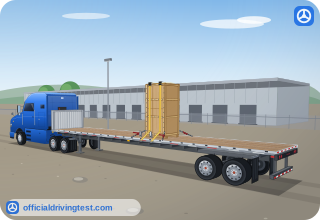
A load is stacked so its weight sits high above the road. What danger goes up?
- Tire blowouts
- Loss of engine power
- Rollover
Show answer
Correct answer: Rollover
A high center of gravity makes a vehicle tip over more easily, so a rollover becomes more likely.
Source: CDL manual, national model as printed by New Jersey, Sections 1 to 3 (July 2017)
-
On a flatbed vehicle, what extra problem can come from a load with a high center of gravity?
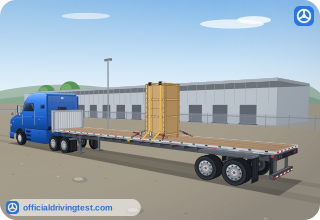
- The load may shift sideways or fall off
- The header board may bend forward
- The front axle may bend under the load
Show answer
Correct answer: The load may shift sideways or fall off
A flatbed has no sides, so a high load is more likely to move to one side or drop off the vehicle.
Source: CDL manual, national model as printed by New Jersey, Sections 1 to 3 (July 2017)
-
Which method places pieces shaped to fit snugly against the front, back or sides of cargo so it cannot slide?
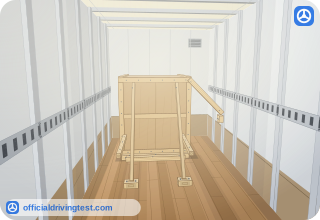
- Blocking
- Bracing
- Tie-down
Show answer
Correct answer: Blocking
Blocking is fitted tightly against the cargo and secured to the cargo deck, so the cargo cannot slide.
Source: CDL manual, national model as printed by New Jersey, Sections 1 to 3 (July 2017)
-
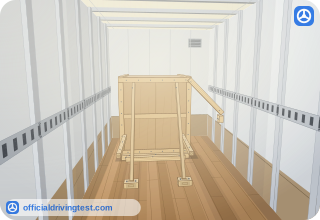
What do you call a support that runs from the top part of the cargo down to the floor or walls of the cargo compartment?
- Blocking
- A header board
- Bracing
Show answer
Correct answer: Bracing
Bracing reaches down from the top of the cargo to the floor or walls, which stops the cargo from moving.
Source: CDL manual, national model as printed by New Jersey, Sections 1 to 3 (July 2017)
-
Your trailer has no sides. What must be done with the cargo?
- Secure it so it cannot shift or fall off
- Let it rest in place if it is heavy enough
- Cover it only if the weather is bad
Show answer
Correct answer: Secure it so it cannot shift or fall off
With no sides to hold it in, cargo on a flatbed or open trailer must be secured so it cannot move or drop off.
Source: CDL manual, national model as printed by New Jersey, Sections 1 to 3 (July 2017)
-
Why can tie-downs still matter inside a closed van?
- Tie-downs keep the van doors from opening
- Shifting cargo can change how the vehicle handles
- A closed van is lawful only with tie-downs on every box
Show answer
Correct answer: Shifting cargo can change how the vehicle handles
Even where cargo cannot fall out, a load that moves inside the van can upset the way the vehicle handles.
Source: CDL manual, national model as printed by New Jersey, Sections 1 to 3 (July 2017)
-
What must be true of the tie-downs you choose?
- They must be chains, never ropes or straps
- They must be the proper type and strength
- They must be fitted only at the rear of the load
Show answer
Correct answer: They must be the proper type and strength
Tie-downs have to suit the job: the right kind and enough strength for the load.
Source: CDL manual, national model as printed by New Jersey, Sections 1 to 3 (July 2017)
-
By federal rules, the combined working load limit of the tie-downs must be at least what part of the cargo's weight?
- Half of the weight of the cargo
- The full weight of the cargo
- Twice the weight of the cargo
Show answer
Correct answer: Half of the weight of the cargo
The securement system's aggregate working load limit must reach at least one-half of the weight of the cargo it holds.
Source: CDL manual, national model as printed by New Jersey, Sections 1 to 3 (July 2017)
-
Which of these is a tensioning device used with tie-downs?
- A winch
- A hook
- A rail
Show answer
Correct answer: A winch
Winches, ratchets and clinching components tighten tie-downs. Hooks, bolts, rails and rings are the places where tie-downs attach to the vehicle.
Source: CDL manual, national model as printed by New Jersey, Sections 1 to 3 (July 2017)
-
What is the least number of tie-downs you need for a long load?
- One for each five feet of cargo
- One for each twenty feet of cargo
- One for each ten feet of cargo
Show answer
Correct answer: One for each ten feet of cargo
Use at least one tie-down for every ten feet of cargo, and add more if needed to meet that count.
Source: CDL manual, national model as printed by New Jersey, Sections 1 to 3 (July 2017)