General Knowledge: Seeing and communicating
Looking ahead and using the mirrors, signaling what you intend to do, and letting others know you are there. Split into 2 shorter tests so you're not stuck in one long quiz.
Independent educational site · not affiliated with any government agency or DMV
Choose a part
Seeing and communicating — Part 1
Questions in this part include: “Which habit is named as a major cause of accidents?”
Seeing and communicating — Part 2
Questions in this part include: “When should you cancel your turn signal during a turn?”
Questions are written in our own words from the CDL manual; they are not the real test's questions. With your state chosen, every answer gives its page in your state's CDL manual. Without a state, answers cite the CDL manual, national model as printed by New Jersey (July 2017).
All 36 Seeing and communicating questions with answers
Choose a part above to take a practice test, or study every question and answer here.
Show the questions and answersHide the questions
1Part 118 questions
-
Which habit is named as a major cause of accidents?
- Using the horn too often
- Shifting gears too early
- Not looking properly
Show answer
Correct answer: Not looking properly
Drivers need to know what is happening around the vehicle; failing to look properly causes many accidents.
Source: CDL manual, national model as printed by New Jersey, Sections 1 to 3 (July 2017)
-
How far ahead, measured in travel time, should a good driver look?
- About 5 to 8 seconds
- At least 12 to 15 seconds
- At least 20 to 25 seconds
Show answer
Correct answer: At least 12 to 15 seconds
Looking 12 to 15 seconds ahead gives you time to stop or change lanes safely instead of reacting at the last moment.
Source: CDL manual, national model as printed by New Jersey, Sections 1 to 3 (July 2017)
-
At lower speeds, about how far ahead is the distance you travel in 12 to 15 seconds?
- About one block
- About half a mile
- About three blocks
Show answer
Correct answer: About one block
At lower speeds, 12 to 15 seconds of travel is about one block.
Source: CDL manual, national model as printed by New Jersey, Sections 1 to 3 (July 2017)
-
At highway speeds, about how far will the vehicle go during 12 to 15 seconds?
- About half a mile ahead
- About 300 feet ahead of you
- About a quarter of a mile
Show answer
Correct answer: About a quarter of a mile
At highway speed, 12 to 15 seconds of travel is about a quarter of a mile.
Source: CDL manual, national model as printed by New Jersey, Sections 1 to 3 (July 2017)
-
While looking far ahead, how should a good driver treat things that are close to the vehicle?
- Ignore them until the far hazards have passed
- Keep watching them, shifting attention near and far
- Watch only the closest vehicle in front of you
Show answer
Correct answer: Keep watching them, shifting attention near and far
Looking far ahead does not mean ignoring nearby things. Good drivers move their attention back and forth between near and far.
Source: CDL manual, national model as printed by New Jersey, Sections 1 to 3 (July 2017)
-
You are driving toward a traffic light that has been green for a long time. What is the best action?
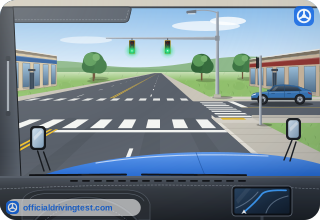
- Ease off the gas and prepare to stop
- Speed up to pass through before it changes
- Hold your speed because the light is green
Show answer
Correct answer: Ease off the gas and prepare to stop
A light that has been green a long time will probably change before you reach it, so slow down and be ready to stop.
Source: CDL manual, national model as printed by New Jersey, Sections 1 to 3 (July 2017)
-
When should you check the adjustment of your mirrors?
- Once a week on a long route
- Only after you notice a problem
- Before you start any trip
Show answer
Correct answer: Before you start any trip
Check the mirror adjustment before every trip, with the trailers straight.
Source: CDL manual, national model as printed by New Jersey, Sections 1 to 3 (July 2017)
-
When can the mirror adjustment be checked accurately on a combination vehicle?
- While the vehicle is turning a corner
- Only when the vehicle is empty
- When the trailer or trailers are straight
Show answer
Correct answer: When the trailer or trailers are straight
Mirrors show the right view only when the trailers are in line with the tractor, so check the adjustment then.
Source: CDL manual, national model as printed by New Jersey, Sections 1 to 3 (July 2017)
-
Why should each mirror be adjusted so that part of your own vehicle shows in it?
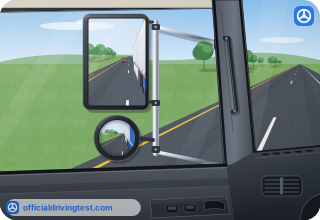
- It gives a reference point to judge other images
- It cuts down glare from the vehicles behind you
- It makes your blind spots disappear completely
Show answer
Correct answer: It gives a reference point to judge other images
A visible part of your own vehicle acts as a fixed point, so you can judge the position of the other vehicles you see.
Source: CDL manual, national model as printed by New Jersey, Sections 1 to 3 (July 2017)
-
What do you check your mirrors regularly for, besides seeing traffic behind you?
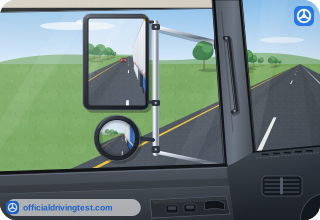
- To see if other vehicles move into your blind spots
- To find out how fast other vehicles are going
- To check that your own signals are working
Show answer
Correct answer: To see if other vehicles move into your blind spots
Regular mirror checks show where other vehicles are and whether they are moving into your blind spots.
Source: CDL manual, national model as printed by New Jersey, Sections 1 to 3 (July 2017)
-
Besides traffic, which part of your own vehicle can you watch in the mirrors to spot a fire?
- Your tires
- Your trailer's rear doors
- Your side marker lamps
Show answer
Correct answer: Your tires
Watching your tires in the mirrors is one way to notice a tire fire early.
Source: CDL manual, national model as printed by New Jersey, Sections 1 to 3 (July 2017)
-
What can you watch for in the mirrors when you carry open cargo?
- Paint wear on the trailer sides
- A tarp that flaps or balloons
- Dents in the rear bumper
Show answer
Correct answer: A tarp that flaps or balloons
Mirrors let you check open cargo for loose straps, ropes or chains, and for a tarp that flaps or balloons.
Source: CDL manual, national model as printed by New Jersey, Sections 1 to 3 (July 2017)
-
During a lane change, why do you check your mirrors again after you have signaled?
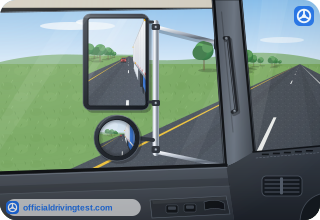
- To confirm the signal light is working
- To confirm nobody has entered your blind spot
- To see how fast the traffic ahead is moving
Show answer
Correct answer: To confirm nobody has entered your blind spot
Another vehicle may move into your blind spot after you signal, so look again before you move over.
Source: CDL manual, national model as printed by New Jersey, Sections 1 to 3 (July 2017)
-
Why do you check your mirrors while making a turn?
- To see whether the turn signal is still flashing on
- To be sure the rear will not hit anything
- To check that the trailer doors are still shut
Show answer
Correct answer: To be sure the rear will not hit anything
During a turn the back of a long vehicle swings, so the mirrors show whether anything is in its path.
Source: CDL manual, national model as printed by New Jersey, Sections 1 to 3 (July 2017)
-
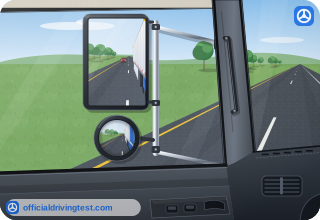
What do you use your mirrors for when you merge into traffic?
- To find the lane with the fastest vehicles in it
- To check that your turn signal is still working
- To judge if the gap in traffic is big enough
Show answer
Correct answer: To judge if the gap in traffic is big enough
When merging, the mirrors tell you whether the gap in traffic is large enough to enter safely.
Source: CDL manual, national model as printed by New Jersey, Sections 1 to 3 (July 2017)
-
Why should you not stare at your mirrors for a long time while driving?
- You could travel far without seeing ahead
- The mirrors could move out of adjustment slowly
- Your eyes could lose focus on the dash gauges
Show answer
Correct answer: You could travel far without seeing ahead
Check the mirrors quickly and look back to the road ahead, because your vehicle keeps moving while you look away.
Source: CDL manual, national model as printed by New Jersey, Sections 1 to 3 (July 2017)
-
How do objects look in a curved (convex) mirror compared with looking at them directly?
- Larger and closer than they really are
- Smaller and farther away than they really are
- Smaller but closer than they really are
Show answer
Correct answer: Smaller and farther away than they really are
A convex mirror shows a wider area, but things look smaller and farther away than they really are, so you must allow for this.
Source: CDL manual, national model as printed by New Jersey, Sections 1 to 3 (July 2017)
-
What does signaling well before a turn help keep other drivers from doing?
- Trying to pass you
- Turning at the same corner
- Following too closely
Show answer
Correct answer: Trying to pass you
An early turn signal is the best way to keep other drivers from trying to pass you as you turn.
Source: CDL manual, national model as printed by New Jersey, Sections 1 to 3 (July 2017)
2Part 218 questions
-
When should you cancel your turn signal during a turn?
- As soon as you begin turning the wheel
- Once the turn has been completed
- About halfway through the turn
Show answer
Correct answer: Once the turn has been completed
You need both hands on the wheel while turning, so keep the signal on until the turn is complete and then cancel it.
Source: CDL manual, national model as printed by New Jersey, Sections 1 to 3 (July 2017)
-
How should you change lanes so that a driver you did not see can react?
- Slowly and smoothly, after signaling
- Quickly, to cross before others notice
- With one sharp move once the signal is on
Show answer
Correct answer: Slowly and smoothly, after signaling
A slow, smooth lane change gives a driver you did not see time to honk or avoid you.
Source: CDL manual, national model as printed by New Jersey, Sections 1 to 3 (July 2017)
-
How can you warn following drivers that you are about to slow down?
- Tap the brake pedal lightly a few times
- Press the brake pedal firmly all the way down
- Shift to neutral and let the vehicle roll along
Show answer
Correct answer: Tap the brake pedal lightly a few times
Light taps flash the brake lights and warn drivers behind you before you slow down.
Source: CDL manual, national model as printed by New Jersey, Sections 1 to 3 (July 2017)
-
Why should you warn the drivers behind you about a hazard ahead when you drive a large vehicle?
- Large vehicles are required by law to warn drivers
- Their headlights do not reach as far as yours do
- The size of your vehicle can hide the hazard from them
Show answer
Correct answer: The size of your vehicle can hide the hazard from them
A large vehicle can block the view of drivers behind it, so flashing your brake lights tells them to slow down.
Source: CDL manual, national model as printed by New Jersey, Sections 1 to 3 (July 2017)
-
How should you warn drivers behind you before a tight turn in a large vehicle?
- Brake early and slow down gradually
- Brake late but firmly
- Signal once and keep your speed
Show answer
Correct answer: Brake early and slow down gradually
Car drivers often do not know how slowly a large vehicle must turn, so brake early and slow gradually to warn them.
Source: CDL manual, national model as printed by New Jersey, Sections 1 to 3 (July 2017)
-
You have to halt in the traffic lane to let off passengers or unload. How should you stop?
- Stop quickly so that others see you stopped
- Stop without warning since the stop is short
- Flash the brake lights and do not stop suddenly
Show answer
Correct answer: Flash the brake lights and do not stop suddenly
Warn following drivers with your brake lights and slow down smoothly, not abruptly, when you stop in the roadway.
Source: CDL manual, national model as printed by New Jersey, Sections 1 to 3 (July 2017)
-
You must drive very slowly. What should you do about your emergency flashers?
- Never use them while the vehicle is moving
- Use them if it is legal, and check the laws of states where you drive
- Always use them, because the law is the same in every state
Show answer
Correct answer: Use them if it is legal, and check the laws of states where you drive
Flashers can warn drivers who are catching up to you, but flasher laws differ from state to state, so check them.
Source: CDL manual, national model as printed by New Jersey, Sections 1 to 3 (July 2017)
-
What is the risk of signaling another driver that it is safe to pass you?
- You could lose your license right away
- You could cause a crash and be blamed for it
- Your insurance would be canceled automatically
Show answer
Correct answer: You could cause a crash and be blamed for it
Do not wave other drivers past. If a crash happens, you may be held responsible and pay thousands of dollars.
Source: CDL manual, national model as printed by New Jersey, Sections 1 to 3 (July 2017)
-
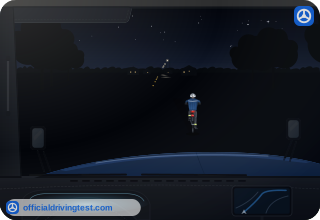
When you are about to pass a bicyclist or pedestrian, what should you assume?
- That they will stay where they are
- That they do not see you
- That they can hear your engine
Show answer
Correct answer: That they do not see you
Assume they do not see you, because they could suddenly move in front of your vehicle.
Source: CDL manual, national model as printed by New Jersey, Sections 1 to 3 (July 2017)
-
At night, you are about to pass a bicyclist and it is legal to signal. How can you let them know you are there?
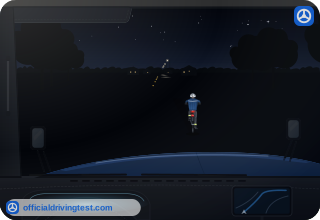
- Blink the headlights from low beam up to high and back
- Leave the high beams on the whole time you pass
- Switch on the four-way emergency flashers
Show answer
Correct answer: Blink the headlights from low beam up to high and back
Tap the horn lightly, or at night blink the headlights from low to high beam and back, to show others you are there.
Source: CDL manual, national model as printed by New Jersey, Sections 1 to 3 (July 2017)
-
At dawn, dusk or in rain, which lights should you turn on to be seen?
- Headlights on low beam
- Headlights on high beam
- Only the clearance lights
Show answer
Correct answer: Headlights on low beam
Use the headlights on low beam. Clearance lights alone are not enough, and high beams can bother people even in the daytime.
Source: CDL manual, national model as printed by New Jersey, Sections 1 to 3 (July 2017)
-
You pull off the road and stop, especially at night. What should you turn on?
- Only the taillights, set bright
- The four-way flashers
- The high beam headlights
Show answer
Correct answer: The four-way flashers
Turn on the four-way flashers. Taillights alone may make other drivers think you are still moving normally.
Source: CDL manual, national model as printed by New Jersey, Sections 1 to 3 (July 2017)
-
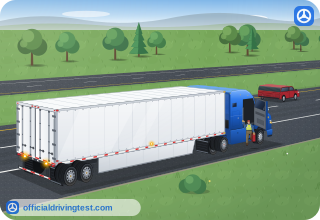
When you have to stop on a road or its shoulder, how soon must warning devices be out?
- Within five minutes
- Within ten minutes
- Within thirty minutes
Show answer
Correct answer: Within ten minutes
Emergency warning devices must be put out within ten minutes of stopping on a road or shoulder.
Source: CDL manual, national model as printed by New Jersey, Sections 1 to 3 (July 2017)
-
You stop on a divided highway. Where do you place your three warning devices?
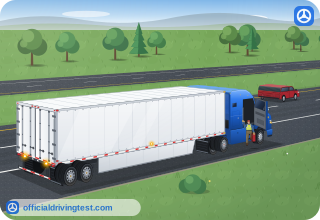
- At 10, 50 and 100 feet toward the approaching traffic
- At 10, 100 and 200 feet toward the approaching traffic
- At 100, 200 and 300 feet behind the vehicle only on the shoulder
Show answer
Correct answer: At 10, 100 and 200 feet toward the approaching traffic
On a one-way or divided highway, place them 10, 100 and 200 feet back toward the approaching traffic.
Source: CDL manual, national model as printed by New Jersey, Sections 1 to 3 (July 2017)
-
You stop on a two-lane road with traffic in both directions. Where do you place the warning devices?
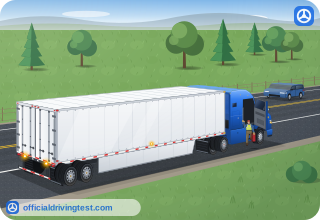
- One each at 200 feet and 500 feet behind the vehicle
- All three set within 10 feet of the rear corners
- Within 10 feet of a corner, and 100 feet behind and ahead
Show answer
Correct answer: Within 10 feet of a corner, and 100 feet behind and ahead
On a two-way road, put one within 10 feet of a front or rear corner and the others 100 feet back and 100 feet ahead.
Source: CDL manual, national model as printed by New Jersey, Sections 1 to 3 (July 2017)
-
A hill or curve keeps other drivers from seeing your stopped vehicle from 500 feet away. What should you do with the rear-most triangle?
- Set it back down the road where it gives warning
- Keep it at 100 feet so it stays near the vehicle
- Set it right beside the rear corner of the vehicle
Show answer
Correct answer: Set it back down the road where it gives warning
When the view is blocked, the rear triangle must be moved farther back so drivers get warning in time.
Source: CDL manual, national model as printed by New Jersey, Sections 1 to 3 (July 2017)
-
How should you carry the warning triangles when walking out to place them?
- Behind your back, away from traffic
- Between yourself and the oncoming traffic
- Under your arm, with the front facing you
Show answer
Correct answer: Between yourself and the oncoming traffic
Holding the triangles between you and oncoming traffic makes you easier for other drivers to see.
Source: CDL manual, national model as printed by New Jersey, Sections 1 to 3 (July 2017)
-
Why should you use your horn only when needed?
- It can drain the battery too quickly
- It can startle others and be dangerous
- It makes the vehicle much harder to see
Show answer
Correct answer: It can startle others and be dangerous
The horn can let others know you are there, but it can startle people and create danger when used without need.
Source: CDL manual, national model as printed by New Jersey, Sections 1 to 3 (July 2017)
-
Only in Arizona's manual
You stop your truck at the side of the road, especially after dark. Which lights should you be sure to switch on?
- The high beam headlights
- The cab interior lights
- The four-way flashers
Show answer
Correct answer: The four-way flashers
After pulling off and stopping beside the road, switch on the four-way emergency flashers, above all at night.
Source: CDL manual, national model as printed by New Jersey, Sections 1 to 3 (July 2017)