General Knowledge: Seeing and communicating — Part 1
Questions in this part include: “Which habit is named as a major cause of accidents?” · “What do you check your mirrors regularly for, besides seeing traffic behind you?”
Independent educational site · not affiliated with any government agency or DMV
Ready? Test yourself
Answer to start, or tap Start below:
Which habit is named as a major cause of accidents?
- Instant feedback with an explanation
- Every answer cites its source in the manual
- Your best score is saved on this device
- Keyboard: press 1 to 3 to answer and Enter for the next question
Questions are written in our own words from the CDL manual; they are not the real test's questions. With your state chosen, every answer gives its page in your state's CDL manual. Without a state, answers cite the CDL manual, national model as printed by New Jersey (July 2017).
All 18 questions in this practice test
Take the test above first, then use this list to study. Tap “Show answer” to see the correct answer and explanation.
Show the questions and answersHide the questions
-
Which habit is named as a major cause of accidents?
- Using the horn too often
- Shifting gears too early
- Not looking properly
Show answer
Correct answer: Not looking properly
Drivers need to know what is happening around the vehicle; failing to look properly causes many accidents.
Source: CDL manual, national model as printed by New Jersey, Sections 1 to 3 (July 2017)
-
How far ahead, measured in travel time, should a good driver look?
- About 5 to 8 seconds
- At least 12 to 15 seconds
- At least 20 to 25 seconds
Show answer
Correct answer: At least 12 to 15 seconds
Looking 12 to 15 seconds ahead gives you time to stop or change lanes safely instead of reacting at the last moment.
Source: CDL manual, national model as printed by New Jersey, Sections 1 to 3 (July 2017)
-
At lower speeds, about how far ahead is the distance you travel in 12 to 15 seconds?
- About one block
- About half a mile
- About three blocks
Show answer
Correct answer: About one block
At lower speeds, 12 to 15 seconds of travel is about one block.
Source: CDL manual, national model as printed by New Jersey, Sections 1 to 3 (July 2017)
-
At highway speeds, about how far will the vehicle go during 12 to 15 seconds?
- About half a mile ahead
- About 300 feet ahead of you
- About a quarter of a mile
Show answer
Correct answer: About a quarter of a mile
At highway speed, 12 to 15 seconds of travel is about a quarter of a mile.
Source: CDL manual, national model as printed by New Jersey, Sections 1 to 3 (July 2017)
-
While looking far ahead, how should a good driver treat things that are close to the vehicle?
- Ignore them until the far hazards have passed
- Keep watching them, shifting attention near and far
- Watch only the closest vehicle in front of you
Show answer
Correct answer: Keep watching them, shifting attention near and far
Looking far ahead does not mean ignoring nearby things. Good drivers move their attention back and forth between near and far.
Source: CDL manual, national model as printed by New Jersey, Sections 1 to 3 (July 2017)
-
You are driving toward a traffic light that has been green for a long time. What is the best action?
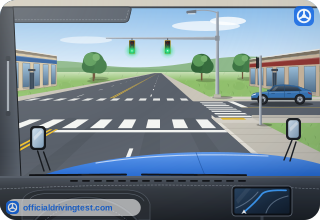
- Ease off the gas and prepare to stop
- Speed up to pass through before it changes
- Hold your speed because the light is green
Show answer
Correct answer: Ease off the gas and prepare to stop
A light that has been green a long time will probably change before you reach it, so slow down and be ready to stop.
Source: CDL manual, national model as printed by New Jersey, Sections 1 to 3 (July 2017)
-
When should you check the adjustment of your mirrors?
- Once a week on a long route
- Only after you notice a problem
- Before you start any trip
Show answer
Correct answer: Before you start any trip
Check the mirror adjustment before every trip, with the trailers straight.
Source: CDL manual, national model as printed by New Jersey, Sections 1 to 3 (July 2017)
-
When can the mirror adjustment be checked accurately on a combination vehicle?
- While the vehicle is turning a corner
- Only when the vehicle is empty
- When the trailer or trailers are straight
Show answer
Correct answer: When the trailer or trailers are straight
Mirrors show the right view only when the trailers are in line with the tractor, so check the adjustment then.
Source: CDL manual, national model as printed by New Jersey, Sections 1 to 3 (July 2017)
-
Why should each mirror be adjusted so that part of your own vehicle shows in it?
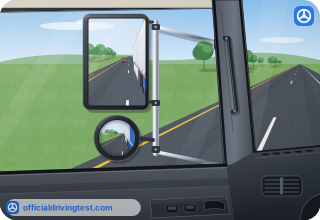
- It gives a reference point to judge other images
- It cuts down glare from the vehicles behind you
- It makes your blind spots disappear completely
Show answer
Correct answer: It gives a reference point to judge other images
A visible part of your own vehicle acts as a fixed point, so you can judge the position of the other vehicles you see.
Source: CDL manual, national model as printed by New Jersey, Sections 1 to 3 (July 2017)
-
What do you check your mirrors regularly for, besides seeing traffic behind you?
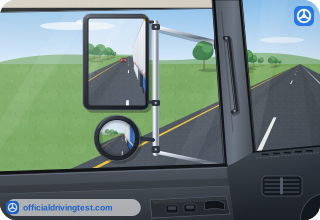
- To see if other vehicles move into your blind spots
- To find out how fast other vehicles are going
- To check that your own signals are working
Show answer
Correct answer: To see if other vehicles move into your blind spots
Regular mirror checks show where other vehicles are and whether they are moving into your blind spots.
Source: CDL manual, national model as printed by New Jersey, Sections 1 to 3 (July 2017)
-
Besides traffic, which part of your own vehicle can you watch in the mirrors to spot a fire?
- Your tires
- Your trailer's rear doors
- Your side marker lamps
Show answer
Correct answer: Your tires
Watching your tires in the mirrors is one way to notice a tire fire early.
Source: CDL manual, national model as printed by New Jersey, Sections 1 to 3 (July 2017)
-
What can you watch for in the mirrors when you carry open cargo?
- Paint wear on the trailer sides
- A tarp that flaps or balloons
- Dents in the rear bumper
Show answer
Correct answer: A tarp that flaps or balloons
Mirrors let you check open cargo for loose straps, ropes or chains, and for a tarp that flaps or balloons.
Source: CDL manual, national model as printed by New Jersey, Sections 1 to 3 (July 2017)
-
During a lane change, why do you check your mirrors again after you have signaled?
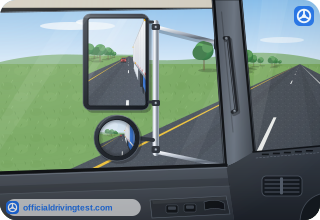
- To confirm the signal light is working
- To confirm nobody has entered your blind spot
- To see how fast the traffic ahead is moving
Show answer
Correct answer: To confirm nobody has entered your blind spot
Another vehicle may move into your blind spot after you signal, so look again before you move over.
Source: CDL manual, national model as printed by New Jersey, Sections 1 to 3 (July 2017)
-
Why do you check your mirrors while making a turn?
- To see whether the turn signal is still flashing on
- To be sure the rear will not hit anything
- To check that the trailer doors are still shut
Show answer
Correct answer: To be sure the rear will not hit anything
During a turn the back of a long vehicle swings, so the mirrors show whether anything is in its path.
Source: CDL manual, national model as printed by New Jersey, Sections 1 to 3 (July 2017)
-
What do you use your mirrors for when you merge into traffic?
- To find the lane with the fastest vehicles in it
- To check that your turn signal is still working
- To judge if the gap in traffic is big enough
Show answer
Correct answer: To judge if the gap in traffic is big enough
When merging, the mirrors tell you whether the gap in traffic is large enough to enter safely.
Source: CDL manual, national model as printed by New Jersey, Sections 1 to 3 (July 2017)
-
Why should you not stare at your mirrors for a long time while driving?
- You could travel far without seeing ahead
- The mirrors could move out of adjustment slowly
- Your eyes could lose focus on the dash gauges
Show answer
Correct answer: You could travel far without seeing ahead
Check the mirrors quickly and look back to the road ahead, because your vehicle keeps moving while you look away.
Source: CDL manual, national model as printed by New Jersey, Sections 1 to 3 (July 2017)
-
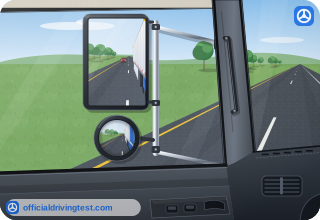
How do objects look in a curved (convex) mirror compared with looking at them directly?
- Larger and closer than they really are
- Smaller and farther away than they really are
- Smaller but closer than they really are
Show answer
Correct answer: Smaller and farther away than they really are
A convex mirror shows a wider area, but things look smaller and farther away than they really are, so you must allow for this.
Source: CDL manual, national model as printed by New Jersey, Sections 1 to 3 (July 2017)
-
What does signaling well before a turn help keep other drivers from doing?
- Trying to pass you
- Turning at the same corner
- Following too closely
Show answer
Correct answer: Trying to pass you
An early turn signal is the best way to keep other drivers from trying to pass you as you turn.
Source: CDL manual, national model as printed by New Jersey, Sections 1 to 3 (July 2017)