General Knowledge: Controlling speed — Part 1
Questions in this part include: “Which three distances are added together to find your total stopping distance?” · “How does an empty truck's stopping distance compare with a loaded one's?”
Independent educational site · not affiliated with any government agency or DMV
Ready? Test yourself
Answer to start, or tap Start below:
Which three distances are added together to find your total stopping distance?
- Instant feedback with an explanation
- Every answer cites its source in the manual
- Your best score is saved on this device
- Keyboard: press 1 to 3 to answer and Enter for the next question
Questions are written in our own words from the CDL manual; they are not the real test's questions. With your state chosen, every answer gives its page in your state's CDL manual. Without a state, answers cite the CDL manual, national model as printed by New Jersey (July 2017).
All 22 questions in this practice test
Take the test above first, then use this list to study. Tap “Show answer” to see the correct answer and explanation.
Show the questions and answersHide the questions
-
Which three distances are added together to find your total stopping distance?
- Perception, following and braking distance
- Perception, reaction and braking distance
- Reaction, braking and skidding distance
Show answer
Correct answer: Perception, reaction and braking distance
Total stopping distance is the distance covered while you notice the hazard, while you move your foot to the brake, and while the vehicle slows to a stop.
Source: CDL manual, national model as printed by New Jersey, Sections 1 to 3 (July 2017)
-
About how long does an alert driver take, on average, to perceive a hazard?
- Three seconds
- ½ second
- 1¾ seconds
Show answer
Correct answer: 1¾ seconds
An alert driver needs about 1¾ seconds from the moment the eyes see a hazard until the brain recognizes it.
Source: CDL manual, national model as printed by New Jersey, Sections 1 to 3 (July 2017)
-
At 55 mph, how far does a vehicle travel during the average perception time?
- 142 feet
- 112 feet
- 172 feet
Show answer
Correct answer: 142 feet
During the average perception time of an alert driver, a vehicle at 55 mph covers 142 feet before the hazard is recognized.
Source: CDL manual, national model as printed by New Jersey, Sections 1 to 3 (July 2017)
-
What is the average driver reaction time, from recognizing a hazard to hitting the brakes?
- 2 to 3 seconds
- 1½ to 2 seconds
- ¾ second to 1 second
Show answer
Correct answer: ¾ second to 1 second
The average driver needs about ¾ second to 1 second to move a foot to the brake after seeing a hazard.
Source: CDL manual, national model as printed by New Jersey, Sections 1 to 3 (July 2017)
-
At 55 mph, how far does a vehicle travel during the average driver's reaction time?
- 61 feet
- 41 feet
- 81 feet
Show answer
Correct answer: 61 feet
At 55 mph the vehicle keeps moving about 61 feet before the driver's foot even reaches the brake.
Source: CDL manual, national model as printed by New Jersey, Sections 1 to 3 (July 2017)
-
On a dry road with good brakes at 55 mph, roughly how many feet does braking alone take?
- 186 feet
- 216 feet
- 246 feet
Show answer
Correct answer: 216 feet
Braking alone covers roughly 216 feet at 55 mph when the road is dry and the brakes are good.
Source: CDL manual, national model as printed by New Jersey, Sections 1 to 3 (July 2017)
-
At 55 mph, what is the minimum total distance your vehicle travels before it comes to a complete stop?
- 359 feet
- 419 feet
- 479 feet
Show answer
Correct answer: 419 feet
Adding perception, reaction and braking distance, a vehicle at 55 mph travels at least 419 feet before stopping.
Source: CDL manual, national model as printed by New Jersey, Sections 1 to 3 (July 2017)
-
You raise your speed from 20 mph to 40 mph. How does your braking distance change?
- It becomes 2 times longer
- It becomes 4 times longer
- It becomes 8 times longer
Show answer
Correct answer: It becomes 4 times longer
Doubling speed makes braking distance 4 times longer, and the force of an impact is 4 times greater too.
Source: CDL manual, national model as printed by New Jersey, Sections 1 to 3 (July 2017)
-
If you go from 20 mph to 60 mph, how much greater are the impact and the braking distance?
- 3 times greater
- 9 times greater
- 12 times greater
Show answer
Correct answer: 9 times greater
Three times the speed gives 9 times the impact and 9 times the braking distance.
Source: CDL manual, national model as printed by New Jersey, Sections 1 to 3 (July 2017)
-
How does your stopping distance at 60 mph compare with the length of a football field?
- It is longer than a football field
- It is about half a football field
- It is about the same as a football field
Show answer
Correct answer: It is longer than a football field
At 60 mph a vehicle needs more than a football field to stop.
Source: CDL manual, national model as printed by New Jersey, Sections 1 to 3 (July 2017)
-
Compared with 20 mph, how much greater are the impact and braking distance at 80 mph?
- 16 times greater
- 8 times greater
- 12 times greater
Show answer
Correct answer: 16 times greater
At 80 mph both the force of impact and the braking distance are 16 times what they are at 20 mph.
Source: CDL manual, national model as printed by New Jersey, Sections 1 to 3 (July 2017)
-
How does an empty truck's stopping distance compare with a loaded one's?
- It is shorter, because the truck is lighter
- It is the same, because brakes work equally
- It is longer, because it has less traction
Show answer
Correct answer: It is longer, because it has less traction
Heavy-vehicle brakes and tires are built to work best fully loaded, so an empty truck has less traction and needs a longer distance to stop.
Source: CDL manual, national model as printed by New Jersey, Sections 1 to 3 (July 2017)
-
What is traction?
- The friction between the tires and the road
- The grip of the brake shoes on the drums
- The weight resting on the drive wheels
Show answer
Correct answer: The friction between the tires and the road
Traction is the friction between tires and road surface. Without it you cannot steer or brake the vehicle.
Source: CDL manual, national model as printed by New Jersey, Sections 1 to 3 (July 2017)
-
A road is wet. What can happen to the distance you need to stop?
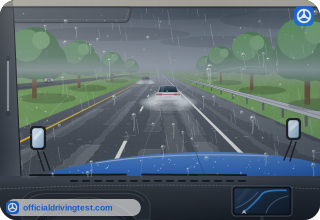
- It can double it
- It adds about ten percent
- It can make it five times longer
Show answer
Correct answer: It can double it
Water can double the distance you need, so slow down to keep the same stopping room you have on a dry road.
Source: CDL manual, national model as printed by New Jersey, Sections 1 to 3 (July 2017)
-
By how much should you reduce your speed on a wet road?
- By about one-tenth
- By about one-third
- By about three-quarters
Show answer
Correct answer: By about one-third
On a wet road, cut your speed by about one-third, for example from 55 mph to about 35 mph.
Source: CDL manual, national model as printed by New Jersey, Sections 1 to 3 (July 2017)
-
How much should you reduce your speed on packed snow?
- By about one-quarter
- By half, or more
- By about one-tenth
Show answer
Correct answer: By half, or more
Packed snow gives little traction, so slow down by half or more.
Source: CDL manual, national model as printed by New Jersey, Sections 1 to 3 (July 2017)
-
What is the right response when the road surface is icy?
- Slow to a crawl, then stop when safe
- Slow to half speed and drive on
- Hold your speed and avoid braking
Show answer
Correct answer: Slow to a crawl, then stop when safe
On ice, drive at a crawl and stop as soon as it is safe to do so.
Source: CDL manual, national model as printed by New Jersey, Sections 1 to 3 (July 2017)
-
After ice has melted from open stretches, which parts of the road can stay icy?
- Freshly paved sections
- Shady parts
- Wide straight sections
Show answer
Correct answer: Shady parts
Shaded road sections stay icy and slippery long after sunny, open areas have melted.
Source: CDL manual, national model as printed by New Jersey, Sections 1 to 3 (July 2017)
-
When the temperature falls near freezing, what part of the route ices up before the rest of the road?
- Tunnels
- Bridges
- Hilltops
Show answer
Correct answer: Bridges
Bridges ice over before the road does, so be extra careful near 32 degrees Fahrenheit.
Source: CDL manual, national model as printed by New Jersey, Sections 1 to 3 (July 2017)
-
Ice has begun to melt slightly and looks wet. How slippery is it compared with ice that is not wet?
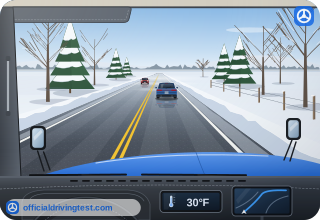
- About equally slippery
- Much more slippery
- Somewhat less slippery
Show answer
Correct answer: Much more slippery
Slight melting puts a film of water on the ice, which makes it far slipperier than ice that stays dry.
Source: CDL manual, national model as printed by New Jersey, Sections 1 to 3 (July 2017)
-
It is freezing outside and the pavement looks wet. What hazard should you suspect?
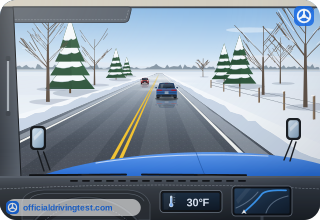
- Black ice
- Oil leaking from traffic
- Light fog settling on the pavement
Show answer
Correct answer: Black ice
A thin, clear ice layer lets the road show through and looks like water. Suspect it whenever it is freezing and the pavement looks wet.
Source: CDL manual, national model as printed by New Jersey, Sections 1 to 3 (July 2017)
-
How can you check from the cab whether the road may be starting to ice up?
- Feel the mirror, its support or the antenna
- Check whether the tires hum louder on the road
- Watch whether the windshield wipers slow down
Show answer
Correct answer: Feel the mirror, its support or the antenna
Ice on the mirror face, its bracket or the antenna, felt through an open window, suggests the road is starting to ice up.
Source: CDL manual, national model as printed by New Jersey, Sections 1 to 3 (July 2017)