General Knowledge: Driving at night and in fog — Part 3
Questions in this part include: “Which part of the windshield should you clean before night driving?” · “You see fog ahead on the highway. What should you not assume?”
Independent educational site · not affiliated with any government agency or DMV
Ready? Test yourself
Answer to start, or tap Start below:
Which part of the windshield should you clean before night driving?
- Instant feedback with an explanation
- Every answer cites its source in the manual
- Your best score is saved on this device
- Keyboard: press 1 to 3 to answer and Enter for the next question
Questions are written in our own words from the CDL manual; they are not the real test's questions. With your state chosen, every answer gives its page in your state's CDL manual. Without a state, answers cite the CDL manual, national model as printed by New Jersey (July 2017).
All 19 questions in this practice test
Take the test above first, then use this list to study. Tap “Show answer” to see the correct answer and explanation.
Show the questions and answersHide the questions
-
Which part of the windshield should you clean before night driving?
- Both the inside and the outside
- Only the outside, where the road dirt gathers
- Only the inside, where the glare forms
Show answer
Correct answer: Both the inside and the outside
Dirt on either side of the glass can cause glare at night, so both sides need cleaning.
Source: CDL manual, national model as printed by New Jersey, Sections 1 to 3 (July 2017)
-
What should you do about sunglasses when you drive at night?
- Do not wear them
- Wear them to reduce glare from oncoming lights
- Wear them only when following another vehicle
Show answer
Correct answer: Do not wear them
Eyeglasses should be clean and unscratched, but sunglasses do not belong on a night drive.
Source: CDL manual, national model as printed by New Jersey, Sections 1 to 3 (July 2017)
-
Before a night trip, what should you do in your vehicle inspection about lights?
- Check every light and reflector and clean those in reach
- Check the lights after dark, once you are on the road
- Replace the bulbs of all the lights before you start
Show answer
Correct answer: Check every light and reflector and clean those in reach
A night inspection covers all lights and reflectors, and you clean the ones within reach.
Source: CDL manual, national model as printed by New Jersey, Sections 1 to 3 (July 2017)
-
At what distance from an oncoming or a followed vehicle should you dim your lights?
- Within 250 feet
- Within 500 feet
- Within 1,000 feet
Show answer
Correct answer: Within 500 feet
Your high beams can blind the driver ahead of you or the one coming toward you, so dim them within 500 feet.
Source: CDL manual, national model as printed by New Jersey, Sections 1 to 3 (July 2017)
-
Where should you look when an oncoming vehicle's lights shine at you?
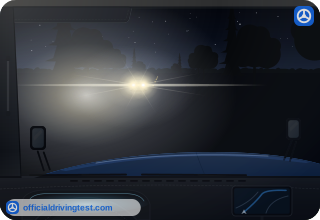
- Slightly to the right, at the lane or edge line
- Straight at the lights, to judge their distance
- Slightly to the left, at the center line
Show answer
Correct answer: Slightly to the right, at the lane or edge line
Looking at the right-side line keeps the glare out of your eyes while you still see where your lane goes.
Source: CDL manual, national model as printed by New Jersey, Sections 1 to 3 (July 2017)
-
An oncoming driver forgets to use low beams. What should you not do?
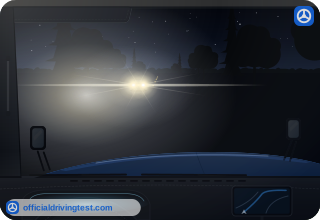
- Switch on your high beams in return
- Look to the right edge of the road
- Slow down and keep your lane position
Show answer
Correct answer: Switch on your high beams in return
Answering with high beams adds to the glare for oncoming drivers and makes a crash more likely.
Source: CDL manual, national model as printed by New Jersey, Sections 1 to 3 (July 2017)
-
What is the problem with always driving on low beams at night?
- It wears out the headlight bulbs faster
- It greatly reduces how far ahead you can see
- It makes other drivers dim their lights
Show answer
Correct answer: It greatly reduces how far ahead you can see
Low beams show much less road than high beams, so switch to high beams whenever it is safe and allowed.
Source: CDL manual, national model as printed by New Jersey, Sections 1 to 3 (July 2017)
-
How should the lights inside the cab be set for night driving?
- Interior light on, gauge lights at full brightness
- Interior light off, gauge lights as low as still readable
- Interior light dim, gauge lights switched off
Show answer
Correct answer: Interior light off, gauge lights as low as still readable
A bright cab makes it harder to see outside, so keep the cab dark enough while you can still read the gauges.
Source: CDL manual, national model as printed by New Jersey, Sections 1 to 3 (July 2017)
-
What can you do to check whether you are too sleepy to drive?
- Count the miles you drove since your last stop
- Look at yourself in a mirror when it is safe
- Turn the radio up and see if you notice it
Show answer
Correct answer: Look at yourself in a mirror when it is safe
People often do not notice how close they are to falling asleep, so a look in the mirror can show it.
Source: CDL manual, national model as printed by New Jersey, Sections 1 to 3 (July 2017)
-
You see fog ahead on the highway. What should you not assume?
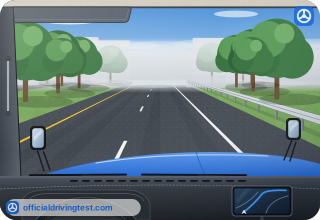
- That your speed should be reduced
- That visibility can drop quickly
- That the fog will thin out as you go in
Show answer
Correct answer: That the fog will thin out as you go in
Fog often appears without warning and visibility can get worse fast, so slow down before you enter.
Source: CDL manual, national model as printed by New Jersey, Sections 1 to 3 (July 2017)
-
What is the best way to deal with fog if you can?
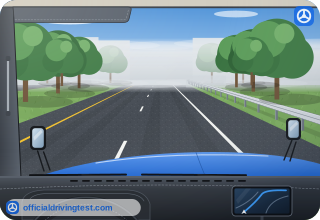
- Follow a vehicle ahead of you closely
- Stay off the road in a rest area until it clears
- Drive through it quickly to get out of it
Show answer
Correct answer: Stay off the road in a rest area until it clears
The safest choice is not to drive in fog. Wait in a rest area or truck stop until you can see better.
Source: CDL manual, national model as printed by New Jersey, Sections 1 to 3 (July 2017)
-
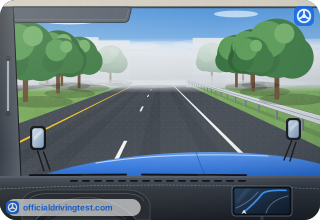
When should you reduce speed for fog ahead?
- After you are inside the fog
- Only if the fog gets thick
- Before you enter the fog
Show answer
Correct answer: Before you enter the fog
Visibility can drop quickly in fog, so your speed should already be lower when you enter it.
Source: CDL manual, national model as printed by New Jersey, Sections 1 to 3 (July 2017)
-
Which lights give the best visibility when you must drive in fog?
- High beams used alone
- Parking lamps used alone
- Low beams plus fog lights
Show answer
Correct answer: Low beams plus fog lights
Low beams with fog lights work best in fog, even by day.
Source: CDL manual, national model as printed by New Jersey, Sections 1 to 3 (July 2017)
-
In fog, what should you watch for among other drivers?
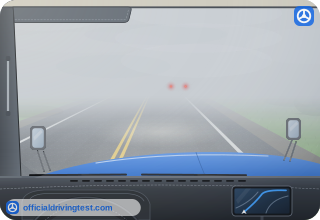
- Drivers who forgot to turn their lights on
- Drivers who use their high beams on purpose
- Drivers who keep a long following distance
Show answer
Correct answer: Drivers who forgot to turn their lights on
Some drivers may not have lit their lights in fog, so they are even harder to see.
Source: CDL manual, national model as printed by New Jersey, Sections 1 to 3 (July 2017)
-
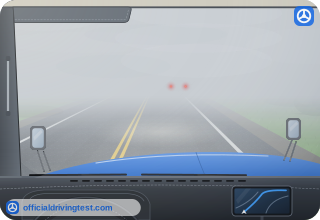
Why turn on your 4-way flashers when driving in fog?
- So oncoming drivers know you will turn
- So drivers behind notice you sooner
- So you do not have to use low beams
Show answer
Correct answer: So drivers behind notice you sooner
Flashers help vehicles coming up behind you see your vehicle more quickly in poor visibility.
Source: CDL manual, national model as printed by New Jersey, Sections 1 to 3 (July 2017)
-
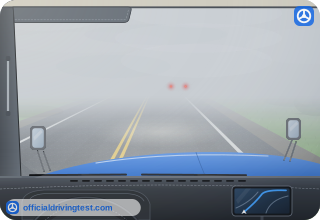
In fog you see taillights ahead of you. What should you keep in mind?
- That vehicle is safely on the road and shows its direction
- That vehicle may be off the road, so its lights may not show the road
- That vehicle is at a safe following distance
Show answer
Correct answer: That vehicle may be off the road, so its lights may not show the road
A vehicle you see in fog may be at the side of the road or off it, so do not follow its lights as if they marked the road.
Source: CDL manual, national model as printed by New Jersey, Sections 1 to 3 (July 2017)
-
In fog, what can help you tell how the road curves ahead?
- The brake lights of the vehicle ahead
- The roadside highway reflectors
- The center line seen in your headlights
Show answer
Correct answer: The roadside highway reflectors
Roadside reflectors mark the edge of the road and show how it bends when you cannot see far.
Source: CDL manual, national model as printed by New Jersey, Sections 1 to 3 (July 2017)
-
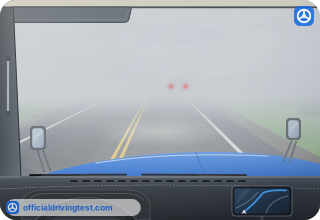
You must drive in fog. What should you do about passing other vehicles?
- Pass quickly with your 4-way flashers on
- Avoid passing them
- Pass only on straight stretches
Show answer
Correct answer: Avoid passing them
Passing in fog is risky because you cannot see far, so avoid it.
Source: CDL manual, national model as printed by New Jersey, Sections 1 to 3 (July 2017)
-
In fog, when may you stop along the side of the road?
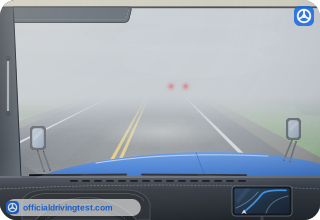
- Only when it is absolutely necessary
- Whenever you want a short rest
- Whenever you need to check your map
Show answer
Correct answer: Only when it is absolutely necessary
Stopping at the roadside in fog is avoided unless there is no choice.
Source: CDL manual, national model as printed by New Jersey, Sections 1 to 3 (July 2017)