General Knowledge: Driving at night and in fog — Part 1
Questions in this part include: “Why is driving at night riskier than driving in daylight?” · “When are most people the least alert?”
Independent educational site · not affiliated with any government agency or DMV
Ready? Test yourself
Answer to start, or tap Start below:
Why is it wise to see an eye specialist for a vision test on a regular schedule?
- Instant feedback with an explanation
- Every answer cites its source in the manual
- Your best score is saved on this device
- Keyboard: press 1 to 3 to answer and Enter for the next question
Questions are written in our own words from the CDL manual; they are not the real test's questions. With your state chosen, every answer gives its page in your state's CDL manual. Without a state, answers cite the CDL manual, national model as printed by New Jersey (July 2017).
All 20 questions in this practice test
Take the test above first, then use this list to study. Tap “Show answer” to see the correct answer and explanation.
Show the questions and answersHide the questions
-
Why is driving at night riskier than driving in daylight?

- Drivers see hazards later, so they have less time to react
- Brakes need a longer distance to stop when it is dark
- Other drivers use their turn signals less after dark
Show answer
Correct answer: Drivers see hazards later, so they have less time to react
In the dark a driver notices hazards later than in daylight. That leaves less time to respond, and a surprised driver is less able to avoid a crash.
Source: CDL manual, national model as printed by New Jersey, Sections 1 to 3 (July 2017)
-
Why is it wise to see an eye specialist for a vision test on a regular schedule?
- Your license is cancelled if you skip a yearly check
- Poor vision can go unnoticed until your eyes are tested
- Eye tests help the eyes recover from glare faster
Show answer
Correct answer: Poor vision can go unnoticed until your eyes are tested
A driver can have poor vision without knowing it. Only a test shows the problem, and good vision is critical for safe driving.
Source: CDL manual, national model as printed by New Jersey, Sections 1 to 3 (July 2017)
-
A driver license carries a corrective lenses restriction. What is true about moving a vehicle without them?
- It is illegal to move the vehicle without them
- It is allowed for short trips in daytime
- It is allowed if you drive slowly
Show answer
Correct answer: It is illegal to move the vehicle without them
When a license requires corrective lenses, moving a vehicle without wearing them is against the law, even for a short distance.
Source: CDL manual, national model as printed by New Jersey, Sections 1 to 3 (July 2017)
-
What should a driver who needs corrective lenses carry in the vehicle?
- A letter from an eye specialist
- A copy of the eye test results
- A second pair of corrective lenses
Show answer
Correct answer: A second pair of corrective lenses
A spare set lets you drive safely if your normal lenses are broken or lost.
Source: CDL manual, national model as printed by New Jersey, Sections 1 to 3 (July 2017)
-
Why should you avoid dark or tinted corrective lenses at night?
- They make oncoming headlights look brighter
- They reduce the light you need to see well
- They make your eyes tire out in a few minutes
Show answer
Correct answer: They reduce the light you need to see well
Tinted lenses block part of the light a driver needs at night. They should be avoided even if they seem to help with glare.
Source: CDL manual, national model as printed by New Jersey, Sections 1 to 3 (July 2017)
-
After bright light blinds a driver for a moment, how long can recovery take?
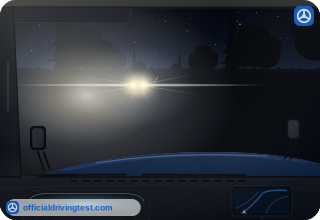
- Several seconds
- Less than half a second
- Several minutes
Show answer
Correct answer: Several seconds
Eyes need several seconds to recover after glare, and the vehicle keeps moving during that time.
Source: CDL manual, national model as printed by New Jersey, Sections 1 to 3 (July 2017)
-
Bright lights blind a driver for two seconds while the vehicle is going 55 mph. How far does the vehicle travel in that time?
- About the length of a tractor-trailer
- More than half a football field
- More than two football fields
Show answer
Correct answer: More than half a football field
At 55 mph a vehicle covers more than half the length of a football field in two seconds. The driver is traveling that far without seeing.
Source: CDL manual, national model as printed by New Jersey, Sections 1 to 3 (July 2017)
-
What does fatigue impair, just as alcohol and drugs do?
- Hearing and balance
- Strength and speed
- Vision and judgment
Show answer
Correct answer: Vision and judgment
Tiredness harms a driver's vision and judgment in the same way alcohol and drugs do.
Source: CDL manual, national model as printed by New Jersey, Sections 1 to 3 (July 2017)
-
NHTSA gives a yearly estimate of crashes reported to police that drowsy driving caused. About how many?
- 100,000
- 10,000
- 1,000,000
Show answer
Correct answer: 100,000
NHTSA estimates about 100,000 police-reported crashes each year come from drowsy driving.
Source: CDL manual, national model as printed by New Jersey, Sections 1 to 3 (July 2017)
-
Besides the night, at what time of day do drowsy-driving crashes tend to happen?
- Right after sunrise
- At the start of the morning rush
- In the mid-afternoon
Show answer
Correct answer: In the mid-afternoon
Sleepiness peaks at night and in the mid-afternoon, and crashes follow those times.
Source: CDL manual, national model as printed by New Jersey, Sections 1 to 3 (July 2017)
-
When are most people the least alert?
- In the late morning, before lunch
- At night, especially after midnight
- During the morning rush hour
Show answer
Correct answer: At night, especially after midnight
Alertness is lowest at night, and especially after midnight. This is more true after a long time at the wheel.
Source: CDL manual, national model as printed by New Jersey, Sections 1 to 3 (July 2017)
-
Which group is at increased risk of a fall-asleep crash?
- Drivers who always travel with a passenger
- Drivers who only drive in the late morning
- Long-haul commercial drivers
Show answer
Correct answer: Long-haul commercial drivers
Long-haul commercial drivers, shift workers and young males face a higher risk of falling asleep at the wheel.
Source: CDL manual, national model as printed by New Jersey, Sections 1 to 3 (July 2017)
-
What share of all heavy truck crashes involve fatigue?
- About 5%
- At least 15%
- About half
Show answer
Correct answer: At least 15%
Research links fatigue to no fewer than 15% of heavy truck crashes.
Source: CDL manual, national model as printed by New Jersey, Sections 1 to 3 (July 2017)
-
A study of 80 long-haul truck drivers found how much sleep per day on average?
- Less than 5 hours
- About 7 hours
- More than 8 hours
Show answer
Correct answer: Less than 5 hours
The long-haul truck drivers in the study slept less than 5 hours a day on average, far below what adults need.
Source: CDL manual, national model as printed by New Jersey, Sections 1 to 3 (July 2017)
-
For crashes that killed a truck driver, what share did the NTSB say drowsiness probably caused?
- Fewer than one in four
- About one in ten
- More than half
Show answer
Correct answer: More than half
The NTSB found that drowsiness was probably behind more than half of the crashes in which a truck driver died.
Source: CDL manual, national model as printed by New Jersey, Sections 1 to 3 (July 2017)
-
For each truck driver killed in a crash, how many other people are killed?
- Three to four
- One to two
- Six to eight
Show answer
Correct answer: Three to four
On average, each truck driver death comes with three to four other deaths.
Source: CDL manual, national model as printed by New Jersey, Sections 1 to 3 (July 2017)
-
Which of these is a warning sign of fatigue that tells you to stop and rest?
- Feeling more alert with each mile
- Noticing every sign long before you reach it
- Not remembering the last few miles you drove
Show answer
Correct answer: Not remembering the last few miles you drove
Not remembering recent miles, or missing exits and signs, shows that you are too tired to keep driving safely.
Source: CDL manual, national model as printed by New Jersey, Sections 1 to 3 (July 2017)
-
If you notice signs of fatigue and choose a nap instead of a night of sleep, how long a nap is suggested?
- 5 to 10 minutes
- 15 to 20 minutes
- 45 to 60 minutes
Show answer
Correct answer: 15 to 20 minutes
A short nap of 15 to 20 minutes is suggested when you notice signs of fatigue and do not sleep for the night.
Source: CDL manual, national model as printed by New Jersey, Sections 1 to 3 (July 2017)
-
How does 6 hours of sleep or less before you drive change your risk of a fatigue crash?
- It triples your risk of a crash
- It doubles your risk of a crash
- It raises your risk by about 40%
Show answer
Correct answer: It triples your risk of a crash
A driver who slept 6 hours or less has three times the risk.
Source: CDL manual, national model as printed by New Jersey, Sections 1 to 3 (July 2017)
-
Between which hours do many heavy motor vehicle crashes occur?
- Between 6 p.m. and midnight
- Between midnight and 6 a.m.
- Between 6 a.m. and noon
Show answer
Correct answer: Between midnight and 6 a.m.
Many heavy-vehicle crashes happen in the hours from midnight to 6 a.m.
Source: CDL manual, national model as printed by New Jersey, Sections 1 to 3 (July 2017)