General Knowledge: Driving at night and in fog
The driver, the road and the vehicle at night, and driving in fog. Split into 3 shorter tests so you're not stuck in one long quiz.
Independent educational site · not affiliated with any government agency or DMV
Choose a part
Driving at night and in fog — Part 1
Questions in this part include: “Why is driving at night riskier than driving in daylight?”
Driving at night and in fog — Part 2
Questions in this part include: “By how much does working more than 60 hours a week increase your fatigue risk?”
Driving at night and in fog — Part 3
Questions in this part include: “Which part of the windshield should you clean before night driving?”
Questions are written in our own words from the CDL manual; they are not the real test's questions. With your state chosen, every answer gives its page in your state's CDL manual. Without a state, answers cite the CDL manual, national model as printed by New Jersey (July 2017).
All 58 Driving at night and in fog questions with answers
Choose a part above to take a practice test, or study every question and answer here.
Show the questions and answersHide the questions
1Part 120 questions
-
Why is driving at night riskier than driving in daylight?
- Drivers see hazards later, so they have less time to react
- Brakes need a longer distance to stop when it is dark
- Other drivers use their turn signals less after dark
Show answer
Correct answer: Drivers see hazards later, so they have less time to react
In the dark a driver notices hazards later than in daylight. That leaves less time to respond, and a surprised driver is less able to avoid a crash.
Source: CDL manual, national model as printed by New Jersey, Sections 1 to 3 (July 2017)
-
Why is it wise to see an eye specialist for a vision test on a regular schedule?
- Your license is cancelled if you skip a yearly check
- Poor vision can go unnoticed until your eyes are tested
- Eye tests help the eyes recover from glare faster
Show answer
Correct answer: Poor vision can go unnoticed until your eyes are tested
A driver can have poor vision without knowing it. Only a test shows the problem, and good vision is critical for safe driving.
Source: CDL manual, national model as printed by New Jersey, Sections 1 to 3 (July 2017)
-
A driver license carries a corrective lenses restriction. What is true about moving a vehicle without them?
- It is illegal to move the vehicle without them
- It is allowed for short trips in daytime
- It is allowed if you drive slowly
Show answer
Correct answer: It is illegal to move the vehicle without them
When a license requires corrective lenses, moving a vehicle without wearing them is against the law, even for a short distance.
Source: CDL manual, national model as printed by New Jersey, Sections 1 to 3 (July 2017)
-
What should a driver who needs corrective lenses carry in the vehicle?
- A letter from an eye specialist
- A copy of the eye test results
- A second pair of corrective lenses
Show answer
Correct answer: A second pair of corrective lenses
A spare set lets you drive safely if your normal lenses are broken or lost.
Source: CDL manual, national model as printed by New Jersey, Sections 1 to 3 (July 2017)
-
Why should you avoid dark or tinted corrective lenses at night?
- They make oncoming headlights look brighter
- They reduce the light you need to see well
- They make your eyes tire out in a few minutes
Show answer
Correct answer: They reduce the light you need to see well
Tinted lenses block part of the light a driver needs at night. They should be avoided even if they seem to help with glare.
Source: CDL manual, national model as printed by New Jersey, Sections 1 to 3 (July 2017)
-
After bright light blinds a driver for a moment, how long can recovery take?
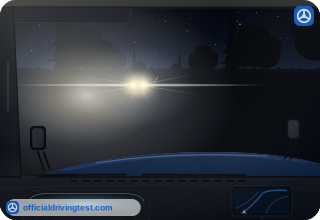
- Several seconds
- Less than half a second
- Several minutes
Show answer
Correct answer: Several seconds
Eyes need several seconds to recover after glare, and the vehicle keeps moving during that time.
Source: CDL manual, national model as printed by New Jersey, Sections 1 to 3 (July 2017)
-
Bright lights blind a driver for two seconds while the vehicle is going 55 mph. How far does the vehicle travel in that time?
- About the length of a tractor-trailer
- More than half a football field
- More than two football fields
Show answer
Correct answer: More than half a football field
At 55 mph a vehicle covers more than half the length of a football field in two seconds. The driver is traveling that far without seeing.
Source: CDL manual, national model as printed by New Jersey, Sections 1 to 3 (July 2017)
-
What does fatigue impair, just as alcohol and drugs do?
- Hearing and balance
- Strength and speed
- Vision and judgment
Show answer
Correct answer: Vision and judgment
Tiredness harms a driver's vision and judgment in the same way alcohol and drugs do.
Source: CDL manual, national model as printed by New Jersey, Sections 1 to 3 (July 2017)
-
NHTSA gives a yearly estimate of crashes reported to police that drowsy driving caused. About how many?
- 100,000
- 10,000
- 1,000,000
Show answer
Correct answer: 100,000
NHTSA estimates about 100,000 police-reported crashes each year come from drowsy driving.
Source: CDL manual, national model as printed by New Jersey, Sections 1 to 3 (July 2017)
-
Besides the night, at what time of day do drowsy-driving crashes tend to happen?
- Right after sunrise
- At the start of the morning rush
- In the mid-afternoon
Show answer
Correct answer: In the mid-afternoon
Sleepiness peaks at night and in the mid-afternoon, and crashes follow those times.
Source: CDL manual, national model as printed by New Jersey, Sections 1 to 3 (July 2017)
-
When are most people the least alert?
- In the late morning, before lunch
- At night, especially after midnight
- During the morning rush hour
Show answer
Correct answer: At night, especially after midnight
Alertness is lowest at night, and especially after midnight. This is more true after a long time at the wheel.
Source: CDL manual, national model as printed by New Jersey, Sections 1 to 3 (July 2017)
-
Which group is at increased risk of a fall-asleep crash?
- Drivers who always travel with a passenger
- Drivers who only drive in the late morning
- Long-haul commercial drivers
Show answer
Correct answer: Long-haul commercial drivers
Long-haul commercial drivers, shift workers and young males face a higher risk of falling asleep at the wheel.
Source: CDL manual, national model as printed by New Jersey, Sections 1 to 3 (July 2017)
-
What share of all heavy truck crashes involve fatigue?
- About 5%
- At least 15%
- About half
Show answer
Correct answer: At least 15%
Research links fatigue to no fewer than 15% of heavy truck crashes.
Source: CDL manual, national model as printed by New Jersey, Sections 1 to 3 (July 2017)
-
A study of 80 long-haul truck drivers found how much sleep per day on average?
- Less than 5 hours
- About 7 hours
- More than 8 hours
Show answer
Correct answer: Less than 5 hours
The long-haul truck drivers in the study slept less than 5 hours a day on average, far below what adults need.
Source: CDL manual, national model as printed by New Jersey, Sections 1 to 3 (July 2017)
-
For crashes that killed a truck driver, what share did the NTSB say drowsiness probably caused?
- Fewer than one in four
- About one in ten
- More than half
Show answer
Correct answer: More than half
The NTSB found that drowsiness was probably behind more than half of the crashes in which a truck driver died.
Source: CDL manual, national model as printed by New Jersey, Sections 1 to 3 (July 2017)
-
For each truck driver killed in a crash, how many other people are killed?
- Three to four
- One to two
- Six to eight
Show answer
Correct answer: Three to four
On average, each truck driver death comes with three to four other deaths.
Source: CDL manual, national model as printed by New Jersey, Sections 1 to 3 (July 2017)
-
Which of these is a warning sign of fatigue that tells you to stop and rest?
- Feeling more alert with each mile
- Noticing every sign long before you reach it
- Not remembering the last few miles you drove
Show answer
Correct answer: Not remembering the last few miles you drove
Not remembering recent miles, or missing exits and signs, shows that you are too tired to keep driving safely.
Source: CDL manual, national model as printed by New Jersey, Sections 1 to 3 (July 2017)
-
If you notice signs of fatigue and choose a nap instead of a night of sleep, how long a nap is suggested?
- 5 to 10 minutes
- 15 to 20 minutes
- 45 to 60 minutes
Show answer
Correct answer: 15 to 20 minutes
A short nap of 15 to 20 minutes is suggested when you notice signs of fatigue and do not sleep for the night.
Source: CDL manual, national model as printed by New Jersey, Sections 1 to 3 (July 2017)
-
How does 6 hours of sleep or less before you drive change your risk of a fatigue crash?
- It triples your risk of a crash
- It doubles your risk of a crash
- It raises your risk by about 40%
Show answer
Correct answer: It triples your risk of a crash
A driver who slept 6 hours or less has three times the risk.
Source: CDL manual, national model as printed by New Jersey, Sections 1 to 3 (July 2017)
-
Between which hours do many heavy motor vehicle crashes occur?
- Between 6 p.m. and midnight
- Between midnight and 6 a.m.
- Between 6 a.m. and noon
Show answer
Correct answer: Between midnight and 6 a.m.
Many heavy-vehicle crashes happen in the hours from midnight to 6 a.m.
Source: CDL manual, national model as printed by New Jersey, Sections 1 to 3 (July 2017)
2Part 219 questions
-
By how much does working more than 60 hours a week increase your fatigue risk?
- 40%
- 20%
- 80%
Show answer
Correct answer: 40%
Working over 60 hours a week raises the risk of a fatigue crash by 40%.
Source: CDL manual, national model as printed by New Jersey, Sections 1 to 3 (July 2017)
-
How much sleep do adults need to stay alert?
- 5 to 6 hours
- 8 to 9 hours
- 6 to 7 hours
Show answer
Correct answer: 8 to 9 hours
Adults need 8 to 9 hours of sleep to maintain alertness, so get enough before a trip.
Source: CDL manual, national model as printed by New Jersey, Sections 1 to 3 (July 2017)
-
To prevent drowsiness, when should you plan your trips?
- During the hours you are normally awake
- During the quiet middle of the night
- Only in the mid-afternoon
Show answer
Correct answer: During the hours you are normally awake
Driving when your body expects to sleep makes drowsiness far more likely, so plan trips for your usual waking hours.
Source: CDL manual, national model as printed by New Jersey, Sections 1 to 3 (July 2017)
-
How can a second person help you stay alert on a long drive?
- By driving the night hours for you
- By sharing the driving in turns
- By bringing coffee to keep you going
Show answer
Correct answer: By sharing the driving in turns
Having another person ride along and taking turns driving helps you stay alert.
Source: CDL manual, national model as printed by New Jersey, Sections 1 to 3 (July 2017)
-
On a long trip, how often should you take a break to stay alert?
- About every 100 miles or 2 hours
- About every 300 miles or 6 hours
- About every 200 miles or 4 hours
Show answer
Correct answer: About every 100 miles or 2 hours
Stop for a break about every 100 miles or every 2 hours on long trips.
Source: CDL manual, national model as printed by New Jersey, Sections 1 to 3 (July 2017)
-
Can you rely on caffeine to prevent fatigue while driving?
- Yes, it keeps you alert for the whole trip
- No, it helps for a few hours and then wears off
- Yes, as long as you drink a large amount
Show answer
Correct answer: No, it helps for a few hours and then wears off
Caffeine raises awareness for only a few hours and then wears off, so it is not a way to prevent fatigue.
Source: CDL manual, national model as printed by New Jersey, Sections 1 to 3 (July 2017)
-
What do drugs do for a tired driver?
- Keep you awake but not alert
- Make you alert for the whole trip
- Remove the need for breaks
Show answer
Correct answer: Keep you awake but not alert
Drugs may keep a driver awake for a time, but they do not make the driver alert.
Source: CDL manual, national model as printed by New Jersey, Sections 1 to 3 (July 2017)
-
What is the only safe cure for drowsiness while driving?
- Getting off the road to sleep
- Opening the window to keep cool
- Taking a break every 100 miles
Show answer
Correct answer: Getting off the road to sleep
Nothing else makes a drowsy driver safe. Leave the road and sleep, because staying on it endangers you and everyone near you.
Source: CDL manual, national model as printed by New Jersey, Sections 1 to 3 (July 2017)
-
Many accidents at night involve which road users?
- Tow trucks, snowplows and road graders
- Motorcycles, delivery vans and taxi cabs
- Pedestrians, joggers, bicyclists and animals
Show answer
Correct answer: Pedestrians, joggers, bicyclists and animals
People and animals without lights are hard to see in the dark, so night crashes with them are common.
Source: CDL manual, national model as printed by New Jersey, Sections 1 to 3 (July 2017)
-
At night, why can traffic signals be hard to spot even where there are lights?
- Signal lenses are dimmed at night
- Signs, shop windows and other lights make a busy background
- Street lights make every signal look the same color
Show answer
Correct answer: Signs, shop windows and other lights make a busy background
Signals and hazards can blend into signs, shop windows and other lights, so the scene is confusing and you need to slow down.
Source: CDL manual, national model as printed by New Jersey, Sections 1 to 3 (July 2017)
-
When should you be especially alert for drunk drivers?
- Around the start of the morning rush hour
- Around the closing times of bars and taverns
- Around sunset when the light changes
Show answer
Correct answer: Around the closing times of bars and taverns
Many people leave bars and taverns at closing time, so impaired drivers are more likely on the road then.
Source: CDL manual, national model as printed by New Jersey, Sections 1 to 3 (July 2017)
-
Which driving behavior at night can show that a driver is under the influence?
- Driving a little below the posted speed limit
- Wandering in the lane or stopping for no reason
- Using the high beams on an empty open road
Show answer
Correct answer: Wandering in the lane or stopping for no reason
Trouble keeping to a lane or a steady speed, and stopping without reason, are signs of a drunk or drugged driver.
Source: CDL manual, national model as printed by New Jersey, Sections 1 to 3 (July 2017)
-
At night, about how far ahead can you see with your low beams?
- About 150 feet
- About 250 feet
- About 500 feet
Show answer
Correct answer: About 250 feet
Low beams light the road only about 250 feet ahead, so your speed must let you stop within that distance.
Source: CDL manual, national model as printed by New Jersey, Sections 1 to 3 (July 2017)
-
About how far ahead can you see with high beams at night?
- About 150 to 250 feet
- About 350 to 500 feet
- About 600 to 800 feet
Show answer
Correct answer: About 350 to 500 feet
High beams reach about 350 to 500 feet, which is farther than low beams but still limited.
Source: CDL manual, national model as printed by New Jersey, Sections 1 to 3 (July 2017)
-
How should you choose your speed when driving at night with headlights?
- Just under the posted speed limit for trucks
- Slowly enough to stop within about 1,000 feet
- Slowly enough to halt inside your headlight reach
Show answer
Correct answer: Slowly enough to halt inside your headlight reach
If you cannot stop inside the distance your lights show, you will not have time to react when a hazard appears.
Source: CDL manual, national model as printed by New Jersey, Sections 1 to 3 (July 2017)
-
How much of their normal light may dirty headlights give?
- Only about half
- About three quarters
- About one tenth
Show answer
Correct answer: Only about half
Dirt can cut headlight output to half, so you see less and others see you less well.
Source: CDL manual, national model as printed by New Jersey, Sections 1 to 3 (July 2017)
-
What is a danger of headlights that are out of adjustment?
- They can blind other drivers and give you a poor view
- They use more fuel than aimed lights
- They switch from high beam to low beam by themselves
Show answer
Correct answer: They can blind other drivers and give you a poor view
Lights pointed the wrong way light the road badly and shine into other drivers' eyes. A qualified person should adjust them.
Source: CDL manual, national model as printed by New Jersey, Sections 1 to 3 (July 2017)
-
Why should your turn signals and brake lights be clean and working at night?
- They are checked by inspectors more often at night
- They tell others your plans, which matters more in the dark
- They help you judge the width of your own lane
Show answer
Correct answer: They tell others your plans, which matters more in the dark
At night other drivers depend on your signals and stop lights even more to know what you plan to do.
Source: CDL manual, national model as printed by New Jersey, Sections 1 to 3 (July 2017)
-
Why is a clean windshield even more important at night than by day?
- Cold night air fogs dirty glass faster
- Dirt on the glass wears wiper blades quickly
- Light on dirty glass glares and blocks your view
Show answer
Correct answer: Light on dirty glass glares and blocks your view
Light from other vehicles reflects off dirt on the windshield or mirrors and forms a glare that hides the road.
Source: CDL manual, national model as printed by New Jersey, Sections 1 to 3 (July 2017)
3Part 319 questions
-
Which part of the windshield should you clean before night driving?
- Both the inside and the outside
- Only the outside, where the road dirt gathers
- Only the inside, where the glare forms
Show answer
Correct answer: Both the inside and the outside
Dirt on either side of the glass can cause glare at night, so both sides need cleaning.
Source: CDL manual, national model as printed by New Jersey, Sections 1 to 3 (July 2017)
-
What should you do about sunglasses when you drive at night?
- Do not wear them
- Wear them to reduce glare from oncoming lights
- Wear them only when following another vehicle
Show answer
Correct answer: Do not wear them
Eyeglasses should be clean and unscratched, but sunglasses do not belong on a night drive.
Source: CDL manual, national model as printed by New Jersey, Sections 1 to 3 (July 2017)
-
Before a night trip, what should you do in your vehicle inspection about lights?
- Check every light and reflector and clean those in reach
- Check the lights after dark, once you are on the road
- Replace the bulbs of all the lights before you start
Show answer
Correct answer: Check every light and reflector and clean those in reach
A night inspection covers all lights and reflectors, and you clean the ones within reach.
Source: CDL manual, national model as printed by New Jersey, Sections 1 to 3 (July 2017)
-
At what distance from an oncoming or a followed vehicle should you dim your lights?
- Within 250 feet
- Within 500 feet
- Within 1,000 feet
Show answer
Correct answer: Within 500 feet
Your high beams can blind the driver ahead of you or the one coming toward you, so dim them within 500 feet.
Source: CDL manual, national model as printed by New Jersey, Sections 1 to 3 (July 2017)
-
Where should you look when an oncoming vehicle's lights shine at you?
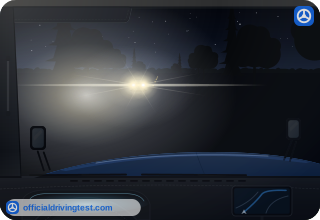
- Slightly to the right, at the lane or edge line
- Straight at the lights, to judge their distance
- Slightly to the left, at the center line
Show answer
Correct answer: Slightly to the right, at the lane or edge line
Looking at the right-side line keeps the glare out of your eyes while you still see where your lane goes.
Source: CDL manual, national model as printed by New Jersey, Sections 1 to 3 (July 2017)
-
An oncoming driver forgets to use low beams. What should you not do?
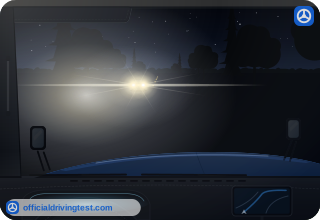
- Switch on your high beams in return
- Look to the right edge of the road
- Slow down and keep your lane position
Show answer
Correct answer: Switch on your high beams in return
Answering with high beams adds to the glare for oncoming drivers and makes a crash more likely.
Source: CDL manual, national model as printed by New Jersey, Sections 1 to 3 (July 2017)
-
What is the problem with always driving on low beams at night?
- It wears out the headlight bulbs faster
- It greatly reduces how far ahead you can see
- It makes other drivers dim their lights
Show answer
Correct answer: It greatly reduces how far ahead you can see
Low beams show much less road than high beams, so switch to high beams whenever it is safe and allowed.
Source: CDL manual, national model as printed by New Jersey, Sections 1 to 3 (July 2017)
-
How should the lights inside the cab be set for night driving?
- Interior light on, gauge lights at full brightness
- Interior light off, gauge lights as low as still readable
- Interior light dim, gauge lights switched off
Show answer
Correct answer: Interior light off, gauge lights as low as still readable
A bright cab makes it harder to see outside, so keep the cab dark enough while you can still read the gauges.
Source: CDL manual, national model as printed by New Jersey, Sections 1 to 3 (July 2017)
-
What can you do to check whether you are too sleepy to drive?
- Count the miles you drove since your last stop
- Look at yourself in a mirror when it is safe
- Turn the radio up and see if you notice it
Show answer
Correct answer: Look at yourself in a mirror when it is safe
People often do not notice how close they are to falling asleep, so a look in the mirror can show it.
Source: CDL manual, national model as printed by New Jersey, Sections 1 to 3 (July 2017)
-
You see fog ahead on the highway. What should you not assume?
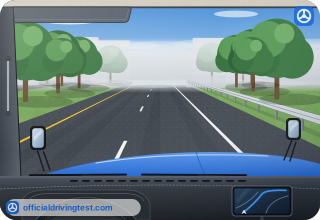
- That your speed should be reduced
- That visibility can drop quickly
- That the fog will thin out as you go in
Show answer
Correct answer: That the fog will thin out as you go in
Fog often appears without warning and visibility can get worse fast, so slow down before you enter.
Source: CDL manual, national model as printed by New Jersey, Sections 1 to 3 (July 2017)
-
What is the best way to deal with fog if you can?
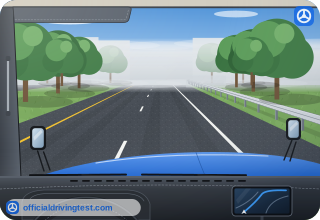
- Follow a vehicle ahead of you closely
- Stay off the road in a rest area until it clears
- Drive through it quickly to get out of it
Show answer
Correct answer: Stay off the road in a rest area until it clears
The safest choice is not to drive in fog. Wait in a rest area or truck stop until you can see better.
Source: CDL manual, national model as printed by New Jersey, Sections 1 to 3 (July 2017)
-
When should you reduce speed for fog ahead?
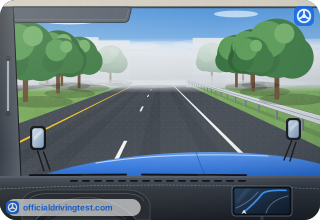
- After you are inside the fog
- Only if the fog gets thick
- Before you enter the fog
Show answer
Correct answer: Before you enter the fog
Visibility can drop quickly in fog, so your speed should already be lower when you enter it.
Source: CDL manual, national model as printed by New Jersey, Sections 1 to 3 (July 2017)
-
Which lights give the best visibility when you must drive in fog?
- High beams used alone
- Parking lamps used alone
- Low beams plus fog lights
Show answer
Correct answer: Low beams plus fog lights
Low beams with fog lights work best in fog, even by day.
Source: CDL manual, national model as printed by New Jersey, Sections 1 to 3 (July 2017)
-
In fog, what should you watch for among other drivers?
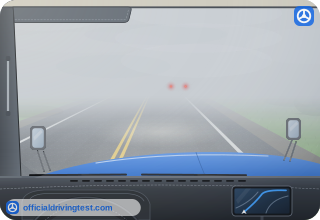
- Drivers who forgot to turn their lights on
- Drivers who use their high beams on purpose
- Drivers who keep a long following distance
Show answer
Correct answer: Drivers who forgot to turn their lights on
Some drivers may not have lit their lights in fog, so they are even harder to see.
Source: CDL manual, national model as printed by New Jersey, Sections 1 to 3 (July 2017)
-
Why turn on your 4-way flashers when driving in fog?
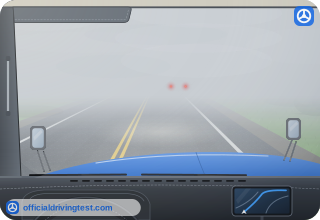
- So oncoming drivers know you will turn
- So drivers behind notice you sooner
- So you do not have to use low beams
Show answer
Correct answer: So drivers behind notice you sooner
Flashers help vehicles coming up behind you see your vehicle more quickly in poor visibility.
Source: CDL manual, national model as printed by New Jersey, Sections 1 to 3 (July 2017)
-
In fog you see taillights ahead of you. What should you keep in mind?
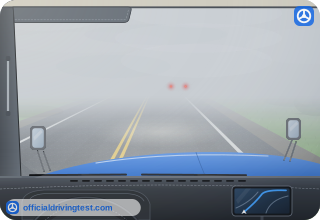
- That vehicle is safely on the road and shows its direction
- That vehicle may be off the road, so its lights may not show the road
- That vehicle is at a safe following distance
Show answer
Correct answer: That vehicle may be off the road, so its lights may not show the road
A vehicle you see in fog may be at the side of the road or off it, so do not follow its lights as if they marked the road.
Source: CDL manual, national model as printed by New Jersey, Sections 1 to 3 (July 2017)
-
In fog, what can help you tell how the road curves ahead?
- The brake lights of the vehicle ahead
- The roadside highway reflectors
- The center line seen in your headlights
Show answer
Correct answer: The roadside highway reflectors
Roadside reflectors mark the edge of the road and show how it bends when you cannot see far.
Source: CDL manual, national model as printed by New Jersey, Sections 1 to 3 (July 2017)
-
You must drive in fog. What should you do about passing other vehicles?
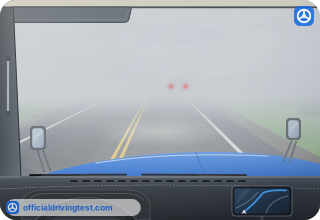
- Pass quickly with your 4-way flashers on
- Avoid passing them
- Pass only on straight stretches
Show answer
Correct answer: Avoid passing them
Passing in fog is risky because you cannot see far, so avoid it.
Source: CDL manual, national model as printed by New Jersey, Sections 1 to 3 (July 2017)
-
In fog, when may you stop along the side of the road?
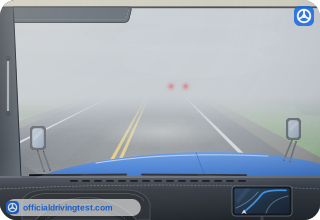
- Only when it is absolutely necessary
- Whenever you want a short rest
- Whenever you need to check your map
Show answer
Correct answer: Only when it is absolutely necessary
Stopping at the roadside in fog is avoided unless there is no choice.
Source: CDL manual, national model as printed by New Jersey, Sections 1 to 3 (July 2017)