General Knowledge: Controlling speed — Part 2
Questions in this part include: “Why is a road especially slippery just after rain begins?” · “At night you have to use low beams. What should you do with your speed?”
Independent educational site · not affiliated with any government agency or DMV
Ready? Test yourself
Answer to start, or tap Start below:
At what low speed can hydroplaning begin when there is a lot of water on the road?
- Instant feedback with an explanation
- Every answer cites its source in the manual
- Your best score is saved on this device
- Keyboard: press 1 to 3 to answer and Enter for the next question
Questions are written in our own words from the CDL manual; they are not the real test's questions. With your state chosen, every answer gives its page in your state's CDL manual. Without a state, answers cite the CDL manual, national model as printed by New Jersey (July 2017).
All 21 questions in this practice test
Take the test above first, then use this list to study. Tap “Show answer” to see the correct answer and explanation.
Show the questions and answersHide the questions
-
Why is a road especially slippery just after rain begins?
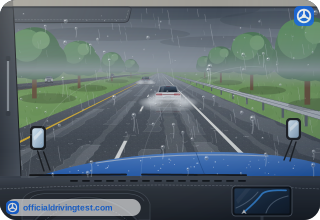
- Rain washes sand onto the road surface
- Rain softens the paint on the lane lines
- Water mixes with oil left by vehicles
Show answer
Correct answer: Water mixes with oil left by vehicles
Early rain mixes with oil on the road and makes it very slippery. Continued rain washes the oil away.
Source: CDL manual, national model as printed by New Jersey, Sections 1 to 3 (July 2017)
-
Your truck is hydroplaning. What should you do to regain control?
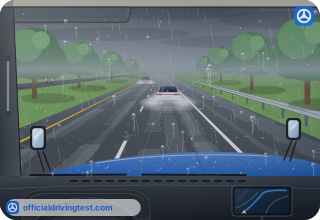
- Brake firmly to slow down quickly
- Ease off the gas and push in the clutch
- Steer sharply toward the road shoulder
Show answer
Correct answer: Ease off the gas and push in the clutch
Easing off the accelerator and pushing in the clutch lets the wheels spin freely and slows the truck. Never brake to slow down.
Source: CDL manual, national model as printed by New Jersey, Sections 1 to 3 (July 2017)
-
At what low speed can hydroplaning begin when there is a lot of water on the road?
- As low as 30 mph
- As low as 15 mph
- As low as 45 mph
Show answer
Correct answer: As low as 30 mph
With enough water, tires can lose contact with the road at speeds as low as 30 mph.
Source: CDL manual, national model as printed by New Jersey, Sections 1 to 3 (July 2017)
-
Which tire condition makes hydroplaning more likely?
- Tires with low pressure or worn tread
- Tires inflated slightly above the usual pressure
- Tires with new, deep tread
Show answer
Correct answer: Tires with low pressure or worn tread
Low pressure or worn tread makes hydroplaning more likely, because shallow grooves cannot carry water away well.
Source: CDL manual, national model as printed by New Jersey, Sections 1 to 3 (July 2017)
-
Which sight on the road tells you that standing water may be present?
- Dust blowing across the lanes
- Faded paint on the lane lines
- Tire splashes from other vehicles
Show answer
Correct answer: Tire splashes from other vehicles
Standing water shows up as clear reflections, splashes from tires and raindrops on the road surface.
Source: CDL manual, national model as printed by New Jersey, Sections 1 to 3 (July 2017)
-
A vehicle takes a curve too fast and its tires lose traction. What happens?
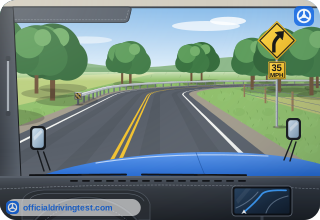
- The engine stalls and the vehicle stops dead
- It goes straight ahead and skids off the road
- The trailer brakes lock up without any braking
Show answer
Correct answer: It goes straight ahead and skids off the road
Too much speed in a curve can make the tires lose traction, so the vehicle goes straight ahead and off the road. The other risk is a rollover.
Source: CDL manual, national model as printed by New Jersey, Sections 1 to 3 (July 2017)
-
A truck with a high center of gravity takes a curve at the posted limit. What is the risk?
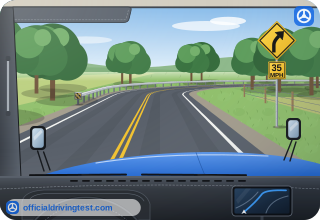
- Its brakes may overheat
- Its engine may stall
- It may roll over
Show answer
Correct answer: It may roll over
Tall-centered trucks may tip over even when they stay within the limit shown for the curve.
Source: CDL manual, national model as printed by New Jersey, Sections 1 to 3 (July 2017)
-
Why finish slowing before entering a curve instead of braking in it?
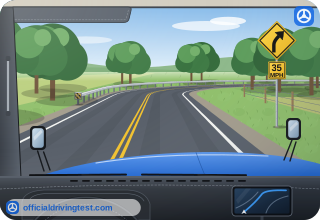
- Brake lights are hard to see from behind in a curve
- Brakes use more air when the truck leans over
- Braking in a curve can lock wheels and start a skid
Show answer
Correct answer: Braking in a curve can lock wheels and start a skid
It is easier to lock the wheels while braking in a curve, which can cause a skid, so be at a safe speed first.
Source: CDL manual, national model as printed by New Jersey, Sections 1 to 3 (July 2017)
-
What gear should you be in as you go through a curve?
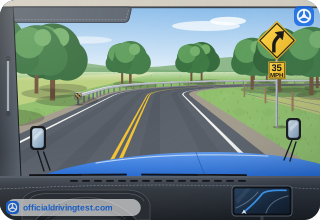
- A gear that lets you speed up slightly
- Neutral, so the truck can coast
- The highest gear to save the engine
Show answer
Correct answer: A gear that lets you speed up slightly
Being in a gear that lets you accelerate slightly in the curve helps you keep control.
Source: CDL manual, national model as printed by New Jersey, Sections 1 to 3 (July 2017)
-
In fog or rain, within what distance should you always be able to stop?
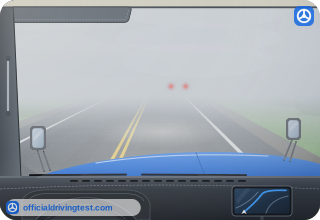
- Within a distance set by the posted limit
- Within the distance to the next intersection
- Within the distance you can see ahead
Show answer
Correct answer: Within the distance you can see ahead
Slow down whenever conditions shorten how far you can see, so you can always stop within the distance you can see.
Source: CDL manual, national model as printed by New Jersey, Sections 1 to 3 (July 2017)
-
At night you have to use low beams. What should you do with your speed?

- Speed up to clear the dark stretch sooner
- Keep your speed and watch the road edge
- Slow down to match the shorter view
Show answer
Correct answer: Slow down to match the shorter view
Low beams light less road than high beams, so slow down.
Source: CDL manual, national model as printed by New Jersey, Sections 1 to 3 (July 2017)
-
Which speed is safest when driving in heavy traffic?
- A little faster than other vehicles
- The speed of the other vehicles
- A little slower than other vehicles
Show answer
Correct answer: The speed of the other vehicles
Vehicles traveling the same way at the same speed rarely collide, provided that speed is legal and safe.
Source: CDL manual, national model as printed by New Jersey, Sections 1 to 3 (July 2017)
-
In many states trucks and buses have lower speed limits than cars. By how much can the limits differ?
- As much as 5 mph
- As much as 15 mph
- As much as 25 mph
Show answer
Correct answer: As much as 15 mph
The truck and bus limit can be as much as 15 mph below the car limit, so take extra care when changing lanes or passing.
Source: CDL manual, national model as printed by New Jersey, Sections 1 to 3 (July 2017)
-
Why is driving faster than the flow of traffic usually not worth it?
- It saves little time and adds risk and fatigue
- It saves time but wears out tires faster
- It saves time but burns much more fuel
Show answer
Correct answer: It saves little time and adds risk and fatigue
Speeding past traffic gains almost no time. You must keep passing vehicles, which raises crash risk and tires you.
Source: CDL manual, national model as printed by New Jersey, Sections 1 to 3 (July 2017)
-
A sign on a downgrade shows a Maximum Safe Speed. What does that speed mean for you?
- You may exceed it briefly if you brake early
- Never go faster than the speed shown
- It applies only to cars, not heavy vehicles
Show answer
Correct answer: Never go faster than the speed shown
Never exceed a posted speed limit or a Maximum Safe Speed on a downgrade.
Source: CDL manual, national model as printed by New Jersey, Sections 1 to 3 (July 2017)
-
What is the main tool for controlling speed on a long downgrade?
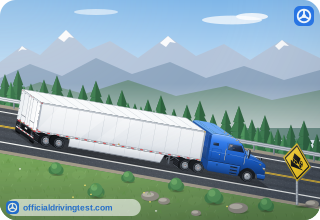
- Light, steady pressure on the service brake
- Repeated stabs on the parking brake
- The braking effect of the engine
Show answer
Correct answer: The braking effect of the engine
Engine braking should do the main work on downgrades, keeping the brakes in reserve for what traffic needs.
Source: CDL manual, national model as printed by New Jersey, Sections 1 to 3 (July 2017)
-
When is the braking effect of the engine strongest?
- Near the governed rpms in a lower gear
- Near idle speed in the highest gear
- Near idle speed with the clutch pushed in
Show answer
Correct answer: Near the governed rpms in a lower gear
Engine braking is strongest when the engine runs near its governed rpms with the transmission in a lower gear.
Source: CDL manual, national model as printed by New Jersey, Sections 1 to 3 (July 2017)
-
When should you shift to a low gear for a long downgrade?
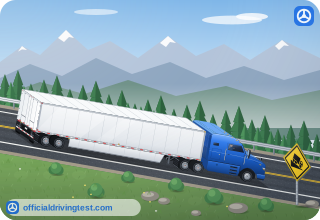
- After the truck picks up speed on the way down
- Before you start down the grade
- Only when the brakes begin to fade
Show answer
Correct answer: Before you start down the grade
Select a low gear before you begin the descent so the engine can hold your speed and the brakes are saved.
Source: CDL manual, national model as printed by New Jersey, Sections 1 to 3 (July 2017)
-
Which factor causes the most injuries and deaths in roadway work zones?
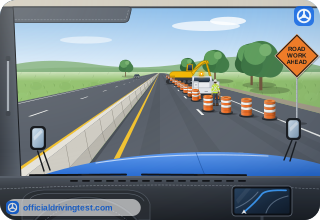
- Poor lighting at night
- Speeding traffic
- Narrow lanes
Show answer
Correct answer: Speeding traffic
Speeding traffic tops the list in work zones, so obey the posted limit the whole way through.
Source: CDL manual, national model as printed by New Jersey, Sections 1 to 3 (July 2017)
-
What should you do about your speed in a long stretch of road construction?
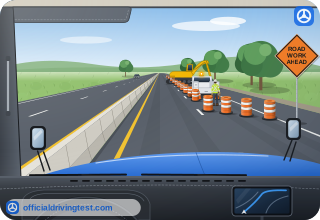
- Match the speed of the fastest vehicles nearby
- Check your speed only at the work zone entrance
- Check the speedometer so your speed does not creep up
Show answer
Correct answer: Check the speedometer so your speed does not creep up
Long construction sections make speed creep up unnoticed, so keep watching the speedometer.
Source: CDL manual, national model as printed by New Jersey, Sections 1 to 3 (July 2017)
-
A worker is standing near the lane you are driving through in a work zone. What is the right move?
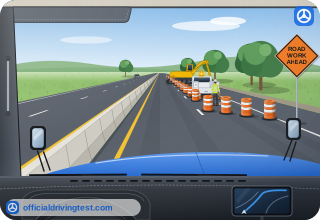
- Slow down even further
- Move over and keep the same speed
- Sound the horn to warn the worker
Show answer
Correct answer: Slow down even further
Cut your speed again when workers are near the road, beyond slowing for weather and road conditions.
Source: CDL manual, national model as printed by New Jersey, Sections 1 to 3 (July 2017)