General Knowledge: Managing space — Part 1
Questions in this part include: “Why does a safe driver want open space all around the vehicle?” · “When is it right to pass another slow vehicle while going uphill?”
Independent educational site · not affiliated with any government agency or DMV
Ready? Test yourself
Answer to start, or tap Start below:
Why does a safe driver want open space all around the vehicle?
- Instant feedback with an explanation
- Every answer cites its source in the manual
- Your best score is saved on this device
- Keyboard: press 1 to 3 to answer and Enter for the next question
Questions are written in our own words from the CDL manual; they are not the real test's questions. With your state chosen, every answer gives its page in your state's CDL manual. Without a state, answers cite the CDL manual, national model as printed by New Jersey (July 2017).
All 22 questions in this practice test
Take the test above first, then use this list to study. Tap “Show answer” to see the correct answer and explanation.
Show the questions and answersHide the questions
-
Why does a safe driver want open space all around the vehicle?
- It gives you time to think and act if something goes wrong
- It lets you drive at a higher speed in traffic
- It keeps other drivers from changing lanes near you
Show answer
Correct answer: It gives you time to think and act if something goes wrong
Open space around the vehicle buys time to think and react when a problem appears.
Source: CDL manual, national model as printed by New Jersey, Sections 1 to 3 (July 2017)
-
Why is managing space especially important for large vehicles?
- They are harder for other drivers to see at night
- They take up more room and need more room to stop and turn
- They travel faster than most cars on the highway
Show answer
Correct answer: They take up more room and need more room to stop and turn
A large vehicle fills more space and needs more room to stop and to turn, so managing space matters most for it.
Source: CDL manual, national model as printed by New Jersey, Sections 1 to 3 (July 2017)
-
Of all the space around your vehicle, which area matters most?
- The area ahead of the vehicle
- The area behind the vehicle
- The area on either side of the vehicle
Show answer
Correct answer: The area ahead of the vehicle
The space ahead, the space you are driving into, is the most important one.
Source: CDL manual, national model as printed by New Jersey, Sections 1 to 3 (July 2017)
-
According to accident reports, which vehicle do trucks and buses most often run into?
- The vehicle in front of them
- A vehicle passing on the left
- A vehicle parked at the roadside
Show answer
Correct answer: The vehicle in front of them
Accident reports show trucks and buses most often hit the vehicle ahead of them.
Source: CDL manual, national model as printed by New Jersey, Sections 1 to 3 (July 2017)
-
What is the most frequent cause of a truck or bus running into the vehicle ahead?
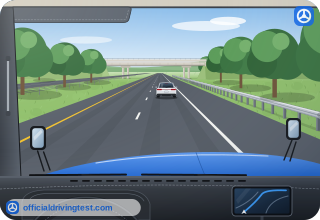
- Following too closely
- Poorly adjusted mirrors
- Driving with worn brake linings
Show answer
Correct answer: Following too closely
Following too closely is the most frequent cause, because it leaves no room to stop suddenly.
Source: CDL manual, national model as printed by New Jersey, Sections 1 to 3 (July 2017)
-
A smaller vehicle is driving in front of your truck. What is likely true about its stopping?
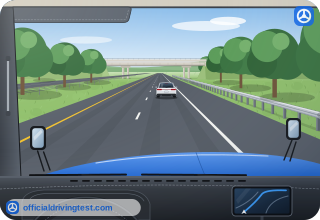
- It can usually stop in less distance than you can
- It needs a longer distance to stop than you do
- It stops in the same distance as your vehicle
Show answer
Correct answer: It can usually stop in less distance than you can
A smaller vehicle can usually stop faster, so following it too closely can lead to a crash.
Source: CDL manual, national model as printed by New Jersey, Sections 1 to 3 (July 2017)
-
At speeds below 40 mph, how much following time do you need for each 10 feet of vehicle length?
- Two seconds
- One second
- Half a second
Show answer
Correct answer: One second
Allow at least one second for every 10 feet of vehicle length when driving under 40 mph.
Source: CDL manual, national model as printed by New Jersey, Sections 1 to 3 (July 2017)
-
How many seconds should you leave behind the vehicle ahead when driving a 60-foot rig faster than 40 mph?
- 7 seconds
- 6 seconds
- 8 seconds
Show answer
Correct answer: 7 seconds
Over 40 mph you add 1 second to the one-second-per-10-feet rule, so a 60-foot rig needs 7 seconds.
Source: CDL manual, national model as printed by New Jersey, Sections 1 to 3 (July 2017)
-
How can you check how much space you are leaving ahead of you?
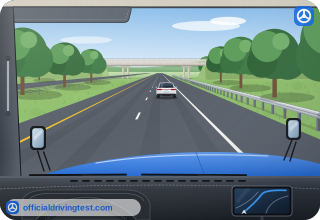
- Compare your speed with the posted speed limit
- Judge it by how big the vehicle looks in your mirror
- Count seconds from a landmark the vehicle ahead passes
Show answer
Correct answer: Count seconds from a landmark the vehicle ahead passes
Pick a clear landmark such as a shadow or a pavement marking, count the seconds until you reach it, and compare the count with the rule.
Source: CDL manual, national model as printed by New Jersey, Sections 1 to 3 (July 2017)
-
How should your following space change when the road is slippery?
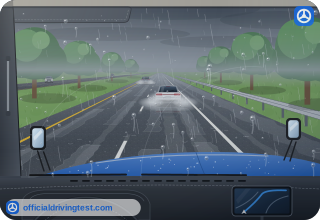
- Keep the same space as on a dry road
- Leave much more space
- Leave a little more space than usual
Show answer
Correct answer: Leave much more space
A slippery road makes stopping much harder, so the space you need grows a lot.
Source: CDL manual, national model as printed by New Jersey, Sections 1 to 3 (July 2017)
-
A heavy load is slowing your truck on a hill. Which lane should you use if you can?
- The left lane
- The center of the road
- The right lane
Show answer
Correct answer: The right lane
Slow heavy vehicles are often tailgated, so stay in the right lane when you are being slowed by the load.
Source: CDL manual, national model as printed by New Jersey, Sections 1 to 3 (July 2017)
-
When is it right to pass another slow vehicle while going uphill?
- Only when you can get around quickly and safely
- Whenever the lane to your left is clear
- Any time you are driving a lightly loaded vehicle
Show answer
Correct answer: Only when you can get around quickly and safely
Going uphill, a heavy vehicle should pass only if it can get around the other vehicle quickly and safely.
Source: CDL manual, national model as printed by New Jersey, Sections 1 to 3 (July 2017)
-
What often happens behind you when you travel slowly?
- Drivers behind you usually honk until you pull over
- Drivers stuck behind you often follow too closely
- Drivers behind you usually pass at once
Show answer
Correct answer: Drivers stuck behind you often follow too closely
Drivers who are stuck behind a slow vehicle tend to crowd it, so slow travel invites tailgating.
Source: CDL manual, national model as printed by New Jersey, Sections 1 to 3 (July 2017)
-
When do many car drivers follow large vehicles too closely?
- On dry roads at night with little traffic
- When the large vehicle speeds up on a downgrade
- In bad weather when the road ahead is hard to see
Show answer
Correct answer: In bad weather when the road ahead is hard to see
In bad weather, car drivers often stay close behind a large vehicle because they cannot see the road ahead well.
Source: CDL manual, national model as printed by New Jersey, Sections 1 to 3 (July 2017)
-
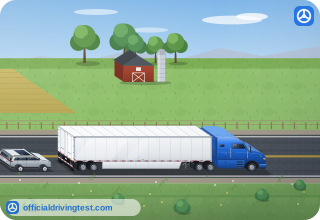
A driver is tailgating you and you must slow down or turn. What should you do?
- Brake hard so the tailgater backs away
- Signal early and slow down very gradually
- Stay at speed until the last moment, then turn
Show answer
Correct answer: Signal early and slow down very gradually
Quick changes surprise a tailgater. Signal early and reduce speed gradually.
Source: CDL manual, national model as printed by New Jersey, Sections 1 to 3 (July 2017)
-
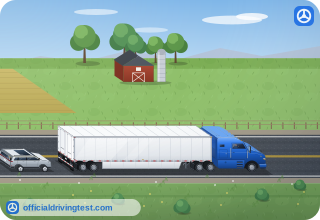
A vehicle is tailgating you. How should you change your own following distance?
- Decrease it
- Increase it
- Keep it the same
Show answer
Correct answer: Increase it
Extra room ahead lets you avoid sudden changes in speed or direction and gives the tailgater a chance to pass.
Source: CDL manual, national model as printed by New Jersey, Sections 1 to 3 (July 2017)
-
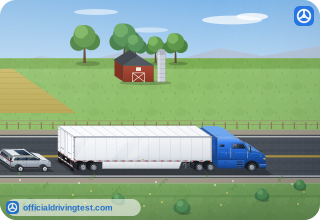
If you are being tailgated, which is safer?
- Being tailgated at a high speed
- Being tailgated at a low speed
- Both are equally safe
Show answer
Correct answer: Being tailgated at a low speed
Do not speed up to get away from a tailgater. A tailgater at a low speed is safer than one at a high speed.
Source: CDL manual, national model as printed by New Jersey, Sections 1 to 3 (July 2017)
-
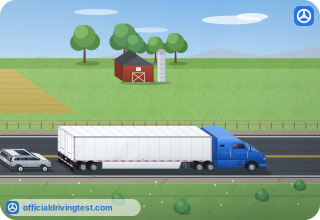
Which action should you avoid when a vehicle is tailgating you?
- Signaling early before slowing or turning
- Flashing your brake lights at the driver
- Opening up more room in front of you
Show answer
Correct answer: Flashing your brake lights at the driver
Tricks such as flashing brake lights do not help. Signal early, reduce speed gradually and add following distance instead.
Source: CDL manual, national model as printed by New Jersey, Sections 1 to 3 (July 2017)
-
How do you keep safe clearance on both sides of a wide commercial vehicle?
- Keep the vehicle centered in the lane
- Drive near the right edge of the lane
- Drive near the center line to see better
Show answer
Correct answer: Keep the vehicle centered in the lane
A wide vehicle has little room to spare, so keep it centered in the lane.
Source: CDL manual, national model as printed by New Jersey, Sections 1 to 3 (July 2017)
-
Which danger comes from driving next to another vehicle in traffic?
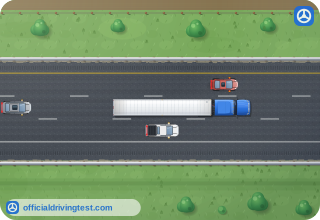
- The other driver may brake hard and stop in your lane
- The other driver may suddenly move into you
- The other driver may run onto the shoulder ahead of you
Show answer
Correct answer: The other driver may suddenly move into you
A driver beside you can change lanes without warning and steer into your vehicle.
Source: CDL manual, national model as printed by New Jersey, Sections 1 to 3 (July 2017)
-
What is one danger of driving alongside other vehicles?
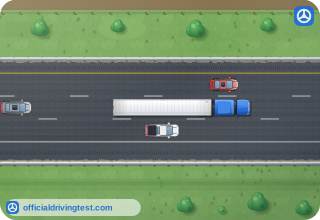
- You can get boxed in when you want to change lanes
- Your mirrors will not show the road behind
- Your vehicle will use much more fuel
Show answer
Correct answer: You can get boxed in when you want to change lanes
Another driver can also cut into your lane without warning, and you may have nowhere to go when you need to move over.
Source: CDL manual, national model as printed by New Jersey, Sections 1 to 3 (July 2017)
-
Traffic is heavy and you must travel near other vehicles. What should you try to do?
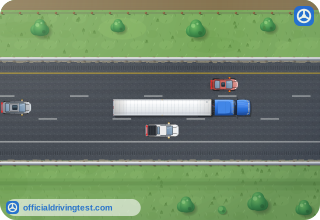
- Stay close alongside so none can squeeze in
- Match their speed and hold your position
- Keep as much room as you can between you and them
Show answer
Correct answer: Keep as much room as you can between you and them
With no open spot available, leave as much space as possible between your vehicle and the others.
Source: CDL manual, national model as printed by New Jersey, Sections 1 to 3 (July 2017)