General Knowledge: Basic control and shifting gears — Part 2
Questions in this part include: “A truck has a synchronized manual transmission. Does the driver need to double clutch?” · “Compared with the gear needed to climb a hill, what gear is usually right for going down it?”
Independent educational site · not affiliated with any government agency or DMV
Ready? Test yourself
Answer to start, or tap Start below:
A truck has a synchronized manual transmission. Does the driver need to double clutch?
- Instant feedback with an explanation
- Every answer cites its source in the manual
- Your best score is saved on this device
- Keyboard: press 1 to 3 to answer and Enter for the next question
Questions are written in our own words from the CDL manual; they are not the real test's questions. With your state chosen, every answer gives its page in your state's CDL manual. Without a state, answers cite the CDL manual, national model as printed by New Jersey (July 2017).
All 23 questions in this practice test
Take the test above first, then use this list to study. Tap “Show answer” to see the correct answer and explanation.
Show the questions and answersHide the questions
-
A truck has a synchronized manual transmission. Does the driver need to double clutch?
- No, it is not required
- Yes, but only when shifting down
- Yes, in every gear change
Show answer
Correct answer: No, it is not required
Double clutching is not required with a synchronized manual transmission.
Source: CDL manual, national model as printed by New Jersey, Sections 1 to 3 (July 2017)
-
What is the first move in the basic method for shifting up?
- Let off the accelerator, push in the clutch and go to neutral together
- Shift to neutral first, then let off the accelerator and push in the clutch
- Push in the clutch and shift to neutral, then let off the accelerator
Show answer
Correct answer: Let off the accelerator, push in the clutch and go to neutral together
The first move is a single combined action: release the accelerator, push in the clutch and shift to neutral together.
Source: CDL manual, national model as printed by New Jersey, Sections 1 to 3 (July 2017)
-
When shifting up with the basic method, what happens after you release the clutch in neutral?
- Press the accelerator to speed up the engine
- Push the clutch in again and hold it down
- Let the engine and gears slow to the next gear's rpm
Show answer
Correct answer: Let the engine and gears slow to the next gear's rpm
After the clutch is released in neutral, you wait while the engine and gears lose speed to the rpm the higher gear needs.
Source: CDL manual, national model as printed by New Jersey, Sections 1 to 3 (July 2017)
-
You waited too long in neutral and the next gear will not go in. What should you do?
- Push the shift lever harder until it goes in
- Stop the truck completely and turn the engine off, then start the shift over
- Shift back to neutral, let the clutch out, rev the engine to road speed, then retry
Show answer
Correct answer: Shift back to neutral, let the clutch out, rev the engine to road speed, then retry
Forcing the gear is the wrong move. Shift back to neutral, let the clutch out, bring engine speed up to road speed, then retry.
Source: CDL manual, national model as printed by New Jersey, Sections 1 to 3 (July 2017)
-
If you decide when to shift up by engine speed, when do you shift?
- At the middle of the operating rpm range
- At the bottom of the operating rpm range
- At the top of the operating rpm range
Show answer
Correct answer: At the top of the operating rpm range
Learn the operating rpm range for your vehicle, watch the tachometer, and shift up when the engine reaches the top of that range.
Source: CDL manual, national model as printed by New Jersey, Sections 1 to 3 (July 2017)
-
On a vehicle that uses progressive shifting, how does the shift rpm change as you move up through the gears?
- It becomes lower in each higher gear
- It becomes higher in each higher gear
- It stays the same in every gear
Show answer
Correct answer: It becomes higher in each higher gear
With this style of shifting, the rpm for each shift rises the higher you go through the gears.
Source: CDL manual, national model as printed by New Jersey, Sections 1 to 3 (July 2017)
-
Which instrument do you watch if you time your upshifts by road speed?
- The tachometer
- The air pressure gauge
- The speedometer
Show answer
Correct answer: The speedometer
When shifting by road speed, you learn the speeds each gear suits and use the speedometer to tell when to shift up.
Source: CDL manual, national model as printed by New Jersey, Sections 1 to 3 (July 2017)
-
Besides instruments, what can a driver learn to use to know when to shift?
- The feel of the clutch pedal
- The sound of the engine
- The shaking of the steering wheel
Show answer
Correct answer: The sound of the engine
With either the rpm method or the road speed method, a driver can learn to judge shift points by the sound of the engine.
Source: CDL manual, national model as printed by New Jersey, Sections 1 to 3 (July 2017)
-
When shifting down with the basic method, what do you do after releasing the clutch in neutral?
- Let the engine and gears slow down further
- Press the accelerator to raise engine speed to the lower gear's rpm
- Brake hard until the truck slows to the lower gear's speed
Show answer
Correct answer: Press the accelerator to raise engine speed to the lower gear's rpm
For a downshift you raise engine and gear speed with the accelerator to the rpm the lower gear needs before you push in the clutch and shift.
Source: CDL manual, national model as printed by New Jersey, Sections 1 to 3 (July 2017)
-
Which instruments can tell you when to downshift?
- The tachometer or the air gauge
- The tachometer or the speedometer
- The speedometer or the oil gauge
Show answer
Correct answer: The tachometer or the speedometer
Downshifting, like upshifting, can be timed by rpm on the tachometer or by road speed on the speedometer.
Source: CDL manual, national model as printed by New Jersey, Sections 1 to 3 (July 2017)
-
Why must you downshift before going down a hill?
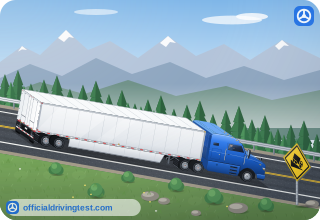
- So the brakes do not overheat and lose braking power
- So the engine uses less fuel on the way down
- So the tires wear less on the way down
Show answer
Correct answer: So the brakes do not overheat and lose braking power
If you go down a hill too fast in a high gear, you have to brake hard. Hard braking can overheat the brakes so they lose their power.
Source: CDL manual, national model as printed by New Jersey, Sections 1 to 3 (July 2017)
-
Compared with the gear needed to climb a hill, what gear is usually right for going down it?
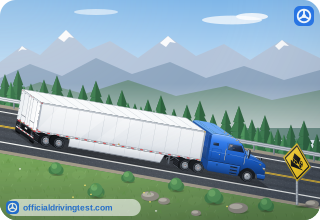
- The same gear
- A higher gear
- A lower gear
Show answer
Correct answer: A lower gear
The gear for the descent is usually lower than the gear needed to climb the same hill.
Source: CDL manual, national model as printed by New Jersey, Sections 1 to 3 (July 2017)
-
When should you downshift for a curve?
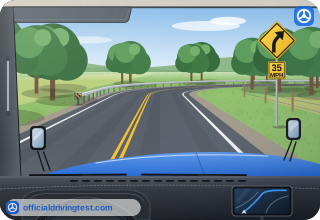
- While you are in the middle of the curve
- After you come out of the curve
- Before you enter the curve
Show answer
Correct answer: Before you enter the curve
Slowing down and downshifting early keeps some engine power available in the curve, which keeps the vehicle steadier and lets you accelerate sooner.
Source: CDL manual, national model as printed by New Jersey, Sections 1 to 3 (July 2017)
-
How do you usually control a multi-speed rear axle or an auxiliary transmission?
- With a selector on the main gearshift lever
- With a pedal beside the clutch
- With a lever mounted on the steering column
Show answer
Correct answer: With a selector on the main gearshift lever
These extra-gear units are normally operated from a selector knob or switch found on the main transmission gearshift lever.
Source: CDL manual, national model as printed by New Jersey, Sections 1 to 3 (July 2017)
-
Why would you select a low range on an automatic transmission?
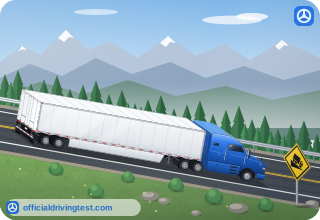
- To get greater engine braking on a downgrade
- To get quicker acceleration on a flat road
- To stop the transmission from using the governor
Show answer
Correct answer: To get greater engine braking on a downgrade
In a low range the transmission normally will not go above the gear you picked, unless the governor rpm is exceeded, so the engine does more of the braking on a downgrade.
Source: CDL manual, national model as printed by New Jersey, Sections 1 to 3 (July 2017)
-
In a selected low range, when can an automatic transmission still shift up past that gear?
- When the driver lets off the accelerator
- When the governor rpm is exceeded
- When the road becomes level
Show answer
Correct answer: When the governor rpm is exceeded
A low range holds the gear except when the governor rpm is exceeded.
Source: CDL manual, national model as printed by New Jersey, Sections 1 to 3 (July 2017)
-
What benefit do retarders give your service brakes?
- Less brake wear
- Shorter stopping distance on dry roads
- More air pressure in the system
Show answer
Correct answer: Less brake wear
Because a retarder helps slow the vehicle, the service brakes are needed less and wear less.
Source: CDL manual, national model as printed by New Jersey, Sections 1 to 3 (July 2017)
-
Which list names the four basic types of retarders?
- Exhaust, engine, hydraulic and electric
- Exhaust, engine, air and mechanical
- Hydraulic, electric, spring and vacuum
Show answer
Correct answer: Exhaust, engine, hydraulic and electric
The four basic retarder types are exhaust, engine, hydraulic and electric.
Source: CDL manual, national model as printed by New Jersey, Sections 1 to 3 (July 2017)
-
How is a retarder switched on or off?
- The driver can turn it on or off
- Only a mechanic can turn it on or off
- Only the brake pedal can control it
Show answer
Correct answer: The driver can turn it on or off
The driver can turn any retarder on or off, and on some vehicles can also adjust its power.
Source: CDL manual, national model as printed by New Jersey, Sections 1 to 3 (July 2017)
-
When a retarder is turned on, when does it apply its braking power?
- Whenever the brake pedal is pressed lightly
- Whenever the accelerator is fully released
- Whenever the engine goes above its top rpm
Show answer
Correct answer: Whenever the accelerator is fully released
A retarder that is switched on brakes the drive wheels only, and does so each time the accelerator is fully released.
Source: CDL manual, national model as printed by New Jersey, Sections 1 to 3 (July 2017)
-
Which wheels does a retarder apply its braking power to?
- The steering wheels only
- The drive wheels only
- All wheels of the vehicle
Show answer
Correct answer: The drive wheels only
A retarder brakes only the drive wheels, which is why poor traction there can cause a skid.
Source: CDL manual, national model as printed by New Jersey, Sections 1 to 3 (July 2017)
-
Why should a driver learn where retarder use is permitted?
- Because retarders can be noisy
- Because retarders can overheat the brakes
- Because retarders use extra fuel in towns
Show answer
Correct answer: Because retarders can be noisy
Retarders can be noisy, so a driver should know where using them is allowed.
Source: CDL manual, national model as printed by New Jersey, Sections 1 to 3 (July 2017)
-
On which roads should you turn the retarder off?
- Wet, icy or snow covered roads
- Steep downhill roads with dry pavement
- Any road where you are driving slowly
Show answer
Correct answer: Wet, icy or snow covered roads
On slippery roads, poor traction at the drive wheels can let the retarder make them skid, so turn it off.
Source: CDL manual, national model as printed by New Jersey, Sections 1 to 3 (July 2017)