Doubles and Triples: Coupling and uncoupling doubles and triples — Part 2
Questions in this part include: “Once the dolly is attached and the lines are connected, what do you do with the rear trailer's landing gear?” · “Which latch must be released before the dolly can be pulled out from under the rear trailer?”
Independent educational site · not affiliated with any government agency or DMV
Ready? Test yourself
Answer to start, or tap Start below:
Once the dolly is attached and the lines are connected, what do you do with the rear trailer's landing gear?
- Instant feedback with an explanation
- Every answer cites its source in the manual
- Your best score is saved on this device
- Keyboard: press 1 to 3 to answer and Enter for the next question
Questions are written in our own words from the CDL manual; they are not the real test's questions. With your state chosen, every answer gives its page in your state's CDL manual. Without a state, answers cite the CDL manual, national model as printed by New Jersey (July 2017).
All 20 questions in this practice test
Take the test above first, then use this list to study. Tap “Show answer” to see the correct answer and explanation.
Show the questions and answersHide the questions
-
Once the dolly is attached and the lines are connected, what do you do with the rear trailer's landing gear?
- Leave it slightly lowered for support
- Raise it all the way up
- Lower it until it rests on the ground
Show answer
Correct answer: Raise it all the way up
The landing gear is fully raised before the rig is driven, after the earlier slight lift.
Source: CDL manual, national model as printed by New Jersey, Section 7 (July 2017)
-
How do you charge the trailer brakes before checking for air at the back?
- Pull the trailer hand valve all the way out
- Open the dolly tank petcock
- Push the air supply knob in
Show answer
Correct answer: Push the air supply knob in
Pushing the air supply knob in sends air back to the trailers so you can check at the rear.
Source: CDL manual, national model as printed by New Jersey, Section 7 (July 2017)
-
You open the emergency line shut-off at the back of the second trailer, but no air comes out. What does that tell you?
- Only the parking brake is affected
- The brakes will not work at all
- The air tank is simply full already
Show answer
Correct answer: The brakes will not work at all
Without air at the rear, the trailer brakes cannot operate, and the problem must be found before driving.
Source: CDL manual, national model as printed by New Jersey, Section 7 (July 2017)
-
You are about to uncouple the rear trailer of a set of twin trailers. How should the rig be parked?
- Straight, on firm and level ground
- Slightly angled, on a small slope
- Straight, on soft ground to hold it
Show answer
Correct answer: Straight, on firm and level ground
Before uncoupling, the rig must stand straight on ground that is firm and level, so nothing shifts or sinks while the trailers are separated.
Source: CDL manual, national model as printed by New Jersey, Section 7 (July 2017)
-
Once the twin-trailer rig is parked, what do you apply so it cannot move while you uncouple the rear trailer?
- The service brake pedal
- The parking brakes
- The trailer hand valve
Show answer
Correct answer: The parking brakes
You set the parking brakes so the whole rig stays still during the uncoupling work.
Source: CDL manual, national model as printed by New Jersey, Section 7 (July 2017)
-
When must you chock the wheels of the second trailer before uncoupling it?
- When the trailer has no spring brakes
- When the trailer is loaded heavily
- When the ground is slightly wet
Show answer
Correct answer: When the trailer has no spring brakes
When the second trailer has no spring brakes, its wheels are chocked before uncoupling.
Source: CDL manual, national model as printed by New Jersey, Section 7 (July 2017)
-
Why do you lower the landing gear of the second semitrailer before pulling the dolly out?
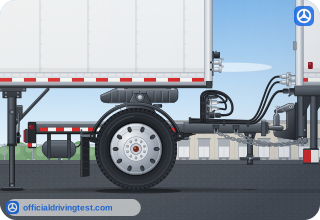
- To take some of the load off the dolly
- To release the dolly's spring brakes
- To open the dolly's air tank petcock
Show answer
Correct answer: To take some of the load off the dolly
The second semitrailer's landing gear is lowered just enough to take some weight off the dolly.
Source: CDL manual, national model as printed by New Jersey, Section 7 (July 2017)
-
Before you disconnect the dolly's air lines, what do you close at the back of the first semitrailer?
- The air tank drain valves
- The air shut-offs
- The glad hand couplers
Show answer
Correct answer: The air shut-offs
The shut-offs at the rear of the first semitrailer (and on the dolly, if it has them) are closed before the dolly's lines are disconnected.
Source: CDL manual, national model as printed by New Jersey, Section 7 (July 2017)
-
What should you do with the dolly's air and electric lines when you uncouple the rear trailer?
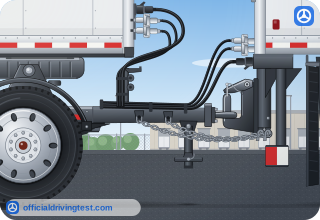
- Keep them connected until the dolly is unhitched
- Disconnect them and secure them
- Disconnect only the air lines
Show answer
Correct answer: Disconnect them and secure them
All the dolly's air and electric lines are disconnected and secured.
Source: CDL manual, national model as printed by New Jersey, Section 7 (July 2017)
-
Which latch must be released before the dolly can be pulled out from under the rear trailer?
- The pintle hook on the first semitrailer
- The converter dolly fifth wheel latch
- The kingpin lock on the tractor
Show answer
Correct answer: The converter dolly fifth wheel latch
The dolly's own fifth wheel holds the rear trailer's kingpin, so that latch is opened before the dolly leaves.
Source: CDL manual, national model as printed by New Jersey, Section 7 (July 2017)
-
How do you move the dolly out from under the rear semitrailer?
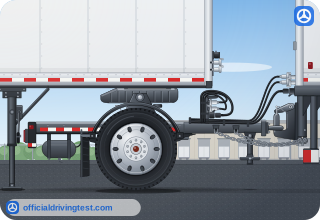
- Pull the tractor, first trailer and dolly forward slowly
- Roll the dolly out by hand at once
- Pull the tractor, first trailer and dolly forward quickly
Show answer
Correct answer: Pull the tractor, first trailer and dolly forward slowly
With the latch released, the tractor, first semitrailer and dolly are drawn forward slowly until the dolly is clear.
Source: CDL manual, national model as printed by New Jersey, Section 7 (July 2017)
-
After the dolly is out from under the rear trailer, what is the first step to uncouple the dolly itself?
- Release the pintle hook
- Lower the dolly's landing gear
- Disconnect the safety chains
Show answer
Correct answer: Lower the dolly's landing gear
The dolly's support legs are lowered first so it will stand on its own once it is free.
Source: CDL manual, national model as printed by New Jersey, Section 7 (July 2017)
-
When you uncouple the converter dolly from the first semitrailer, what do you do about the safety chains?
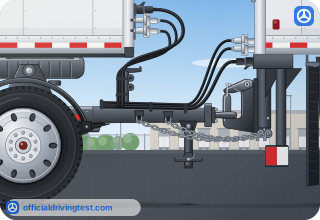
- Disconnect them
- Wrap them around the pintle hook
- Leave them on until you drive off
Show answer
Correct answer: Disconnect them
The safety chains between the dolly and the first semitrailer are disconnected as part of freeing the dolly.
Source: CDL manual, national model as printed by New Jersey, Section 7 (July 2017)
-
How do you keep the dolly from rolling once it is being uncoupled?
- Set the tractor parking brake only
- Apply its spring brakes or chocks
- Raise its landing gear fully
Show answer
Correct answer: Apply its spring brakes or chocks
The dolly has to be held in place, either by its spring brakes or by chocks under its wheels.
Source: CDL manual, national model as printed by New Jersey, Section 7 (July 2017)
-
What do you release on the first semitrailer to free the converter dolly from it?
- The dolly fifth wheel
- The pintle hook
- The kingpin
Show answer
Correct answer: The pintle hook
The dolly is hitched to the first semitrailer by its pintle hook, so releasing that hook frees it.
Source: CDL manual, national model as printed by New Jersey, Section 7 (July 2017)
-
What can happen if you unlock the pintle hook while the dolly is still under the rear trailer?
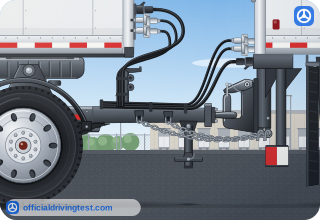
- The rear trailer's brakes lock up
- The dolly's air tank loses its pressure
- The tow bar can fly up and hurt someone
Show answer
Correct answer: The tow bar can fly up and hurt someone
The tow bar may spring up, which can injure someone and also makes it very hard to couple again.
Source: CDL manual, national model as printed by New Jersey, Section 7 (July 2017)
-
When you build a triple-trailer rig, how do you couple the tractor to the first trailer?
- With the usual tractor-semitrailer coupling method
- With the method for coupling a double bottom
- With the dolly attached to the tractor first
Show answer
Correct answer: With the usual tractor-semitrailer coupling method
The first step is an ordinary tractor-semitrailer coupling, done the same way as for any single semitrailer.
Source: CDL manual, national model as printed by New Jersey, Section 7 (July 2017)
-
After the tractor is coupled to the first trailer of a triples rig, how is the second trailer added?
- With a second fifth wheel on the first trailer
- With a dolly, using the method for coupling doubles
- By backing the tractor under the second trailer
Show answer
Correct answer: With a dolly, using the method for coupling doubles
A converter dolly is moved into place and the first trailer is coupled to the second the same way as in a set of doubles.
Source: CDL manual, national model as printed by New Jersey, Section 7 (July 2017)
-
What is done first when you uncouple a triple-trailer rig?
- The first dolly is lowered to the ground
- The dolly is pulled out from under the first trailer
- The third trailer is uncoupled by pulling its dolly out
Show answer
Correct answer: The third trailer is uncoupled by pulling its dolly out
You begin at the back: the dolly is pulled out from the third trailer and then unhitched, as you would for doubles.
Source: CDL manual, national model as printed by New Jersey, Section 7 (July 2017)
-
You will drive a truck-trailer combination that is not one of the common types. How do you learn the correct way to couple it?
- Copy the way another driver couples his rig
- Follow what the manufacturer or owner specifies
- Use the steps for the closest common type of rig
Show answer
Correct answer: Follow what the manufacturer or owner specifies
There are too many kinds of combinations for one method, so you learn the correct way from the manufacturer or the owner's specifications.
Source: CDL manual, national model as printed by New Jersey, Section 7 (July 2017)