Doubles and Triples: Inspecting doubles and triples and checking their air brakes
The extra checks on coupling areas, converter dollies, air and electrical lines and shut-off valves, and the air brake checks for doubles and triples.
Independent educational site · not affiliated with any government agency or DMV
Ready? Test yourself
Answer to start, or tap Start below:
How many steps are in the inspection method a driver uses on a doubles or triples rig?
- Instant feedback with an explanation
- Every answer cites its source in the manual
- Your best score is saved on this device
- Keyboard: press 1 to 3 to answer and Enter for the next question
Questions are written in our own words from the CDL manual; they are not the real test's questions. With your state chosen, every answer gives its page in your state's CDL manual. Without a state, answers cite the CDL manual, national model as printed by New Jersey (July 2017).
All 23 questions in this practice test
Take the test above first, then use this list to study. Tap “Show answer” to see the correct answer and explanation.
Show the questions and answersHide the questions
-
How many steps are in the inspection method a driver uses on a doubles or triples rig?
- Seven
- Five
- Nine
Show answer
Correct answer: Seven
A doubles or triples rig is inspected with the same seven-step method used for any vehicle, plus extra items for the added trailers.
Source: CDL manual, national model as printed by New Jersey, Section 7 (July 2017)
-
The extra coupling and landing gear checks for doubles and triples are added to which inspection step?
- The engine compartment step
- The lights check step
- The walk-around inspection step
Show answer
Correct answer: The walk-around inspection step
The extra coupling and trailer checks are added to the walk-around inspection, Step 5.
Source: CDL manual, national model as printed by New Jersey, Section 7 (July 2017)
-
When you check the lower fifth wheel, where should the locking jaws be closed on the kingpin?
- Around the shank
- Around the head
- Around the base plate
Show answer
Correct answer: Around the shank
The locking jaws must close around the shank of the kingpin, not its head.
Source: CDL manual, national model as printed by New Jersey, Section 7 (July 2017)
-
How should the air lines between the tractor and trailer be arranged for tight turns?
- With enough slack
- Pulled tight
- Left loose on the ground
Show answer
Correct answer: With enough slack
The lines must be fastened well but still have enough extra length so they are not stretched when the rig turns.
Source: CDL manual, national model as printed by New Jersey, Section 7 (July 2017)
-
What problem could happen if a sliding fifth wheel is set too far toward the front of the tractor?
- The trailer brakes could lose their air
- The cab could hit the trailer in a turn
- The kingpin could slip from the jaws
Show answer
Correct answer: The cab could hit the trailer in a turn
With the fifth wheel too far forward, the tractor frame can hit the landing gear or the cab can hit the trailer when turning.
Source: CDL manual, national model as printed by New Jersey, Section 7 (July 2017)
-
In which position should the service and emergency shut-off valves be at the back of a trailer that has another trailer behind it?
- Closed
- Half open
- Open
Show answer
Correct answer: Open
Air must pass through every front trailer to reach the trailers behind it, so those valves stay open.
Source: CDL manual, national model as printed by New Jersey, Section 7 (July 2017)
-
In which position should the shut-off valves be at the back of the very last trailer?
- Open
- Closed
- Open only the emergency one
Show answer
Correct answer: Closed
The last trailer's valves are closed so air does not escape from the end of the rig's brake lines.
Source: CDL manual, national model as printed by New Jersey, Section 7 (July 2017)
-
What position should the drain valve of the converter dolly's air tank be in when you inspect the rig?
- Closed
- Open
- Cracked open slightly
Show answer
Correct answer: Closed
An open drain valve would let air leak out of the dolly tank, so it must be shut.
Source: CDL manual, national model as printed by New Jersey, Section 7 (July 2017)
-
A spare tire is carried on the converter dolly. What do you check about it?
- That it is fastened down
- That it is fully inflated to 100 psi
- That it matches the tractor tires
Show answer
Correct answer: That it is fastened down
A spare tire riding on a dolly must be tied or bolted down so it cannot fall off.
Source: CDL manual, national model as printed by New Jersey, Section 7 (July 2017)
-
What must you confirm about the pintle hook when you inspect a dolly?
- It is set to its highest notch
- It is latched
- It is free of any grease
Show answer
Correct answer: It is latched
During the inspection, make sure the pintle hook is latched.
Source: CDL manual, national model as printed by New Jersey, Section 7 (July 2017)
-
Before you check that air flows to all trailers, how should the vehicle be held still?
- Foot on the service brake pedal only
- Trailer air supply knob left pulled out
- Tractor parking brake and/or chocked wheels
Show answer
Correct answer: Tractor parking brake and/or chocked wheels
Hold the rig with the tractor parking brake and/or wheel chocks, then wait for air pressure to reach normal before starting the check.
Source: CDL manual, national model as printed by New Jersey, Section 7 (July 2017)
-
When checking that air reaches every trailer, what does pushing in the red trailer air supply knob do?
- It sends air into the emergency (supply) lines
- It sends air into the service line only
- It releases the tractor's parking brake
Show answer
Correct answer: It sends air into the emergency (supply) lines
Pushing the red knob in charges the emergency (supply) lines going back to the trailers. The service line is fed separately.
Source: CDL manual, national model as printed by New Jersey, Section 7 (July 2017)
-
During the check that air flows to all trailers, how do you get air into the service line?
- Apply the trailer handbrake
- Pull out the trailer air supply knob
- Open the dolly air tank drain valve
Show answer
Correct answer: Apply the trailer handbrake
The trailer handbrake sends air into the service line, so you can test that service pressure reaches the last trailer.
Source: CDL manual, national model as printed by New Jersey, Section 7 (July 2017)
-
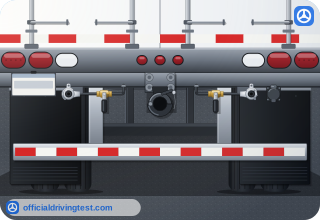
The system is charged and you open the last trailer's emergency line valve. What shows the whole system is charged?
- The trailer air supply knob pops out
- The low air warning stops sounding
- You hear air escaping from the valve
Show answer
Correct answer: You hear air escaping from the valve
Air rushing out of the last trailer's emergency line valve proves the whole system is charged all the way to the back.
Source: CDL manual, national model as printed by New Jersey, Section 7 (July 2017)
-
After closing the emergency line valve at the back, how do you check that service pressure reaches every trailer?
- Open the rear service line valve with a brake applied
- Pull the red trailer air supply knob out and hold it there
- Open the converter dolly air tank drain valve at the rear
Show answer
Correct answer: Open the rear service line valve with a brake applied
With the trailer handbrake or service pedal applied, open the service line valve at the rear and listen for air, then close it.
Source: CDL manual, national model as printed by New Jersey, Section 7 (July 2017)
-
You open the rear valves and hear no air escaping from both lines. What should you check?
- The slack adjusters are in correct adjustment
- The air compressor governor cut-out setting
- Trailer and dolly shut-off valves are open
Show answer
Correct answer: Trailer and dolly shut-off valves are open
The trailer and dolly shut-off valves must be open. Air has to reach all the way to the back for every brake to work.
Source: CDL manual, national model as printed by New Jersey, Section 7 (July 2017)
-
To test the tractor protection valve, how do you bring the tank air pressure down after charging the system?
- Open the tank drain valves a little
- Engine off, then pump the brake pedal
- Pull the trailer air supply knob out and wait
Show answer
Correct answer: Engine off, then pump the brake pedal
With the engine off, repeated pedal applications use up tank air until the valve should pop the control out.
Source: CDL manual, national model as printed by New Jersey, Section 7 (July 2017)
-
In a tractor protection valve test, the trailer air supply control should pop out when pressure drops into what usual range?
- 20 to 45 psi
- 45 to 80 psi
- 80 to 100 psi
Show answer
Correct answer: 20 to 45 psi
The control normally pops out somewhere between 20 and 45 psi, within the range the manufacturer sets.
Source: CDL manual, national model as printed by New Jersey, Section 7 (July 2017)
-
Why is a faulty tractor protection valve dangerous?
- It lets the trailer brakes release while you drive
- It stops the tractor from building air pressure
- A leak could drain tractor air and set emergency brakes
Show answer
Correct answer: A leak could drain tractor air and set emergency brakes
Without a working valve, a leak in a hose or trailer brake can empty the tractor's air, applying the emergency brakes and risking loss of control.
Source: CDL manual, national model as printed by New Jersey, Section 7 (July 2017)
-
Before pulling the trailer air supply control out to test the emergency brakes, what do you confirm?
- That the trailer rolls freely once the system is charged
- That the trailer air tanks are drained of all air
- That the trailer handbrake is applied firmly
Show answer
Correct answer: That the trailer rolls freely once the system is charged
Charge the system and confirm the trailer rolls freely. That way you know any holding you feel afterward comes from the emergency brakes.
Source: CDL manual, national model as printed by New Jersey, Section 7 (July 2017)
-
After you pull the trailer air supply control out, how do you test the trailer emergency brakes?
- Pump the brake pedal and watch the gauge
- Tug gently forward with the tractor
- Press the service pedal hard and hold it
Show answer
Correct answer: Tug gently forward with the tractor
With the supply control out, a gentle pull on the trailer should show the emergency brakes are holding it.
Source: CDL manual, national model as printed by New Jersey, Section 7 (July 2017)
-
What do you do to test the trailer service brakes?
- Roll slowly ahead, use the hand valve, feel it
- Pull the supply control out and stay parked
- Stop and open the rear emergency line valve
Show answer
Correct answer: Roll slowly ahead, use the hand valve, feel it
Moving slowly and applying the hand control should produce a noticeable braking feel, showing the trailer brakes are connected and working.
Source: CDL manual, national model as printed by New Jersey, Section 7 (July 2017)
-
Which control is used for everyday braking of the trailer service brakes, rather than for the test?
- The trolley valve hand control
- The trailer air supply knob
- The foot brake pedal
Show answer
Correct answer: The foot brake pedal
The hand valve is used for the brake test. In normal driving, the foot pedal sends air to the service brakes at every wheel.
Source: CDL manual, national model as printed by New Jersey, Section 7 (July 2017)