Doubles and Triples: Coupling and uncoupling doubles and triples — Part 1
Questions in this part include: “The rear trailer has no spring brakes. How do you set its emergency brakes before you couple the dolly to it?” · “Before you back the dolly under the rear trailer, how must that trailer be held?”
Independent educational site · not affiliated with any government agency or DMV
Ready? Test yourself
Answer to start, or tap Start below:
The rear trailer has no spring brakes. How do you set its emergency brakes before you couple the dolly to it?
- Instant feedback with an explanation
- Every answer cites its source in the manual
- Your best score is saved on this device
- Keyboard: press 1 to 3 to answer and Enter for the next question
Questions are written in our own words from the CDL manual; they are not the real test's questions. With your state chosen, every answer gives its page in your state's CDL manual. Without a state, answers cite the CDL manual, national model as printed by New Jersey (July 2017).
All 20 questions in this practice test
Take the test above first, then use this list to study. Tap “Show answer” to see the correct answer and explanation.
Show the questions and answersHide the questions
-
The rear trailer has no spring brakes. How do you set its emergency brakes before you couple the dolly to it?
- Hook up the emergency line, fill the trailer air tank, then unhook the line
- Hook up the service line, drain the trailer air tank, then leave the line on
- Hook up the emergency line, drain the air tank, then leave the line hooked up
Show answer
Correct answer: Hook up the emergency line, fill the trailer air tank, then unhook the line
Charging the trailer tank through the emergency line and then removing the line sets the trailer emergency brakes, provided the slack adjusters are set right.
Source: CDL manual, national model as printed by New Jersey, Section 7 (July 2017)
-
You are not sure the brakes of the rear trailer will hold it still. What extra step protects you?
- Lower the landing gear all the way down
- Open the air tank petcock on the dolly
- Chock the wheels of that trailer
Show answer
Correct answer: Chock the wheels of that trailer
When you cannot trust the trailer's brakes, wheel chocks keep it from rolling.
Source: CDL manual, national model as printed by New Jersey, Section 7 (July 2017)
-
In a set of twin trailers, which trailer gives the safest handling when it is placed right behind the tractor?
- The trailer that is more lightly loaded
- The trailer that is more heavily loaded
- The shorter of the two, whatever its load
Show answer
Correct answer: The trailer that is more heavily loaded
Put the heavier load up front and the lighter trailer at the rear for better stability on the road.
Source: CDL manual, national model as printed by New Jersey, Section 7 (July 2017)
-
What is the job of a converter dolly in a set of doubles?
- It adds a fifth wheel so a second semitrailer can be hitched behind the first
- It lets the tractor pull the first trailer without using its own fifth wheel
- It carries the air tank that supplies the tractor's parking brakes
Show answer
Correct answer: It adds a fifth wheel so a second semitrailer can be hitched behind the first
A dolly has one or two axles and its own fifth wheel, so a semitrailer can be hooked behind a tractor-trailer to make a double bottom.
Source: CDL manual, national model as printed by New Jersey, Section 7 (July 2017)
-
How do you release the brakes on a converter dolly that has no spring brakes?
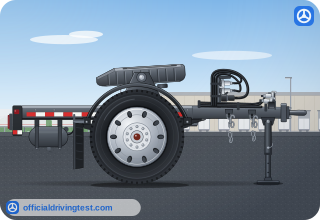
- Pull out the trailer air supply knob in the cab
- Turn the shut-off valve at the dolly's rear
- Open the petcock on the dolly's air tank
Show answer
Correct answer: Open the petcock on the dolly's air tank
Draining air through the dolly tank petcock frees its brakes. A dolly with spring brakes has a parking brake control instead.
Source: CDL manual, national model as printed by New Jersey, Section 7 (July 2017)
-
When you move the dolly by hand to the front of the rear trailer, what should it be lined up with?
- The landing gear of that trailer
- The kingpin of that trailer
- The rear axle of the first trailer
Show answer
Correct answer: The kingpin of that trailer
The dolly must sit squarely in line with the kingpin so it can be backed under the trailer.
Source: CDL manual, national model as printed by New Jersey, Section 7 (July 2017)
-
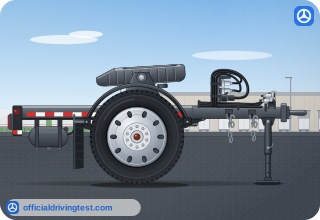
Under what condition may you move the converter dolly into place by hand?
- The dolly's brakes are still applied
- The distance is not too great
- The dolly has only one axle
Show answer
Correct answer: The distance is not too great
Hand positioning suits a short distance only; for a longer move the tractor and first semitrailer fetch the dolly.
Source: CDL manual, national model as printed by New Jersey, Section 7 (July 2017)
-
You use the tractor and first semitrailer to fetch the dolly. Right after you hitch the dolly to the rear of the first trailer, what comes next?
- Lower the dolly support
- Lock the pintle hook
- Unhook the dolly again
Show answer
Correct answer: Lock the pintle hook
Once the dolly is coupled to the first trailer, the pintle hook is locked before the dolly is moved.
Source: CDL manual, national model as printed by New Jersey, Section 7 (July 2017)
-
While you tow the dolly with the first semitrailer to the second trailer, where should the dolly support be?
- Lowered halfway as a skid guard
- Resting on the first trailer's bumper
- Raised and secured
Show answer
Correct answer: Raised and secured
While the dolly is pulled into place behind the first trailer, its support stays secured in the raised position.
Source: CDL manual, national model as printed by New Jersey, Section 7 (July 2017)
-
You have pulled the dolly close to the nose of the second semitrailer. Before you unhook it from the first trailer, what must you do?
- Raise and secure the dolly support
- Release the dolly's fifth wheel latch
- Lower the dolly support
Show answer
Correct answer: Lower the dolly support
The dolly support is put down before the dolly is unhooked from the first trailer.
Source: CDL manual, national model as printed by New Jersey, Section 7 (July 2017)
-
When you connect the dolly to the front trailer, what do you back into position?
- The dolly, toward the rear trailer
- The second trailer, toward the tractor
- The first semitrailer, in front of the dolly
Show answer
Correct answer: The first semitrailer, in front of the dolly
The first semitrailer is backed until it is directly ahead of the dolly's tongue, ready to be hooked.
Source: CDL manual, national model as printed by New Jersey, Section 7 (July 2017)
-
Before you back the dolly under the rear trailer, how must that trailer be held?
- Brakes locked or wheels chocked
- Landing gear fully raised
- Air lines already connected to the dolly
Show answer
Correct answer: Brakes locked or wheels chocked
The rear trailer must not move while the dolly is pushed under it, so its brakes are locked or its wheels chocked.
Source: CDL manual, national model as printed by New Jersey, Section 7 (July 2017)
-
How should the height of the rear trailer compare with the dolly's fifth wheel before you back under it?
- Slightly lower than the fifth wheel center
- A little higher than the fifth wheel center
- Exactly level with the fifth wheel center
Show answer
Correct answer: Slightly lower than the fifth wheel center
The trailer must sit slightly lower than the fifth wheel center, so the dolly raises it a little as it is pushed under.
Source: CDL manual, national model as printed by New Jersey, Section 7 (July 2017)
-
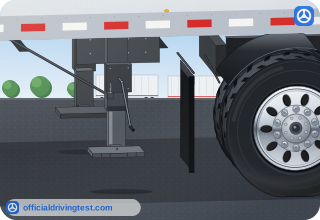
After the dolly is backed under the rear trailer, why do you lift the trailer's landing gear a little off the ground?
- To dump air from the trailer brake chambers
- To avoid gear damage if the trailer moves
- To test whether the dolly brakes will hold
Show answer
Correct answer: To avoid gear damage if the trailer moves
Lifting the gear slightly keeps it from being damaged should the trailer move.
Source: CDL manual, national model as printed by New Jersey, Section 7 (July 2017)
-
How do you test that the dolly is locked onto the rear trailer?
- Back the dolly harder against the trailer
- Pull against the trailer's kingpin
- Raise the landing gear and watch the trailer settle
Show answer
Correct answer: Pull against the trailer's kingpin
Pulling against the kingpin of the second semitrailer shows whether the coupling has really locked.
Source: CDL manual, national model as printed by New Jersey, Section 7 (July 2017)
-
When you look over the finished dolly coupling, what should you see between the upper and lower fifth wheel?
- No space between them
- A narrow gap for the plates to move
- Grease filling a small gap
Show answer
Correct answer: No space between them
The plates must sit tight together with the jaws shut on the kingpin; a gap means a bad hookup.
Source: CDL manual, national model as printed by New Jersey, Section 7 (July 2017)
-
In the visual check of a finished dolly coupling, what must the locking jaws be doing?
- Resting open against the kingpin
- Closed on the kingpin
- Closed on the dolly's pintle eye
Show answer
Correct answer: Closed on the kingpin
Closed jaws on the kingpin show the dolly is really locked to the trailer.
Source: CDL manual, national model as printed by New Jersey, Section 7 (July 2017)
-
After the visual check of the dolly coupling, which connections do you make to the rear trailer?
- Safety chains, air hoses and landing gear crank
- Air hoses, light cords and pintle hook release
- Safety chains, air hoses and light cords
Show answer
Correct answer: Safety chains, air hoses and light cords
Once the coupling looks right, the safety chains, the air hoses and the light cords all get hooked up.
Source: CDL manual, national model as printed by New Jersey, Section 7 (July 2017)
-
Which valves do you close at the back of the second trailer, along with the dolly tank petcock?
- Its service and emergency valves
- Only its emergency shut-off valve
- Its landing gear air valves
Show answer
Correct answer: Its service and emergency valves
Both shut-offs at the back of the last trailer are closed, as is the dolly tank petcock.
Source: CDL manual, national model as printed by New Jersey, Section 7 (July 2017)
-
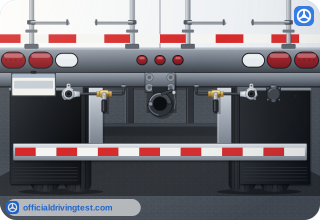
Which shut-off valves are opened so air can pass to the dolly and the rear trailer?
- The ones at the rear of the first trailer
- The ones at the rear of the second trailer
- The converter dolly air tank petcock
Show answer
Correct answer: The ones at the rear of the first trailer
Air must flow back through the first trailer, so its rear shut-offs, and any on the dolly, are opened.
Source: CDL manual, national model as printed by New Jersey, Section 7 (July 2017)