Air Brakes: Spring brakes, parking controls and ABS
Spring brakes, the parking brake controls, and antilock braking systems with their malfunction lamps.
Independent educational site · not affiliated with any government agency or DMV
Ready? Test yourself
Answer to start, or tap Start below:
At roughly what air pressure range do spring brakes on a tractor or straight truck come fully on?
- Instant feedback with an explanation
- Every answer cites its source in the manual
- Your best score is saved on this device
- Keyboard: press 1 to 3 to answer and Enter for the next question
Questions are written in our own words from the CDL manual; they are not the real test's questions. With your state chosen, every answer gives its page in your state's CDL manual. Without a state, answers cite the CDL manual, national model as printed by New Jersey (July 2017).
All 30 questions in this practice test
Take the test above first, then use this list to study. Tap “Show answer” to see the correct answer and explanation.
Show the questions and answersHide the questions
-
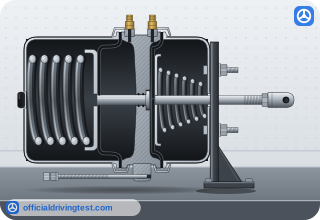
Why are spring brakes the usual choice for a truck's emergency and parking brakes?
- They use less air than the service brakes when stopping the truck
- They are held on mechanically, not by air that can leak away
- They give a stronger stop than the service brakes
Show answer
Correct answer: They are held on mechanically, not by air that can leak away
Emergency and parking brakes must be held on mechanically, because air can slowly leak out. Springs do this job.
Source: CDL manual, national model as printed by New Jersey, Section 5 (July 2017)
-
While you drive, what stops the strong springs of the spring brakes from applying the brakes?
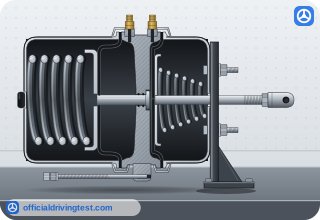
- Air pressure holds the springs back
- A mechanical latch inside each brake chamber holds them
- Electric current from the battery holds them back
Show answer
Correct answer: Air pressure holds the springs back
Air pressure pushes the springs back so the brakes stay released. When the air is removed, the springs apply the brakes.
Source: CDL manual, national model as printed by New Jersey, Section 5 (July 2017)
-
What happens to the spring brakes if a leak lets all the air escape from the system?
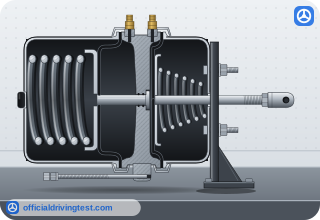
- The springs apply the brakes
- The brakes release so the wheels roll freely
- The brakes stay as they were until you press the pedal
Show answer
Correct answer: The springs apply the brakes
With no air to hold the springs back, they apply the brakes by themselves.
Source: CDL manual, national model as printed by New Jersey, Section 5 (July 2017)
-
At roughly what air pressure range do spring brakes on a tractor or straight truck come fully on?
- 20 to 45 psi
- 5 to 15 psi
- 70 to 90 psi
Show answer
Correct answer: 20 to 45 psi
Spring brakes apply fully when the pressure falls into about 20 to 45 psi, and typically 20 to 30 psi.
Source: CDL manual, national model as printed by New Jersey, Section 5 (July 2017)
-
What does the braking power of spring brakes depend on?
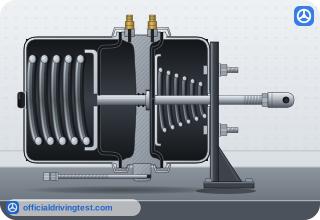
- Whether the brakes are properly adjusted
- How often the air tanks are drained
- How high the governor cut-out pressure is set
Show answer
Correct answer: Whether the brakes are properly adjusted
If the brakes are out of adjustment, neither the regular brakes nor the emergency and parking brakes work well.
Source: CDL manual, national model as printed by New Jersey, Section 5 (July 2017)
-
On a newer vehicle with air brakes, what does the parking brake control look like?
- A red, eight-sided push-pull knob
- A green, round twist knob
- A yellow, diamond-shaped push-pull knob
Show answer
Correct answer: A yellow, diamond-shaped push-pull knob
Newer air brake vehicles use a yellow, diamond-shaped push-pull knob for the parking brakes. Older vehicles may use a lever.
Source: CDL manual, national model as printed by New Jersey, Section 5 (July 2017)
-
With a push-pull parking brake knob, how do you apply the parking brakes?
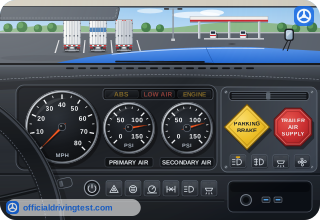
- Push the knob in
- Pull the knob out
- Turn the knob a quarter turn
Show answer
Correct answer: Pull the knob out
Pulling the knob out lets the air out of the spring brakes so they apply. Pushing it in releases them.
Source: CDL manual, national model as printed by New Jersey, Section 5 (July 2017)
-
What could happen if you push the brake pedal down while the spring brakes are on?
- The spring brakes would let go of the wheels right away
- The brakes could be damaged by springs and air pushing together
- The air tanks would lose all of their pressure at once
Show answer
Correct answer: The brakes could be damaged by springs and air pushing together
The spring force and the pedal's air pressure add together and can damage the brakes, so keep your foot off the pedal while the spring brakes are on.
Source: CDL manual, national model as printed by New Jersey, Section 5 (July 2017)
-
What is a modulating control valve on the dash used for?
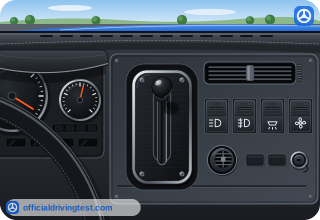
- To switch the front brakes between normal and slippery settings
- To release the spring brakes using air from a separate tank
- To apply the spring brakes gradually, with a feel for the braking
Show answer
Correct answer: To apply the spring brakes gradually, with a feel for the braking
The valve is spring-loaded, so you can feel the braking as the spring brakes go on little by little. It gives you control of the spring brakes should the service brakes stop working.
Source: CDL manual, national model as printed by New Jersey, Section 5 (July 2017)
-
With a modulating control valve, what happens as you move the lever farther?
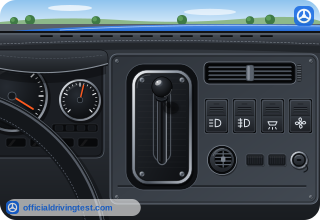
- The spring brakes apply harder
- The spring brakes release further
- The service brakes take over
Show answer
Correct answer: The spring brakes apply harder
The farther the lever travels, the more strongly the spring brakes apply.
Source: CDL manual, national model as printed by New Jersey, Section 5 (July 2017)
-
How should you set a modulating control valve when you park?
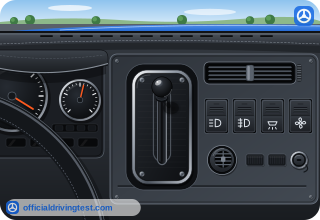
- Move the lever all the way and lock it there
- Move the lever to the middle so the braking stays gentle
- Pull the lever partway and let it spring back
Show answer
Correct answer: Move the lever all the way and lock it there
For parking, the lever goes to its limit and the locking device keeps it there so the spring brakes stay fully on.
Source: CDL manual, national model as printed by New Jersey, Section 5 (July 2017)
-
Why do some vehicles, such as buses, carry a separate air tank for the dual parking control valves?
- To keep the service brakes working after the main tanks fail
- To free the spring brakes so the vehicle can be moved in an emergency
- To feed extra air to the compressor when the governor cuts out
Show answer
Correct answer: To free the spring brakes so the vehicle can be moved in an emergency
Spring brakes apply when main air is lost. Air from the separate tank can free them so you can move the vehicle.
Source: CDL manual, national model as printed by New Jersey, Section 5 (July 2017)
-
With dual parking control valves, which valve puts on the spring brakes when you park?
- The push-pull valve
- The spring-loaded valve
- The tractor protection valve
Show answer
Correct answer: The push-pull valve
The push-pull valve is the one you use to set the spring brakes for parking.
Source: CDL manual, national model as printed by New Jersey, Section 5 (July 2017)
-
With dual parking control valves, what happens when you let go of the spring-loaded valve?
- The spring brakes stay released
- The separate tank refills at once
- The spring brakes come on again
Show answer
Correct answer: The spring brakes come on again
The spring-loaded valve frees the spring brakes only while you hold it in. Let go and they apply again.
Source: CDL manual, national model as printed by New Jersey, Section 5 (July 2017)
-
Why must you plan carefully when you use the separate air tank to move the vehicle?
- The release works only once and then the valve locks up
- Each release also drains the air from the main tanks
- Only a few releases are possible, so you could get stranded
Show answer
Correct answer: Only a few releases are possible, so you could get stranded
The separate tank holds only enough air for a few releases. If it runs out, you may be stopped in a dangerous spot.
Source: CDL manual, national model as printed by New Jersey, Section 5 (July 2017)
-
Air brake truck tractors built on or after which date must have antilock brakes?
- March 1, 1997
- March 1, 1995
- March 1, 1999
Show answer
Correct answer: March 1, 1997
Air brake truck tractors built on or after March 1, 1997 must have ABS.
Source: CDL manual, national model as printed by New Jersey, Section 5 (July 2017)
-
Air brake trucks, buses, trailers and converter dollies must have ABS if built on or after which date?
- March 1, 1996
- March 1, 1998
- March 1, 2000
Show answer
Correct answer: March 1, 1998
For air brake trucks, buses, trailers and converter dollies, the ABS requirement starts with vehicles built on or after March 1, 1998.
Source: CDL manual, national model as printed by New Jersey, Section 5 (July 2017)
-
How can you tell from its age whether a vehicle should have ABS?
- Read the date stamped on a brake drum
- Look at the date on the certification label
- Check the model year on the fuel tank label
Show answer
Correct answer: Look at the date on the certification label
The certification label shows when the vehicle was made, and that date tells you whether ABS was required.
Source: CDL manual, national model as printed by New Jersey, Section 5 (July 2017)
-
What does ABS do when you brake hard?
- A computer works to stop the wheels from locking
- It adds extra air pressure to the brake chambers
- It automatically releases the spring brakes
Show answer
Correct answer: A computer works to stop the wheels from locking
ABS uses a computer to keep the wheels from locking during hard braking.
Source: CDL manual, national model as printed by New Jersey, Section 5 (July 2017)
-
What color are the ABS malfunction lamps?
- Red
- Green
- Yellow
Show answer
Correct answer: Yellow
ABS malfunction lamps are yellow.
Source: CDL manual, national model as printed by New Jersey, Section 5 (July 2017)
-
Where is the ABS malfunction lamp on a tractor, a truck or a bus?
- On the mirror bracket
- On the rear bumper, beside the tail lights
- On the instrument panel
Show answer
Correct answer: On the instrument panel
On tractors, trucks and buses the yellow ABS lamp is on the instrument panel.
Source: CDL manual, national model as printed by New Jersey, Section 5 (July 2017)
-
Where do you look for the ABS malfunction lamp on a trailer?
- On the right side, at a front or rear corner
- On the underside, near the axle
- On the left side, at the front or rear corner
Show answer
Correct answer: On the left side, at the front or rear corner
A trailer's yellow ABS lamp is on its left side, at the front or the rear corner.
Source: CDL manual, national model as printed by New Jersey, Section 5 (July 2017)
-
A dolly built on or after March 1, 1998 must have its ABS lamp on which side?
- The right side
- The rear, in the middle
- The left side
Show answer
Correct answer: The left side
Dollies made from March 1, 1998 on must carry the lamp on the left side.
Source: CDL manual, national model as printed by New Jersey, Section 5 (July 2017)
-
On a newer vehicle, what should a working ABS lamp do at start-up?
- Light up briefly as a bulb check, then go out
- Stay off until the system finds a fault
- Flash for ten seconds and then stay lit
Show answer
Correct answer: Light up briefly as a bulb check, then go out
A newer system lights the lamp for a short bulb check and then turns it off quickly.
Source: CDL manual, national model as printed by New Jersey, Section 5 (July 2017)
-
On an older ABS system, how long might the lamp stay on after start-up?
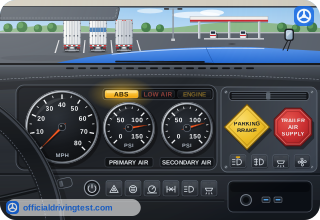
- Until you are driving faster than five mph
- Until the parking brake is released
- Until the air pressure reaches 100 psi
Show answer
Correct answer: Until you are driving faster than five mph
On older systems the lamp can stay lit until the vehicle is moving at more than five mph.
Source: CDL manual, national model as printed by New Jersey, Section 5 (July 2017)
-
The ABS lamp stays lit after the bulb check, or comes on while you drive. What may this mean?
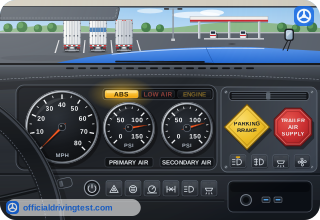
- ABS may not be working on some wheels
- The regular service brakes have failed
- ABS is working because the road is slippery
Show answer
Correct answer: ABS may not be working on some wheels
A lamp that stays on or comes on later warns that ABS may not be working at one or more wheels.
Source: CDL manual, national model as printed by New Jersey, Section 5 (July 2017)
-
A towed unit is old and you cannot tell if it has ABS. What can you look for under it?
- A control unit (ECU) and sensor wires at the brakes
- A separate air tank with a dual parking valve
- A yellow lamp on the right side of the frame
Show answer
Correct answer: A control unit (ECU) and sensor wires at the brakes
Under an older towed unit, a computer box (ECU) and sensor wiring at the wheel brakes show that it has ABS.
Source: CDL manual, national model as printed by New Jersey, Section 5 (July 2017)
-
How does ABS change the braking power of your normal brakes?
- It makes the normal brakes stronger
- It adds to them without raising or lowering their power
- It replaces the normal brakes when they are hot
Show answer
Correct answer: It adds to them without raising or lowering their power
ABS works on top of the normal brakes. It does not make them stronger or weaker.
Source: CDL manual, national model as printed by New Jersey, Section 5 (July 2017)
-
When does ABS start to work?
- Whenever you touch the brake pedal
- Whenever the vehicle is above five mph
- Only when wheels are about to lock up
Show answer
Correct answer: Only when wheels are about to lock up
ABS stays inactive during normal braking and acts only when a wheel is close to locking.
Source: CDL manual, national model as printed by New Jersey, Section 5 (July 2017)
-
What can you expect from ABS when it comes to stopping distance?
- It helps you keep control, though the distance may not be shorter
- It cuts the stopping distance by a fixed amount every time
- It lengthens the distance but gives a smoother ride
Show answer
Correct answer: It helps you keep control, though the distance may not be shorter
ABS does not always shorten the stop, but it helps the driver stay in control during hard braking.
Source: CDL manual, national model as printed by New Jersey, Section 5 (July 2017)