California: Traffic signals Practice Test
Red, yellow, and green lights and arrows, and how to use a roundabout.
Independent educational site · not affiliated with any government agency or DMV
Ready? Test yourself
- Instant feedback with an explanation
- Every answer cites its source in the manual
- Your best score is saved on this device
- Keyboard: press 1 to 4 to answer and Enter for the next question
Questions are original and based on the official manual "California Driver Handbook" (2025), California DMV.
All 27 questions in this practice test
Take the test above first, then use this list to study. Tap “Show answer” to see the correct answer and explanation.
Show the questions and answersHide the questions
-
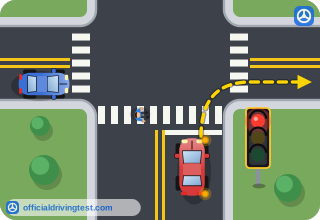
May you turn right on a red light in California?
- Yes, without stopping, if the way looks clear.
- Yes, after a complete stop, unless a NO TURN ON RED sign is posted.
- No, never.
- Only between 9 a.m. and 4 p.m., outside the busiest commuting hours.
Show answer
Correct answer: Yes, after a complete stop, unless a NO TURN ON RED sign is posted.
A right turn on red is allowed after you come to a complete stop, unless a NO TURN ON RED sign is posted.
Source: California Driver Handbook (2025), page 18 · Open this page in the manual (Manual page 18)
-
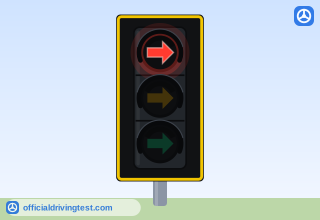
You are stopped at a red arrow and want to turn right. What must you do?
- Turn after stopping, just as you would at a red light.
- Turn if no pedestrians are present.
- Wait until the light changes to green.
- Turn as long as there is no NO TURN ON RED sign.
Show answer
Correct answer: Wait until the light changes to green.
You may not turn right against a red arrow. Wait for the signal to turn green.
Source: California Driver Handbook (2025), page 18 · Open this page in the manual (Manual page 18)
-
When may you turn left against a red light?
- From a one-way street onto another one-way street, if no sign forbids it.
- From any street at all onto a one-way street, as long as you come to a stop first.
- Never.
- Whenever no cars are coming.
Show answer
Correct answer: From a one-way street onto another one-way street, if no sign forbids it.
A left turn on red is allowed only from a one-way street onto another one-way street, provided no sign prohibits it. Yield to anyone who has a green light.
Source: California Driver Handbook (2025), page 20 · Open this page in the manual (Manual page 20)
-
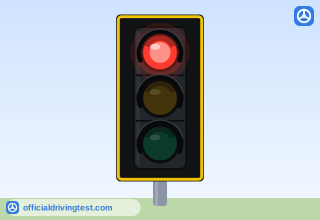
What does a solid red traffic signal light require you to do?
- Come to a complete stop
- Slow to about 10 mph and roll through
- Stop only when another vehicle is approaching
- Accelerate to clear the intersection quickly
Show answer
Correct answer: Come to a complete stop
A solid red light means stop. Stay stopped until the signal changes or until you can legally turn.
Source: California Driver Handbook (2025), page 33 · Open this page in the manual (Manual page 33)
-
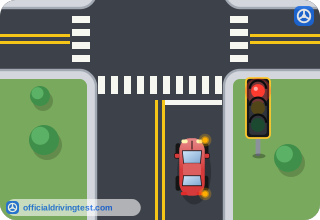
Under what conditions may you make a right turn while the signal is red?
- Any time, as long as you slow down first
- After you stop and yield to pedestrians, if no sign bans it
- Never; California does not allow right turns on red
- Only when no pedestrians are anywhere on the block
Show answer
Correct answer: After you stop and yield to pedestrians, if no sign bans it
A right on red is legal only after a full stop, after yielding to pedestrians, and when no sign forbids the turn.
Source: California Driver Handbook (2025), page 33 · Open this page in the manual (Manual page 33)
-
A NO TURN ON RED sign is posted at the corner where you are stopped. What must you do?
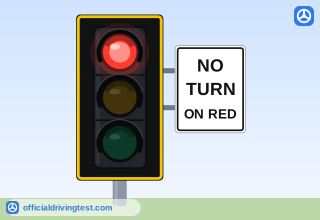
- Turn right after a three-second stop
- Turn right if no pedestrians are present
- Wait for a green signal before turning
- Treat the intersection as a four-way stop
Show answer
Correct answer: Wait for a green signal before turning
The sign cancels the right-on-red permission, so you must remain stopped until the signal turns green.
Source: California Driver Handbook (2025), page 33 · Open this page in the manual (Manual page 33)
-
You are facing a red arrow in a left-turn lane. What is correct?
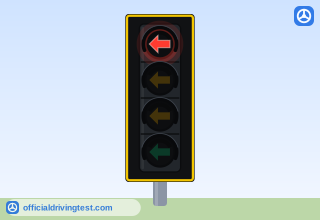
- You may turn after stopping and yielding
- You must stay stopped until a green light or arrow
- A red arrow is only advisory in a turn lane
- You may turn if oncoming traffic has stopped
Show answer
Correct answer: You must stay stopped until a green light or arrow
A red arrow means stop, with no turn permitted. Stay stopped until a green signal light or a green arrow appears.
Source: California Driver Handbook (2025), page 33 · Open this page in the manual (Manual page 33)
-
What should you do at a flashing red traffic signal light?
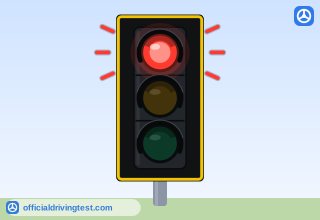
- Keep moving without stopping
- Wait for it to change to a steady color
- Sound your horn and continue through
- Stop first, then go when it is safe
Show answer
Correct answer: Stop first, then go when it is safe
A flashing red signal light means STOP. After stopping, you may go when it is safe.
Source: California Driver Handbook (2025), page 33 · Open this page in the manual (Manual page 33)
-
A solid yellow traffic signal light is a signal to do what?
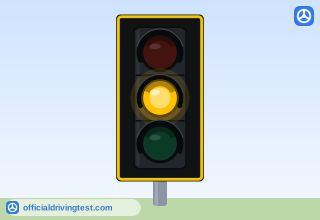
- Use caution, because the light is about to turn red
- Speed up before the light changes
- The green light is about to return
- Pedestrians are being given the right-of-way
Show answer
Correct answer: Use caution, because the light is about to turn red
Yellow means caution. It warns you that the red light is coming next.
Source: California Driver Handbook (2025), page 33 · Open this page in the manual (Manual page 33)
-
The signal turns yellow when you are already so close that stopping would be dangerous. What should you do?
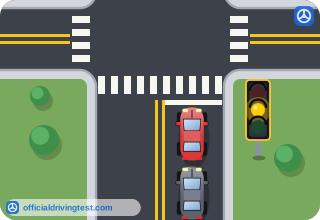
- Brake hard and stop no matter what
- Stop in the middle of the crosswalk
- Reverse to clear the crosswalk
- Cross the intersection carefully
Show answer
Correct answer: Cross the intersection carefully
You should stop for a yellow light when you can do so safely; if you cannot, continue through the intersection cautiously.
Source: California Driver Handbook (2025), page 33 · Open this page in the manual (Manual page 33)
-
A yellow arrow appears in your turn lane. What is it telling you?
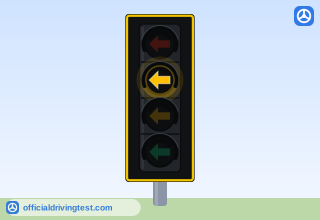
- Turns in that direction are now banned
- The protected turning time is ending
- Oncoming traffic has just been released
- You have extra time to complete two turns
Show answer
Correct answer: The protected turning time is ending
The yellow arrow warns that your protected turn phase is finishing and the signal is about to change.
Source: California Driver Handbook (2025), page 33 · Open this page in the manual (Manual page 33)
-
The turn arrow changes to yellow after you have already entered the intersection. What should you do?
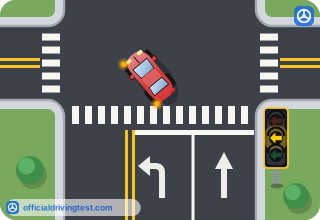
- Stop where you are and wait
- Complete your turn cautiously
- Back up behind the limit line
- Straighten out and go through instead
Show answer
Correct answer: Complete your turn cautiously
If you cannot stop safely or are already in the intersection, finish the turn carefully rather than stopping.
Source: California Driver Handbook (2025), page 33 · Open this page in the manual (Manual page 33)
-
After a yellow turn arrow goes out, which display should you be ready for?
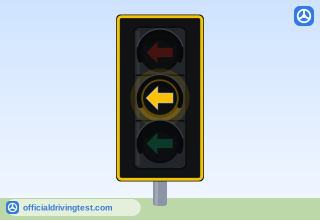
- Only a flashing yellow arrow
- A green or red traffic signal light, or a red arrow
- Always a green arrow in the other direction
- A completely dark signal
Show answer
Correct answer: A green or red traffic signal light, or a red arrow
The display that follows a yellow arrow may be a green light, a red light, or a red arrow, so watch the signal closely.
Source: California Driver Handbook (2025), page 33 · Open this page in the manual (Manual page 33)
-
What does a flashing yellow traffic signal light mean?
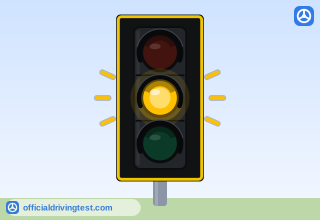
- Stop completely before entering the intersection
- The signal has failed and is out of service
- Only emergency vehicles may pass
- Slow down and be alert; you do not need to stop
Show answer
Correct answer: Slow down and be alert; you do not need to stop
A flashing yellow light is a warning. You do not have to stop, but you must slow down and stay alert.
Source: California Driver Handbook (2025), page 34 · Open this page in the manual (Manual page 34)
-
A flashing yellow left-turn arrow allows you to do what?
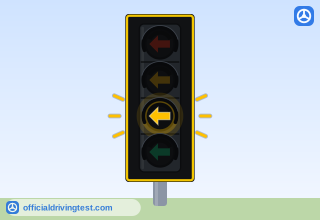
- Turn left with full protection from oncoming traffic
- Turn left after yielding to oncoming traffic
- Make a U-turn only
- Nothing; you must wait for a green arrow
Show answer
Correct answer: Turn left after yielding to oncoming traffic
A flashing yellow arrow permits the turn, but oncoming traffic is not stopped, so you must yield and proceed carefully.
Source: California Driver Handbook (2025), page 34 · Open this page in the manual (Manual page 34)
-
A solid green traffic signal light means what?
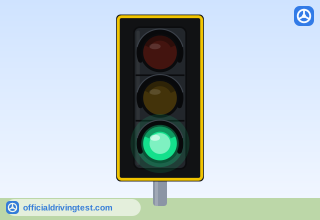
- Go, if the intersection is clear
- Go, and you always have the right-of-way over everyone
- Stop and check for cross traffic first
- Left turns are prohibited
Show answer
Correct answer: Go, if the intersection is clear
Green means go, but only when it is safe and the intersection is clear.
Source: California Driver Handbook (2025), page 34 · Open this page in the manual (Manual page 34)
-
Your light turns green but a bicyclist is still in the intersection. What must you do?
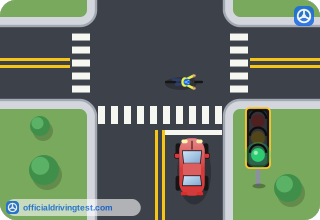
- Pass to the right of the bicyclist
- Honk so the bicyclist hurries
- Stop and let the bicyclist clear the intersection
- Proceed, because a green light gives you priority
Show answer
Correct answer: Stop and let the bicyclist clear the intersection
Even on green you must stop for any vehicle, bicyclist, or pedestrian still in the intersection.
Source: California Driver Handbook (2025), page 34 · Open this page in the manual (Manual page 34)
-
Your light is green, but traffic on the far side is backed up and you could not get all the way across. What is correct?
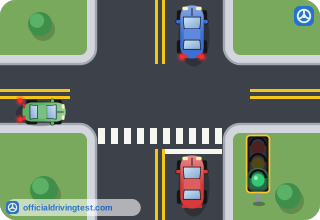
- Enter anyway; the green light protects you
- Wait outside the intersection until you can clear it
- Enter and stop in the middle of the intersection
- Use the crosswalk area to wait
Show answer
Correct answer: Wait outside the intersection until you can clear it
Do not enter an intersection you cannot get completely across before the light turns red. Blocking an intersection is illegal.
Source: California Driver Handbook (2025), page 34 · Open this page in the manual (Manual page 34)
-
What does a green arrow tell you?
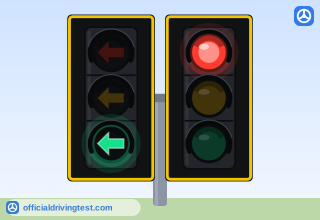
- You may make a protected turn where the arrow points
- You may go in any direction you choose
- You may turn but must yield to oncoming traffic
- The arrow is about to turn red
Show answer
Correct answer: You may make a protected turn where the arrow points
A green arrow means go in the direction it points. The turn is protected because oncoming vehicles face a red light.
Source: California Driver Handbook (2025), page 34 · Open this page in the manual (Manual page 34)
-
You reach an intersection where the traffic signal is dark and not working. What should you do?
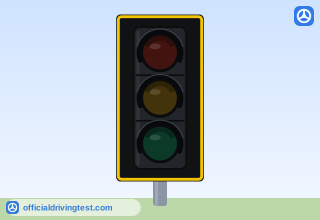
- Treat the bigger road as having the right-of-way and keep going
- Proceed at normal speed since no signal is displayed
- Stop as if STOP signs were in all directions, then go when safe
- Wait at the curb until the signal is repaired
Show answer
Correct answer: Stop as if STOP signs were in all directions, then go when safe
A dead signal is treated as an all-way stop. Stop, then move through cautiously when it is safe.
Source: California Driver Handbook (2025), page 34 · Open this page in the manual (Manual page 34)
-
A DO NOT BLOCK INTERSECTION sign reminds drivers of which law?
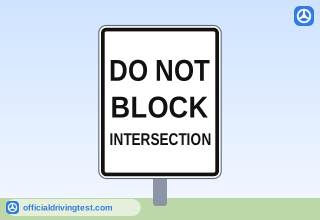
- That turning right on a red light is banned at this intersection
- That the intersection is controlled by a police officer
- That you may not block an intersection you cannot cross before a red light
- That pedestrians may not cross the street at this intersection
Show answer
Correct answer: That you may not block an intersection you cannot cross before a red light
It is against the law to stop or block an intersection where there is not enough space to completely cross before the traffic signal light turns red.
Source: California Driver Handbook (2025), page 39 · Open this page in the manual (Manual page 39)
-
How does traffic move in a roundabout?
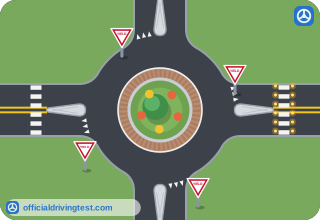
- In alternating directions controlled by a signal
- In one direction around a central island
- In both directions on opposite sides of the island
- Straight across the island when it is clear
Show answer
Correct answer: In one direction around a central island
All vehicles in a roundabout circulate the same way around the island in the middle.
Source: California Driver Handbook (2025), page 40 · Open this page in the manual (Manual page 40)
-
Once you are inside a roundabout, what should you do?
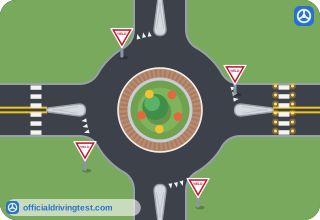
- Stop at each exit to check for merging traffic
- Pass slower vehicles on the inside of the circle
- Travel counterclockwise without stopping or passing
- Reverse if you took the wrong lane
Show answer
Correct answer: Travel counterclockwise without stopping or passing
Travel counterclockwise inside the roundabout and do not stop or pass.
Source: California Driver Handbook (2025), page 40 · Open this page in the manual (Manual page 40)
-
When should you use your turn signal in a roundabout?
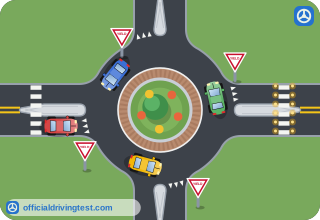
- Only when entering the roundabout
- When you change lanes or exit
- Continuously while you are inside the circle
- Turn signals are not used in roundabouts
Show answer
Correct answer: When you change lanes or exit
Signal so other drivers know your intentions when you change lanes or leave the roundabout.
Source: California Driver Handbook (2025), page 40 · Open this page in the manual (Manual page 40)
-
You realize you have driven past the exit you wanted in a roundabout. What should you do?
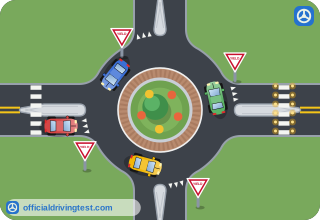
- Stop and reverse to the exit
- Take the next exit and make a U-turn there
- Continue around until you return to it
- Cross the central island to reach it
Show answer
Correct answer: Continue around until you return to it
Simply keep circulating until your exit comes around again. Never stop or pass inside a roundabout.
Source: California Driver Handbook (2025), page 40 · Open this page in the manual (Manual page 40)
-
In a multi-lane roundabout, which lane should you use to turn right at the first exit?
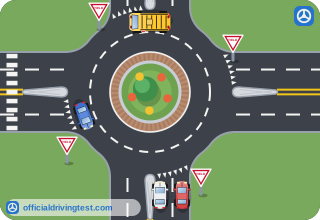
- The left lane, then cross over to the exit
- The right lane, and exit in the right lane
- Either lane, as long as you signal
- The lane closest to the central island
Show answer
Correct answer: The right lane, and exit in the right lane
For a right turn, choose the right lane on entry and stay in the right lane through the exit.
Source: California Driver Handbook (2025), page 40 · Open this page in the manual (Manual page 40)
-
You want to go straight through a multi-lane roundabout. What is correct?
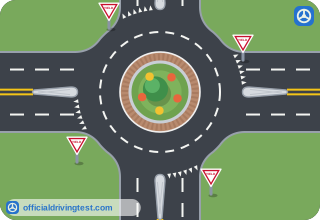
- You may choose either lane, and you exit in the lane you entered
- You must always use the left lane
- You must always use the right lane
- You must change to the outer lane before exiting
Show answer
Correct answer: You may choose either lane, and you exit in the lane you entered
To continue straight you may enter in either lane, but you must leave the roundabout in that same lane.
Source: California Driver Handbook (2025), page 40 · Open this page in the manual (Manual page 40)