California: 30 Hardest Driving Test Questions
Questions that need a second thought, picked for close numbers, exceptions and easy-to-confuse rules. Take your time.
Independent educational site · not affiliated with any government agency or DMV
Ready? Test yourself
- Instant feedback with an explanation
- Every answer cites its source in the manual
- Your best score is saved on this device
- Keyboard: press 1 to 4 to answer and Enter for the next question
Questions are original and based on the official manual "California Driver Handbook" (2025), California DMV.
All 30 questions in this practice test
Take the test above first, then use this list to study. Tap “Show answer” to see the correct answer and explanation.
Show the questions and answersHide the questions
-
In a Safety Enhanced-Double Fine Zone, or in a construction zone with workers present, what happens to traffic fines?
- They are doubled
- They are reduced by half
- They are replaced by a warning
- They stay exactly the same
Show answer
Correct answer: They are doubled
Fines double in designated double fine zones and in highway construction or maintenance areas when workers are present.
Source: California Driver Handbook (2025), page 49 · Open this page in the manual (Manual page 49)
-
How large can a fine be for a traffic violation committed in a work zone?
- No more than $100
- No more than $250
- $1,000 or more
- Fines do not change inside work zones
Show answer
Correct answer: $1,000 or more
Work zone violations can cost $1,000 or more, far above an ordinary ticket.
Source: California Driver Handbook (2025), page 49 · Open this page in the manual (Manual page 49)
-
Who is eligible for the Mature Driver Improvement Program, and how long is the course?
- Drivers 65 and older; a four-hour course
- Drivers 55 years old and older; an eight-hour course
- Any licensed driver; a two-day course
- Drivers 70 and older; a one-hour online course
Show answer
Correct answer: Drivers 55 years old and older; an eight-hour course
The program is an eight-hour course open to drivers 55 and older, offered by DMV-approved providers. Your insurer may give a discount for completing it.
Source: California Driver Handbook (2025), page 83 · Open this page in the manual (Manual page 83)
-
When may a child use a regular safety belt instead of a child passenger restraint system?
- At 6 years old or when weighing 50 pounds
- At 10 years old only
- As soon as the child can buckle the belt without help
- At 8 years old or older, or when at least 4 feet 9 inches tall
Show answer
Correct answer: At 8 years old or older, or when at least 4 feet 9 inches tall
Children who are 8 or older, or at least 4 feet 9 inches tall, may use a properly secured safety belt that meets federal standards.
Source: California Driver Handbook (2025), page 66 · Open this page in the manual (Manual page 66)
-
May you make a U-turn at an intersection with a green light or green arrow?
- Yes, unless a NO U-TURN sign is posted.
- No, U-turns require a red light.
- Only from the right lane.
- Only where the intersection has no crosswalk.
Show answer
Correct answer: Yes, unless a NO U-TURN sign is posted.
U-turns are allowed at an intersection on a green light or green arrow unless a NO U-TURN sign is posted.
Source: California Driver Handbook (2025), page 20 · Open this page in the manual (Manual page 20)
-
You are stopped at a red arrow and want to turn right. What must you do?
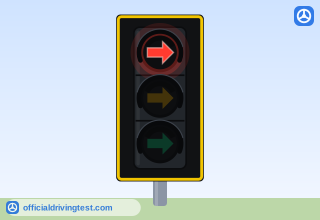
- Turn after stopping, just as you would at a red light.
- Turn if no pedestrians are present.
- Wait until the light changes to green.
- Turn as long as there is no NO TURN ON RED sign.
Show answer
Correct answer: Wait until the light changes to green.
You may not turn right against a red arrow. Wait for the signal to turn green.
Source: California Driver Handbook (2025), page 18 · Open this page in the manual (Manual page 18)
-
You move to California and start a job there, bringing your out-of-state car. How long do you have to register it?
- 60 days
- 10 days
- 20 days
- Until the out-of-state plates expire
Show answer
Correct answer: 20 days
You have 20 days to register the vehicle once you become a California resident or take a job in the state.
Source: California Driver Handbook (2025), page 79 · Open this page in the manual (Manual page 79)
-
About how far does an average passenger vehicle traveling at 55 mph need in order to stop?
- Within 100 feet
- Within 300 feet
- Within 500 feet
- Within 800 feet
Show answer
Correct answer: Within 300 feet
The handbook gives 300 feet as the stopping distance for an average passenger vehicle at 55 mph.
Source: California Driver Handbook (2025), page 42 · Open this page in the manual (Manual page 42)
-
An alley is a road no wider than 25 feet used to reach rear or side entrances. What is the speed limit in an alley?
- 25 mph
- 20 mph
- 15 mph
- 10 mph
Show answer
Correct answer: 15 mph
The speed limit in an alley is 15 mph. You may drive on or cross a sidewalk to enter or exit a driveway or alley.
Source: California Driver Handbook (2025), page 51 · Open this page in the manual (Manual page 51)
-
How far from the air bag cover should you sit, and how is that distance measured?
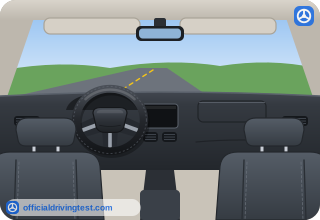
- At least 6 inches, measured from your knees to the bottom of the dashboard
- At least 10 inches, measured from the center of the steering wheel to your breastbone
- At least 18 inches, measured from the top of the windshield to your forehead
- As close as possible for better steering control
Show answer
Correct answer: At least 10 inches, measured from the center of the steering wheel to your breastbone
Sit at least 10 inches back, measured from the center of the steering wheel to your breastbone, as long as you keep full control. Passengers should do the same, and children seated next to a side air bag are at risk of serious injury.
Source: California Driver Handbook (2025), page 67 · Open this page in the manual (Manual page 67)
-
Before a driver under 18 can schedule the behind-the-wheel drive test, how long must they have held an instruction permit (unless they turn 18 first)?
- 30 days
- 3 months
- 6 months
- 12 months
Show answer
Correct answer: 6 months
A minor must hold a California or out-of-state instruction permit for at least six months, or reach age 18, before the drive test can be scheduled.
Source: California Driver Handbook (2025), page 3 · Open this page in the manual (Manual page 3)
-
How far from a marked or unmarked crosswalk must you park?
- At least 5 feet
- At least 10 feet
- At least 20 feet
- At least 50 feet
Show answer
Correct answer: At least 20 feet
Never park within 20 feet of a marked or unmarked crosswalk, or within 15 feet of a crosswalk where a curb extension is present.
Source: California Driver Handbook (2025), page 28 · Open this page in the manual (Manual page 28)
-
On a divided highway, when is a U-turn permitted?
- Wherever the median happens to be narrow.
- Only where the speed limit is 45 mph or lower.
- Never, under any circumstances.
- Only where a center divider opening is provided.
Show answer
Correct answer: Only where a center divider opening is provided.
A U-turn on a divided highway is legal only where a center divider opening is provided. Never make one by crossing a dividing section, curb, strip of land, or two sets of double yellow lines.
Source: California Driver Handbook (2025), page 20 · Open this page in the manual (Manual page 20)
-
A 19-year-old driver is stopped. At what BAC does driving become illegal for that driver?
- 0.01% or higher
- 0.04% or higher
- 0.05% or higher
- 0.08% or higher
Show answer
Correct answer: 0.01% or higher
Drivers under 21 face a near-zero limit of 0.01%, far stricter than the adult limit.
Source: California Driver Handbook (2025), page 73 · Open this page in the manual (Manual page 73)
-
A bus is stopped at a safety zone. If you pass it, what is the maximum speed allowed?
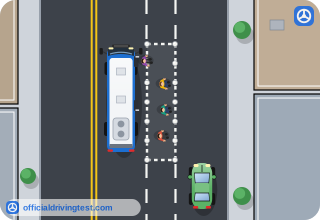
- 5 mph
- 10 mph
- 15 mph
- 25 mph
Show answer
Correct answer: 10 mph
When a bus, streetcar, or trolley is stopped at a safety zone or a traffic light, you may pass at no more than 10 mph.
Source: California Driver Handbook (2025), page 43 · Open this page in the manual (Manual page 43)
-
A car is coming toward you at night. When must you switch your high beams to low?
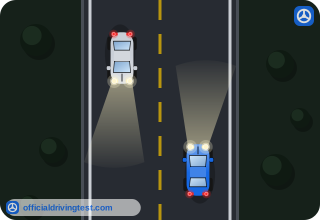
- Within 500 feet of it
- Within 300 feet of it
- Within 150 feet of it
- Only once that driver flashes their own lights at you
Show answer
Correct answer: Within 500 feet of it
Dim your high beams to low beams within 500 feet of any vehicle coming toward you.
Source: California Driver Handbook (2025), page 11 · Open this page in the manual (Manual page 11)
-
You want to turn left into a private driveway across a single set of double yellow lines. Is that allowed?
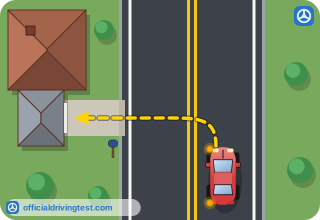
- No, you must drive on to an intersection.
- Only if the driveway serves a business.
- Only where a gap has been painted into the lines for that purpose.
- Yes, and a U-turn there is allowed too.
Show answer
Correct answer: Yes, and a U-turn there is allowed too.
You may turn left across a single set of double yellow lines to enter or leave a driveway or private road, or to make a U-turn.
Source: California Driver Handbook (2025), page 13 · Open this page in the manual (Manual page 13)
-
You are preparing to make a right turn across a bike lane. How far before the turn may you enter that bike lane?
- No more than 200 feet before the turn
- At least 500 feet before the turn
- Anywhere along the block
- Only within 50 feet of the corner
Show answer
Correct answer: No more than 200 feet before the turn
Drivers may enter a bike lane no more than 200 feet before beginning the turn, and only when it is safe.
Source: California Driver Handbook (2025), page 48 · Open this page in the manual (Manual page 48)
-
You are within 100 feet of a railroad crossing and cannot see the tracks for 400 feet in both directions. What is the speed limit?
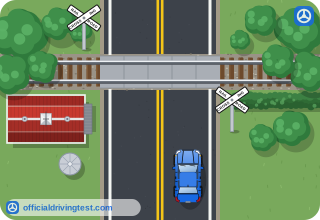
- The posted limit still applies
- 25 mph
- 35 mph
- 15 mph
Show answer
Correct answer: 15 mph
Limited visibility near a crossing lowers the limit to 15 mph within 100 feet of the tracks.
Source: California Driver Handbook (2025), page 51 · Open this page in the manual (Manual page 51)
-
In a heavy rainstorm you cannot see farther than 100 feet ahead. What is the fastest safe speed?
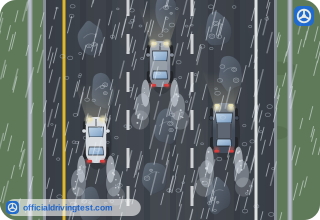
- 55 mph
- 45 mph
- 30 mph
- The posted limit still applies unchanged
Show answer
Correct answer: 30 mph
If visibility drops below 100 feet, it is not safe to drive faster than 30 mph.
Source: California Driver Handbook (2025), page 62 · Open this page in the manual (Manual page 62)
-
Besides 4 points in 12 months, which other point totals can also lead to a license suspension for an adult driver?
- 6 points in 24 months, or 8 points in 36 months
- 5 points in 18 months, or 7 points in 30 months
- 3 points in 24 months only
- There are no other point totals besides 4 in 12 months
Show answer
Correct answer: 6 points in 24 months, or 8 points in 36 months
The three suspension thresholds are 4 points in 12 months, 6 points in 24 months, and 8 points in 36 months.
Source: California Driver Handbook (2025), page 54 · Open this page in the manual (Manual page 54)
-
At a T intersection where a one-way street meets a two-way street, who has the right-of-way?
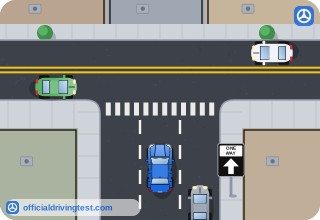
- The driver turning left.
- Traffic going straight through.
- The driver turning right.
- Whoever reaches the intersection first.
Show answer
Correct answer: Traffic going straight through.
Traffic going straight through the intersection has the right-of-way. From the one-way street you may turn either right or left from the center lane.
Source: California Driver Handbook (2025), page 22 · Open this page in the manual (Manual page 22)
-
You are following another vehicle at night with high beams on. When must you dim them?
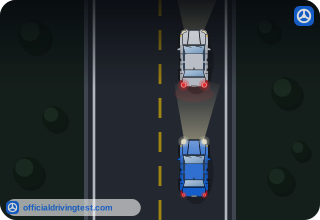
- Within 1,000 feet
- Within 500 feet
- Within 300 feet
- Dimming is required only for oncoming traffic, never for a car you follow.
Show answer
Correct answer: Within 300 feet
Dim your high beams within 300 feet of a vehicle you are following.
Source: California Driver Handbook (2025), page 11 · Open this page in the manual (Manual page 11)
-
What is the general rule about passing a light rail vehicle or a streetcar?
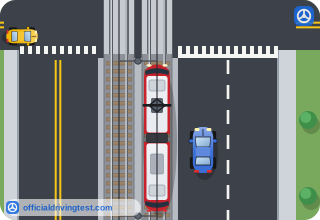
- You may pass on either side once it stops.
- Do not pass it on the left, whether moving or standing.
- You may never pass it under any circumstances.
- You may pass on the left only while it is moving.
Show answer
Correct answer: Do not pass it on the left, whether moving or standing.
As a rule you must not overtake a light rail vehicle or streetcar on its left side, moving or stopped, except in a few listed situations.
Source: California Driver Handbook (2025), page 44 · Open this page in the manual (Manual page 44)
-
Construction signs direct you onto the other side of the road because your side is blocked. May you cross the double yellow lines?
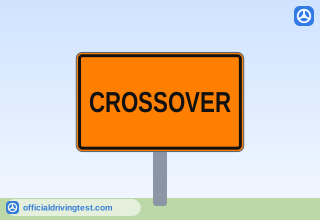
- Yes, the signs give you that permission.
- No, double yellow lines may never be crossed.
- Only if a flagger has physically stopped the oncoming traffic for you first.
- Only between sunrise and sunset.
Show answer
Correct answer: Yes, the signs give you that permission.
You may drive left of double solid yellow lines when construction or other signs instruct you to use the other side because your side is closed or blocked.
Source: California Driver Handbook (2025), page 13 · Open this page in the manual (Manual page 13)
-
The driver in front of you is signaling a left turn. What is true?
- You may pass on either side as long as you signal
- You must wait until the turn is completed before doing anything
- You may pass on the right if it is safe, but never on the left
- You must use the shoulder to get around
Show answer
Correct answer: You may pass on the right if it is safe, but never on the left
You may pass on the right if the driver ahead is turning left and you can do so safely. Never pass on the left if the driver is signaling a left turn.
Source: California Driver Handbook (2025), page 25 · Open this page in the manual (Manual page 25)
-
At a crosswalk where a curb extension is present, how far away must you park?
- At least 15 feet
- At least 20 feet
- At least 25 feet
- There is no distance rule there
Show answer
Correct answer: At least 15 feet
The general rule is 20 feet from a marked or unmarked crosswalk. Where a curb extension is present, the distance is 15 feet.
Source: California Driver Handbook (2025), page 28 · Open this page in the manual (Manual page 28)
-
A driver under 21 is caught with alcohol in the vehicle. For how long can law enforcement impound the vehicle?
- Up to 30 days
- Up to 10 days
- Up to 6 months
- The vehicle cannot be impounded for this
Show answer
Correct answer: Up to 30 days
The vehicle can be impounded for up to 30 days, and the court may also fine the driver and suspend the license for a year, or delay a first license by up to a year.
Source: California Driver Handbook (2025), page 75 · Open this page in the manual (Manual page 75)
-
What makes an intersection "blind," and what is the speed limit there?
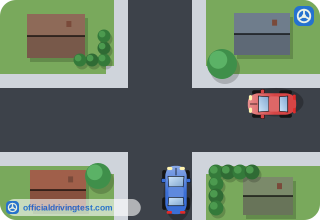
- It has no traffic signal; the limit is 25 mph
- It has no stop signs at any corner; the limit is 15 mph
- It has a hill on one side; the limit is 20 mph
- It has four stop signs; the limit is 10 mph
Show answer
Correct answer: It has no stop signs at any corner; the limit is 15 mph
An intersection with no stop signs on any corner is blind, and the limit is 15 mph. Edge forward slowly until you can see.
Source: California Driver Handbook (2025), page 51 · Open this page in the manual (Manual page 51)
-
A 40-year-old driver is currently on DUI probation. Which BAC limit applies to them?
- The standard 0.08% limit
- 0.04%, the commercial limit
- 0.01%, the same as a driver under 21
- 0.06%, a special probation limit
Show answer
Correct answer: 0.01%, the same as a driver under 21
Anyone on DUI probation is held to the 0.01% limit regardless of age.
Source: California Driver Handbook (2025), page 73 · Open this page in the manual (Manual page 73)