California: Exam Simulator
40 random questions from every topic, like a mini exam.
Independent educational site · not affiliated with any government agency or DMV
Ready? Test yourself
40 questions (the state does not publish how many its test has); pass mark 80%, as on the real test.
- Instant feedback with an explanation
- Every answer cites its source in the manual
- Your best score is saved on this device
- Keyboard: press 1 to 4 to answer and Enter for the next question
Questions are original and based on the official manual "California Driver Handbook" (2025), California DMV.
Sample questions
The exam simulator picks 40 random questions from every topic each time you start. Here are a few examples.
Show the questions and answersHide the questions
-
Before California will issue you a driver's license, which tests must you pass?
- The knowledge test and the behind-the-wheel drive test
- Only a written test about road signs and pavement markings
- A first-aid course and a hearing exam
- A mechanical inspection of your own car
Show answer
Correct answer: The knowledge test and the behind-the-wheel drive test
California requires applicants to pass both the knowledge test and the behind-the-wheel drive test, which are based on the material in the driver handbook.
Source: California Driver Handbook (2025), page 1 · Open this page in the manual (Manual page 1)
-
What is the basic rule for your hands while driving?
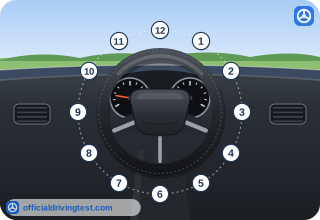
- Always keep one hand free so you can reach the controls quickly.
- Rest both hands at the bottom of the wheel.
- Keep both hands on the wheel whenever you can.
- Hand position does not matter as long as the car stays in its lane.
Show answer
Correct answer: Keep both hands on the wheel whenever you can.
Keeping both hands on the steering wheel whenever possible is critical to controlling your vehicle.
Source: California Driver Handbook (2025), page 9 · Open this page in the manual (Manual page 9)
-
What is a traffic lane?
- Any paved surface wide enough for a car.
- The shoulder alongside a highway.
- The space between two parked cars.
- A section of road for a single line of traffic.
Show answer
Correct answer: A section of road for a single line of traffic.
A traffic lane is a section of road set aside for a single line of traffic.
Source: California Driver Handbook (2025), page 13 · Open this page in the manual (Manual page 13)
-
The lane you are in is marked with unusually large broken lines. What does that mean?
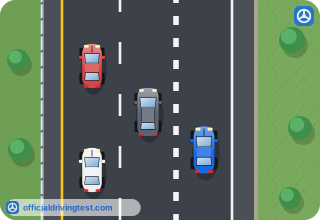
- The lane is reserved for trucks and other slow-moving heavy vehicles that are climbing the grade.
- You have entered a carpool lane.
- The lane is ending or becoming an exit, so look for a sign telling you to exit or merge.
- Passing is allowed in both directions.
Show answer
Correct answer: The lane is ending or becoming an exit, so look for a sign telling you to exit or merge.
Large broken lines mark freeway and street lanes that are ending. Be ready to exit or for the lane to end, and watch for a sign to exit or merge.
Source: California Driver Handbook (2025), page 14 · Open this page in the manual (Manual page 14)
-
How long should a parallel parking space be?
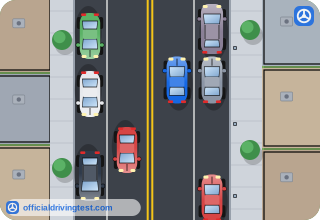
- Exactly the same length as your vehicle
- At least three feet longer than your vehicle
- At least 18 inches longer than your vehicle
- At least twice the length of your vehicle
Show answer
Correct answer: At least three feet longer than your vehicle
Look for a gap at least three feet longer than your car, then signal to show that you plan to park.
Source: California Driver Handbook (2025), page 26 · Open this page in the manual (Manual page 26)
-
Which statement about warning signs is correct?
- Only diamond-shaped warning signs are legally binding
- Yellow warning signs may be ignored in good weather
- You must obey every warning sign, whatever its shape or color
- Warning signs apply only to commercial vehicles
Show answer
Correct answer: You must obey every warning sign, whatever its shape or color
All warning signs must be obeyed regardless of their shape or color.
Source: California Driver Handbook (2025), page 35 · Open this page in the manual (Manual page 35)
-
Where must you stop at this sign when both a limit line and a crosswalk are painted?
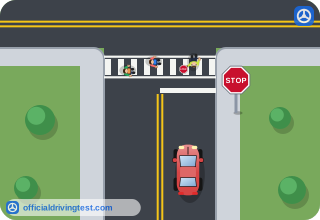
- Anywhere inside the crosswalk
- At the limit line, before entering the crosswalk
- Just past the crosswalk for a better view
- Wherever the car ahead of you stopped
Show answer
Correct answer: At the limit line, before entering the crosswalk
Make a full stop at the limit line, before the crosswalk. If neither is marked, stop before entering the intersection, and check traffic in every direction.
Source: California Driver Handbook (2025), page 35 · Open this page in the manual (Manual page 35)
-
May you turn right on a red light in California?
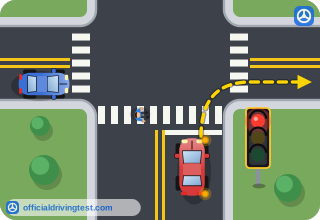
- Yes, without stopping, if the way looks clear.
- Yes, after a complete stop, unless a NO TURN ON RED sign is posted.
- No, never.
- Only between 9 a.m. and 4 p.m., outside the busiest commuting hours.
Show answer
Correct answer: Yes, after a complete stop, unless a NO TURN ON RED sign is posted.
A right turn on red is allowed after you come to a complete stop, unless a NO TURN ON RED sign is posted.
Source: California Driver Handbook (2025), page 18 · Open this page in the manual (Manual page 18)
-
You realize you have just missed your turn. What should you do?
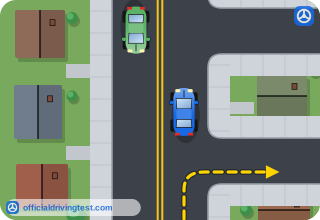
- Brake hard and take the turn anyway.
- Reverse back to the intersection.
- Keep driving, then turn around safely and legally.
- Stop and wait for a gap so you can back up.
Show answer
Correct answer: Keep driving, then turn around safely and legally.
Once you start through an intersection or start a turn, follow through. If you miss a turn, keep driving until you can turn around safely and legally.
Source: California Driver Handbook (2025), page 15 · Open this page in the manual (Manual page 15)
-
May you make a U-turn at a railroad crossing?
- Yes, if no train is in sight.
- Yes, if the gates are up.
- No, it is prohibited.
- Only where the crossing has no signals or gates installed.
Show answer
Correct answer: No, it is prohibited.
Never make a U-turn at or on a railroad crossing.
Source: California Driver Handbook (2025), page 20 · Open this page in the manual (Manual page 20)