California: Right of way & turning Practice Test
Who goes first at intersections, and the rules for turning safely.
Independent educational site · not affiliated with any government agency or DMV
Ready? Test yourself
- Instant feedback with an explanation
- Every answer cites its source in the manual
- Your best score is saved on this device
- Keyboard: press 1 to 4 to answer and Enter for the next question
Questions are original and based on the official manual "California Driver Handbook" (2025), California DMV.
All 27 questions in this practice test
Take the test above first, then use this list to study. Tap “Show answer” to see the correct answer and explanation.
Show the questions and answersHide the questions
-
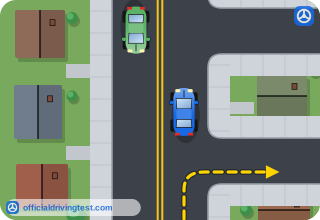
You realize you have just missed your turn. What should you do?
- Brake hard and take the turn anyway.
- Reverse back to the intersection.
- Keep driving, then turn around safely and legally.
- Stop and wait for a gap so you can back up.
Show answer
Correct answer: Keep driving, then turn around safely and legally.
Once you start through an intersection or start a turn, follow through. If you miss a turn, keep driving until you can turn around safely and legally.
Source: California Driver Handbook (2025), page 15 · Open this page in the manual (Manual page 15)
-
What may a center left turn lane be used for?
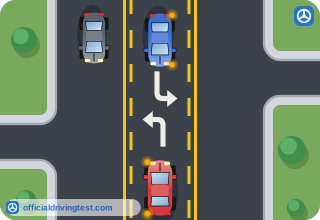
- Preparing for and making a left turn or a U-turn.
- Driving in it whenever the other lanes are busy.
- Passing slower vehicles.
- Parking for short periods.
Show answer
Correct answer: Preparing for and making a left turn or a U-turn.
Use the center left turn lane to prepare for and make a left turn or U-turn. It is not a regular traffic lane or a passing lane.
Source: California Driver Handbook (2025), page 16 · Open this page in the manual (Manual page 16)
-
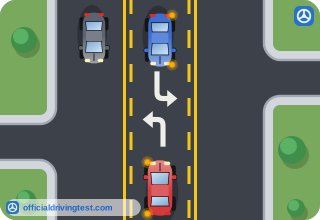
How far may you drive inside a center left turn lane?
- 200 feet
- 500 feet
- One city block
- There is no distance limit at all
Show answer
Correct answer: 200 feet
You may drive no more than 200 feet in a center left turn lane.
Source: California Driver Handbook (2025), page 16 · Open this page in the manual (Manual page 16)
-
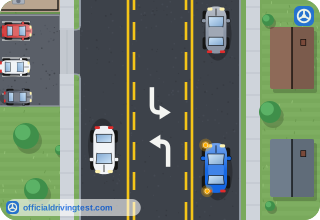
You are turning left from a center left turn lane. What must you do?
- Stay partly in your own travel lane so that approaching traffic can see you waiting there.
- Watch for vehicles coming toward you in the same center lane, and merge fully into it.
- Reverse a little if the gap is too small.
- Signal only once the turn has begun.
Show answer
Correct answer: Watch for vehicles coming toward you in the same center lane, and merge fully into it.
Look for vehicles coming toward you in the center left turn lane, signal, check your blind spots, and merge completely into the lane so you do not block traffic.
Source: California Driver Handbook (2025), page 16 · Open this page in the manual (Manual page 16)
-
How should you position your car for a right turn?
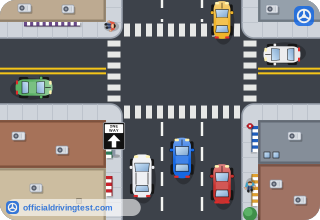
- In the left lane, swinging right at the last moment so you have more room to steer.
- Close to the right edge of the road, entering any right turn lane at its opening.
- Straddling two lanes.
- Wherever traffic happens to be lightest.
Show answer
Correct answer: Close to the right edge of the road, entering any right turn lane at its opening.
Drive close to the right edge of the road and enter a designated right turn lane at its opening. Watch for pedestrians, bicyclists and motorcyclists between your vehicle and the curb.
Source: California Driver Handbook (2025), page 18 · Open this page in the manual (Manual page 18)
-
Where should a right turn finish?
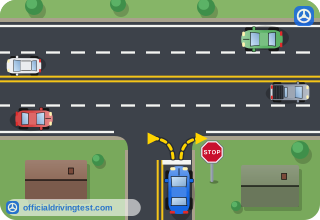
- In whichever lane happens to be clear.
- On the shoulder.
- In the centre lane.
- In the right lane, without swinging wide.
Show answer
Correct answer: In the right lane, without swinging wide.
Look left-right-left, turn when it is safe, and complete the turn in the right lane without swinging wide into another lane.
Source: California Driver Handbook (2025), page 18 · Open this page in the manual (Manual page 18)
-
A dedicated right turn lane does not merge into another lane. What does that allow?
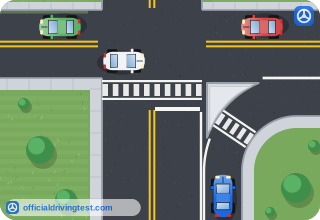
- Making the turn without stopping, even when through traffic has a red light.
- Passing on the right at any speed.
- Skipping the need to yield to pedestrians.
- Parking briefly in the lane while you wait for a gap in the cross traffic.
Show answer
Correct answer: Making the turn without stopping, even when through traffic has a red light.
A dedicated right turn lane lets you turn without stopping, even on a red through signal. But if a light or sign stands on the right curb of that lane, obey it, and always yield to pedestrians in a crosswalk.
Source: California Driver Handbook (2025), page 19 · Open this page in the manual (Manual page 19)
-
How do you enter a designated left turn lane?
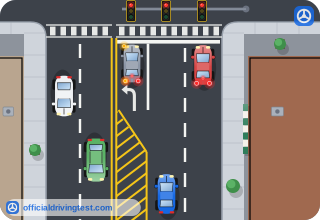
- Cross the solid line wherever it is convenient.
- At the opening, without crossing any solid line.
- By merging across from the right lane at the intersection itself.
- Only after the light turns green.
Show answer
Correct answer: At the opening, without crossing any solid line.
Enter a designated left turn lane at its opening and never cross a solid line. A two-way center left turn lane may be entered within 200 feet of the turn, yielding to anyone already in it.
Source: California Driver Handbook (2025), page 19 · Open this page in the manual (Manual page 19)
-
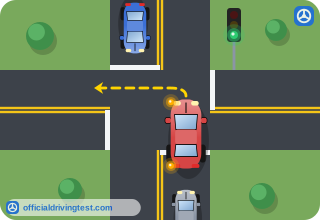
While you wait to turn left, which way should your front wheels point?
- Slightly left, ready for the turn.
- Slightly right.
- It makes no difference which way they point while you are stationary.
- Straight ahead until it is safe to begin.
Show answer
Correct answer: Straight ahead until it is safe to begin.
Keep your wheels pointed straight ahead until you can safely start the turn. If they point left and you are hit from behind, you could be pushed into oncoming traffic.
Source: California Driver Handbook (2025), page 19 · Open this page in the manual (Manual page 19)
-
Which lane do you use to begin a U-turn?
- The far-right lane.
- The shoulder.
- The left turn lane or the far-left lane, after signalling.
- Any lane, since a U-turn crosses them all anyway.
Show answer
Correct answer: The left turn lane or the far-left lane, after signalling.
To make a U-turn, signal and use the left turn lane or the far-left lane.
Source: California Driver Handbook (2025), page 20 · Open this page in the manual (Manual page 20)
-
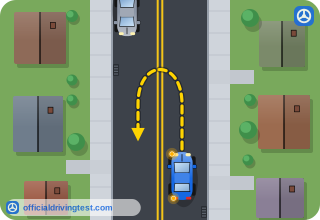
May a U-turn be made across a double yellow line?
- Yes.
- No, never.
- Only on a freeway.
- Only when a police officer is present to direct the traffic around you.
Show answer
Correct answer: Yes.
A U-turn across a double yellow line is permitted.
Source: California Driver Handbook (2025), page 20 · Open this page in the manual (Manual page 20)
-
In a residential district, a U-turn is allowed when what is true?
- The street is at least two lanes wide.
- No vehicles are approaching you within 200 feet.
- It is after 8 p.m.
- You have signalled for a full five seconds.
Show answer
Correct answer: No vehicles are approaching you within 200 feet.
In a residential district you may make a U-turn if no vehicles are approaching you within 200 feet.
Source: California Driver Handbook (2025), page 20 · Open this page in the manual (Manual page 20)
-
May you make a U-turn at an intersection with a green light or green arrow?
- Yes, unless a NO U-TURN sign is posted.
- No, U-turns require a red light.
- Only from the right lane.
- Only where the intersection has no crosswalk.
Show answer
Correct answer: Yes, unless a NO U-TURN sign is posted.
U-turns are allowed at an intersection on a green light or green arrow unless a NO U-TURN sign is posted.
Source: California Driver Handbook (2025), page 20 · Open this page in the manual (Manual page 20)
-
On a divided highway, when is a U-turn permitted?
- Wherever the median happens to be narrow.
- Only where the speed limit is 45 mph or lower.
- Never, under any circumstances.
- Only where a center divider opening is provided.
Show answer
Correct answer: Only where a center divider opening is provided.
A U-turn on a divided highway is legal only where a center divider opening is provided. Never make one by crossing a dividing section, curb, strip of land, or two sets of double yellow lines.
Source: California Driver Handbook (2025), page 20 · Open this page in the manual (Manual page 20)
-
How far must you be able to see in each direction before making a U-turn?
- 100 feet
- 200 feet
- 500 feet
- Visibility does not matter as long as you signal in advance
Show answer
Correct answer: 200 feet
Never make a U-turn when you cannot see clearly for 200 feet in each direction.
Source: California Driver Handbook (2025), page 20 · Open this page in the manual (Manual page 20)
-
Are U-turns allowed on a one-way street?
- Yes, at any intersection.
- Yes, if the street has at least three lanes.
- Yes, outside of normal business hours when traffic is very light.
- No.
Show answer
Correct answer: No.
Never make a U-turn on a one-way street.
Source: California Driver Handbook (2025), page 20 · Open this page in the manual (Manual page 20)
-
What does the handbook say about turning around at a fire station?
- It is fine when no emergency is in progress.
- Never U-turn in front of one, and never use its driveway to turn around.
- It is allowed after 10 p.m.
- Only drivers of emergency vehicles are restricted from doing so.
Show answer
Correct answer: Never U-turn in front of one, and never use its driveway to turn around.
Never make a U-turn in front of a fire station, and never use a fire station driveway to turn around.
Source: California Driver Handbook (2025), page 20 · Open this page in the manual (Manual page 20)
-
Where in a business district may a U-turn be made?
- Nowhere at all.
- Anywhere the street happens to be wide enough for your vehicle to complete the turn.
- At an intersection, or on a divided highway where an opening is provided.
- Only in front of a public parking garage.
Show answer
Correct answer: At an intersection, or on a divided highway where an opening is provided.
U-turns are prohibited in business districts, the part of a city where most offices and businesses are, except at an intersection or at a divided-highway opening.
Source: California Driver Handbook (2025), page 20 · Open this page in the manual (Manual page 20)
-
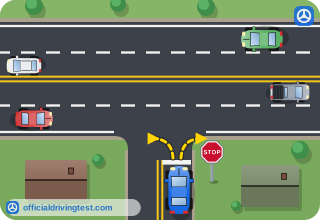
Turning left from a two-way street onto another two-way street, which lane do you start and finish in?
- Start in the right lane and end wherever there is room.
- Start in the left lane and end in the far-right lane.
- Start in the middle lane and end in the right lane.
- Start and end in the left lane nearest the middle of the street.
Show answer
Correct answer: Start and end in the left lane nearest the middle of the street.
Start the turn in the left lane closest to the middle of the street and end in the left lane closest to the middle going your direction. The same finish applies when turning left from a one-way street onto a two-way street.
Source: California Driver Handbook (2025), page 21 · Open this page in the manual (Manual page 21)
-
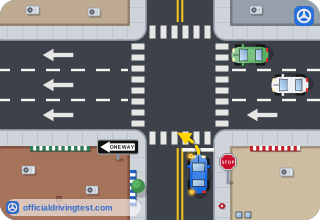
You turn left onto a one-way street with three lanes going your way. Where may you finish?
- Only in the far-left lane.
- Only in the far-right lane.
- In any lane that is open.
- This turn may not be made at all when the street has three lanes.
Show answer
Correct answer: In any lane that is open.
When a one-way street you are turning onto has three or more lanes in your direction of travel, you may end the turn in any open lane.
Source: California Driver Handbook (2025), page 22 · Open this page in the manual (Manual page 22)
-
Turning right from a one-way street onto another one-way street, where do you start and where may you end?
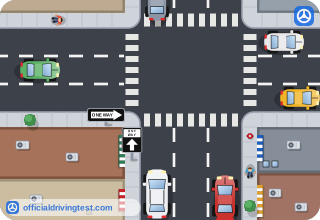
- Start in the far-right lane; if it is safe you may end in any lane.
- Start in the centre lane and end in the right lane.
- Start anywhere and end in the far-left lane.
- Start in the far-left lane and end in the far-right lane.
Show answer
Correct answer: Start in the far-right lane; if it is safe you may end in any lane.
Begin the turn in the far-right lane. If it is safe, you may end the turn in any lane of the one-way street.
Source: California Driver Handbook (2025), page 22 · Open this page in the manual (Manual page 22)
-
At a T intersection where a one-way street meets a two-way street, who has the right-of-way?
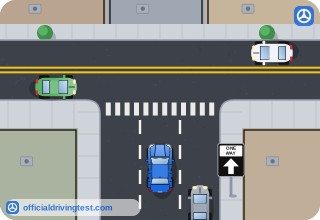
- The driver turning left.
- Traffic going straight through.
- The driver turning right.
- Whoever reaches the intersection first.
Show answer
Correct answer: Traffic going straight through.
Traffic going straight through the intersection has the right-of-way. From the one-way street you may turn either right or left from the center lane.
Source: California Driver Handbook (2025), page 22 · Open this page in the manual (Manual page 22)
-
You are waiting to turn left and an approaching vehicle has its right turn signal flashing. What should you do?
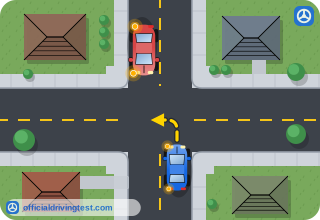
- Turn right away, since the other driver is turning
- Flash your headlights so the other driver turns first
- Wait until that vehicle actually begins its turn
- Sound your horn and proceed slowly
Show answer
Correct answer: Wait until that vehicle actually begins its turn
The signal may have been left on by mistake, or the driver may plan to turn past you. Wait for the turn to actually start.
Source: California Driver Handbook (2025), page 24 · Open this page in the manual (Manual page 24)
-
Who has the right-of-way as you reach the entrance of a roundabout?
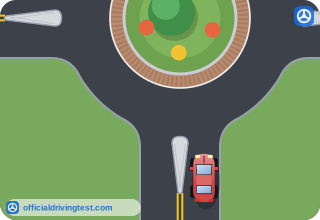
- Whoever is travelling fastest
- The vehicle entering from the largest road
- The vehicle waiting at the next entrance
- Traffic already circulating in the roundabout
Show answer
Correct answer: Traffic already circulating in the roundabout
Entering drivers must yield to all traffic already in the roundabout before merging.
Source: California Driver Handbook (2025), page 40 · Open this page in the manual (Manual page 40)
-
What are the first steps for using a roundabout correctly?
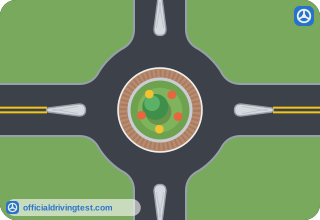
- Slow down, yield to traffic in the circle, then enter heading right
- Stop completely at the entry line every time, then enter
- Enter heading to the left and cut across to your exit
- Speed up on approach so you can merge without yielding
Show answer
Correct answer: Slow down, yield to traffic in the circle, then enter heading right
Approach slowly, give way to circulating traffic, and merge to the right only when the gap is large enough.
Source: California Driver Handbook (2025), page 40 · Open this page in the manual (Manual page 40)
-
Two vehicles meet on a steep, narrow mountain road and neither can pass. Who has the right-of-way?
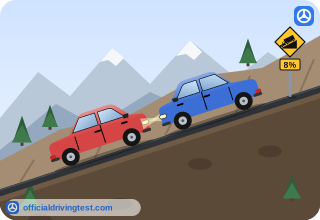
- The vehicle facing downhill
- The vehicle facing uphill
- The heavier of the two vehicles
- The vehicle that arrived at the narrow section second
Show answer
Correct answer: The vehicle facing uphill
On a steep narrow road, the vehicle heading uphill keeps the right-of-way.
Source: California Driver Handbook (2025), page 42 · Open this page in the manual (Manual page 42)
-
On a steep narrow road where two vehicles cannot pass each other, why is the downhill vehicle the one that backs up?
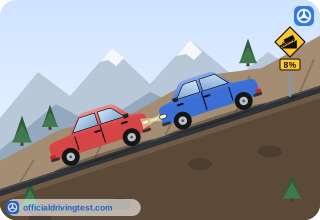
- Because it is usually the lighter vehicle
- Because it has better control while backing up the hill
- Because its brakes are cooler
- Because it has a clearer view of oncoming traffic
Show answer
Correct answer: Because it has better control while backing up the hill
A vehicle pointing downhill has more control when reversing up the slope, so it yields and backs up.
Source: California Driver Handbook (2025), page 42 · Open this page in the manual (Manual page 42)