California: Signals & vehicle controls Practice Test
Signaling, horns, headlights, and what to do if your vehicle breaks down.
Independent educational site · not affiliated with any government agency or DMV
Ready? Test yourself
- Instant feedback with an explanation
- Every answer cites its source in the manual
- Your best score is saved on this device
- Keyboard: press 1 to 4 to answer and Enter for the next question
Questions are original and based on the official manual "California Driver Handbook" (2025), California DMV.
All 30 questions in this practice test
Take the test above first, then use this list to study. Tap “Show answer” to see the correct answer and explanation.
Show the questions and answersHide the questions
-
What is the basic rule for your hands while driving?
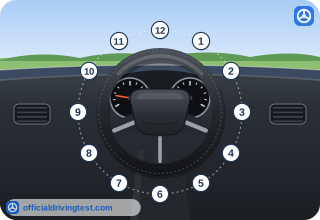
- Always keep one hand free so you can reach the controls quickly.
- Rest both hands at the bottom of the wheel.
- Keep both hands on the wheel whenever you can.
- Hand position does not matter as long as the car stays in its lane.
Show answer
Correct answer: Keep both hands on the wheel whenever you can.
Keeping both hands on the steering wheel whenever possible is critical to controlling your vehicle.
Source: California Driver Handbook (2025), page 9 · Open this page in the manual (Manual page 9)
-
Where do your hands start in hand-to-hand (push/pull) steering?
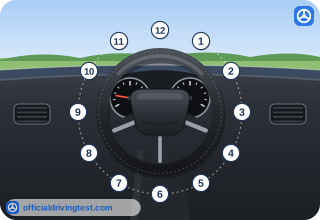
- At 9 and 3 o'clock, or 8 and 4 o'clock.
- At 10 and 2 o'clock only.
- One hand at 12 o'clock.
- Both hands together at 6 o'clock.
Show answer
Correct answer: At 9 and 3 o'clock, or 8 and 4 o'clock.
Start with your hands at either 9 and 3 o'clock or 8 and 4 o'clock on the wheel.
Source: California Driver Handbook (2025), page 9 · Open this page in the manual (Manual page 9)
-
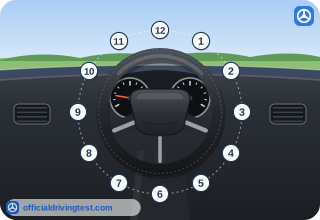
In hand-to-hand steering, what happens to your hands when you turn?
- They slide up to the top of the wheel so you can pull it around faster.
- They cross over the center to gain leverage.
- One hand lets go and the other steers alone.
- They stay in position and never cross over the middle of the wheel.
Show answer
Correct answer: They stay in position and never cross over the middle of the wheel.
With hand-to-hand steering you keep your hands in their starting positions, even through turns, and never cross them over the middle of the wheel.
Source: California Driver Handbook (2025), page 9 · Open this page in the manual (Manual page 9)
-
When is hand-over-hand steering the recommended method?
- On long, straight freeway stretches.
- Any time you drive faster than 55 mph.
- Only when reversing out of a driveway onto a quiet residential street.
- Turning at low speed, parking, or recovering from a skid.
Show answer
Correct answer: Turning at low speed, parking, or recovering from a skid.
Hand-over-hand steering, starting at 8 and 4 o'clock, is used for low-speed turns, parking, and skid recovery. Only two situations call for one-hand steering.
Source: California Driver Handbook (2025), page 10 · Open this page in the manual (Manual page 10)
-
Where should your hand be when you steer while backing up?
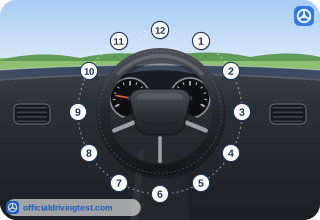
- At the 12 o'clock position.
- At 8 and 4 o'clock.
- At the 6 o'clock position.
- On the gear selector, so you can change direction fast.
Show answer
Correct answer: At the 12 o'clock position.
Turning while backing up is one of only two situations that call for one-hand steering, with your hand at 12 o'clock so you can look behind you.
Source: California Driver Handbook (2025), page 10 · Open this page in the manual (Manual page 10)
-
Which actions always require a signal?
- Turning only.
- Turning and changing lanes, but not slowing down.
- Turning, changing lanes, slowing down, and stopping.
- Only moves made when other cars are close by.
Show answer
Correct answer: Turning, changing lanes, slowing down, and stopping.
Always signal when you turn, change lanes, slow down or stop, and also before pulling next to a curb or away from one.
Source: California Driver Handbook (2025), page 10 · Open this page in the manual (Manual page 10)
-
When should you use hand-and-arm signals instead of your signal lights?
- Whenever you drive in a residential area.
- Only when a police officer tells you to.
- Never, because hand signals are no longer recognized.
- If signal lights fail or bright sun makes them hard to see.
Show answer
Correct answer: If signal lights fail or bright sun makes them hard to see.
Use hand-and-arm signals when your signal lights are not working or bright sun makes them difficult for others to see.
Source: California Driver Handbook (2025), page 10 · Open this page in the manual (Manual page 10)
-
How far before a turn should you begin signaling?
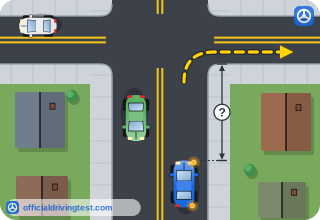
- 50 feet
- At least 100 feet
- At least 300 feet
- One full block, whatever that distance happens to be
Show answer
Correct answer: At least 100 feet
Signal at least 100 feet before you make a turn.
Source: California Driver Handbook (2025), page 11 · Open this page in the manual (Manual page 11)
-
On a freeway, how long before a lane change must you signal?
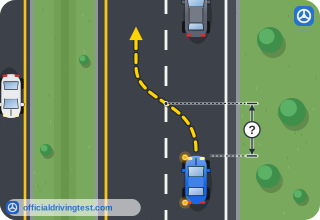
- At least two seconds
- At least three seconds
- At least five seconds
- At least ten seconds
Show answer
Correct answer: At least five seconds
Freeway lane changes require a signal at least five seconds in advance.
Source: California Driver Handbook (2025), page 11 · Open this page in the manual (Manual page 11)
-
The street looks empty. Should you still signal your turn?
- No, signals only benefit cars that are already close to you.
- Only if a traffic camera is present.
- Yes, signal even when you see no one around.
- Only during daylight hours.
Show answer
Correct answer: Yes, signal even when you see no one around.
Signal even when you do not see other vehicles around you.
Source: California Driver Handbook (2025), page 11 · Open this page in the manual (Manual page 11)
-
You plan to turn shortly after crossing an intersection. When do you switch on the signal?
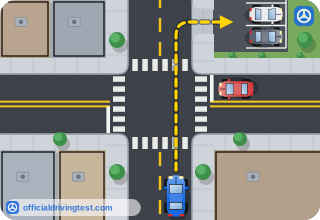
- Well before you reach the intersection.
- When you are almost through the intersection.
- After the turn has already begun.
- No signal is needed for turns this close together.
Show answer
Correct answer: When you are almost through the intersection.
Wait until you are almost through the intersection, so other drivers do not think you are turning at the intersection itself.
Source: California Driver Handbook (2025), page 11 · Open this page in the manual (Manual page 11)
-
What should you do with your turn signal once the maneuver is finished?
- Leave it on until the next turn.
- Switch it over to the emergency flashers.
- Tap the brakes to cancel it.
- Turn it off.
Show answer
Correct answer: Turn it off.
Turn your signal off as soon as you no longer need it, so you do not mislead other drivers.
Source: California Driver Handbook (2025), page 11 · Open this page in the manual (Manual page 11)
-
What is your horn for?
- Telling a slow driver ahead of you to speed up and move over.
- Claiming the right-of-way at an intersection where nobody seems willing to go first.
- Showing other drivers that you are annoyed.
- Letting others know you are there and warning of a hazard.
Show answer
Correct answer: Letting others know you are there and warning of a hazard.
Use the horn to let other drivers know you are there, to warn of a hazard, and to avoid collisions.
Source: California Driver Handbook (2025), page 11 · Open this page in the manual (Manual page 11)
-
On a narrow mountain road, when should you sound your horn?
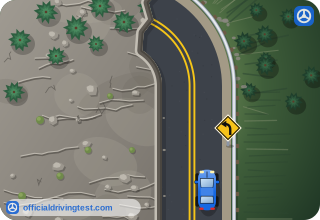
- When you cannot see at least 200 feet ahead.
- Only after another vehicle honks first.
- Every time you enter a curve, no matter how far you can see.
- When you cannot see at least 500 feet ahead.
Show answer
Correct answer: When you cannot see at least 200 feet ahead.
On narrow mountain roads, use your horn to alert oncoming traffic wherever you cannot see at least 200 feet ahead.
Source: California Driver Handbook (2025), page 11 · Open this page in the manual (Manual page 11)
-
A car is coming toward you at night. When must you switch your high beams to low?
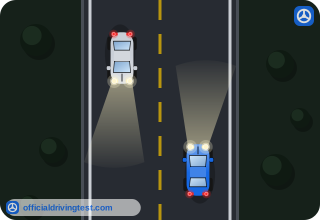
- Within 500 feet of it
- Within 300 feet of it
- Within 150 feet of it
- Only once that driver flashes their own lights at you
Show answer
Correct answer: Within 500 feet of it
Dim your high beams to low beams within 500 feet of any vehicle coming toward you.
Source: California Driver Handbook (2025), page 11 · Open this page in the manual (Manual page 11)
-
You are following another vehicle at night with high beams on. When must you dim them?
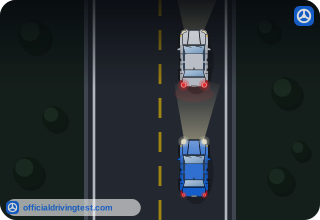
- Within 1,000 feet
- Within 500 feet
- Within 300 feet
- Dimming is required only for oncoming traffic, never for a car you follow.
Show answer
Correct answer: Within 300 feet
Dim your high beams within 300 feet of a vehicle you are following.
Source: California Driver Handbook (2025), page 11 · Open this page in the manual (Manual page 11)
-
May you drive using only your parking lights?
- Yes, on well-lit city streets.
- Yes, if a headlight has burned out.
- No, it is illegal.
- Yes, as long as you stay under 25 mph.
Show answer
Correct answer: No, it is illegal.
Driving on parking lights alone is illegal; you must use your headlights.
Source: California Driver Handbook (2025), page 11 · Open this page in the manual (Manual page 11)
-
Darkness requires headlights once you can no longer see how far ahead?
- 500 feet
- 1,000 feet
- 200 feet
- 2,000 feet
Show answer
Correct answer: 1,000 feet
Turn on your headlights when it is too dark to see 1,000 feet away.
Source: California Driver Handbook (2025), page 11 · Open this page in the manual (Manual page 11)
-
Headlights must be on during which window around sunset and sunrise?
- From sunset to sunrise exactly.
- From 30 minutes after sunset until 30 minutes before sunrise.
- From one hour after sunset until the first light of dawn appears.
- Only between midnight and 5 a.m.
Show answer
Correct answer: From 30 minutes after sunset until 30 minutes before sunrise.
Use headlights beginning 30 minutes after sunset and keep them on until 30 minutes before sunrise.
Source: California Driver Handbook (2025), page 11 · Open this page in the manual (Manual page 11)
-
Fog, rain or snow has you using your windshield wipers. What else is required?
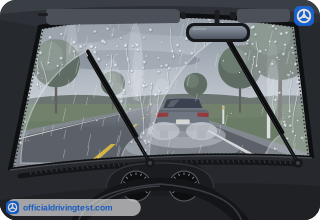
- Turn on your low-beam headlights.
- Turn on your high beams.
- Switch on the emergency flashers.
- Nothing extra is legally required in that situation.
Show answer
Correct answer: Turn on your low-beam headlights.
If weather makes you use your wipers, you must turn on your low-beam headlights.
Source: California Driver Handbook (2025), page 11 · Open this page in the manual (Manual page 11)
-
Dust and smoke are making other vehicles hard to make out. What should you do?
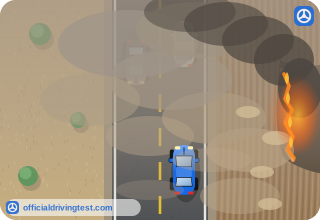
- Sound the horn at regular intervals.
- Switch to parking lights so you dazzle no one.
- Move into the Number 1 lane.
- Turn on your headlights.
Show answer
Correct answer: Turn on your headlights.
Use your headlights whenever clouds, dust, smoke or fog keep you from seeing other vehicles.
Source: California Driver Handbook (2025), page 11 · Open this page in the manual (Manual page 11)
-
Where should you use headlights even on a bright, sunny day?
- In parking structures only.
- Nowhere; in full daylight headlights serve no purpose at all.
- On any road posted above 55 mph.
- On mountain roads and in tunnels.
Show answer
Correct answer: On mountain roads and in tunnels.
Headlights are required on mountain roads and in tunnels even on sunny days, and any time a road sign states they must be on.
Source: California Driver Handbook (2025), page 11 · Open this page in the manual (Manual page 11)
-
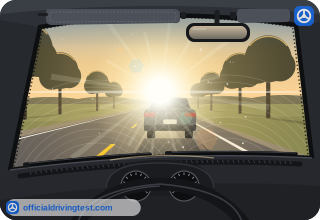
Why turn on your headlights when the sun sits low on the horizon?
- It cuts glare inside your own car.
- It keeps the battery charged.
- It helps other drivers see your vehicle.
- It is needed to run the air conditioning.
Show answer
Correct answer: It helps other drivers see your vehicle.
Use your headlights to help other drivers see your vehicle, especially when the sun is low on the horizon.
Source: California Driver Handbook (2025), page 11 · Open this page in the manual (Manual page 11)
-
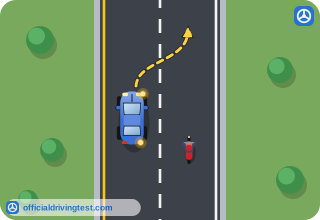
Besides signalling and checking your mirrors, what must you do before changing lanes?
- Sound your horn.
- Look over your shoulder toward the lane you want.
- Flash your headlights twice at the traffic beside you.
- Slow almost to a stop.
Show answer
Correct answer: Look over your shoulder toward the lane you want.
Look over your shoulder in the direction you plan to move and check your blind spots for vehicles, motorcyclists and bicyclists.
Source: California Driver Handbook (2025), page 15 · Open this page in the manual (Manual page 15)
-
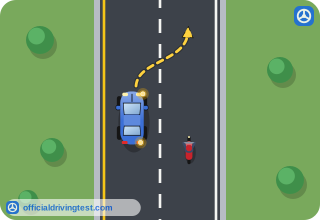
Should you slow down before making a lane change?
- Yes, always drop about 10 mph first so that a gap opens up ahead of you.
- Yes, unless you are on a freeway.
- No, but you must have enough room for your vehicle in the next lane.
- No, you should accelerate hard instead.
Show answer
Correct answer: No, but you must have enough room for your vehicle in the next lane.
It is not necessary to slow down before a lane change, but there must be enough space for your vehicle in the lane you are entering.
Source: California Driver Handbook (2025), page 15 · Open this page in the manual (Manual page 15)
-
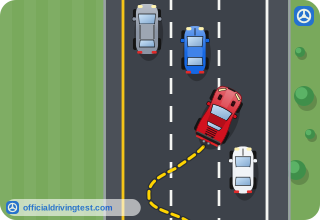
What does the handbook say about weaving between lanes?
- It is an efficient way to get through heavy traffic.
- It is discouraged for new drivers but fine for experienced ones.
- It is acceptable as long as you signal each move.
- Stay in one lane as much as you can and do not weave in and out.
Show answer
Correct answer: Stay in one lane as much as you can and do not weave in and out.
Stay in one lane as much as possible. Weaving and last-minute lane or direction changes raise the risk of a collision.
Source: California Driver Handbook (2025), page 15 · Open this page in the manual (Manual page 15)
-
What is the correct way to check your blind spots?
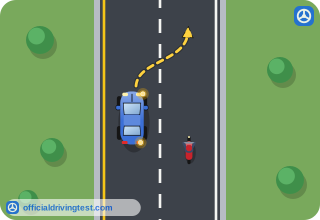
- Adjust the side mirrors outward until the blind spots disappear
- Turn only your head and look over your shoulder out the side window
- Turn your body and the steering wheel together toward the window
- Glance at the rearview mirror twice before moving
Show answer
Correct answer: Turn only your head and look over your shoulder out the side window
Look over your right and left shoulders through the side windows, turning only your head so you do not pull the steering wheel off course.
Source: California Driver Handbook (2025), page 58 · Open this page in the manual (Manual page 58)
-
When are high-beam headlights appropriate at night?
- In heavy rain, to cut through the water
- Whenever another vehicle is approaching, to be seen
- On open country roads or dark city streets
- Only in tunnels and underpasses
Show answer
Correct answer: On open country roads or dark city streets
High beams help on dark open roads, but you must dim them so you do not blind an oncoming driver, and never use them where they are illegal.
Source: California Driver Handbook (2025), page 59 · Open this page in the manual (Manual page 59)
-
An oncoming vehicle's headlights are painfully bright. What should you do?
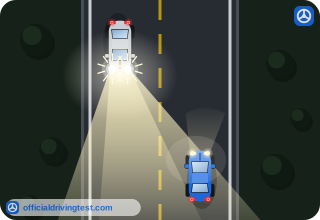
- Look toward the right edge of your lane
- Switch on your own high beams so the other driver dims theirs
- Stare at the headlights so your eyes adjust
- Close your eyes briefly until the vehicle passes
Show answer
Correct answer: Look toward the right edge of your lane
Shift your gaze to the right edge of your lane; retaliating with your high beams only makes it harder for both drivers to see.
Source: California Driver Handbook (2025), page 59 · Open this page in the manual (Manual page 59)
-
Which lights should you use when it is raining?
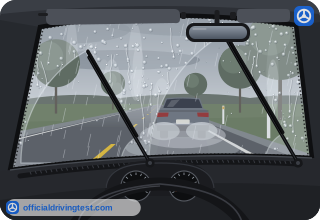
- Parking lights only
- High-beam headlights
- Emergency flashers while moving
- Low-beam headlights
Show answer
Correct answer: Low-beam headlights
Use low beams in the rain. Driving on parking lights alone is never an acceptable substitute for headlights.
Source: California Driver Handbook (2025), page 59 · Open this page in the manual (Manual page 59)