California: Railroad & light rail crossings Practice Test
Safety rules for crossing train tracks and sharing the road with light rail.
Independent educational site · not affiliated with any government agency or DMV
Ready? Test yourself
- Instant feedback with an explanation
- Every answer cites its source in the manual
- Your best score is saved on this device
- Keyboard: press 1 to 4 to answer and Enter for the next question
Questions are original and based on the official manual "California Driver Handbook" (2025), California DMV.
All 15 questions in this practice test
Take the test above first, then use this list to study. Tap “Show answer” to see the correct answer and explanation.
Show the questions and answersHide the questions
-
May you make a U-turn at a railroad crossing?
- Yes, if no train is in sight.
- Yes, if the gates are up.
- No, it is prohibited.
- Only where the crossing has no signals or gates installed.
Show answer
Correct answer: No, it is prohibited.
Never make a U-turn at or on a railroad crossing.
Source: California Driver Handbook (2025), page 20 · Open this page in the manual (Manual page 20)
-
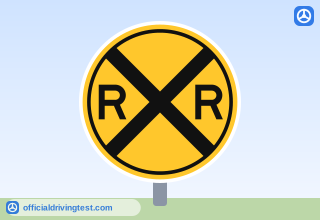
What is this yellow-and-black circular sign telling you?
- A rest area is ahead
- The road curves sharply ahead
- A railroad crossing is ahead
- Two roads merge just ahead
Show answer
Correct answer: A railroad crossing is ahead
The round yellow sign with the black X is the advance warning that railroad tracks cross the road ahead.
Source: California Driver Handbook (2025), page 38 · Open this page in the manual (Manual page 38)
-
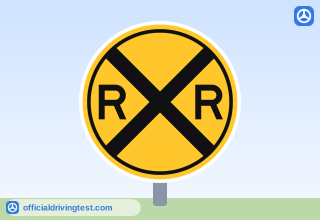
What should you do after passing a railroad advance warning sign?
- Maintain your speed so you clear the tracks quickly
- Look, listen, slow down, and let any train pass first
- Stop only if crossing gates are lowered
- Change lanes to the left before the tracks
Show answer
Correct answer: Look, listen, slow down, and let any train pass first
Look, listen, slow down and prepare to stop. Let any trains pass before you proceed.
Source: California Driver Handbook (2025), page 38 · Open this page in the manual (Manual page 38)
-
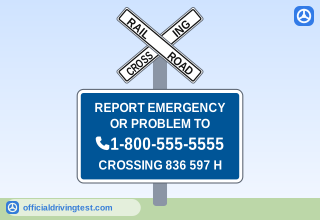
Many railroad crossings have a blue and white sign. What information does it give?
- The times trains are scheduled to pass here
- The speed limit for crossing the tracks
- The number of tracks at the crossing
- What to do in an emergency on or near the tracks
Show answer
Correct answer: What to do in an emergency on or near the tracks
The blue and white sign carries emergency contact information for problems on or near the tracks.
Source: California Driver Handbook (2025), page 38 · Open this page in the manual (Manual page 38)
-
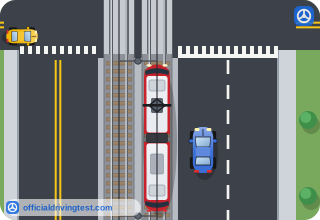
What is the general rule about passing a light rail vehicle or a streetcar?
- You may pass on either side once it stops.
- Do not pass it on the left, whether moving or standing.
- You may never pass it under any circumstances.
- You may pass on the left only while it is moving.
Show answer
Correct answer: Do not pass it on the left, whether moving or standing.
As a rule you must not overtake a light rail vehicle or streetcar on its left side, moving or stopped, except in a few listed situations.
Source: California Driver Handbook (2025), page 44 · Open this page in the manual (Manual page 44)
-
Which situation allows you to pass a light rail vehicle on its left side?
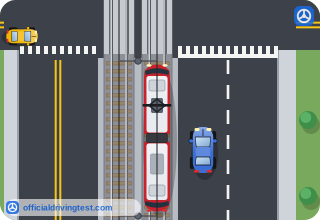
- The light rail vehicle is stopped to let passengers off.
- You are running late and traffic is heavy.
- A traffic officer directs you to pass on the left.
- The street has two lanes in each direction.
Show answer
Correct answer: A traffic officer directs you to pass on the left.
Passing on the left is allowed when a traffic officer directs it, on a one-way street, or when the tracks leave no room to pass on the right.
Source: California Driver Handbook (2025), page 44 · Open this page in the manual (Manual page 44)
-
The tracks run so close to the right side of the street that your vehicle cannot fit past the light rail vehicle on the right. What may you do?
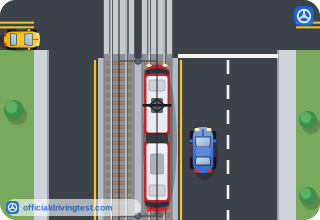
- Drive onto the tracks and pass over them
- Pass it on the left
- Use the sidewalk to get around it
- Sound your horn and follow closely until it moves
Show answer
Correct answer: Pass it on the left
One of the listed exceptions is that tracks sitting too close to the right side leave you no choice but to pass on the left.
Source: California Driver Handbook (2025), page 44 · Open this page in the manual (Manual page 44)
-
On public roads, what status do light rail vehicles have?
- They have the same rights and responsibilities as other vehicles.
- They always have the right-of-way over every road user.
- They are exempt from traffic signal lights.
- They must yield to every passenger vehicle.
Show answer
Correct answer: They have the same rights and responsibilities as other vehicles.
Light rail vehicles share public roads under the same rights and responsibilities as other vehicles.
Source: California Driver Handbook (2025), page 44 · Open this page in the manual (Manual page 44)
-
Why does a light rail operator sometimes have trouble seeing you?
- The cab windows are tinted for passenger comfort.
- Buildings, trees, and other items can cause blind spots.
- The vehicle has no mirrors at all.
- Operators must watch the tracks and never look up.
Show answer
Correct answer: Buildings, trees, and other items can cause blind spots.
Objects alongside the route such as buildings and trees block the operator's view, so know where light rail vehicles run.
Source: California Driver Handbook (2025), page 44 · Open this page in the manual (Manual page 44)
-
A light rail vehicle is approaching and you want to turn across its path. What should you do?
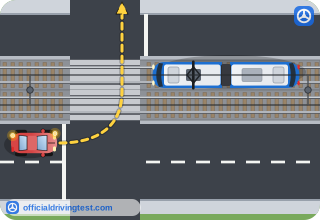
- Turn quickly before it reaches you.
- Never turn in front of it; keep a safe distance.
- Turn if you can beat it by a car length.
- Flash your lights so the operator slows down.
Show answer
Correct answer: Never turn in front of it; keep a safe distance.
You must never turn in front of an approaching light rail vehicle, and you should keep a safe distance from it.
Source: California Driver Handbook (2025), page 44 · Open this page in the manual (Manual page 44)
-
Before you turn across light rail tracks, you should:
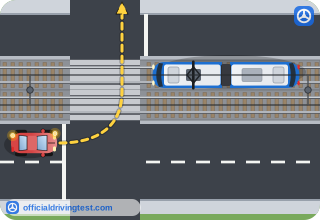
- assume the tracks are clear if the signal is green
- check for approaching light rail vehicles
- stop on the tracks and look both ways
- wait for a light rail vehicle to pass first, every time
Show answer
Correct answer: check for approaching light rail vehicles
Always look for approaching light rail vehicles before turning across the tracks.
Source: California Driver Handbook (2025), page 44 · Open this page in the manual (Manual page 44)
-
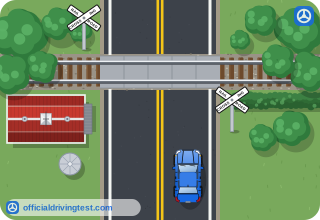
You are within 100 feet of a railroad crossing and cannot see the tracks for 400 feet in both directions. What is the speed limit?
- The posted limit still applies
- 25 mph
- 35 mph
- 15 mph
Show answer
Correct answer: 15 mph
Limited visibility near a crossing lowers the limit to 15 mph within 100 feet of the tracks.
Source: California Driver Handbook (2025), page 51 · Open this page in the manual (Manual page 51)
-
When may you drive faster than 15 mph as you approach a railroad crossing?
- When no train is scheduled
- When it has gates, a signal, or a flagman
- When you are late for work
- Never, even when the crossing has gates
Show answer
Correct answer: When it has gates, a signal, or a flagman
Gates, a warning signal, or a flagman controlling the crossing lift the 15 mph restriction.
Source: California Driver Handbook (2025), page 51 · Open this page in the manual (Manual page 51)
-
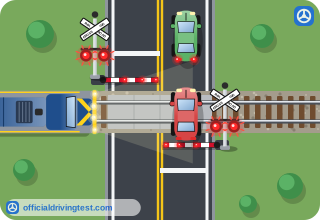
Your vehicle stalls on a railroad track, a train is coming, and the warning lights are flashing. What should you do?
- Stay in the vehicle and keep trying to restart the engine before the train arrives
- Get out at once and run from the tracks at an angle toward the approaching train, then call 911
- Get out and run straight along the tracks, away from the train, then call 911
- Get out, stand beside the vehicle, and wave at the train to warn the engineer
Show answer
Correct answer: Get out at once and run from the tracks at an angle toward the approaching train, then call 911
Leave the vehicle immediately and run away from the tracks diagonally, in the direction the train is coming from. Then call 911.
Source: California Driver Handbook (2025), page 70 · Open this page in the manual (Manual page 70)
-
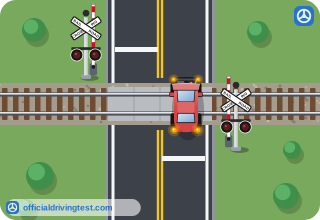
Your vehicle stops on a railroad track, but no train is in sight and the warning lights are not flashing. What should you do?
- Leave the car there and walk to the nearest gas station for help
- Stay inside the vehicle and wait there for a tow truck to arrive
- Get out, call the number on the crossing post or control box, then call 911
- Push the vehicle back off the tracks the way you came
Show answer
Correct answer: Get out, call the number on the crossing post or control box, then call 911
Exit the vehicle, then call the number on the railroad crossing post or the metal control box, report the crossing number and the vehicle on the tracks, and call 911.
Source: California Driver Handbook (2025), page 70 · Open this page in the manual (Manual page 70)