California: Pedestrian rights Practice Test
Crosswalk rules and a driver's duty to yield to people on foot.
Independent educational site · not affiliated with any government agency or DMV
Ready? Test yourself
- Instant feedback with an explanation
- Every answer cites its source in the manual
- Your best score is saved on this device
- Keyboard: press 1 to 4 to answer and Enter for the next question
Questions are original and based on the official manual "California Driver Handbook" (2025), California DMV.
All 29 questions in this practice test
Take the test above first, then use this list to study. Tap “Show answer” to see the correct answer and explanation.
Show the questions and answersHide the questions
-
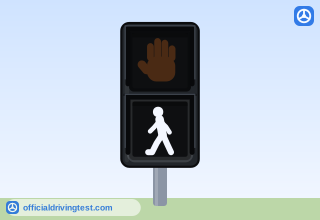
A pedestrian signal shows a walking person symbol. What does this mean for a person on foot?
- Wait at the curb
- They may cross the street
- Crossing is allowed only at the corner
- Finish crossing immediately, but do not start
Show answer
Correct answer: They may cross the street
The WALK signal or walking person symbol means a pedestrian may begin crossing the street.
Source: California Driver Handbook (2025), page 35 · Open this page in the manual (Manual page 35)
-
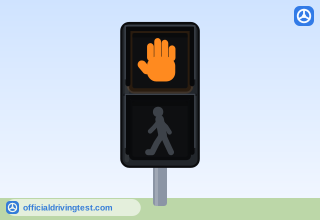
What does a steady upraised hand on a pedestrian signal mean?
- Cross quickly
- Cross only with another pedestrian
- You may not cross the street
- Press the button again to reset the signal
Show answer
Correct answer: You may not cross the street
The DON'T WALK signal or raised hand tells pedestrians that crossing is not allowed at that time.
Source: California Driver Handbook (2025), page 35 · Open this page in the manual (Manual page 35)
-
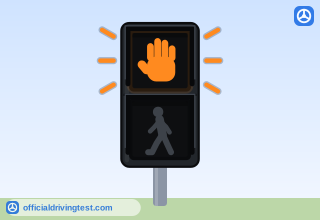
A pedestrian signal begins flashing the raised hand. What should a pedestrian standing at the curb do?
- Not start crossing the street
- Start crossing but run
- Cross diagonally instead
- Step into the street and wave at drivers
Show answer
Correct answer: Not start crossing the street
A flashing raised hand means do not begin crossing; the traffic signal is about to change.
Source: California Driver Handbook (2025), page 35 · Open this page in the manual (Manual page 35)
-
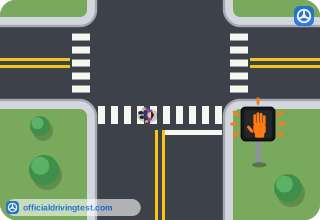
A pedestrian is still in the crosswalk while the raised hand is flashing. What must a driver do?
- Drive around behind the pedestrian
- Proceed, because the pedestrian's time has expired
- Yield to the pedestrian
- Move forward slowly to encourage them to hurry
Show answer
Correct answer: Yield to the pedestrian
Drivers must yield to pedestrians in the crosswalk even when the DON'T WALK signal is flashing.
Source: California Driver Handbook (2025), page 35 · Open this page in the manual (Manual page 35)
-
Some pedestrian signals display numbers. What do those numbers show?
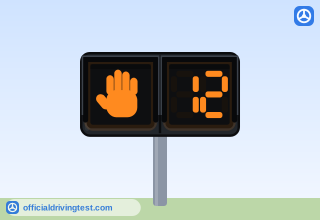
- The seconds remaining to finish crossing
- The width of the street in feet
- The number of pedestrians waiting
- The signal's identification number
Show answer
Correct answer: The seconds remaining to finish crossing
The numerals count down the seconds left for pedestrians to cross the street.
Source: California Driver Handbook (2025), page 35 · Open this page in the manual (Manual page 35)
-
Some intersections have crisscross and diagonal crosswalks. What do they allow?
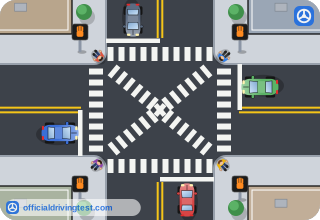
- Vehicles to turn while pedestrians cross
- Pedestrians to cross in any direction at the same time
- Bicyclists to ride through without stopping
- Pedestrians to cross at any moment they choose
Show answer
Correct answer: Pedestrians to cross in any direction at the same time
Diagonal crossings let pedestrians move in any direction at once, but only while the WALK signal permits it.
Source: California Driver Handbook (2025), page 35 · Open this page in the manual (Manual page 35)
-
Why do some pedestrian signals make beeping, chirping, or spoken sounds?
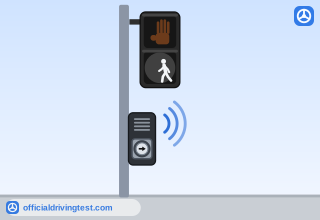
- To warn drivers that the light is changing
- To discourage jaywalking
- To help blind or visually impaired people cross
- To signal that a train is approaching
Show answer
Correct answer: To help blind or visually impaired people cross
Sounds such as beeping, chirping, or verbal messages help blind or visually impaired pedestrians cross the street.
Source: California Driver Handbook (2025), page 35 · Open this page in the manual (Manual page 35)
-
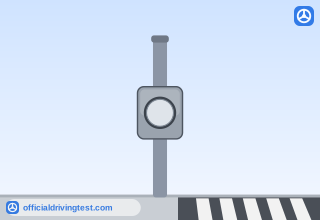
What is the purpose of the button on a pole at a crosswalk?
- To call for emergency assistance
- To turn the traffic light red immediately
- To add extra time to the countdown
- To activate the WALK or walking person signal
Show answer
Correct answer: To activate the WALK or walking person signal
The push button requests the walk phase so the pedestrian signal will display WALK.
Source: California Driver Handbook (2025), page 35 · Open this page in the manual (Manual page 35)
-
There are no pedestrian signals at an intersection you want to cross on foot. What should you follow?
- The vehicle traffic signals
- The direction of the nearest parked cars
- Whatever other pedestrians do
- Cross only at the next block
Show answer
Correct answer: The vehicle traffic signals
Where pedestrian signals are missing, pedestrians obey the regular vehicle traffic signals.
Source: California Driver Handbook (2025), page 35 · Open this page in the manual (Manual page 35)
-
What does this yellow warning sign tell a driver to do?
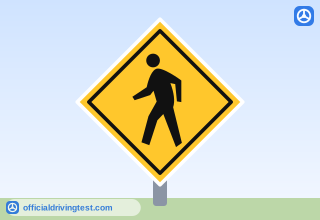
- Watch for pedestrians crossing ahead
- Watch for a bus stop ahead
- Watch for workers repairing the road
- Watch for a hiking trail entrance
Show answer
Correct answer: Watch for pedestrians crossing ahead
This sign marks a pedestrian crossing. When a pedestrian is crossing the road, you must use caution, reduce your speed, or stop to let them safely finish crossing.
Source: California Driver Handbook (2025), page 37 · Open this page in the manual (Manual page 37)
-
Which of the following road users is treated as a pedestrian?
- A rider on a bicycle in a bike lane
- Someone on roller skates or a skateboard
- A motorcyclist waiting at a red light
- The driver of a golf cart
Show answer
Correct answer: Someone on roller skates or a skateboard
A pedestrian is a person on foot or traveling by something that is not a vehicle or a bicycle, such as skates or a skateboard.
Source: California Driver Handbook (2025), page 41 · Open this page in the manual (Manual page 41)
-
A person with a disability who gets around using a wheelchair, a tricycle, or a quadricycle is legally considered:
- A slow-moving vehicle
- A bicyclist
- A pedestrian
- A road user with no right-of-way
Show answer
Correct answer: A pedestrian
The handbook counts people with disabilities who use wheelchairs, tricycles, or quadricycles for transportation as pedestrians.
Source: California Driver Handbook (2025), page 41 · Open this page in the manual (Manual page 41)
-
Which statement about pedestrians and the rules of the road is correct?
- Having the right-of-way excuses pedestrians from traffic rules.
- Pedestrians have the right-of-way but must still follow the rules of the road.
- Pedestrians only have the right-of-way where a signal tells them to walk.
- Drivers owe pedestrians nothing away from an intersection.
Show answer
Correct answer: Pedestrians have the right-of-way but must still follow the rules of the road.
Although pedestrians have the right-of-way, they also must follow the rules of the road.
Source: California Driver Handbook (2025), page 41 · Open this page in the manual (Manual page 41)
-
A pedestrian is crossing the road ahead of you at a spot with no crosswalk markings. What should you do?
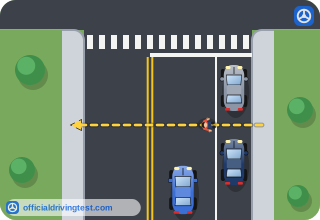
- Keep your speed; the crossing is not marked, so they must wait.
- Sound your horn so they hurry up.
- Use caution, reduce your speed, or stop so they can finish crossing safely.
- Steer around them without slowing down.
Show answer
Correct answer: Use caution, reduce your speed, or stop so they can finish crossing safely.
Whether or not there are crosswalk lines, you must slow, use caution, or stop and let the pedestrian finish crossing safely.
Source: California Driver Handbook (2025), page 41 · Open this page in the manual (Manual page 41)
-
The vehicle in the lane next to you has stopped at a crosswalk. What is the correct action?
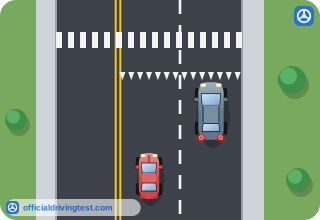
- Do not pass it; a pedestrian you cannot see may be crossing.
- Pass it slowly while watching the sidewalk for people.
- Pass it normally, since your own lane is clear ahead.
- Flash your lights to warn others and then pass.
Show answer
Correct answer: Do not pass it; a pedestrian you cannot see may be crossing.
A stopped vehicle can hide a pedestrian in the crosswalk, so never pass a vehicle stopped at a crosswalk.
Source: California Driver Handbook (2025), page 41 · Open this page in the manual (Manual page 41)
-
A pedestrian standing at the edge of the road makes eye contact with you. What does this usually mean?
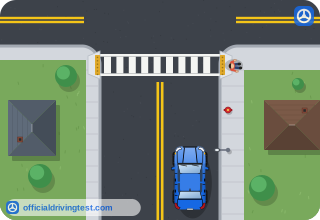
- They are waving you through.
- They are ready to cross, so yield to them.
- They are simply looking at your vehicle.
- They want you to sound your horn.
Show answer
Correct answer: They are ready to cross, so yield to them.
Eye contact from a pedestrian is a sign that they intend to cross, so give them the right-of-way.
Source: California Driver Handbook (2025), page 41 · Open this page in the manual (Manual page 41)
-
Which pedestrians are most likely to need extra time to finish crossing a street?
- Only people who are crossing against the traffic light
- Only people carrying heavy bags or large packages
- Seniors, people with small children, and people with disabilities
- Nobody; every pedestrian crosses at about the same pace
Show answer
Correct answer: Seniors, people with small children, and people with disabilities
Older pedestrians, adults with small children, and people with disabilities may cross more slowly, so allow them enough time.
Source: California Driver Handbook (2025), page 41 · Open this page in the manual (Manual page 41)
-
How are crosswalk lines at a school crossing sometimes different from ordinary crosswalk lines?
- They may be painted yellow instead of white.
- They are always painted red.
- They are marked with raised blue buttons.
- They are never painted at all.
Show answer
Correct answer: They may be painted yellow instead of white.
Crosswalks are usually marked with white lines, but school crossings may use yellow lines.
Source: California Driver Handbook (2025), page 41 · Open this page in the manual (Manual page 41)
-
Where do pedestrians have the right-of-way?
- Only in crosswalks painted with white lines
- Only at intersections with traffic signal lights
- In both marked and unmarked crosswalks
- Only where a crossing guard is on duty
Show answer
Correct answer: In both marked and unmarked crosswalks
Not every crosswalk is painted, and pedestrians hold the right-of-way in marked and unmarked crosswalks alike.
Source: California Driver Handbook (2025), page 41 · Open this page in the manual (Manual page 41)
-
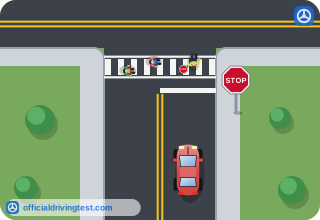
There is a limit line painted before the crosswalk you are approaching. Where should you stop for pedestrians?
- On the crosswalk lines themselves
- At the limit line, then let them cross
- Halfway into the crosswalk for a better view
- Wherever the vehicle ahead of you stopped
Show answer
Correct answer: At the limit line, then let them cross
When a limit line comes before the crosswalk, stop at that line so pedestrians have the whole crosswalk.
Source: California Driver Handbook (2025), page 41 · Open this page in the manual (Manual page 41)
-
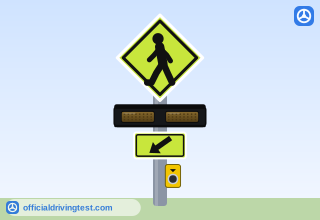
You approach a crosswalk fitted with flashing warning lights, but the lights are not flashing right now. What should you do?
- Treat the crossing as empty and keep your speed.
- Look for pedestrians anyway and be ready to stop.
- Stop completely every time, flashing or not.
- Sound your horn before entering the crossing.
Show answer
Correct answer: Look for pedestrians anyway and be ready to stop.
Whether or not the lights are flashing, you still have to watch for pedestrians and be prepared to stop.
Source: California Driver Handbook (2025), page 41 · Open this page in the manual (Manual page 41)
-
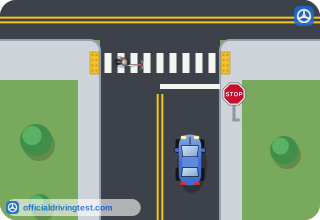
What right-of-way do pedestrians using a guide dog or a white cane have?
- The right-of-way only inside marked crosswalks
- The right-of-way only when a signal shows the walk symbol
- The same right-of-way as any other vehicle
- The right-of-way at all times
Show answer
Correct answer: The right-of-way at all times
Pedestrians who are partially or totally blind and use a guide dog or white cane always have the right-of-way.
Source: California Driver Handbook (2025), page 42 · Open this page in the manual (Manual page 42)
-
Why should drivers of hybrid and electric vehicles be especially careful when turning or backing up near a blind pedestrian?
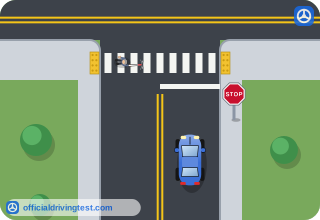
- Because blind pedestrians rely on sound to know a vehicle is near
- Because these vehicles have a much wider turning circle
- Because their brakes take longer to respond in reverse
- Because guide dogs are distracted by their headlights
Show answer
Correct answer: Because blind pedestrians rely on sound to know a vehicle is near
Be careful when turning or backing up near blind pedestrians, particularly in a hybrid or electric vehicle, because they rely on sound to know a vehicle is nearby.
Source: California Driver Handbook (2025), page 42 · Open this page in the manual (Manual page 42)
-
Why should you avoid stopping your vehicle in the middle of a crosswalk?
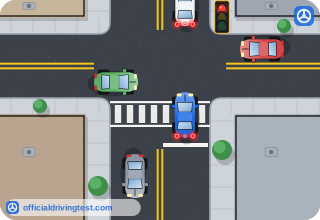
- It blocks the view of the traffic signal lights.
- It could force a blind pedestrian to walk into traffic.
- It wears out the painted lines faster.
- It is allowed as long as you keep the engine running.
Show answer
Correct answer: It could force a blind pedestrian to walk into traffic.
A vehicle sitting in the crosswalk pushes a blind pedestrian out of the safe crossing path and into traffic.
Source: California Driver Handbook (2025), page 42 · Open this page in the manual (Manual page 42)
-
You are waiting while a blind pedestrian crosses slowly in front of you. Is it acceptable to honk your horn?
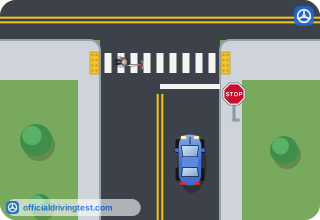
- Yes, one short tap tells them where you are.
- Yes, but only if they have stopped moving.
- No, you should never honk at a blind person.
- No, unless another vehicle is coming toward them.
Show answer
Correct answer: No, you should never honk at a blind person.
The handbook says plainly: do not honk your horn at a blind person.
Source: California Driver Handbook (2025), page 42 · Open this page in the manual (Manual page 42)
-
A blind pedestrian at the corner pulls in their cane and steps back from the intersection. What does this gesture usually mean?
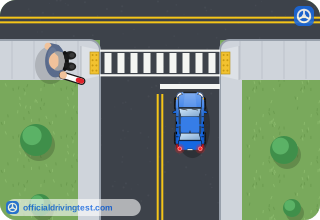
- That you may go
- That they want you to stop and wait
- That they need help crossing
- That the signal has changed for you
Show answer
Correct answer: That you may go
Drawing the cane in and stepping away from the intersection is normally the pedestrian's way of signaling you to proceed.
Source: California Driver Handbook (2025), page 42 · Open this page in the manual (Manual page 42)
-
A bicyclist wants to use a crosswalk to get to the other side of the street. What must the rider do?
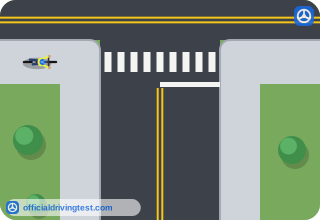
- Ride through at normal speed with the traffic signal
- Stop first and then cross as a pedestrian
- Wave drivers through and cross last
- Use the crosswalk only if there is no bike lane nearby
Show answer
Correct answer: Stop first and then cross as a pedestrian
Bicyclists may choose to use crosswalks, but they stop first and cross the way a pedestrian would.
Source: California Driver Handbook (2025), page 46 · Open this page in the manual (Manual page 46)
-
When a bicyclist and a pedestrian meet, who has the right-of-way?
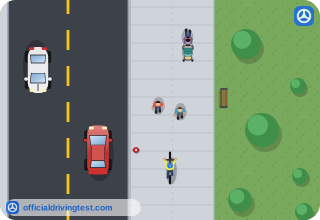
- The pedestrian; bicyclists must yield
- The bicyclist, because a bicycle is a vehicle
- Whoever arrives first, in every case
- The bicyclist, but only inside a bike lane
Show answer
Correct answer: The pedestrian; bicyclists must yield
Yielding to pedestrians is one of the bicyclist's listed legal responsibilities.
Source: California Driver Handbook (2025), page 47 · Open this page in the manual (Manual page 47)
-
A school crossing guard signals you to stop, but you see no children yet. What must you do?
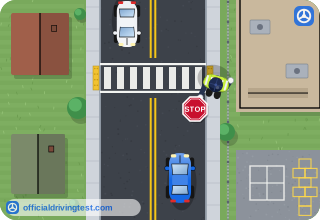
- Obey the guard's directions at all times
- Continue if the crosswalk looks empty
- Follow the guard only when the school bell rings
- Treat the guard's signal as advice, not a rule
Show answer
Correct answer: Obey the guard's directions at all times
School safety patrols and crossing guards must be obeyed at all times near schools.
Source: California Driver Handbook (2025), page 50 · Open this page in the manual (Manual page 50)