California: Emergencies and special situations — Part 2 Practice Test
Questions in this part include: “What usually causes a locked wheel skid?” · “Why is the pavement especially slippery when it first starts to rain after a long dry, hot spell?”
Independent educational site · not affiliated with any government agency or DMV
Ready? Test yourself
- Instant feedback with an explanation
- Every answer cites its source in the manual
- Your best score is saved on this device
Questions are original and based on the official manual "California Driver Handbook" (2025), California DMV.
All 17 questions in this practice test
Take the test above first, then use this list to study. Tap “Show answer” to see the correct answer and explanation.
Show the questions and answersHide the questions
-
You are recording an officer during a stop and it is not interfering with their duties. The officer:
- May confiscate your device for evidence
- May delete the recording before returning the device
- May order you to stop recording at any point during the enforcement stop itself
- Cannot take your device or erase the recording just because you are recording
Show answer
Correct answer: Cannot take your device or erase the recording just because you are recording
Recording in public is generally protected. Say right away that you are recording, and do not reach into concealed areas for your device without permission.
Source: California Driver Handbook (2025), page 31 · Open this page in the manual (Manual page 31)
-
Your vehicle begins to skid on a slippery surface. What is the correct response?
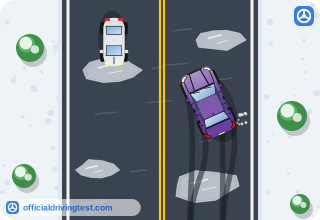
- Brake hard and hold the wheel straight
- Ease off the accelerator and steer into the skid
- Accelerate to pull the vehicle straight
- Pull the parking brake until the wheels grip
Show answer
Correct answer: Ease off the accelerator and steer into the skid
Take your foot off the gas gradually, avoid the brakes, steer into the skid, and try to get a wheel onto dry pavement.
Source: California Driver Handbook (2025), page 60 · Open this page in the manual (Manual page 60)
-
What usually causes a locked wheel skid?
- Under-inflated tires on a dry road
- Turning the steering wheel too gently
- Braking too hard while traveling too fast
- Driving with the parking brake partly engaged
Show answer
Correct answer: Braking too hard while traveling too fast
Braking too hard at too high a speed locks the wheels, and the vehicle keeps skidding no matter how you turn the steering wheel.
Source: California Driver Handbook (2025), page 60 · Open this page in the manual (Manual page 60)
-
Your vehicle has a four-wheel antilock braking system (ABS) and goes into a locked wheel skid. What should you do?
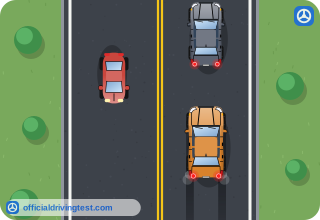
- Apply firm pressure to the brake pedal
- Pump the brake pedal rapidly
- Take your foot completely off the brake
- Shift into neutral and coast
Show answer
Correct answer: Apply firm pressure to the brake pedal
With four-wheel ABS, apply firm pressure on the brake pedal. Check the vehicle owner's manual to learn whether your vehicle has ABS.
Source: California Driver Handbook (2025), page 60 · Open this page in the manual (Manual page 60)
-
Your vehicle has no antilock braking system and starts to skid. What does the handbook recommend?
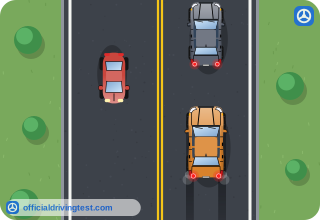
- Hold the brake pedal down firmly until you stop
- Quickly pump the brakes until you reach a safe speed
- Use the parking brake immediately
- Shift into a higher gear
Show answer
Correct answer: Quickly pump the brakes until you reach a safe speed
Without ABS, pump the brakes quickly to slow down. If the pedal sinks to the floor, pump it gently, then downshift and try the emergency brake.
Source: California Driver Handbook (2025), page 61 · Open this page in the manual (Manual page 61)
-
On a cold, wet day, which part of the road is most likely to be icy?
- Long straight stretches in full sunlight
- Freshly paved asphalt
- Bridges, overpasses, and shaded areas
- Gravel shoulders
Show answer
Correct answer: Bridges, overpasses, and shaded areas
Bridges and overpasses freeze before the rest of the road, and shaded spots freeze first and dry out last.
Source: California Driver Handbook (2025), page 61 · Open this page in the manual (Manual page 61)
-
Why is the pavement especially slippery when it first starts to rain after a long dry, hot spell?
- Oil and dust have not been washed away
- Hot asphalt melts and becomes soft
- Tires expand in heat and lose their tread
- Rain washes gravel onto the lanes
Show answer
Correct answer: Oil and dust have not been washed away
Built-up oil and dust mix with the first rain and make the road very slick, so slow down at the first sign of rain, drizzle, or snow.
Source: California Driver Handbook (2025), page 61 · Open this page in the manual (Manual page 61)
-
What is hydroplaning?
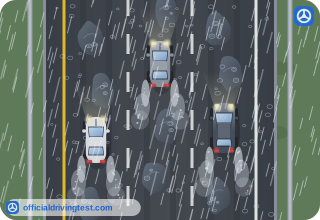
- When the engine stalls because water enters the exhaust
- When the tires lose all contact with the road and ride on water
- When the brakes get wet and squeal
- When the windshield fogs over in rain
Show answer
Correct answer: When the tires lose all contact with the road and ride on water
In wet conditions the tires can lose all contact with the pavement and ride on a film of water; a small steering input or gust can then start a skid.
Source: California Driver Handbook (2025), page 62 · Open this page in the manual (Manual page 62)
-
If your vehicle starts to hydroplane, you should:
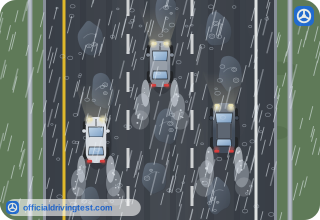
- Brake firmly to regain traction
- Turn the wheel sharply toward the shoulder
- Accelerate briefly to push the water away
- Slow down gradually and stay off the brakes
Show answer
Correct answer: Slow down gradually and stay off the brakes
Ease off gradually; sudden braking during hydroplaning can make you lose control. Steering around standing water helps prevent it.
Source: California Driver Handbook (2025), page 62 · Open this page in the manual (Manual page 62)
-
You reach a flooded stretch of road and cannot judge how deep the water is. What is the best course of action?
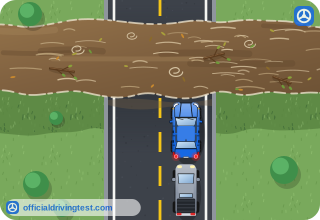
- Find another route; if you must cross, go slowly, then test your brakes
- Drive through quickly so the water has less time to enter the vehicle
- Follow the tire tracks of the vehicle ahead at the same speed
- Stop in the water and wait for the level to drop
Show answer
Correct answer: Find another route; if you must cross, go slowly, then test your brakes
Depth is hard to judge by sight, and flooding brings risks such as being swept away, hidden debris, road collapse, and downed power lines. Another route is safest.
Source: California Driver Handbook (2025), page 63 · Open this page in the manual (Manual page 63)
-
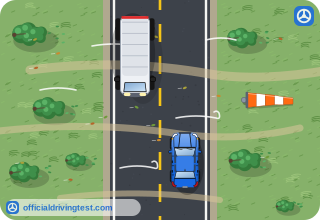
Which of these is recommended when driving in high winds?
- Use cruise control to hold a steady speed
- Hold the wheel loosely so gusts can pass through
- Slow down, grip the wheel firmly, and avoid cruise control
- Increase speed to get out of the windy area sooner
Show answer
Correct answer: Slow down, grip the wheel firmly, and avoid cruise control
Slower speed and a firm grip keep you in control when a gust hits, and cruise control takes away accelerator control. Pulling over to wait out the storm can be safest.
Source: California Driver Handbook (2025), page 63 · Open this page in the manual (Manual page 63)
-
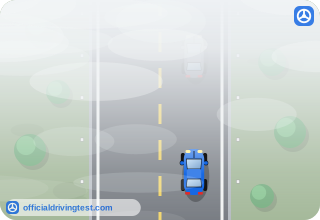
Which headlights should you use in heavy fog or smoke, and why?
- High beams, because they reach farther
- Low beams, because high beams reflect and cause glare
- Fog lights alone, because they sit lower
- Parking lights, because they draw less attention
Show answer
Correct answer: Low beams, because high beams reflect and cause glare
Fog reflects high-beam light straight back at you. Use low beams, increase your following distance, and never drive on parking or fog lights alone. If the fog gets too thick, pull off the road and turn on your emergency flashers.
Source: California Driver Handbook (2025), page 64 · Open this page in the manual (Manual page 64)
-
A tire blows out while you are driving. What should you do first?
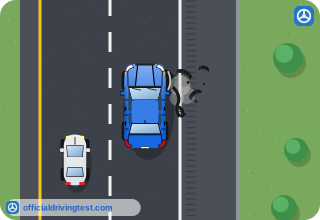
- Brake hard to bring the vehicle to a stop as quickly as possible
- Lift your foot off the accelerator abruptly to slow the vehicle
- Hold the wheel with both hands and keep your speed if it is safe
- Steer immediately onto the shoulder and stop there
Show answer
Correct answer: Hold the wheel with both hands and keep your speed if it is safe
Grip the wheel with both hands, keep your speed if safe, then release the accelerator gradually, steer to stabilize, and pull off the road once the vehicle is under control.
Source: California Driver Handbook (2025), page 68 · Open this page in the manual (Manual page 68)
-
Your right wheels drift off the pavement onto the shoulder. What should you do?
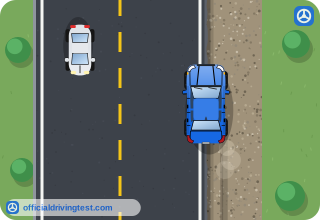
- Grip the wheel firmly, ease off the gas, brake gently, check traffic, steer back
- Turn the wheel sharply to get back onto the pavement right away
- Brake hard and come to a full stop on the shoulder at once
- Accelerate firmly to regain traction and climb back onto the pavement
Show answer
Correct answer: Grip the wheel firmly, ease off the gas, brake gently, check traffic, steer back
Pulling the wheel with too much force can throw you into oncoming traffic; slow gently and ease back onto the pavement.
Source: California Driver Handbook (2025), page 68 · Open this page in the manual (Manual page 68)
-
Your vehicle breaks down on the freeway and you have pulled onto the right shoulder. What does the handbook tell you to do?
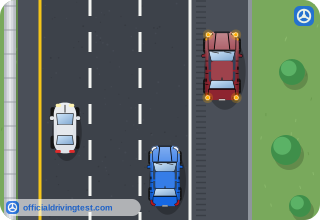
- Stand behind the vehicle and wave down passing drivers for help
- Walk along the shoulder to the nearest exit and call for help there
- Raise the hood, then cross the lanes to wait at the center divider
- Call 511 or use a call box, then wait inside with your seat belt on
Show answer
Correct answer: Call 511 or use a call box, then wait inside with your seat belt on
Use the right side away from traffic, dial 511 or use a call box, and stay belted inside until help arrives. Use your emergency flashers at your discretion.
Source: California Driver Handbook (2025), page 69 · Open this page in the manual (Manual page 69)
-
Which service does the CHP Freeway Service Patrol (FSP) provide free of charge?
- Changing a flat tire or jump starting a dead battery
- Towing your vehicle to the repair shop you choose
- Recommending a body shop near your home
- Towing motorcycles off the freeway
Show answer
Correct answer: Changing a flat tire or jump starting a dead battery
During commute hours FSP can change a flat, jump start you, add a gallon of gas, refill a radiator, and report collisions. It does not tow motorcycles or tow to a private shop or home.
Source: California Driver Handbook (2025), page 69 · Open this page in the manual (Manual page 69)
-
Which statement about carbon monoxide is true?
- It has a strong smell that warns you early of a leak
- It is a deadly odorless gas released from the exhaust pipe
- Only diesel engines produce it, not gas-powered vehicles
- It is harmless in small amounts and causes no symptoms
Show answer
Correct answer: It is a deadly odorless gas released from the exhaust pipe
All gas-powered vehicles release this deadly odorless gas from the exhaust pipe. Tiredness, yawning, dizziness, nausea, headache, or ringing ears are warning signs to have the exhaust system checked.
Source: California Driver Handbook (2025), page 71 · Open this page in the manual (Manual page 71)