Alaska: Speed and following distance
Alaska speed laws, the four-second rule, impact and reaction distance, and night and winter driving. Split into 5 shorter tests so you're not stuck in one long quiz.
Independent educational site · not affiliated with any government agency or DMV
Choose a part
Speed and following distance — Part 1
Questions in this part include: “According to the manual, what is the greatest singular cause of traffic crashes?”
StartSpeed and following distance — Part 2
Questions in this part include: “How can you tell whether a distant car is in motion or stopped?”
StartSpeed and following distance — Part 3
Questions in this part include: “Who may alter the speed limits set by law?”
StartSpeed and following distance — Part 4
Questions in this part include: “Who is the glare recovery problem generally more acute in, according to the manual?”
StartSpeed and following distance — Part 5
Questions in this part include: “Where does the manual say to practice stopping and skid recovery before driving on ice or packed snow in traffic?”
StartAll 92 Speed and following distance questions with answers
Choose a part above to take a practice test, or study every question and answer here.
Show the questions and answersHide the questions
-
According to the manual, what is the greatest singular cause of traffic crashes?
- The road surface
- The driver
- Vehicle breakdowns
- The weather
Show answer
Correct answer: The driver
The manual states that the driver is the greatest singular cause of traffic crashes.
Source: Alaska Driver Manual (Revised October 2025), page 25 · Open this page in the manual (Manual page 25)
-
Under which conditions did more fatal crashes occur than under any other condition?
- Darkness, icy surface, snowy weather, vehicle in poor mechanical condition
- Dusk, wet surface, foggy weather, vehicle in good mechanical condition
- Night, normal surface, clear weather, vehicle in poor mechanical condition
- Daylight, normal surface, clear weather, vehicle in good mechanical condition
Show answer
Correct answer: Daylight, normal surface, clear weather, vehicle in good mechanical condition
The manual says more fatal crashes occurred during daylight hours with normal surface, clear weather conditions and the vehicle in good mechanical condition.
Source: Alaska Driver Manual (Revised October 2025), page 25 · Open this page in the manual (Manual page 25)
-
A driver's license is issued based on the premise that you will do what?
- Obey the laws and always keep your vehicle under control
- Drive only in daylight hours and in clear weather
- Retake the written test whenever the traffic law changes
- Never exceed 55 mph on any road in the state
Show answer
Correct answer: Obey the laws and always keep your vehicle under control
The manual says a license is issued on the premise that you will obey the laws and always keep your vehicle under control.
Source: Alaska Driver Manual (Revised October 2025), page 25 · Open this page in the manual (Manual page 25)
-
How does the manual describe exercising control of your motor vehicle?
- Keeping both hands on the wheel at all times, in all kinds of weather
- Driving at exactly the posted speed limit under every road condition
- Being able to direct its course and speed and to slow or stop when you wish
- Being able to stop only by using your emergency brake or parking brake
Show answer
Correct answer: Being able to direct its course and speed and to slow or stop when you wish
The manual defines control as being able to direct and regulate the course and speed of the vehicle and to slow or stop when you wish.
Source: Alaska Driver Manual (Revised October 2025), page 25 · Open this page in the manual (Manual page 25)
-
How does the manual describe "pedestrians" in its due care rule?
- People walking or riding a bicycle
- People walking only
- People walking or riding a motorcycle
- People walking or waiting at a bus stop
Show answer
Correct answer: People walking or riding a bicycle
In the due care rule, pedestrians are described as people walking or riding a bicycle.
Source: Alaska Driver Manual (Revised October 2025), page 25 · Open this page in the manual (Manual page 25)
-
What must every driver be able to do under the due care rule?
- Keep the same speed on every road unless a sign says otherwise
- Pass any vehicle that is driving below the speed limit
- Stop if necessary and slow down when circumstances require
- Brake only when a traffic signal or sign tells you to
Show answer
Correct answer: Stop if necessary and slow down when circumstances require
The manual says you must be able to stop if necessary and shall slow down when circumstances require.
Source: Alaska Driver Manual (Revised October 2025), page 25 · Open this page in the manual (Manual page 25)
-
Which of these is listed as a circumstance to watch for when exercising due care?
- A vehicle parked in a driveway beside the road
- A person walking or biking on or along the roadway
- A green traffic light at an intersection
- A mailbox standing beside the road
Show answer
Correct answer: A person walking or biking on or along the roadway
The list of circumstances to watch for starts with a person walking or biking on or along the roadway.
Source: Alaska Driver Manual (Revised October 2025), page 26 · Open this page in the manual (Manual page 26)
-
Which of these is listed as a circumstance to watch for when exercising due care?
- Birds flying over the highway ahead of your vehicle
- Snow piled up on the shoulder of the highway
- Cars waiting in a large shopping center parking lot
- Animals being led, ridden or driven on or along the highway
Show answer
Correct answer: Animals being led, ridden or driven on or along the highway
The list includes animals walking being led, ridden or driven on or along the highway.
Source: Alaska Driver Manual (Revised October 2025), page 26 · Open this page in the manual (Manual page 26)
-
Which of these is listed among the circumstances to watch for when exercising due care?
- A railroad crossing, intersection, bridge, sharp turn, curve or steep downgrade
- A long, straight, flat and dry road with no other traffic anywhere on it
- A parking space in the lot of a shopping center or a store nearby
- A road with a freshly painted white edge line along its right side
Show answer
Correct answer: A railroad crossing, intersection, bridge, sharp turn, curve or steep downgrade
A railroad crossing, intersection, bridge, sharp turn, curve and steep downgrade are all circumstances to watch for.
Source: Alaska Driver Manual (Revised October 2025), page 26 · Open this page in the manual (Manual page 26)
-
Which of these is listed among the circumstances to watch for when exercising due care?
- Blue reflectors, blue flags, or lanterns
- Green flags held by pedestrians
- Red reflectors, red flags, or flares
- White flags on parked vehicles
Show answer
Correct answer: Red reflectors, red flags, or flares
The list of circumstances includes red reflectors, red flags or flares, with the note that a flare burns a bright red.
Source: Alaska Driver Manual (Revised October 2025), page 26 · Open this page in the manual (Manual page 26)
-
Which of the following is a rule about following another vehicle?
- You may follow as closely as you wish, as long as you signal first
- You may not follow more closely than is reasonable and prudent for conditions
- You must stay exactly 100 feet behind every vehicle you are following
- You may follow as closely as you like, whenever the road is dry and clear
Show answer
Correct answer: You may not follow more closely than is reasonable and prudent for conditions
The law says a driver may not follow another vehicle more closely than is reasonable and prudent, having due regard for speed, traffic and conditions of the roadway.
Source: Alaska Driver Manual (Revised October 2025), page 27 · Open this page in the manual (Manual page 27)
-
Besides not following too closely, what duty do you have toward following vehicles?
- A duty to speed up for them
- A duty to flash your headlights at them
- A duty to keep them from passing you
- A duty to yield to them
Show answer
Correct answer: A duty to yield to them
The manual says that you also have a duty to yield to following vehicles.
Source: Alaska Driver Manual (Revised October 2025), page 27 · Open this page in the manual (Manual page 27)
-
On a two-lane roadway outside of an urban area, how many vehicles immediately behind you require you to safely pull over under AS 28.35.140?
- Five or more
- Two or more
- Three or more
- Ten or more
Show answer
Correct answer: Five or more
AS 28.35.140 requires drivers on a two-lane roadway outside an urban area to safely pull over when there are five or more vehicles immediately behind.
Source: Alaska Driver Manual (Revised October 2025), page 27 · Open this page in the manual (Manual page 27)
-
According to the manual, what is the easiest way to calculate a safe following distance?
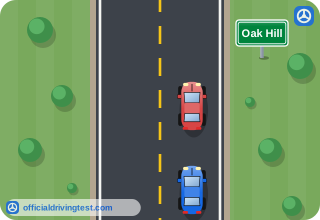
- Staying one car length behind for every 10 mph
- Following at exactly the same speed as the car ahead
- The four-second interval method
- Keeping the other car's bumper below your hood
Show answer
Correct answer: The four-second interval method
The manual says the easiest way to calculate a safe following distance is the four-second interval method.
Source: Alaska Driver Manual (Revised October 2025), page 27 · Open this page in the manual (Manual page 27)
-
Using the four-second rule, what does it mean if you pass the same point before you finish counting?
- You are following at a safe distance
- You are following too closely
- You are driving too slowly
- You should speed up to keep pace
Show answer
Correct answer: You are following too closely
The manual says that if you pass the same point before you finish counting, you are following too closely.
Source: Alaska Driver Manual (Revised October 2025), page 27 · Open this page in the manual (Manual page 27)
-
When towing a trailer or when the road surface is wet or slippery, what should you do with the four-second following interval?
- Decrease it to two seconds
- Keep it at four seconds
- Increase it to five seconds only
- Increase it to six seconds or more
Show answer
Correct answer: Increase it to six seconds or more
The manual says to increase the four seconds to six or more when towing a trailer or when the road is wet or slippery.
Source: Alaska Driver Manual (Revised October 2025), page 27 · Open this page in the manual (Manual page 27)
-
Why does the manual say you can also use the four-second rule at night?
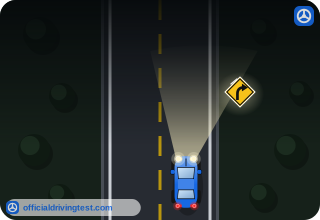
- To make sure you are not "overdriving your headlights"
- To judge how far oncoming traffic is
- To check that your headlights are aimed properly
- To know when to turn on your high beams
Show answer
Correct answer: To make sure you are not "overdriving your headlights"
The manual says the four-second rule can be used at night to make sure you are not overdriving your headlights.
Source: Alaska Driver Manual (Revised October 2025), page 27 · Open this page in the manual (Manual page 27)
-
To avoid a rear-end collision, what should you do when you see brake lights ahead?
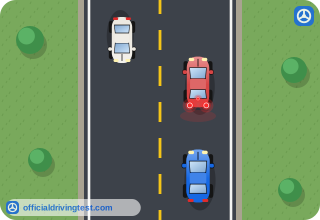
- Wait until the other car stops completely before you slow down
- Sound your horn at the driver of the car ahead of you in traffic
- Shift your foot to the brake pedal promptly so you are ready to stop
- Move your foot away from the pedals so the car can coast along
Show answer
Correct answer: Shift your foot to the brake pedal promptly so you are ready to stop
The manual says to watch for brake lights and shift your foot to the brake pedal promptly so you are ready to stop if necessary.
Source: Alaska Driver Manual (Revised October 2025), page 27 · Open this page in the manual (Manual page 27)
-
What does a shrinking distance between your car and the one ahead warn of?
- That the other driver is about to turn
- An impending crash with the vehicle ahead
- That the road ahead is about to end
- That your tires are running low on air
Show answer
Correct answer: An impending crash with the vehicle ahead
The manual says shrinking distance warns of an impending crash with the vehicle ahead.
Source: Alaska Driver Manual (Revised October 2025), page 27 · Open this page in the manual (Manual page 27)
-
How can you tell whether a distant car is in motion or stopped?
- Watch only its brake lights
- Check whether its tires are turning
- Wait to see if its driver gets out
- Learn to relate vehicles to fixed objects
Show answer
Correct answer: Learn to relate vehicles to fixed objects
The manual says some drivers find it hard to tell whether a distant car is moving, so you should learn to relate vehicles to fixed objects.
Source: Alaska Driver Manual (Revised October 2025), page 27 · Open this page in the manual (Manual page 27)
-
Why should you look for problems that might develop for the driver ahead of you?
- It makes it easy to react in time
- It lets you pass more quickly
- It lets you follow more closely
- It means you can use your horn sooner
Show answer
Correct answer: It makes it easy to react in time
The manual says looking for problems that might develop for the driver ahead makes it easy to react in time.
Source: Alaska Driver Manual (Revised October 2025), page 27 · Open this page in the manual (Manual page 27)
-
What does 13 AAC 02.090 require at a minimum for following distance?
- The 3 second rule
- The 4 second rule
- The 2 second rule
- The 6 second rule
Show answer
Correct answer: The 2 second rule
The note says that although the chart recommends the 4 second rule, 13 AAC 02.090 requires at a minimum the 2 second rule.
Source: Alaska Driver Manual (Revised October 2025), page 27 · Open this page in the manual (Manual page 27)
-
To avoid being hit from behind, what should you do with your brake lights when preparing to stop?
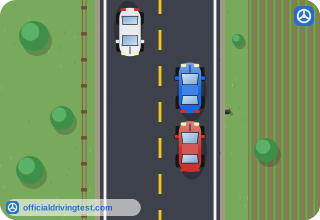
- Turn them off
- Flash them
- Leave them dim
- Cover them with a cloth
Show answer
Correct answer: Flash them
The manual says to keep brake lights clean and working and to flash them when preparing to stop.
Source: Alaska Driver Manual (Revised October 2025), page 27 · Open this page in the manual (Manual page 27)
-
To know what is going on behind you, what does the manual say you should have and keep clean?
- Tinted rear windows and a spare mirror kept in the glove box
- A dash camera mounted on the windshield and clean side windows
- Rear fog lights and a clean license plate on the back bumper
- An outside rear vision mirror and a rear window clear of frost and snow
Show answer
Correct answer: An outside rear vision mirror and a rear window clear of frost and snow
The manual says to have an outside rear vision mirror and to keep the rear window clean and clear of frost and snow.
Source: Alaska Driver Manual (Revised October 2025), page 27 · Open this page in the manual (Manual page 27)
-
When should you signal for lane changes, stops or turns to avoid being hit from behind?
- Well in advance
- Just as you start to move
- Only after you have slowed
- Only when other cars are close
Show answer
Correct answer: Well in advance
The manual says to signal well in advance because the person behind you can't read your mind.
Source: Alaska Driver Manual (Revised October 2025), page 27 · Open this page in the manual (Manual page 27)
-
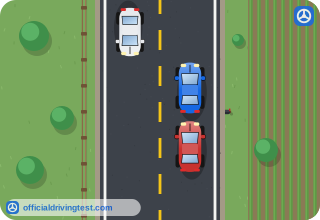
How should you slow down to give the drivers behind more time and space to react?
- Suddenly with the brakes
- Only by taking your foot off the gas at the last second
- Gradually over a long distance
- In steps, by stopping in the traffic lane
Show answer
Correct answer: Gradually over a long distance
The manual says to slow down gradually over a long distance to give drivers behind more time and space to react.
Source: Alaska Driver Manual (Revised October 2025), page 27 · Open this page in the manual (Manual page 27)
-
To lessen the likelihood of a rear-end crash, how should you drive relative to other traffic?
- Drive slower than the traffic around you at all times, to be safe
- Keep pace with the traffic, within weather conditions and speed limits
- Drive faster than the traffic around you in order to stay ahead of it
- Match the traffic around you even when it exceeds the speed limit
Show answer
Correct answer: Keep pace with the traffic, within weather conditions and speed limits
The manual says to keep pace with the traffic within limitations of weather conditions and speed limits.
Source: Alaska Driver Manual (Revised October 2025), page 27 · Open this page in the manual (Manual page 27)
-
When you double your speed from 20 to 40 miles per hour, how much greater is the impact of your vehicle?
- 2 times greater
- 3 times greater
- 8 times greater
- 4 times greater
Show answer
Correct answer: 4 times greater
The manual says the impact is 4 times greater at 40 mph than at 20 mph, even though many believe it would only double.
Source: Alaska Driver Manual (Revised October 2025), page 28 · Open this page in the manual (Manual page 28)
-
If you triple your speed from 20 to 60 mph, how much greater is the impact (striking power) of your vehicle?
- 3 times greater
- 6 times greater
- 9 times greater
- 12 times greater
Show answer
Correct answer: 9 times greater
The manual says that tripling the speed from 20 to 60 mph makes the impact 9 times greater.
Source: Alaska Driver Manual (Revised October 2025), page 28 · Open this page in the manual (Manual page 28)
-
If you increase your speed to 80 mph, how much greater is the impact (striking power) of your vehicle than at 20 mph?
- 4 times greater
- 16 times greater
- 8 times greater
- 12 times greater
Show answer
Correct answer: 16 times greater
The manual says that at 80 mph the impact is 16 times greater than at 20 mph.
Source: Alaska Driver Manual (Revised October 2025), page 28 · Open this page in the manual (Manual page 28)
-
Under which conditions does the manual say speed need not be dangerous?
- When it is kept below the speed of all other traffic on the road at all times
- When the driver has many years of driving experience behind the wheel of a car
- When the vehicle has new tires and good brakes installed on it by a mechanic
- When adjusted for traffic, road and weather conditions and managed by a considerate driver
Show answer
Correct answer: When adjusted for traffic, road and weather conditions and managed by a considerate driver
The manual says speed adjusted for traffic, road and weather conditions and carefully managed by a considerate driver need not be dangerous.
Source: Alaska Driver Manual (Revised October 2025), page 28 · Open this page in the manual (Manual page 28)
-
According to the speed and stopping distance chart, what is the thinking distance at 60 mph?
- 44 feet
- 66 feet
- 77 feet
- 88 feet
Show answer
Correct answer: 66 feet
The chart shows a thinking distance of 66 feet at 60 mph.
Source: Alaska Driver Manual (Revised October 2025), page 28 · Open this page in the manual (Manual page 28)
-
According to the speed and stopping distance chart, how many feet per second does a vehicle travel at 30 mph?
- 44
- 29
- 59
- 74
Show answer
Correct answer: 44
The chart lists 44 feet per second for a speed of 30 mph.
Source: Alaska Driver Manual (Revised October 2025), page 28 · Open this page in the manual (Manual page 28)
-
What is the maximum speed limit in a business district, under favorable conditions on highways not otherwise posted?
- 15 mph
- 25 mph
- 20 mph
- 30 mph
Show answer
Correct answer: 20 mph
The speed laws set the maximum in a business district at 20 mph.
Source: Alaska Driver Manual (Revised October 2025), page 29 · Open this page in the manual (Manual page 29)
-
What is the maximum speed limit in an alley, under favorable conditions on highways not otherwise posted?
- 10 mph
- 15 mph
- 20 mph
- 25 mph
Show answer
Correct answer: 15 mph
The speed laws set the maximum in an alley at 15 mph.
Source: Alaska Driver Manual (Revised October 2025), page 29 · Open this page in the manual (Manual page 29)
-
What is the maximum speed limit in a school zone, under favorable conditions on highways not otherwise posted?
- 15 mph
- 25 mph
- 35 mph
- 20 mph
Show answer
Correct answer: 20 mph
The speed laws set the maximum in a school zone at 20 mph.
Source: Alaska Driver Manual (Revised October 2025), page 29 · Open this page in the manual (Manual page 29)
-
What is the maximum speed limit in a residential district, under favorable conditions on highways not otherwise posted?
- 25 mph
- 15 mph
- 20 mph
- 30 mph
Show answer
Correct answer: 25 mph
The speed laws set the maximum in a residential district at 25 mph.
Source: Alaska Driver Manual (Revised October 2025), page 29 · Open this page in the manual (Manual page 29)
-
What is the maximum speed limit on any other roadway, under favorable conditions on highways not otherwise posted?
- 45 mph
- 50 mph
- 55 mph
- 60 mph
Show answer
Correct answer: 55 mph
The speed laws set the maximum on any other roadway at 55 mph.
Source: Alaska Driver Manual (Revised October 2025), page 29 · Open this page in the manual (Manual page 29)
-
Who may alter the speed limits set by law?
- Any driver who holds a commercial driver license issued by the state
- Local authorities or the State Department of Transportation and Public Facilities
- Only the Division of Motor Vehicles, by posting a notice at its offices
- Only the police officer who is on patrol on that particular highway
Show answer
Correct answer: Local authorities or the State Department of Transportation and Public Facilities
The manual says local authorities or the State Department of Transportation and Public Facilities may alter speed limits.
Source: Alaska Driver Manual (Revised October 2025), page 29 · Open this page in the manual (Manual page 29)
-
What speed may be posted on selected highways?
- 60 mph
- 70 mph
- 75 mph
- 65 mph
Show answer
Correct answer: 65 mph
The manual says speed limits on selected highways may be posted at 65.
Source: Alaska Driver Manual (Revised October 2025), page 29 · Open this page in the manual (Manual page 29)
-
Which condition is named in the speed limitation law as a reason to drive at a careful and prudent speed?
- When the road surface is rough, icy, wet, or provides poor traction
- When the road is straight, dry and free of any other traffic
- When the road has a wide paved shoulder on both of its sides
- When no other vehicles are visible anywhere on the road ahead
Show answer
Correct answer: When the road surface is rough, icy, wet, or provides poor traction
The speed limitation law lists surface conditions such as a rough, icy or wet road that provides poor traction.
Source: Alaska Driver Manual (Revised October 2025), page 29 · Open this page in the manual (Manual page 29)
-
Which condition is named in the speed limitation law as a reason to drive at a careful and prudent speed?
- When the roadway has two or more lanes in each direction
- When the roadway has a center turn lane
- When the width of the roadway reduces your margin of safety
- When the roadway runs through a business district
Show answer
Correct answer: When the width of the roadway reduces your margin of safety
The speed limitation law lists width, when the width of the roadway reduces your margin of safety.
Source: Alaska Driver Manual (Revised October 2025), page 29 · Open this page in the manual (Manual page 29)
-
Which of these weather conditions does the speed limitation law list as affecting sight, distance and traction?
- Sunshine and clear skies all day
- Rain, snow, fog, dust, or smoke
- Warm temperatures and low humidity
- A light breeze from behind you
Show answer
Correct answer: Rain, snow, fog, dust, or smoke
The law names weather that affects sight, distance and traction: rain, snow, fog, dust or smoke.
Source: Alaska Driver Manual (Revised October 2025), page 29 · Open this page in the manual (Manual page 29)
-
According to the speed limitation law, when must you drive at a careful and prudent speed because of traffic?
- When traffic is light and moving at a fast pace
- When no vehicles are in front of you
- Only when you are driving on multi-lane highways
- When traffic is heavy, congested, or moving slowly
Show answer
Correct answer: When traffic is heavy, congested, or moving slowly
The law lists traffic as a condition when it is heavy, congested or moving slowly.
Source: Alaska Driver Manual (Revised October 2025), page 29 · Open this page in the manual (Manual page 29)
-
What may a person not do regarding speed on a highway?
- Drive faster than will permit them to stop within the assured clear distance ahead
- Drive at the posted speed limit when the weather is clear and the road is dry
- Drive in the right lane on a multi-lane highway when traffic is slow
- Drive below 55 mph on a highway where a lower limit is posted
Show answer
Correct answer: Drive faster than will permit them to stop within the assured clear distance ahead
The manual says a person may not drive at a speed greater than will permit them to stop within the assured clear distance ahead.
Source: Alaska Driver Manual (Revised October 2025), page 29 · Open this page in the manual (Manual page 29)
-
The speed of a motor driven cycle is limited by what?
- The size of its engine
- The number of riders on it
- The intensity of its headlamp
- The age of its operator
Show answer
Correct answer: The intensity of its headlamp
The manual says motor driven cycle speed is limited by intensity of headlamp.
Source: Alaska Driver Manual (Revised October 2025), page 29 · Open this page in the manual (Manual page 29)
-
For a motor driven cycle, at what speed is the headlamp rule met if the lamps reveal a person or vehicle at 100 feet?
- 21 to 29 mph
- 20 mph or less
- 30 mph or more
- 45 mph or less
Show answer
Correct answer: 20 mph or less
The manual pairs lamps that reveal a person or vehicle at 100 feet with a speed of 20 mph or less.
Source: Alaska Driver Manual (Revised October 2025), page 29 · Open this page in the manual (Manual page 29)
-
For a motor driven cycle traveling at 21 to 29 mph, at what distance must its lamps reveal a person or vehicle?
- 100 feet
- 200 feet
- 300 feet
- 500 feet
Show answer
Correct answer: 200 feet
The manual says a motor driven cycle's lamps must reveal a person or vehicle at 200 feet for a speed of 21 to 29 mph.
Source: Alaska Driver Manual (Revised October 2025), page 29 · Open this page in the manual (Manual page 29)
-
For a motor driven cycle traveling at 30 mph or more, at what distance must its lamps reveal a person or vehicle?
- 100 feet
- 200 feet
- 500 feet
- 300 feet
Show answer
Correct answer: 300 feet
The manual says a motor driven cycle's lamps must reveal a person or vehicle at 300 feet for a speed of 30 mph or more.
Source: Alaska Driver Manual (Revised October 2025), page 29 · Open this page in the manual (Manual page 29)
-
What does the manual say about driving at such slow speed that you block traffic?
- Driving slowly is always safer than driving fast, so it is always allowed
- It is allowed on any road that has two or more lanes
- A driver may not drive so slowly as to block the normal flow of traffic
- It is allowed whenever you use your hazard lights
Show answer
Correct answer: A driver may not drive so slowly as to block the normal flow of traffic
The slow speed rule says a driver may not drive at such slow speed as to hold back or block the normal and reasonable flow of traffic.
Source: Alaska Driver Manual (Revised October 2025), page 29 · Open this page in the manual (Manual page 29)
-
How does the manual define reckless driving?
- Driving over the posted speed limit by any amount
- A willful disregard for the safety of persons or property
- Driving without a seat belt fastened
- Driving with an expired registration on the vehicle
Show answer
Correct answer: A willful disregard for the safety of persons or property
The manual defines reckless driving as a willful disregard for the safety of persons or property.
Source: Alaska Driver Manual (Revised October 2025), page 29 · Open this page in the manual (Manual page 29)
-
What will a conviction for reckless driving result in?
- A written warning only
- A required safety course only
- A one-year suspension of the vehicle registration
- A license revocation
Show answer
Correct answer: A license revocation
The manual says conviction for reckless driving will result in a license revocation.
Source: Alaska Driver Manual (Revised October 2025), page 29 · Open this page in the manual (Manual page 29)
-
On a multi-lane highway, which lane should you use if you drive slower than other traffic?
- The right, outside lane, except when passing
- The left lane, to stay clear of exits
- The center lane
- Any lane you prefer
Show answer
Correct answer: The right, outside lane, except when passing
The manual says to use the right, outside lane, except when passing, if you drive slower than other traffic.
Source: Alaska Driver Manual (Revised October 2025), page 29 · Open this page in the manual (Manual page 29)
-
What happens to fines for traffic offenses that occur in a traffic safety corridor?
- They are cut in half
- They are doubled
- They are waived for first offenses
- They stay the same
Show answer
Correct answer: They are doubled
The manual says fines for traffic offenses occurring in a traffic safety corridor are doubled.
Source: Alaska Driver Manual (Revised October 2025), page 29 · Open this page in the manual (Manual page 29)
-
In which place does the manual tell you to be especially careful to follow the speed limit?
- On long open stretches of rural highway
- On freeways with no pedestrians nearby
- In neighborhoods where children are present
- On roads with a wide paved shoulder
Show answer
Correct answer: In neighborhoods where children are present
The manual names areas around people on the street, school zones and neighborhoods where children are present.
Source: Alaska Driver Manual (Revised October 2025), page 43 · Open this page in the manual (Manual page 43)
-
Based on miles driven, how does the fatal crash rate for night driving compare with daytime driving?
- It is greater at night than during the day
- It is lower at night than during the day
- It is the same day and night
- It is greater only in winter months
Show answer
Correct answer: It is greater at night than during the day
The manual says the fatal crash rate for night driving is greater than for daytime driving.
Source: Alaska Driver Manual (Revised October 2025), page 54 · Open this page in the manual (Manual page 54 · PDF 66)
-
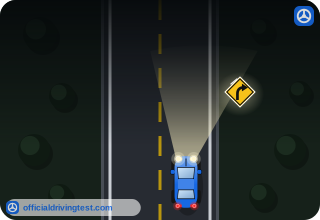
According to the manual, why is the fatal crash rate greater for night driving?
- Drivers tend to drive much faster at night
- Fewer traffic laws apply after dark
- Drivers cannot see as far, as soon, and as much
- Roads are always slippery at night
Show answer
Correct answer: Drivers cannot see as far, as soon, and as much
The manual attributes the higher night crash rate to the inability of the driver to see as far, as soon, and as much.
Source: Alaska Driver Manual (Revised October 2025), page 54 · Open this page in the manual (Manual page 54 · PDF 66)
-
Who is the glare recovery problem generally more acute in, according to the manual?
- Young drivers and those who are new to driving
- Older drivers and those with certain medical conditions
- Drivers who wear sunglasses during the day
- Drivers of large trucks and buses
Show answer
Correct answer: Older drivers and those with certain medical conditions
The manual says the glare recovery problem is generally more acute in older drivers and those with certain medical conditions.
Source: Alaska Driver Manual (Revised October 2025), page 54 · Open this page in the manual (Manual page 54 · PDF 66)
-
Why does the manual say to check oil, water level, radiator hoses, and fan belt frequently on major roads?
- Major roads have no service stations
- Hilly roads wear out engines faster
- Cold air freezes the radiator hoses
- High speeds generate heat
Show answer
Correct answer: High speeds generate heat
The manual says high speeds generate heat, so these items should be checked frequently.
Source: Alaska Driver Manual (Revised October 2025), page 56 · Open this page in the manual (Manual page 56 · PDF 68)
-
Which tire problem does the manual say is a common factor in crashes?
- Blowouts
- Slow leaks
- Uneven tire wear
- Mismatched tire brands
Show answer
Correct answer: Blowouts
The manual says to be sure tires are safe for high-speed driving because blowouts are a common factor in crashes.
Source: Alaska Driver Manual (Revised October 2025), page 56 · Open this page in the manual (Manual page 56 · PDF 68)
-
Speed limitations imposed by traffic, weather, and road conditions are applicable on which roadway systems?
- Only on freeways
- All roadway systems
- Only on gravel roads
- Only on roads in urban areas
Show answer
Correct answer: All roadway systems
The manual says speed limitations imposed by traffic, weather and road conditions are applicable on all roadway systems.
Source: Alaska Driver Manual (Revised October 2025), page 56 · Open this page in the manual (Manual page 56 · PDF 68)
-
On certain roads, how many vehicles behind you require you to pull off the roadway at the first safe opportunity?
- When three or more vehicles are behind you
- When ten or more vehicles are behind you
- When any vehicle behind you honks
- When five or more vehicles are behind you
Show answer
Correct answer: When five or more vehicles are behind you
The manual says that on certain roads you must pull off the roadway at the first safe opportunity if five or more vehicles are behind you.
Source: Alaska Driver Manual (Revised October 2025), page 56 · Open this page in the manual (Manual page 56 · PDF 68)
-
What does the manual say high speed causes?
- Tire wear and poor gasoline mileage
- Better gasoline mileage and less tire wear
- Faster engine cooling and longer tire life
- Lower fuel use but more engine wear
Show answer
Correct answer: Tire wear and poor gasoline mileage
The manual says high speed causes tire wear and results in poor gasoline mileage.
Source: Alaska Driver Manual (Revised October 2025), page 56 · Open this page in the manual (Manual page 56 · PDF 68)
-
Why does the manual say to vary your speed from time to time?
- To save fuel on long trips
- To keep other drivers from following too closely
- To prevent monotony and road hypnosis
- To keep your tires from overheating
Show answer
Correct answer: To prevent monotony and road hypnosis
The manual says varying speed prevents monotony and road hypnosis, since driving at the same speed for a long time dulls the senses.
Source: Alaska Driver Manual (Revised October 2025), page 56 · Open this page in the manual (Manual page 56 · PDF 68)
-
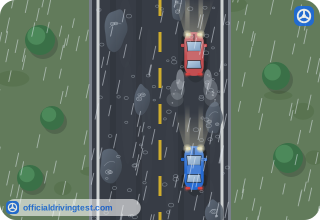
When do hard surface roads often become slippery after a rain?
- During the first half hour after the rain
- Only after it has rained for two hours
- Only after the road has completely dried
- During the first day after the rain
Show answer
Correct answer: During the first half hour after the rain
The manual says the first half hour after a rain often makes hard surface roads slippery.
Source: Alaska Driver Manual (Revised October 2025), page 59 · Open this page in the manual (Manual page 59 · PDF 71)
-
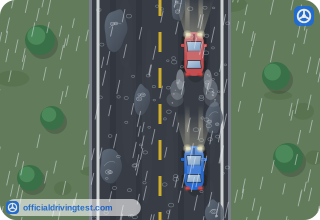
According to the manual, what forms a slippery combination on a road after rain?
- Salt, sand, and gravel mixed with snow
- Road paint and fuel mixed with water
- Oil, dirt, and tire dust mixed with water
- Leaves and mud mixed with frost
Show answer
Correct answer: Oil, dirt, and tire dust mixed with water
The manual says oil, dirt, and tire dust mixed with water form a slippery combination because dust and road film are not washed off.
Source: Alaska Driver Manual (Revised October 2025), page 59 · Open this page in the manual (Manual page 59 · PDF 71)
-
What should you do before testing the road surface for traction?
- Turn on your hazard lights first
- Check your rear vision mirror
- Slow down to a complete stop
- Check the speedometer reading
Show answer
Correct answer: Check your rear vision mirror
The manual says to test the road surface for traction but to check the rear vision mirror before doing so.
Source: Alaska Driver Manual (Revised October 2025), page 59 · Open this page in the manual (Manual page 59 · PDF 71)
-
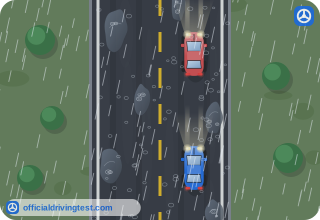
How does staying well back from the vehicle ahead help you in rain, according to the manual?
- It keeps the road surface from becoming slippery
- It helps avoid spatter on your windshield and headlights
- It lets you test the road surface for traction
- It stops the wipers from streaking and skipping
Show answer
Correct answer: It helps avoid spatter on your windshield and headlights
The manual says to stay well back from the vehicle ahead to aid in avoiding spatter on the windshield and headlights.
Source: Alaska Driver Manual (Revised October 2025), page 59 · Open this page in the manual (Manual page 59 · PDF 71)
-
What happens when you try to stop on a wet surface with bald tires?
- They stop the car in a shorter distance
- They only affect handling on dry pavement
- They do not give you directional control of your car
- They give better traction because of the smooth surface
Show answer
Correct answer: They do not give you directional control of your car
The manual says bald tires do not give you directional control when you attempt to stop on a wet surface, so you should drive on tires with good tread.
Source: Alaska Driver Manual (Revised October 2025), page 59 · Open this page in the manual (Manual page 59 · PDF 71)
-
What can you not do quickly when the road surface is covered with rain, snow, or ice?

- Accelerate or shift gears
- Turn on your lights
- See other vehicles
- Stop or change direction
Show answer
Correct answer: Stop or change direction
The manual says you can’t stop or change direction quickly when the road surface is covered with rain, snow, or ice.
Source: Alaska Driver Manual (Revised October 2025), page 59 · Open this page in the manual (Manual page 59 · PDF 71)
-
Which two things does the manual say weather conditions greatly affect?
- Visibility and vehicle traction
- Fuel economy and engine noise
- Speed limits and lane widths
- Tire pressure and battery power
Show answer
Correct answer: Visibility and vehicle traction
The manual says weather conditions greatly affect visibility and vehicle traction.
Source: Alaska Driver Manual (Revised October 2025), page 59 · Open this page in the manual (Manual page 59 · PDF 71)
-
Which areas become slippery before the rest of the road surface and stay slippery longer?
- Shaded areas, protected areas, and bridges
- Wide, sunny stretches with open shoulders
- Hilltops and straight rural highways
- Intersections and parking lot entrances
Show answer
Correct answer: Shaded areas, protected areas, and bridges
The manual says shaded areas, protected areas, and bridges become slippery before the balance of the road surface and stay so longer.
Source: Alaska Driver Manual (Revised October 2025), page 61 · Open this page in the manual (Manual page 61)
-
During which weather should you be extra alert for slippery conditions?
- Dry, windy summer weather
- Hot, humid summer weather
- Thawing and freezing weather
- Clear, sunny, warm weather
Show answer
Correct answer: Thawing and freezing weather
The manual says to be extra alert for slippery conditions during thawing and freezing weather.
Source: Alaska Driver Manual (Revised October 2025), page 61 · Open this page in the manual (Manual page 61)
-
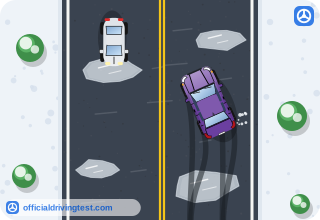
What happens if you over-correct in a skidding situation?
- It stops the skid immediately
- It only changes the direction of the skid
- It locks the wheels and ends the skid
- It shortens your stopping distance
Show answer
Correct answer: It only changes the direction of the skid
The manual says over-correcting results only in changing the direction of the skid.
Source: Alaska Driver Manual (Revised October 2025), page 61 · Open this page in the manual (Manual page 61)
-
Where does the manual say to practice stopping and skid recovery before driving on ice or packed snow in traffic?
- On a quiet public road at normal traffic speed
- On a freeway on-ramp during light traffic
- On the shoulder of a busy highway at low speed
- In a safe area, on private property at slow speed
Show answer
Correct answer: In a safe area, on private property at slow speed
The manual says to practice in a safe area, on private property at slow speed, before driving on ice or packed snow in traffic.
Source: Alaska Driver Manual (Revised October 2025), page 61 · Open this page in the manual (Manual page 61)
-
When you are suspicious of ice, what does the manual say to do?

- Brake hard to test how slippery the surface has become
- Speed up to cross the suspicious area as fast as possible
- Cautiously test the road surface, checking your mirror first
- Swerve from side to side to test the grip of the tires
Show answer
Correct answer: Cautiously test the road surface, checking your mirror first
The manual says to test the road surface cautiously and to check your mirror before making a test stop.
Source: Alaska Driver Manual (Revised October 2025), page 61 · Open this page in the manual (Manual page 61)
-
When should you begin slowing down for a stop on ice or packed snow?

- Well in advance of your stopping point
- Right at your stopping point
- Only when you see brake lights ahead
- As late as possible to keep traffic moving
Show answer
Correct answer: Well in advance of your stopping point
The manual says to slow down well in advance of the stopping point on ice or packed snow.
Source: Alaska Driver Manual (Revised October 2025), page 61 · Open this page in the manual (Manual page 61)
-
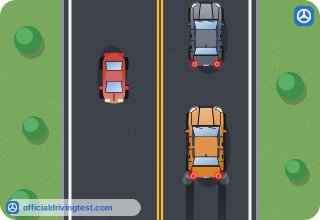
In a vehicle without antilock brakes (ABS), how does the manual say to use the brakes to slow down or stop on a slippery surface?
- Press the brake pedal as hard as you possibly can
- Hold the brake pedal firmly pressed to the floor
- Apply the brakes only at the very last moment
- Pump the brakes lightly without locking the wheels
Show answer
Correct answer: Pump the brakes lightly without locking the wheels
The manual says not to lock the wheels and to pump the brakes lightly, because if the wheels do not roll you do not have control. With ABS, check your vehicle manual.
Source: Alaska Driver Manual (Revised October 2025), page 61 · Open this page in the manual (Manual page 61)
-
If your vehicle is equipped with ABS, where does the manual say to look for instructions on its use?
- The tire manufacturer’s guide
- Your vehicle manual
- The nearest DMV office
- The state road map
Show answer
Correct answer: Your vehicle manual
The manual says that if your vehicle has ABS, you should check your vehicle manual for instructions on use.
Source: Alaska Driver Manual (Revised October 2025), page 61 · Open this page in the manual (Manual page 61)
-
Which habit does the manual list for preventing skids?

- Avoiding abrupt speed and direction changes
- Making quick lane changes to find better traction
- Accelerating sharply out of curves
- Braking suddenly whenever the road looks wet
Show answer
Correct answer: Avoiding abrupt speed and direction changes
The manual lists avoiding abrupt speed and direction changes as a way to prevent skids.
Source: Alaska Driver Manual (Revised October 2025), page 61 · Open this page in the manual (Manual page 61)
-
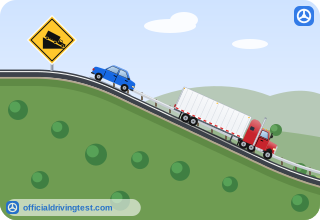
What is a driver of a motor vehicle not allowed to do on a downgrade?
- Drive in a lower gear on the hill
- Use the brakes lightly on the hill
- Coast in neutral or with the clutch in
- Keep the engine running on the hill
Show answer
Correct answer: Coast in neutral or with the clutch in
The manual prohibits coasting on a downgrade with the gears in neutral or the clutch disengaged.
Source: Alaska Driver Manual (Revised October 2025), page 67 · Open this page in the manual (Manual page 67)
-
How many feet does the manual say a truck traveling at 55 mph needs to stop?
- 200 feet
- 250 feet
- 400 feet
- 600 feet
Show answer
Correct answer: 400 feet
The manual states that a truck needs 400 feet to stop.
Source: Alaska Driver Manual (Revised October 2025), page 70 · Open this page in the manual (Manual page 70)
-
What do truck drivers do behind the vehicles they follow?
- Stay as close as a car would
- Keep the same gap that cars leave
- Flash lights to warn drivers behind
- Leave extra room behind them
Show answer
Correct answer: Leave extra room behind them
Truck drivers leave extra room behind the vehicles they follow, and a car moving into that space shortens their stopping room.
Source: Alaska Driver Manual (Revised October 2025), page 70 · Open this page in the manual (Manual page 70)
-
What happens when you drive too close behind a truck?
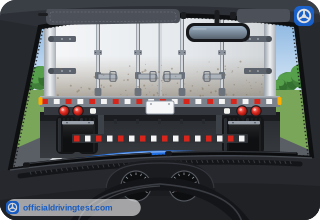
- You cannot see and react to changing traffic conditions
- The truck's large size lets you see farther down the road
- The truck driver can see you clearly in the mirrors
- You get extra time to react to problems ahead
Show answer
Correct answer: You cannot see and react to changing traffic conditions
Driving too close behind a truck prevents you from seeing and reacting to changing traffic conditions.
Source: Alaska Driver Manual (Revised October 2025), page 71 · Open this page in the manual (Manual page 71)
-
If you follow close behind a truck and there is a problem ahead, what is your first hint?
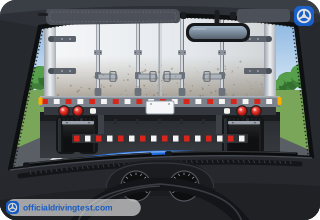
- The truck's horn
- The truck's turn signal
- The truck's brake lights
- A change in the road surface
Show answer
Correct answer: The truck's brake lights
If there is a problem ahead, your first hint will be the truck's brake lights.
Source: Alaska Driver Manual (Revised October 2025), page 71 · Open this page in the manual (Manual page 71)
-
How much room should you give yourself behind a truck?
- The same room you would give a passenger vehicle
- More than you would for a passenger vehicle
- Less room, because trucks accelerate slowly
- Only a few feet, so you stay out of the No-Zone
Show answer
Correct answer: More than you would for a passenger vehicle
The manual says to give yourself plenty of room, more than you would for a passenger vehicle.
Source: Alaska Driver Manual (Revised October 2025), page 71 · Open this page in the manual (Manual page 71)
-
To save fuel when approaching a red light, what does the manual advise?
- Keep accelerating until you are close to the light
- Let your foot off the gas pedal as early as possible
- Shift into park to save fuel
- Tap the brake repeatedly as you approach
Show answer
Correct answer: Let your foot off the gas pedal as early as possible
The manual says to anticipate your stops and let your foot off the gas pedal as early as possible when approaching a red light.
Source: Alaska Driver Manual (Revised October 2025), page 73 · Open this page in the manual (Manual page 73)
-
According to the two-second rule, how do you know you are following too closely?
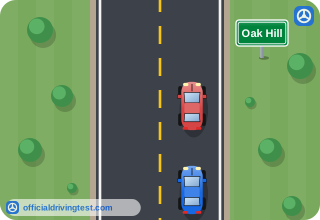
- You reach the object only after counting to four
- You count to two before the vehicle ahead reaches the object
- You reach the object before you count two
- You can no longer read the other vehicle's license plate
Show answer
Correct answer: You reach the object before you count two
The manual says that if you reach the object before you count two, you are too close and should slow down.
Source: Alaska Driver Manual (Revised October 2025), page 74 · Open this page in the manual (Manual page 74)
-
About how long does the manual say it takes to react to a situation and step on the brake pedal?
- About one-quarter of a second
- About three-quarters of a second
- About one and a half seconds
- About three seconds
Show answer
Correct answer: About three-quarters of a second
The manual says it takes about three-quarters of a second to react to a situation and step on the brake pedal.
Source: Alaska Driver Manual (Revised October 2025), page 74 · Open this page in the manual (Manual page 74)
-
At 50 mph, how far does the manual say your vehicle will go in the time it takes you to react?
- 30 feet
- 85 feet
- 160 feet
- 55 feet
Show answer
Correct answer: 55 feet
The manual says that at 50 mph your vehicle will go another 55 feet during the three-quarters of a second it takes to react.
Source: Alaska Driver Manual (Revised October 2025), page 74 · Open this page in the manual (Manual page 74)
-
What does the manual say you should always do near a curve or an area where you cannot see clearly ahead?
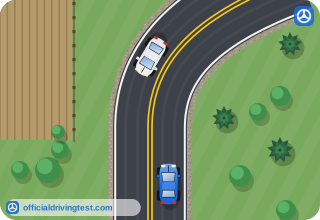
- Speed up
- Slow down
- Turn on your hazard lights
- Pass slower vehicles
Show answer
Correct answer: Slow down
The manual says to always slow down near a curve or an area where you cannot see clearly ahead.
Source: Alaska Driver Manual (Revised October 2025), page 74 · Open this page in the manual (Manual page 74)
-
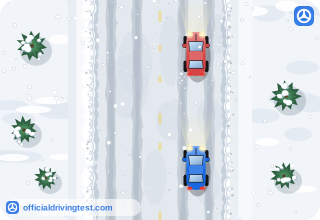
What does the manual say to do about the distance from other vehicles when it is raining or snowing?
- Keep the same distance as on dry roads
- Give yourself less distance so you can see better
- Stay close to the vehicle ahead and follow its path
- Give yourself more distance
Show answer
Correct answer: Give yourself more distance
The manual says to give yourself more distance from other vehicles in rain or snow, since wet or icy roads require a longer distance to stop.
Source: Alaska Driver Manual (Revised October 2025), page 74 · Open this page in the manual (Manual page 74)