Alaska: Speed and following distance — Part 5 Practice Test
Questions in this part include: “Where does the manual say to practice stopping and skid recovery before driving on ice or packed snow in traffic?” · “How much room should you give yourself behind a truck?”
Independent educational site · not affiliated with any government agency or DMV
Ready? Test yourself
- Instant feedback with an explanation
- Every answer cites its source in the manual
- Your best score is saved on this device
Questions are original and based on the official manual "Alaska Driver Manual" (Revised October 2025), Alaska Department of Administration, Division of Motor Vehicles (DMV).
All 18 questions in this practice test
Take the test above first, then use this list to study. Tap “Show answer” to see the correct answer and explanation.
Show the questions and answersHide the questions
-
Where does the manual say to practice stopping and skid recovery before driving on ice or packed snow in traffic?
- On a quiet public road at normal traffic speed
- On a freeway on-ramp during light traffic
- On the shoulder of a busy highway at low speed
- In a safe area, on private property at slow speed
Show answer
Correct answer: In a safe area, on private property at slow speed
The manual says to practice in a safe area, on private property at slow speed, before driving on ice or packed snow in traffic.
Source: Alaska Driver Manual (Revised October 2025), page 61 · Open this page in the manual (Manual page 61)
-
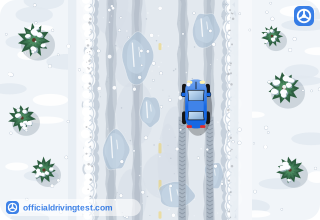
When you are suspicious of ice, what does the manual say to do?
- Brake hard to test how slippery the surface has become
- Speed up to cross the suspicious area as fast as possible
- Cautiously test the road surface, checking your mirror first
- Swerve from side to side to test the grip of the tires
Show answer
Correct answer: Cautiously test the road surface, checking your mirror first
The manual says to test the road surface cautiously and to check your mirror before making a test stop.
Source: Alaska Driver Manual (Revised October 2025), page 61 · Open this page in the manual (Manual page 61)
-
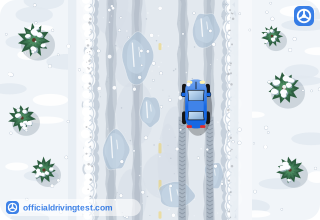
When should you begin slowing down for a stop on ice or packed snow?
- Well in advance of your stopping point
- Right at your stopping point
- Only when you see brake lights ahead
- As late as possible to keep traffic moving
Show answer
Correct answer: Well in advance of your stopping point
The manual says to slow down well in advance of the stopping point on ice or packed snow.
Source: Alaska Driver Manual (Revised October 2025), page 61 · Open this page in the manual (Manual page 61)
-
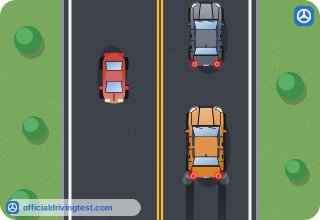
In a vehicle without antilock brakes (ABS), how does the manual say to use the brakes to slow down or stop on a slippery surface?
- Press the brake pedal as hard as you possibly can
- Hold the brake pedal firmly pressed to the floor
- Apply the brakes only at the very last moment
- Pump the brakes lightly without locking the wheels
Show answer
Correct answer: Pump the brakes lightly without locking the wheels
The manual says not to lock the wheels and to pump the brakes lightly, because if the wheels do not roll you do not have control. With ABS, check your vehicle manual.
Source: Alaska Driver Manual (Revised October 2025), page 61 · Open this page in the manual (Manual page 61)
-
If your vehicle is equipped with ABS, where does the manual say to look for instructions on its use?
- The tire manufacturer’s guide
- Your vehicle manual
- The nearest DMV office
- The state road map
Show answer
Correct answer: Your vehicle manual
The manual says that if your vehicle has ABS, you should check your vehicle manual for instructions on use.
Source: Alaska Driver Manual (Revised October 2025), page 61 · Open this page in the manual (Manual page 61)
-
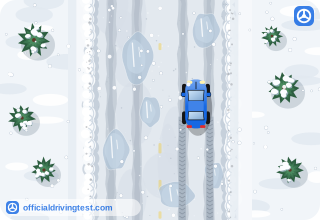
Which habit does the manual list for preventing skids?
- Avoiding abrupt speed and direction changes
- Making quick lane changes to find better traction
- Accelerating sharply out of curves
- Braking suddenly whenever the road looks wet
Show answer
Correct answer: Avoiding abrupt speed and direction changes
The manual lists avoiding abrupt speed and direction changes as a way to prevent skids.
Source: Alaska Driver Manual (Revised October 2025), page 61 · Open this page in the manual (Manual page 61)
-
What is a driver of a motor vehicle not allowed to do on a downgrade?
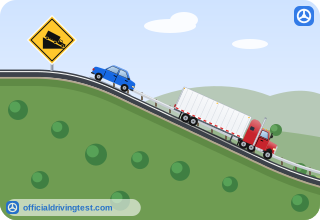
- Drive in a lower gear on the hill
- Use the brakes lightly on the hill
- Coast in neutral or with the clutch in
- Keep the engine running on the hill
Show answer
Correct answer: Coast in neutral or with the clutch in
The manual prohibits coasting on a downgrade with the gears in neutral or the clutch disengaged.
Source: Alaska Driver Manual (Revised October 2025), page 67 · Open this page in the manual (Manual page 67)
-
How many feet does the manual say a truck traveling at 55 mph needs to stop?
- 200 feet
- 250 feet
- 400 feet
- 600 feet
Show answer
Correct answer: 400 feet
The manual states that a truck needs 400 feet to stop.
Source: Alaska Driver Manual (Revised October 2025), page 70 · Open this page in the manual (Manual page 70)
-
What do truck drivers do behind the vehicles they follow?
- Stay as close as a car would
- Keep the same gap that cars leave
- Flash lights to warn drivers behind
- Leave extra room behind them
Show answer
Correct answer: Leave extra room behind them
Truck drivers leave extra room behind the vehicles they follow, and a car moving into that space shortens their stopping room.
Source: Alaska Driver Manual (Revised October 2025), page 70 · Open this page in the manual (Manual page 70)
-
What happens when you drive too close behind a truck?
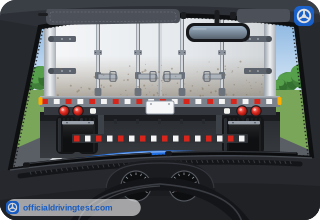
- You cannot see and react to changing traffic conditions
- The truck's large size lets you see farther down the road
- The truck driver can see you clearly in the mirrors
- You get extra time to react to problems ahead
Show answer
Correct answer: You cannot see and react to changing traffic conditions
Driving too close behind a truck prevents you from seeing and reacting to changing traffic conditions.
Source: Alaska Driver Manual (Revised October 2025), page 71 · Open this page in the manual (Manual page 71)
-
If you follow close behind a truck and there is a problem ahead, what is your first hint?
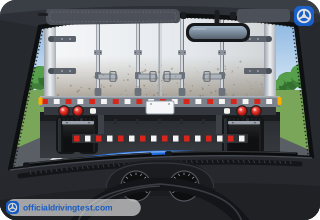
- The truck's horn
- The truck's turn signal
- The truck's brake lights
- A change in the road surface
Show answer
Correct answer: The truck's brake lights
If there is a problem ahead, your first hint will be the truck's brake lights.
Source: Alaska Driver Manual (Revised October 2025), page 71 · Open this page in the manual (Manual page 71)
-
How much room should you give yourself behind a truck?
- The same room you would give a passenger vehicle
- More than you would for a passenger vehicle
- Less room, because trucks accelerate slowly
- Only a few feet, so you stay out of the No-Zone
Show answer
Correct answer: More than you would for a passenger vehicle
The manual says to give yourself plenty of room, more than you would for a passenger vehicle.
Source: Alaska Driver Manual (Revised October 2025), page 71 · Open this page in the manual (Manual page 71)
-
To save fuel when approaching a red light, what does the manual advise?
- Keep accelerating until you are close to the light
- Let your foot off the gas pedal as early as possible
- Shift into park to save fuel
- Tap the brake repeatedly as you approach
Show answer
Correct answer: Let your foot off the gas pedal as early as possible
The manual says to anticipate your stops and let your foot off the gas pedal as early as possible when approaching a red light.
Source: Alaska Driver Manual (Revised October 2025), page 73 · Open this page in the manual (Manual page 73)
-
According to the two-second rule, how do you know you are following too closely?
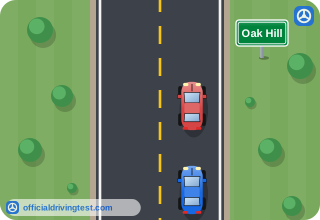
- You reach the object only after counting to four
- You count to two before the vehicle ahead reaches the object
- You reach the object before you count two
- You can no longer read the other vehicle's license plate
Show answer
Correct answer: You reach the object before you count two
The manual says that if you reach the object before you count two, you are too close and should slow down.
Source: Alaska Driver Manual (Revised October 2025), page 74 · Open this page in the manual (Manual page 74)
-
About how long does the manual say it takes to react to a situation and step on the brake pedal?
- About one-quarter of a second
- About three-quarters of a second
- About one and a half seconds
- About three seconds
Show answer
Correct answer: About three-quarters of a second
The manual says it takes about three-quarters of a second to react to a situation and step on the brake pedal.
Source: Alaska Driver Manual (Revised October 2025), page 74 · Open this page in the manual (Manual page 74)
-
At 50 mph, how far does the manual say your vehicle will go in the time it takes you to react?
- 30 feet
- 85 feet
- 160 feet
- 55 feet
Show answer
Correct answer: 55 feet
The manual says that at 50 mph your vehicle will go another 55 feet during the three-quarters of a second it takes to react.
Source: Alaska Driver Manual (Revised October 2025), page 74 · Open this page in the manual (Manual page 74)
-
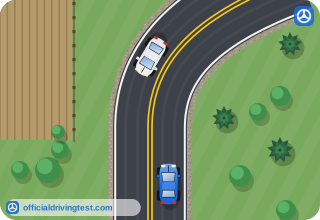
What does the manual say you should always do near a curve or an area where you cannot see clearly ahead?
- Speed up
- Slow down
- Turn on your hazard lights
- Pass slower vehicles
Show answer
Correct answer: Slow down
The manual says to always slow down near a curve or an area where you cannot see clearly ahead.
Source: Alaska Driver Manual (Revised October 2025), page 74 · Open this page in the manual (Manual page 74)
-
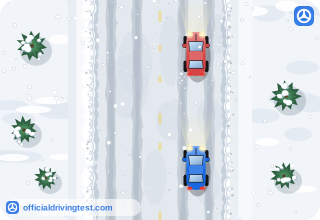
What does the manual say to do about the distance from other vehicles when it is raining or snowing?
- Keep the same distance as on dry roads
- Give yourself less distance so you can see better
- Stay close to the vehicle ahead and follow its path
- Give yourself more distance
Show answer
Correct answer: Give yourself more distance
The manual says to give yourself more distance from other vehicles in rain or snow, since wet or icy roads require a longer distance to stop.
Source: Alaska Driver Manual (Revised October 2025), page 74 · Open this page in the manual (Manual page 74)