Alaska: Speed and following distance — Part 1 Practice Test
Questions in this part include: “According to the manual, what is the greatest singular cause of traffic crashes?” · “What must every driver be able to do under the due care rule?”
Independent educational site · not affiliated with any government agency or DMV
Ready? Test yourself
- Instant feedback with an explanation
- Every answer cites its source in the manual
- Your best score is saved on this device
Questions are original and based on the official manual "Alaska Driver Manual" (Revised October 2025), Alaska Department of Administration, Division of Motor Vehicles (DMV).
All 19 questions in this practice test
Take the test above first, then use this list to study. Tap “Show answer” to see the correct answer and explanation.
Show the questions and answersHide the questions
-
According to the manual, what is the greatest singular cause of traffic crashes?
- The road surface
- The driver
- Vehicle breakdowns
- The weather
Show answer
Correct answer: The driver
The manual states that the driver is the greatest singular cause of traffic crashes.
Source: Alaska Driver Manual (Revised October 2025), page 25 · Open this page in the manual (Manual page 25)
-
Under which conditions did more fatal crashes occur than under any other condition?
- Darkness, icy surface, snowy weather, vehicle in poor mechanical condition
- Dusk, wet surface, foggy weather, vehicle in good mechanical condition
- Night, normal surface, clear weather, vehicle in poor mechanical condition
- Daylight, normal surface, clear weather, vehicle in good mechanical condition
Show answer
Correct answer: Daylight, normal surface, clear weather, vehicle in good mechanical condition
The manual says more fatal crashes occurred during daylight hours with normal surface, clear weather conditions and the vehicle in good mechanical condition.
Source: Alaska Driver Manual (Revised October 2025), page 25 · Open this page in the manual (Manual page 25)
-
A driver's license is issued based on the premise that you will do what?
- Obey the laws and always keep your vehicle under control
- Drive only in daylight hours and in clear weather
- Retake the written test whenever the traffic law changes
- Never exceed 55 mph on any road in the state
Show answer
Correct answer: Obey the laws and always keep your vehicle under control
The manual says a license is issued on the premise that you will obey the laws and always keep your vehicle under control.
Source: Alaska Driver Manual (Revised October 2025), page 25 · Open this page in the manual (Manual page 25)
-
How does the manual describe exercising control of your motor vehicle?
- Keeping both hands on the wheel at all times, in all kinds of weather
- Driving at exactly the posted speed limit under every road condition
- Being able to direct its course and speed and to slow or stop when you wish
- Being able to stop only by using your emergency brake or parking brake
Show answer
Correct answer: Being able to direct its course and speed and to slow or stop when you wish
The manual defines control as being able to direct and regulate the course and speed of the vehicle and to slow or stop when you wish.
Source: Alaska Driver Manual (Revised October 2025), page 25 · Open this page in the manual (Manual page 25)
-
How does the manual describe "pedestrians" in its due care rule?
- People walking or riding a bicycle
- People walking only
- People walking or riding a motorcycle
- People walking or waiting at a bus stop
Show answer
Correct answer: People walking or riding a bicycle
In the due care rule, pedestrians are described as people walking or riding a bicycle.
Source: Alaska Driver Manual (Revised October 2025), page 25 · Open this page in the manual (Manual page 25)
-
What must every driver be able to do under the due care rule?
- Keep the same speed on every road unless a sign says otherwise
- Pass any vehicle that is driving below the speed limit
- Stop if necessary and slow down when circumstances require
- Brake only when a traffic signal or sign tells you to
Show answer
Correct answer: Stop if necessary and slow down when circumstances require
The manual says you must be able to stop if necessary and shall slow down when circumstances require.
Source: Alaska Driver Manual (Revised October 2025), page 25 · Open this page in the manual (Manual page 25)
-
Which of these is listed as a circumstance to watch for when exercising due care?
- A vehicle parked in a driveway beside the road
- A person walking or biking on or along the roadway
- A green traffic light at an intersection
- A mailbox standing beside the road
Show answer
Correct answer: A person walking or biking on or along the roadway
The list of circumstances to watch for starts with a person walking or biking on or along the roadway.
Source: Alaska Driver Manual (Revised October 2025), page 26 · Open this page in the manual (Manual page 26)
-
Which of these is listed as a circumstance to watch for when exercising due care?
- Birds flying over the highway ahead of your vehicle
- Snow piled up on the shoulder of the highway
- Cars waiting in a large shopping center parking lot
- Animals being led, ridden or driven on or along the highway
Show answer
Correct answer: Animals being led, ridden or driven on or along the highway
The list includes animals walking being led, ridden or driven on or along the highway.
Source: Alaska Driver Manual (Revised October 2025), page 26 · Open this page in the manual (Manual page 26)
-
Which of these is listed among the circumstances to watch for when exercising due care?
- A railroad crossing, intersection, bridge, sharp turn, curve or steep downgrade
- A long, straight, flat and dry road with no other traffic anywhere on it
- A parking space in the lot of a shopping center or a store nearby
- A road with a freshly painted white edge line along its right side
Show answer
Correct answer: A railroad crossing, intersection, bridge, sharp turn, curve or steep downgrade
A railroad crossing, intersection, bridge, sharp turn, curve and steep downgrade are all circumstances to watch for.
Source: Alaska Driver Manual (Revised October 2025), page 26 · Open this page in the manual (Manual page 26)
-
Which of these is listed among the circumstances to watch for when exercising due care?
- Blue reflectors, blue flags, or lanterns
- Green flags held by pedestrians
- Red reflectors, red flags, or flares
- White flags on parked vehicles
Show answer
Correct answer: Red reflectors, red flags, or flares
The list of circumstances includes red reflectors, red flags or flares, with the note that a flare burns a bright red.
Source: Alaska Driver Manual (Revised October 2025), page 26 · Open this page in the manual (Manual page 26)
-
Which of the following is a rule about following another vehicle?
- You may follow as closely as you wish, as long as you signal first
- You may not follow more closely than is reasonable and prudent for conditions
- You must stay exactly 100 feet behind every vehicle you are following
- You may follow as closely as you like, whenever the road is dry and clear
Show answer
Correct answer: You may not follow more closely than is reasonable and prudent for conditions
The law says a driver may not follow another vehicle more closely than is reasonable and prudent, having due regard for speed, traffic and conditions of the roadway.
Source: Alaska Driver Manual (Revised October 2025), page 27 · Open this page in the manual (Manual page 27)
-
Besides not following too closely, what duty do you have toward following vehicles?
- A duty to speed up for them
- A duty to flash your headlights at them
- A duty to keep them from passing you
- A duty to yield to them
Show answer
Correct answer: A duty to yield to them
The manual says that you also have a duty to yield to following vehicles.
Source: Alaska Driver Manual (Revised October 2025), page 27 · Open this page in the manual (Manual page 27)
-
On a two-lane roadway outside of an urban area, how many vehicles immediately behind you require you to safely pull over under AS 28.35.140?
- Five or more
- Two or more
- Three or more
- Ten or more
Show answer
Correct answer: Five or more
AS 28.35.140 requires drivers on a two-lane roadway outside an urban area to safely pull over when there are five or more vehicles immediately behind.
Source: Alaska Driver Manual (Revised October 2025), page 27 · Open this page in the manual (Manual page 27)
-
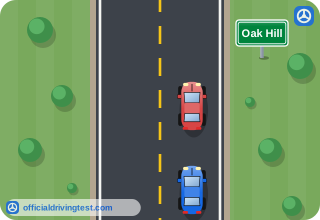
According to the manual, what is the easiest way to calculate a safe following distance?
- Staying one car length behind for every 10 mph
- Following at exactly the same speed as the car ahead
- The four-second interval method
- Keeping the other car's bumper below your hood
Show answer
Correct answer: The four-second interval method
The manual says the easiest way to calculate a safe following distance is the four-second interval method.
Source: Alaska Driver Manual (Revised October 2025), page 27 · Open this page in the manual (Manual page 27)
-
Using the four-second rule, what does it mean if you pass the same point before you finish counting?
- You are following at a safe distance
- You are following too closely
- You are driving too slowly
- You should speed up to keep pace
Show answer
Correct answer: You are following too closely
The manual says that if you pass the same point before you finish counting, you are following too closely.
Source: Alaska Driver Manual (Revised October 2025), page 27 · Open this page in the manual (Manual page 27)
-
When towing a trailer or when the road surface is wet or slippery, what should you do with the four-second following interval?
- Decrease it to two seconds
- Keep it at four seconds
- Increase it to five seconds only
- Increase it to six seconds or more
Show answer
Correct answer: Increase it to six seconds or more
The manual says to increase the four seconds to six or more when towing a trailer or when the road is wet or slippery.
Source: Alaska Driver Manual (Revised October 2025), page 27 · Open this page in the manual (Manual page 27)
-
Why does the manual say you can also use the four-second rule at night?
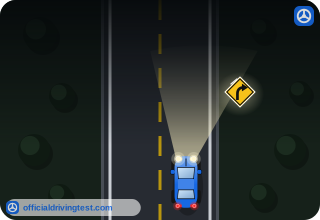
- To make sure you are not "overdriving your headlights"
- To judge how far oncoming traffic is
- To check that your headlights are aimed properly
- To know when to turn on your high beams
Show answer
Correct answer: To make sure you are not "overdriving your headlights"
The manual says the four-second rule can be used at night to make sure you are not overdriving your headlights.
Source: Alaska Driver Manual (Revised October 2025), page 27 · Open this page in the manual (Manual page 27)
-
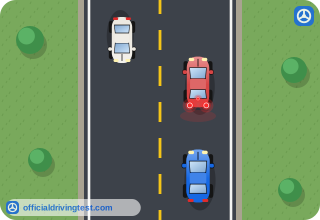
To avoid a rear-end collision, what should you do when you see brake lights ahead?
- Wait until the other car stops completely before you slow down
- Sound your horn at the driver of the car ahead of you in traffic
- Shift your foot to the brake pedal promptly so you are ready to stop
- Move your foot away from the pedals so the car can coast along
Show answer
Correct answer: Shift your foot to the brake pedal promptly so you are ready to stop
The manual says to watch for brake lights and shift your foot to the brake pedal promptly so you are ready to stop if necessary.
Source: Alaska Driver Manual (Revised October 2025), page 27 · Open this page in the manual (Manual page 27)
-
What does a shrinking distance between your car and the one ahead warn of?
- That the other driver is about to turn
- An impending crash with the vehicle ahead
- That the road ahead is about to end
- That your tires are running low on air
Show answer
Correct answer: An impending crash with the vehicle ahead
The manual says shrinking distance warns of an impending crash with the vehicle ahead.
Source: Alaska Driver Manual (Revised October 2025), page 27 · Open this page in the manual (Manual page 27)