Alaska: Speed and following distance — Part 4 Practice Test
Questions in this part include: “Who is the glare recovery problem generally more acute in, according to the manual?” · “Why does the manual say to vary your speed from time to time?”
Independent educational site · not affiliated with any government agency or DMV
Ready? Test yourself
- Instant feedback with an explanation
- Every answer cites its source in the manual
- Your best score is saved on this device
Questions are original and based on the official manual "Alaska Driver Manual" (Revised October 2025), Alaska Department of Administration, Division of Motor Vehicles (DMV).
All 18 questions in this practice test
Take the test above first, then use this list to study. Tap “Show answer” to see the correct answer and explanation.
Show the questions and answersHide the questions
-
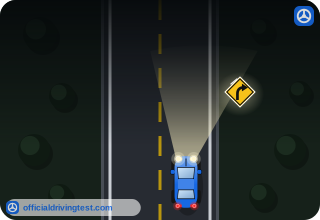
According to the manual, why is the fatal crash rate greater for night driving?
- Drivers tend to drive much faster at night
- Fewer traffic laws apply after dark
- Drivers cannot see as far, as soon, and as much
- Roads are always slippery at night
Show answer
Correct answer: Drivers cannot see as far, as soon, and as much
The manual attributes the higher night crash rate to the inability of the driver to see as far, as soon, and as much.
Source: Alaska Driver Manual (Revised October 2025), page 54 · Open this page in the manual (Manual page 54 · PDF 66)
-
Who is the glare recovery problem generally more acute in, according to the manual?
- Young drivers and those who are new to driving
- Older drivers and those with certain medical conditions
- Drivers who wear sunglasses during the day
- Drivers of large trucks and buses
Show answer
Correct answer: Older drivers and those with certain medical conditions
The manual says the glare recovery problem is generally more acute in older drivers and those with certain medical conditions.
Source: Alaska Driver Manual (Revised October 2025), page 54 · Open this page in the manual (Manual page 54 · PDF 66)
-
Why does the manual say to check oil, water level, radiator hoses, and fan belt frequently on major roads?
- Major roads have no service stations
- Hilly roads wear out engines faster
- Cold air freezes the radiator hoses
- High speeds generate heat
Show answer
Correct answer: High speeds generate heat
The manual says high speeds generate heat, so these items should be checked frequently.
Source: Alaska Driver Manual (Revised October 2025), page 56 · Open this page in the manual (Manual page 56 · PDF 68)
-
Which tire problem does the manual say is a common factor in crashes?
- Blowouts
- Slow leaks
- Uneven tire wear
- Mismatched tire brands
Show answer
Correct answer: Blowouts
The manual says to be sure tires are safe for high-speed driving because blowouts are a common factor in crashes.
Source: Alaska Driver Manual (Revised October 2025), page 56 · Open this page in the manual (Manual page 56 · PDF 68)
-
Speed limitations imposed by traffic, weather, and road conditions are applicable on which roadway systems?
- Only on freeways
- All roadway systems
- Only on gravel roads
- Only on roads in urban areas
Show answer
Correct answer: All roadway systems
The manual says speed limitations imposed by traffic, weather and road conditions are applicable on all roadway systems.
Source: Alaska Driver Manual (Revised October 2025), page 56 · Open this page in the manual (Manual page 56 · PDF 68)
-
On certain roads, how many vehicles behind you require you to pull off the roadway at the first safe opportunity?
- When three or more vehicles are behind you
- When ten or more vehicles are behind you
- When any vehicle behind you honks
- When five or more vehicles are behind you
Show answer
Correct answer: When five or more vehicles are behind you
The manual says that on certain roads you must pull off the roadway at the first safe opportunity if five or more vehicles are behind you.
Source: Alaska Driver Manual (Revised October 2025), page 56 · Open this page in the manual (Manual page 56 · PDF 68)
-
What does the manual say high speed causes?
- Tire wear and poor gasoline mileage
- Better gasoline mileage and less tire wear
- Faster engine cooling and longer tire life
- Lower fuel use but more engine wear
Show answer
Correct answer: Tire wear and poor gasoline mileage
The manual says high speed causes tire wear and results in poor gasoline mileage.
Source: Alaska Driver Manual (Revised October 2025), page 56 · Open this page in the manual (Manual page 56 · PDF 68)
-
Why does the manual say to vary your speed from time to time?
- To save fuel on long trips
- To keep other drivers from following too closely
- To prevent monotony and road hypnosis
- To keep your tires from overheating
Show answer
Correct answer: To prevent monotony and road hypnosis
The manual says varying speed prevents monotony and road hypnosis, since driving at the same speed for a long time dulls the senses.
Source: Alaska Driver Manual (Revised October 2025), page 56 · Open this page in the manual (Manual page 56 · PDF 68)
-
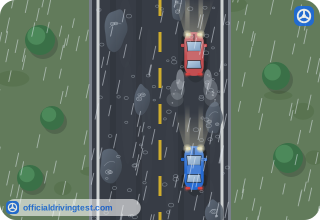
When do hard surface roads often become slippery after a rain?
- During the first half hour after the rain
- Only after it has rained for two hours
- Only after the road has completely dried
- During the first day after the rain
Show answer
Correct answer: During the first half hour after the rain
The manual says the first half hour after a rain often makes hard surface roads slippery.
Source: Alaska Driver Manual (Revised October 2025), page 59 · Open this page in the manual (Manual page 59 · PDF 71)
-
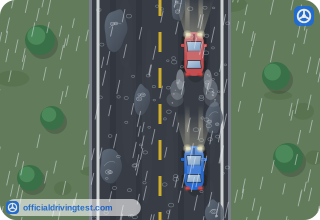
According to the manual, what forms a slippery combination on a road after rain?
- Salt, sand, and gravel mixed with snow
- Road paint and fuel mixed with water
- Oil, dirt, and tire dust mixed with water
- Leaves and mud mixed with frost
Show answer
Correct answer: Oil, dirt, and tire dust mixed with water
The manual says oil, dirt, and tire dust mixed with water form a slippery combination because dust and road film are not washed off.
Source: Alaska Driver Manual (Revised October 2025), page 59 · Open this page in the manual (Manual page 59 · PDF 71)
-
What should you do before testing the road surface for traction?
- Turn on your hazard lights first
- Check your rear vision mirror
- Slow down to a complete stop
- Check the speedometer reading
Show answer
Correct answer: Check your rear vision mirror
The manual says to test the road surface for traction but to check the rear vision mirror before doing so.
Source: Alaska Driver Manual (Revised October 2025), page 59 · Open this page in the manual (Manual page 59 · PDF 71)
-
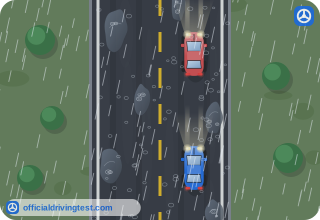
How does staying well back from the vehicle ahead help you in rain, according to the manual?
- It keeps the road surface from becoming slippery
- It helps avoid spatter on your windshield and headlights
- It lets you test the road surface for traction
- It stops the wipers from streaking and skipping
Show answer
Correct answer: It helps avoid spatter on your windshield and headlights
The manual says to stay well back from the vehicle ahead to aid in avoiding spatter on the windshield and headlights.
Source: Alaska Driver Manual (Revised October 2025), page 59 · Open this page in the manual (Manual page 59 · PDF 71)
-
What happens when you try to stop on a wet surface with bald tires?
- They stop the car in a shorter distance
- They only affect handling on dry pavement
- They do not give you directional control of your car
- They give better traction because of the smooth surface
Show answer
Correct answer: They do not give you directional control of your car
The manual says bald tires do not give you directional control when you attempt to stop on a wet surface, so you should drive on tires with good tread.
Source: Alaska Driver Manual (Revised October 2025), page 59 · Open this page in the manual (Manual page 59 · PDF 71)
-
What can you not do quickly when the road surface is covered with rain, snow, or ice?

- Accelerate or shift gears
- Turn on your lights
- See other vehicles
- Stop or change direction
Show answer
Correct answer: Stop or change direction
The manual says you can’t stop or change direction quickly when the road surface is covered with rain, snow, or ice.
Source: Alaska Driver Manual (Revised October 2025), page 59 · Open this page in the manual (Manual page 59 · PDF 71)
-
Which two things does the manual say weather conditions greatly affect?
- Visibility and vehicle traction
- Fuel economy and engine noise
- Speed limits and lane widths
- Tire pressure and battery power
Show answer
Correct answer: Visibility and vehicle traction
The manual says weather conditions greatly affect visibility and vehicle traction.
Source: Alaska Driver Manual (Revised October 2025), page 59 · Open this page in the manual (Manual page 59 · PDF 71)
-
Which areas become slippery before the rest of the road surface and stay slippery longer?
- Shaded areas, protected areas, and bridges
- Wide, sunny stretches with open shoulders
- Hilltops and straight rural highways
- Intersections and parking lot entrances
Show answer
Correct answer: Shaded areas, protected areas, and bridges
The manual says shaded areas, protected areas, and bridges become slippery before the balance of the road surface and stay so longer.
Source: Alaska Driver Manual (Revised October 2025), page 61 · Open this page in the manual (Manual page 61)
-
During which weather should you be extra alert for slippery conditions?
- Dry, windy summer weather
- Hot, humid summer weather
- Thawing and freezing weather
- Clear, sunny, warm weather
Show answer
Correct answer: Thawing and freezing weather
The manual says to be extra alert for slippery conditions during thawing and freezing weather.
Source: Alaska Driver Manual (Revised October 2025), page 61 · Open this page in the manual (Manual page 61)
-
What happens if you over-correct in a skidding situation?

- It stops the skid immediately
- It only changes the direction of the skid
- It locks the wheels and ends the skid
- It shortens your stopping distance
Show answer
Correct answer: It only changes the direction of the skid
The manual says over-correcting results only in changing the direction of the skid.
Source: Alaska Driver Manual (Revised October 2025), page 61 · Open this page in the manual (Manual page 61)