Alaska: Speed and following distance — Part 2 Practice Test
Questions in this part include: “How can you tell whether a distant car is in motion or stopped?” · “If you increase your speed to 80 mph, how much greater is the impact (striking power) of your vehicle than at 20 mph?”
Independent educational site · not affiliated with any government agency or DMV
Ready? Test yourself
- Instant feedback with an explanation
- Every answer cites its source in the manual
- Your best score is saved on this device
Questions are original and based on the official manual "Alaska Driver Manual" (Revised October 2025), Alaska Department of Administration, Division of Motor Vehicles (DMV).
All 19 questions in this practice test
Take the test above first, then use this list to study. Tap “Show answer” to see the correct answer and explanation.
Show the questions and answersHide the questions
-
How can you tell whether a distant car is in motion or stopped?
- Watch only its brake lights
- Check whether its tires are turning
- Wait to see if its driver gets out
- Learn to relate vehicles to fixed objects
Show answer
Correct answer: Learn to relate vehicles to fixed objects
The manual says some drivers find it hard to tell whether a distant car is moving, so you should learn to relate vehicles to fixed objects.
Source: Alaska Driver Manual (Revised October 2025), page 27 · Open this page in the manual (Manual page 27)
-
Why should you look for problems that might develop for the driver ahead of you?
- It makes it easy to react in time
- It lets you pass more quickly
- It lets you follow more closely
- It means you can use your horn sooner
Show answer
Correct answer: It makes it easy to react in time
The manual says looking for problems that might develop for the driver ahead makes it easy to react in time.
Source: Alaska Driver Manual (Revised October 2025), page 27 · Open this page in the manual (Manual page 27)
-
What does 13 AAC 02.090 require at a minimum for following distance?
- The 3 second rule
- The 4 second rule
- The 2 second rule
- The 6 second rule
Show answer
Correct answer: The 2 second rule
The note says that although the chart recommends the 4 second rule, 13 AAC 02.090 requires at a minimum the 2 second rule.
Source: Alaska Driver Manual (Revised October 2025), page 27 · Open this page in the manual (Manual page 27)
-
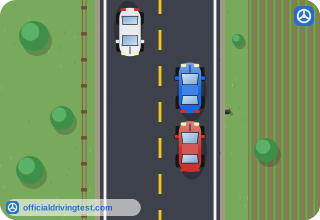
To avoid being hit from behind, what should you do with your brake lights when preparing to stop?
- Turn them off
- Flash them
- Leave them dim
- Cover them with a cloth
Show answer
Correct answer: Flash them
The manual says to keep brake lights clean and working and to flash them when preparing to stop.
Source: Alaska Driver Manual (Revised October 2025), page 27 · Open this page in the manual (Manual page 27)
-
To know what is going on behind you, what does the manual say you should have and keep clean?
- Tinted rear windows and a spare mirror kept in the glove box
- A dash camera mounted on the windshield and clean side windows
- Rear fog lights and a clean license plate on the back bumper
- An outside rear vision mirror and a rear window clear of frost and snow
Show answer
Correct answer: An outside rear vision mirror and a rear window clear of frost and snow
The manual says to have an outside rear vision mirror and to keep the rear window clean and clear of frost and snow.
Source: Alaska Driver Manual (Revised October 2025), page 27 · Open this page in the manual (Manual page 27)
-
When should you signal for lane changes, stops or turns to avoid being hit from behind?
- Well in advance
- Just as you start to move
- Only after you have slowed
- Only when other cars are close
Show answer
Correct answer: Well in advance
The manual says to signal well in advance because the person behind you can't read your mind.
Source: Alaska Driver Manual (Revised October 2025), page 27 · Open this page in the manual (Manual page 27)
-
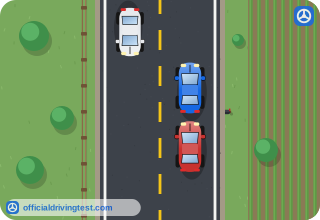
How should you slow down to give the drivers behind more time and space to react?
- Suddenly with the brakes
- Only by taking your foot off the gas at the last second
- Gradually over a long distance
- In steps, by stopping in the traffic lane
Show answer
Correct answer: Gradually over a long distance
The manual says to slow down gradually over a long distance to give drivers behind more time and space to react.
Source: Alaska Driver Manual (Revised October 2025), page 27 · Open this page in the manual (Manual page 27)
-
To lessen the likelihood of a rear-end crash, how should you drive relative to other traffic?
- Drive slower than the traffic around you at all times, to be safe
- Keep pace with the traffic, within weather conditions and speed limits
- Drive faster than the traffic around you in order to stay ahead of it
- Match the traffic around you even when it exceeds the speed limit
Show answer
Correct answer: Keep pace with the traffic, within weather conditions and speed limits
The manual says to keep pace with the traffic within limitations of weather conditions and speed limits.
Source: Alaska Driver Manual (Revised October 2025), page 27 · Open this page in the manual (Manual page 27)
-
When you double your speed from 20 to 40 miles per hour, how much greater is the impact of your vehicle?
- 2 times greater
- 3 times greater
- 8 times greater
- 4 times greater
Show answer
Correct answer: 4 times greater
The manual says the impact is 4 times greater at 40 mph than at 20 mph, even though many believe it would only double.
Source: Alaska Driver Manual (Revised October 2025), page 28 · Open this page in the manual (Manual page 28)
-
If you triple your speed from 20 to 60 mph, how much greater is the impact (striking power) of your vehicle?
- 3 times greater
- 6 times greater
- 9 times greater
- 12 times greater
Show answer
Correct answer: 9 times greater
The manual says that tripling the speed from 20 to 60 mph makes the impact 9 times greater.
Source: Alaska Driver Manual (Revised October 2025), page 28 · Open this page in the manual (Manual page 28)
-
If you increase your speed to 80 mph, how much greater is the impact (striking power) of your vehicle than at 20 mph?
- 4 times greater
- 16 times greater
- 8 times greater
- 12 times greater
Show answer
Correct answer: 16 times greater
The manual says that at 80 mph the impact is 16 times greater than at 20 mph.
Source: Alaska Driver Manual (Revised October 2025), page 28 · Open this page in the manual (Manual page 28)
-
Under which conditions does the manual say speed need not be dangerous?
- When it is kept below the speed of all other traffic on the road at all times
- When the driver has many years of driving experience behind the wheel of a car
- When the vehicle has new tires and good brakes installed on it by a mechanic
- When adjusted for traffic, road and weather conditions and managed by a considerate driver
Show answer
Correct answer: When adjusted for traffic, road and weather conditions and managed by a considerate driver
The manual says speed adjusted for traffic, road and weather conditions and carefully managed by a considerate driver need not be dangerous.
Source: Alaska Driver Manual (Revised October 2025), page 28 · Open this page in the manual (Manual page 28)
-
According to the speed and stopping distance chart, what is the thinking distance at 60 mph?
- 44 feet
- 66 feet
- 77 feet
- 88 feet
Show answer
Correct answer: 66 feet
The chart shows a thinking distance of 66 feet at 60 mph.
Source: Alaska Driver Manual (Revised October 2025), page 28 · Open this page in the manual (Manual page 28)
-
According to the speed and stopping distance chart, how many feet per second does a vehicle travel at 30 mph?
- 44
- 29
- 59
- 74
Show answer
Correct answer: 44
The chart lists 44 feet per second for a speed of 30 mph.
Source: Alaska Driver Manual (Revised October 2025), page 28 · Open this page in the manual (Manual page 28)
-
What is the maximum speed limit in a business district, under favorable conditions on highways not otherwise posted?
- 15 mph
- 25 mph
- 20 mph
- 30 mph
Show answer
Correct answer: 20 mph
The speed laws set the maximum in a business district at 20 mph.
Source: Alaska Driver Manual (Revised October 2025), page 29 · Open this page in the manual (Manual page 29)
-
What is the maximum speed limit in an alley, under favorable conditions on highways not otherwise posted?
- 10 mph
- 15 mph
- 20 mph
- 25 mph
Show answer
Correct answer: 15 mph
The speed laws set the maximum in an alley at 15 mph.
Source: Alaska Driver Manual (Revised October 2025), page 29 · Open this page in the manual (Manual page 29)
-
What is the maximum speed limit in a school zone, under favorable conditions on highways not otherwise posted?
- 15 mph
- 25 mph
- 35 mph
- 20 mph
Show answer
Correct answer: 20 mph
The speed laws set the maximum in a school zone at 20 mph.
Source: Alaska Driver Manual (Revised October 2025), page 29 · Open this page in the manual (Manual page 29)
-
What is the maximum speed limit in a residential district, under favorable conditions on highways not otherwise posted?
- 25 mph
- 15 mph
- 20 mph
- 30 mph
Show answer
Correct answer: 25 mph
The speed laws set the maximum in a residential district at 25 mph.
Source: Alaska Driver Manual (Revised October 2025), page 29 · Open this page in the manual (Manual page 29)
-
What is the maximum speed limit on any other roadway, under favorable conditions on highways not otherwise posted?
- 45 mph
- 50 mph
- 55 mph
- 60 mph
Show answer
Correct answer: 55 mph
The speed laws set the maximum on any other roadway at 55 mph.
Source: Alaska Driver Manual (Revised October 2025), page 29 · Open this page in the manual (Manual page 29)