Alaska: Signals and vehicle controls
Turn and hand signals, headlights, required equipment, towing and keeping your vehicle in safe condition. Split into 5 shorter tests so you're not stuck in one long quiz.
Independent educational site · not affiliated with any government agency or DMV
Choose a part
Signals and vehicle controls — Part 1
Questions in this part include: “What must you do before you stop or suddenly decrease your speed?”
StartSignals and vehicle controls — Part 2
Questions in this part include: “Which statement about glare recovery time is made in the manual?”
StartSignals and vehicle controls — Part 3
Questions in this part include: “What does the manual say to ask a service station attendant to avoid using on your windshield?”
StartSignals and vehicle controls — Part 4
Questions in this part include: “What is the purpose of anti-spray devices such as mud flaps or fenders?”
StartSignals and vehicle controls — Part 5
Questions in this part include: “With the penny test, if you slide a penny into a tread groove and can see the top of Lincoln's head, what does it mean?”
StartAll 98 Signals and vehicle controls questions with answers
Choose a part above to take a practice test, or study every question and answer here.
Show the questions and answersHide the questions
-
Instead of depending on mirrors when backing, what should you do?
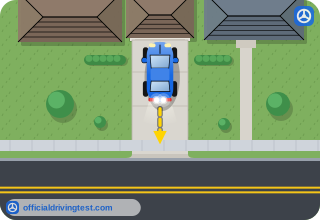
- Watch the side mirrors and ignore the rear window completely
- Lean out of the driver’s window and look back at the road
- Rely only on a rearview camera if your vehicle has one fitted
- Turn your body and head to the right and look out the rear window
Show answer
Correct answer: Turn your body and head to the right and look out the rear window
The backing instructions say not to depend on mirrors, but to turn your body and head to the right and look out the rear window.
Source: Alaska Driver Manual (Revised October 2025), page 26 · Open this page in the manual (Manual page 26)
-
When backing, where should your left hand be?
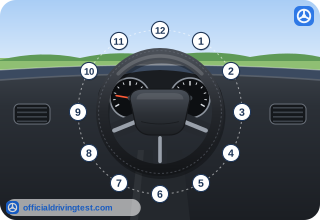
- At the top of the steering wheel
- At the bottom of the steering wheel
- On the gear shift
- On the window ledge
Show answer
Correct answer: At the top of the steering wheel
The manual says to place your left hand at the top of the steering wheel when backing.
Source: Alaska Driver Manual (Revised October 2025), page 26 · Open this page in the manual (Manual page 26)
-
When backing, in which direction should you move the steering wheel?
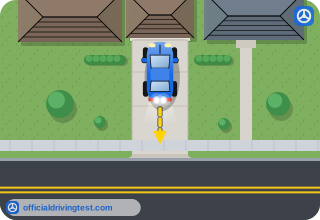
- In the direction you want the front of your vehicle to go
- Away from the direction you want to go
- In the direction you want the rear of your vehicle to go
- Straight until the vehicle has stopped
Show answer
Correct answer: In the direction you want the rear of your vehicle to go
The manual says to move the wheel in the direction you want the REAR of your vehicle to go.
Source: Alaska Driver Manual (Revised October 2025), page 26 · Open this page in the manual (Manual page 26)
-
How should you back your vehicle?
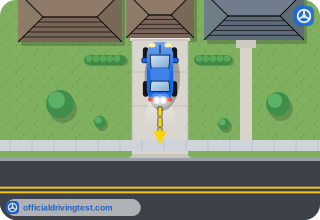
- At a steady moderate speed, looking only at the rear window
- Slowly, keeping your eyes moving to all sides of your car
- Quickly, so you spend less time in the roadway
- Slowly, keeping your eyes fixed straight behind you
Show answer
Correct answer: Slowly, keeping your eyes moving to all sides of your car
The manual says to back slowly and keep your eyes moving to all sides of your car.
Source: Alaska Driver Manual (Revised October 2025), page 26 · Open this page in the manual (Manual page 26)
-
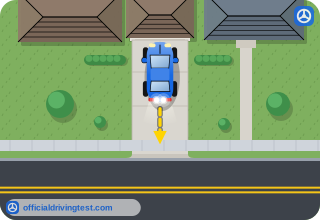
When backing, whom must you always yield to?
- Only vehicles on the street
- Only people on the sidewalk
- Only vehicles that are moving faster than you
- Vehicles or people on the street or sidewalk
Show answer
Correct answer: Vehicles or people on the street or sidewalk
The manual says to always yield to vehicles or people on the street or sidewalk and be prepared to stop when backing.
Source: Alaska Driver Manual (Revised October 2025), page 26 · Open this page in the manual (Manual page 26)
-
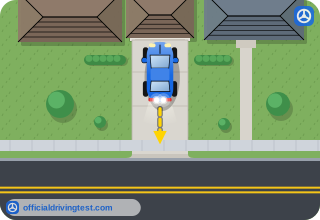
What speed does the manual suggest you not exceed when backing?
- 5 mph
- 10 mph
- 15 mph
- 20 mph
Show answer
Correct answer: 5 mph
The manual suggests your speed not exceed 5 mph when backing.
Source: Alaska Driver Manual (Revised October 2025), page 26 · Open this page in the manual (Manual page 26)
-
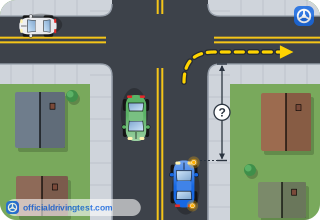
How far before a turn must your hand or directional signal be given continuously?
- During the last 100 feet
- During the last 50 feet
- During the last 200 feet
- During the last 25 feet
Show answer
Correct answer: During the last 100 feet
The signal must be given continuously during the last 100 feet before turning.
Source: Alaska Driver Manual (Revised October 2025), page 30 · Open this page in the manual (Manual page 30)
-
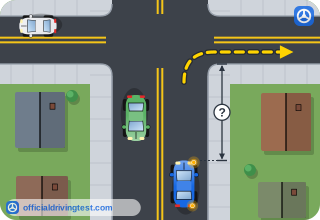
When may a turn signal be given from farther away than 100 feet before the turn?
- Only when you are turning from a one-way street
- Only when another driver asks you to signal early
- When traffic conditions or your higher speeds warrant it
- Never, because the signal must start at exactly 100 feet
Show answer
Correct answer: When traffic conditions or your higher speeds warrant it
The signal may be given from a greater distance when traffic conditions or the higher speeds of your vehicle warrant it.
Source: Alaska Driver Manual (Revised October 2025), page 30 · Open this page in the manual (Manual page 30)
-
What must you do before you stop or suddenly decrease your speed?
- Sound your horn to warn the drivers behind you
- Signal your intentions for the benefit of other drivers
- Turn on your headlights so others can see you
- Move onto the shoulder of the road first
Show answer
Correct answer: Signal your intentions for the benefit of other drivers
You must never stop or suddenly slow down without signaling your intentions to the other drivers.
Source: Alaska Driver Manual (Revised October 2025), page 30 · Open this page in the manual (Manual page 30)
-
What should you make sure of regarding your turn signals?
- They are switched on at all times while the vehicle is moving
- They are replaced by hand signals whenever it is snowing
- They flash faster than the signals of other vehicles
- They are clean and free from dust, dirt, ice, or snow
Show answer
Correct answer: They are clean and free from dust, dirt, ice, or snow
The manual says to be sure turn signals are clean and free from dust, dirt, ice, or snow.
Source: Alaska Driver Manual (Revised October 2025), page 30 · Open this page in the manual (Manual page 30)
-
When does the manual say you should use hand signals?
- Only when your turn signal lights stop working at night
- Whenever you are driving on a road with more than two lanes
- When bright sun or a line of cars behind you could hide your turn signal
- Only when you are turning at an intersection with a traffic light
Show answer
Correct answer: When bright sun or a line of cars behind you could hide your turn signal
Hand signals are used when the sun is shining brightly or a line of cars following you could obscure your turn signal light.
Source: Alaska Driver Manual (Revised October 2025), page 30 · Open this page in the manual (Manual page 30)
-
What does Alaska law require you to do with your directional signal light after you use it?
- Cancel the signal light
- Leave it on until you reach the next intersection
- Leave it flashing for 100 feet after the turn
- Turn it off only if a vehicle is behind you
Show answer
Correct answer: Cancel the signal light
Alaska law requires you to cancel your directional signal light after you use it.
Source: Alaska Driver Manual (Revised October 2025), page 30 · Open this page in the manual (Manual page 30)
-
Why is it a problem to leave a directional signal on after you have finished turning?
- It signals other drivers that you plan to stop suddenly ahead
- Other drivers may think your headlights are not working
- It tells pedestrians that they may cross in front of you
- Other drivers think you are still turning and may pull in front of you
Show answer
Correct answer: Other drivers think you are still turning and may pull in front of you
An unintended signal still means you are turning to other drivers, who might turn or drive across in front of you.
Source: Alaska Driver Manual (Revised October 2025), page 30 · Open this page in the manual (Manual page 30)
-
Who else is required to use hand signals to signal a turn?
- Pedestrians who are crossing the street
- Bicyclists
- Only drivers of vehicles without turn signals
- Passengers riding in the front seat
Show answer
Correct answer: Bicyclists
The manual states that bicyclists are also required to use hand signals to signal a turn.
Source: Alaska Driver Manual (Revised October 2025), page 30 · Open this page in the manual (Manual page 30)
-
In the hand signals shown in the manual, how does a driver signal a left turn?
- The left arm held straight out to the side
- The left arm bent straight up at the elbow
- The left arm pointing downward
- The left arm pulled inside and resting on the door
Show answer
Correct answer: The left arm held straight out to the side
The manual shows a left turn signaled with the driver’s arm extended straight out the window.
Source: Alaska Driver Manual (Revised October 2025), page 30 · Open this page in the manual (Manual page 30)
-
In the hand signals shown in the manual, how does a driver signal a right turn?
- The left arm held straight out to the side
- The left arm pointing downward
- The left arm bent upward at the elbow
- The left arm pulled inside and resting on the door
Show answer
Correct answer: The left arm bent upward at the elbow
The manual shows a right turn signaled with the driver’s arm bent upward out the window.
Source: Alaska Driver Manual (Revised October 2025), page 30 · Open this page in the manual (Manual page 30)
-
In the hand signals shown in the manual, how does a driver signal to stop or slow?
- The left arm held straight out to the side
- The left arm pointing downward
- The left arm bent upward at the elbow
- The left arm pulled inside and resting on the door
Show answer
Correct answer: The left arm pointing downward
The manual shows a stop or slow signal with the driver’s arm pointing downward out the window.
Source: Alaska Driver Manual (Revised October 2025), page 30 · Open this page in the manual (Manual page 30)
-
What can signaling for turns help prevent?
- Head-on collisions
- Collisions with pedestrians
- Rear end collisions
- Skids on icy roads
Show answer
Correct answer: Rear end collisions
The manual says signaling for turns can prevent rear end collisions.
Source: Alaska Driver Manual (Revised October 2025), page 32 · Open this page in the manual (Manual page 32)
-
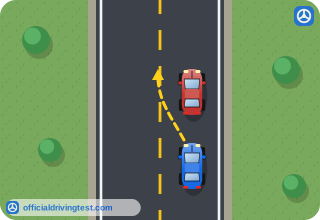
Before moving into the left lane to pass, what should you signal?
- A right turn
- A left turn
- A stop or slow signal
- Nothing until you are beside the vehicle
Show answer
Correct answer: A left turn
The manual says to check your rear vision mirror and signal a left turn to the left lane.
Source: Alaska Driver Manual (Revised October 2025), page 36 · Open this page in the manual (Manual page 36)
-
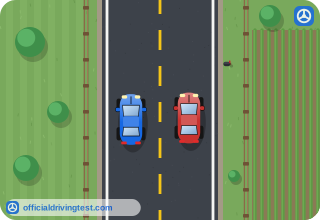
When you return to the right lane after passing, what should you do with your signal?
- Signal a right turn and leave it on for 100 feet
- Signal a left turn and leave it on until you are in the lane
- Use no signal, because you already signaled to pass
- Signal a right turn, then cancel the signal light
Show answer
Correct answer: Signal a right turn, then cancel the signal light
You signal a right turn to return to the right lane and be sure to cancel the signal light.
Source: Alaska Driver Manual (Revised October 2025), page 36 · Open this page in the manual (Manual page 36)
-
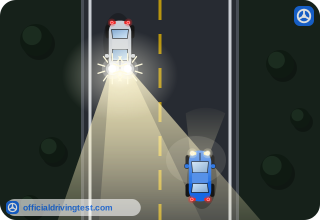
What does the glare from the headlights of oncoming vehicles cause the pupil of the eye to do?
- Dilate
- Contract
- Stay the same size
- Close completely
Show answer
Correct answer: Contract
The manual says glare from oncoming headlights causes the pupil of the eye to contract.
Source: Alaska Driver Manual (Revised October 2025), page 54 · Open this page in the manual (Manual page 54 · PDF 66)
-
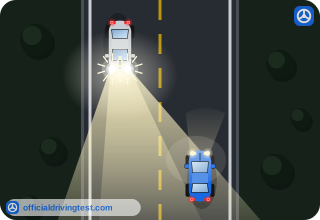
After an oncoming vehicle has passed, what is the interval of time the pupil needs to readjust to the less intense light called?
- Night adjustment period
- Visual acuity time
- Pupil reaction delay
- Glare recovery time
Show answer
Correct answer: Glare recovery time
The manual calls the time the pupil takes to readjust to less intense light glare recovery time.
Source: Alaska Driver Manual (Revised October 2025), page 54 · Open this page in the manual (Manual page 54 · PDF 66)
-
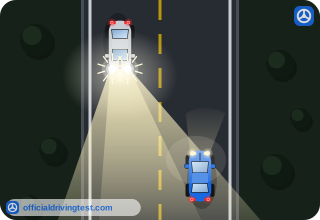
How does the manual describe your condition during the glare recovery period?
- Virtually driving blind
- Driving with sharper night vision
- Driving with a slight delay in reaction only
- Driving with normal vision but tired eyes
Show answer
Correct answer: Virtually driving blind
The manual says that during the recovery period you are virtually driving blind.
Source: Alaska Driver Manual (Revised October 2025), page 54 · Open this page in the manual (Manual page 54 · PDF 66)
-
Which statement about glare recovery time is made in the manual?
- It is based on visual acuity and is the same for everyone
- It is the same for all drivers regardless of age
- It is not based on visual acuity and varies from person to person
- It lasts only a fraction of a second for every driver
Show answer
Correct answer: It is not based on visual acuity and varies from person to person
The manual says glare recovery time is not based on visual acuity and varies from person to person.
Source: Alaska Driver Manual (Revised October 2025), page 54 · Open this page in the manual (Manual page 54 · PDF 66)
-
Where does the manual say you can check the high and low beams of your headlights?
- On the side of another parked vehicle
- Against a road sign at night
- On a mirror in your driveway
- On a garage wall
Show answer
Correct answer: On a garage wall
The night driving safety tips say to check the high and low beam on a garage wall.
Source: Alaska Driver Manual (Revised October 2025), page 54 · Open this page in the manual (Manual page 54 · PDF 66)
-
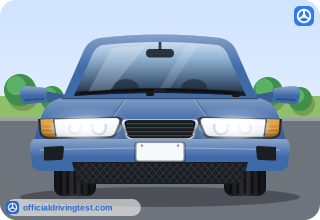
Which of these is a night driving safety tip in the manual?
- Be sure headlights are in working order and lenses are clean
- Use your high beams whenever you follow another vehicle closely
- Tint the windshield as dark as possible
- Look straight at oncoming headlights to judge distance
Show answer
Correct answer: Be sure headlights are in working order and lenses are clean
The manual tells night drivers to make sure headlights work and the lenses are clean.
Source: Alaska Driver Manual (Revised October 2025), page 54 · Open this page in the manual (Manual page 54 · PDF 66)
-
Why does the manual recommend wearing sunglasses in bright sunlight?
- To reduce the glare of oncoming headlights at night
- To protect night seeing ability
- To keep the windshield from fogging
- To make traffic signals easier to recognize
Show answer
Correct answer: To protect night seeing ability
The manual says to wear sunglasses in bright sunlight to protect night seeing ability.
Source: Alaska Driver Manual (Revised October 2025), page 54 · Open this page in the manual (Manual page 54 · PDF 66)
-
When does the manual say you should not wear sunglasses?
- In bright sunlight
- While driving in fog
- On a freeway
- In the dark
Show answer
Correct answer: In the dark
The manual says not to wear sunglasses in the dark.
Source: Alaska Driver Manual (Revised October 2025), page 54 · Open this page in the manual (Manual page 54 · PDF 66)
-
How do tinted windshields and front windows affect driving, according to the manual?
- They affect night vision and increase crash risk
- They reduce glare and make night driving safer
- They have no effect on night vision
- They improve night vision but reduce daytime vision
Show answer
Correct answer: They affect night vision and increase crash risk
The manual says tinted windshields and front windows affect night vision and increase crash risk.
Source: Alaska Driver Manual (Revised October 2025), page 54 · Open this page in the manual (Manual page 54 · PDF 66)
-
Why must lights marked or intended for off-road use only not be used while traveling on the roadway?
- They use too much electricity and drain the battery
- They are too dim to be seen by other drivers
- They could worsen the effects of glare for other road users
- They shine only to the side of the vehicle
Show answer
Correct answer: They could worsen the effects of glare for other road users
The manual says using off-road lights on the roadway could worsen the effects of glare for other road users.
Source: Alaska Driver Manual (Revised October 2025), page 54 · Open this page in the manual (Manual page 54 · PDF 66)
-
Under the lighting law, when must headlights be turned on?
- From sunset to sunrise
- From 1 hour after sunset to 1 hour before sunrise
- From 1/2 hour after sunset to 1/2 hour before sunrise
- From 1/2 hour before sunset to 1/2 hour after sunrise
Show answer
Correct answer: From 1/2 hour after sunset to 1/2 hour before sunrise
The lighting law requires headlights from 1/2 hour after sunset to 1/2 hour before sunrise.
Source: Alaska Driver Manual (Revised October 2025), page 55 · Open this page in the manual (Manual page 55 · PDF 67)
-
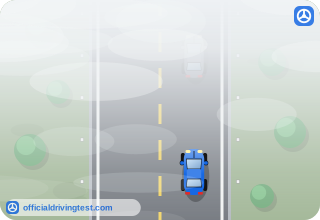
In the daytime, headlights must be turned on when visibility is reduced to how many feet or less by fog, rain, snow, smoke, or dust?
- 500 feet
- 1000 feet
- 200 feet
- 2000 feet
Show answer
Correct answer: 1000 feet
The lighting law requires daytime headlights when visibility is reduced to 1000 feet or less.
Source: Alaska Driver Manual (Revised October 2025), page 55 · Open this page in the manual (Manual page 55 · PDF 67)
-
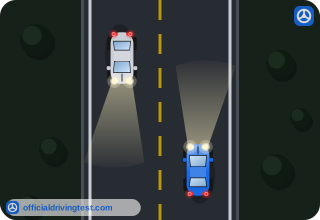
How far from an oncoming vehicle must you change your headlights to low beam (dim)?
- 100 feet
- 300 feet or more
- 1000 feet or more
- 500 feet or more
Show answer
Correct answer: 500 feet or more
The lighting law says to change to low beam 500 feet or more from an oncoming vehicle.
Source: Alaska Driver Manual (Revised October 2025), page 55 · Open this page in the manual (Manual page 55 · PDF 67)
-
How far from a vehicle going in the same direction must you change your headlights to low beam (dim)?
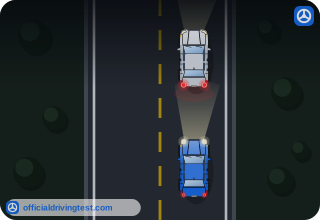
- 300 feet or more
- 500 feet or more
- 200 feet or more
- 100 feet or more
Show answer
Correct answer: 300 feet or more
The lighting law says to change to low beam 300 feet or more from a vehicle going in the same direction.
Source: Alaska Driver Manual (Revised October 2025), page 55 · Open this page in the manual (Manual page 55 · PDF 67)
-
What do parking lights denote?
- A vehicle that is slowing down
- A vehicle that is about to turn
- A parked vehicle
- A vehicle with a mechanical failure
Show answer
Correct answer: A parked vehicle
The lighting law says parking lights denote a parked vehicle.
Source: Alaska Driver Manual (Revised October 2025), page 55 · Open this page in the manual (Manual page 55 · PDF 67)
-
Which statement about using only parking lights is correct?
- They may be used alone at dusk if the road is well lit
- They must not be used alone while the vehicle is moving
- They may be used alone in fog if you drive slowly
- They may be used alone at night on roads with streetlights
Show answer
Correct answer: They must not be used alone while the vehicle is moving
The lighting law says not to use only parking lights, day or night, when the vehicle is in motion.
Source: Alaska Driver Manual (Revised October 2025), page 55 · Open this page in the manual (Manual page 55 · PDF 67)
-
As a safety suggestion, when should you turn on your headlights so the other driver sees you?
- Only after it is completely dark
- Only when other vehicles have their lights on
- Only when driving on a freeway
- At dusk and in daytime when visibility is poor
Show answer
Correct answer: At dusk and in daytime when visibility is poor
The manual suggests turning on headlights at dusk and in daytime when visibility is poor.
Source: Alaska Driver Manual (Revised October 2025), page 55 · Open this page in the manual (Manual page 55 · PDF 67)
-
Which headlight setting does the manual say to use when driving in rain, fog, snow, or dust?
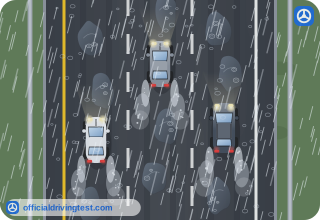
- Low beam (dim)
- High beam
- Parking lights only
- No lights during daytime
Show answer
Correct answer: Low beam (dim)
The manual suggests using low beam (dim) when driving in rain, fog, snow, or dust.
Source: Alaska Driver Manual (Revised October 2025), page 55 · Open this page in the manual (Manual page 55 · PDF 67)
-
What does the manual say is especially hazardous on a rainy night?
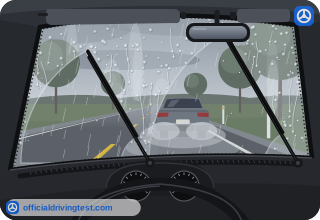
- Wipers that are set on a slow speed
- A windshield cleaned with washer fluid
- Headlights set on low beam
- Windshield wipers that streak and skip
Show answer
Correct answer: Windshield wipers that streak and skip
The manual says wipers that streak and skip are especially hazardous on a rainy night.
Source: Alaska Driver Manual (Revised October 2025), page 59 · Open this page in the manual (Manual page 59 · PDF 71)
-
What does the manual suggest rubbing on the windshield when it begins to rain to cut the oil film?
- A small amount of detergent
- A small amount of motor oil
- A small amount of gasoline
- A small amount of antifreeze
Show answer
Correct answer: A small amount of detergent
The manual suggests carrying a small bottle of detergent and rubbing a small amount on the windshield when it begins to rain.
Source: Alaska Driver Manual (Revised October 2025), page 59 · Open this page in the manual (Manual page 59 · PDF 71)
-
What does the manual say to ask a service station attendant to avoid using on your windshield?
- Washer fluid
- A squeegee
- An oily cloth
- A wet sponge
Show answer
Correct answer: An oily cloth
The manual says to request that the attendant refrain from using an oily cloth on the windshield.
Source: Alaska Driver Manual (Revised October 2025), page 59 · Open this page in the manual (Manual page 59 · PDF 71)
-
When does the manual say you should especially clean your lights often?
- After a sunny spell
- Only before a long trip
- After the first snowfall
- After a rainy spell
Show answer
Correct answer: After a rainy spell
The manual says to clean lights often, especially after a rainy spell.
Source: Alaska Driver Manual (Revised October 2025), page 59 · Open this page in the manual (Manual page 59 · PDF 71)
-
Why does the manual say to keep your fuel tank full in cold weather?
- To keep the engine from overheating on cold mornings
- To prevent moisture condensation in the fuel tank
- To give the tires extra weight for better grip on ice
- To prevent the fuel lines from cracking in freezing air
Show answer
Correct answer: To prevent moisture condensation in the fuel tank
The manual says to keep the fuel tank full in cold weather to prevent moisture condensation in the fuel tank.
Source: Alaska Driver Manual (Revised October 2025), page 59 · Open this page in the manual (Manual page 59 · PDF 71)
-
According to the required equipment list, which seating positions should have safety/seat belts?
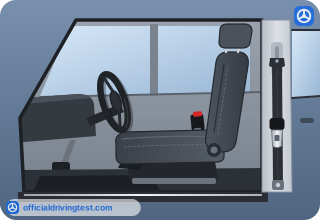
- The front seats only
- All seating positions
- The driver seat only
- Seats used by adults only
Show answer
Correct answer: All seating positions
The manual says all seating positions should have safety/seat belts.
Source: Alaska Driver Manual (Revised October 2025), page 68 · Open this page in the manual (Manual page 68)
-
How many headlights are required, and where?
- One in the center of the front
- At least four, two on each side
- Two, one on the front and one on the rear
- At least two, one on each side of the front
Show answer
Correct answer: At least two, one on each side of the front
The manual requires at least two headlights, one on each side on the front.
Source: Alaska Driver Manual (Revised October 2025), page 68 · Open this page in the manual (Manual page 68)
-
What is the required number and color of taillights?
- One red light on the rear
- At least two white lights on the rear
- Two amber lights on each side
- At least two red lights on the rear
Show answer
Correct answer: At least two red lights on the rear
The manual requires at least two red taillights on the rear, and both must be working.
Source: Alaska Driver Manual (Revised October 2025), page 68 · Open this page in the manual (Manual page 68)
-
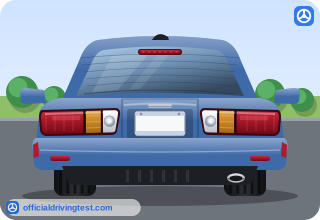
When must the required brake lights work?
- Whenever the engine is running
- Only when the foot brake is applied
- Whenever the headlights are on
- Only when the parking brake is set
Show answer
Correct answer: Only when the foot brake is applied
The manual says the two brake lights shall only work when the foot brake is applied.
Source: Alaska Driver Manual (Revised October 2025), page 68 · Open this page in the manual (Manual page 68)
-
A white light must illuminate the rear license plate so that numbers are visible for at least how far?
- 25 feet
- 100 feet
- 50 feet
- 200 feet
Show answer
Correct answer: 50 feet
The manual requires the license plate light to make numbers visible for at least 50 ft., if equipped.
Source: Alaska Driver Manual (Revised October 2025), page 68 · Open this page in the manual (Manual page 68)
-
What color must the light that illuminates the rear license plate be?
- White
- Red
- Amber
- Blue
Show answer
Correct answer: White
The manual says a white light must illuminate the rear license plate.
Source: Alaska Driver Manual (Revised October 2025), page 68 · Open this page in the manual (Manual page 68)
-
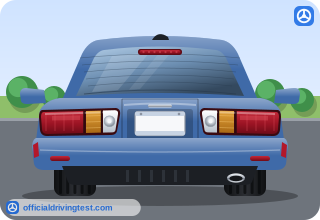
What does the manual say about turn signals?
- They are needed only on vehicles over a certain size
- All vehicles must have them and they must be in working order
- They are optional if you use hand signals
- Only the rear signals must work
Show answer
Correct answer: All vehicles must have them and they must be in working order
The manual says all vehicles must be equipped with directional signals in working order.
Source: Alaska Driver Manual (Revised October 2025), page 68 · Open this page in the manual (Manual page 68)
-
The foot brake must be adequate to stop a passenger vehicle within how many feet at 20 miles per hour?
- 15 feet
- 40 feet
- 60 feet
- 25 feet
Show answer
Correct answer: 25 feet
The manual says the foot brake must stop a passenger vehicle within 25 feet at a speed of 20 miles per hour.
Source: Alaska Driver Manual (Revised October 2025), page 68 · Open this page in the manual (Manual page 68)
-
What must the emergency or parking brake be able to do?
- Hold the vehicle stationary on any grade
- Stop the vehicle from any speed
- Work only on level ground or flat roads
- Slow the vehicle on icy roads only
Show answer
Correct answer: Hold the vehicle stationary on any grade
The manual says the emergency or parking brake must be adequate to hold the vehicle stationary on any grade.
Source: Alaska Driver Manual (Revised October 2025), page 68 · Open this page in the manual (Manual page 68)
-
What must a vehicle display on the rear, according to the required equipment list?
- Two plates, one on each side
- A single plate with year tab only
- A single plate with month and year tabs
- No plate if the front plate is displayed
Show answer
Correct answer: A single plate with month and year tabs
The manual requires a single license plate with month and year tabs displayed on the rear.
Source: Alaska Driver Manual (Revised October 2025), page 68 · Open this page in the manual (Manual page 68)
-
What does the manual say about window tinting?
- It may not exceed the percent allowed by law
- It is never allowed
- It is allowed on the windshield without limit
- It is allowed only on the rear window
Show answer
Correct answer: It may not exceed the percent allowed by law
The manual says tinting may not exceed the percent allowed by law.
Source: Alaska Driver Manual (Revised October 2025), page 68 · Open this page in the manual (Manual page 68)
-
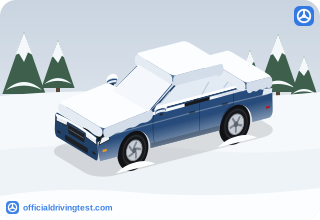
Which devices are required for cleaning rain, snow, etc., from the windshield?
- Mud flaps and fenders on each wheel
- A washer fluid tank with no wipers
- Windshield wipers and a defroster
- A snow brush and a frost scraper
Show answer
Correct answer: Windshield wipers and a defroster
The manual requires windshield wipers and a defroster.
Source: Alaska Driver Manual (Revised October 2025), page 68 · Open this page in the manual (Manual page 68)
-
What kind of glass must all original and replacement glass be?
- Tempered tinted glass
- Safety glass
- Laminated plastic only
- Any clear glass
Show answer
Correct answer: Safety glass
The manual says all original and replacement glass must be safety glass.
Source: Alaska Driver Manual (Revised October 2025), page 68 · Open this page in the manual (Manual page 68)
-
A vehicle’s horn must be capable of emitting a sound audible under normal conditions from not less than how far?
- 100 feet
- 300 feet
- 500 feet
- 200 feet
Show answer
Correct answer: 200 feet
The manual says the horn must be audible from not less than 200 feet under normal conditions.
Source: Alaska Driver Manual (Revised October 2025), page 68 · Open this page in the manual (Manual page 68)
-
What does the manual say about devices that make an unusually loud sound or whistle?
- They are allowed on trucks
- They are allowed in an emergency only
- They are allowed if the horn also works
- No device shall emit one
Show answer
Correct answer: No device shall emit one
The manual says no device shall emit an unusually loud sound or whistle.
Source: Alaska Driver Manual (Revised October 2025), page 68 · Open this page in the manual (Manual page 68)
-
Which mirrors does the manual require on a vehicle?
- A right side mirror and no other mirrors
- A left side mirror and an inside or right one
- A left side mirror and no other mirrors
- An inside mirror and no outside mirror
Show answer
Correct answer: A left side mirror and an inside or right one
The manual requires a left side mirror and an inside or right mirror.
Source: Alaska Driver Manual (Revised October 2025), page 68 · Open this page in the manual (Manual page 68)
-
Which vehicles are required to have mirrors on both the left and right side?
- Passenger cars with automatic transmissions
- Vehicles that have no trunk or cargo area
- Buses and vehicles with an obstructed rear view
- Vehicles with tinted side windows only
Show answer
Correct answer: Buses and vehicles with an obstructed rear view
The manual requires left and right mirrors on buses and on vehicles whose view through the rear window is obstructed.
Source: Alaska Driver Manual (Revised October 2025), page 68 · Open this page in the manual (Manual page 68)
-
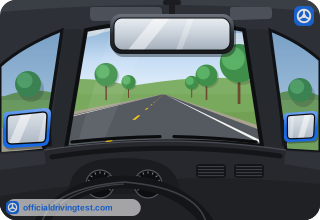
How must mirrors be adjusted?
- To give a view to the rear of the vehicle
- To show only the sides of the vehicle
- To face the road directly ahead of you
- To cut down glare from the sun only
Show answer
Correct answer: To give a view to the rear of the vehicle
The manual says mirrors must be adjusted to afford the driver a view to the rear of the vehicle.
Source: Alaska Driver Manual (Revised October 2025), page 68 · Open this page in the manual (Manual page 68)
-
What is the purpose of anti-spray devices such as mud flaps or fenders?
- To keep snow off the headlights
- To reduce wheel spray to the rear
- To stop the doors from freezing
- To protect the muffler from rust
Show answer
Correct answer: To reduce wheel spray to the rear
The manual says the vehicle design or accessories must effectively reduce wheel spray to the rear.
Source: Alaska Driver Manual (Revised October 2025), page 68 · Open this page in the manual (Manual page 68)
-
How should lights that are illuminated while the vehicle is on the roadway be labeled?
- They should be labeled “for off-road use only”
- They should be labeled with the maker’s name
- They should be labeled with their wattage
- They should not be labeled “for off-road use only”
Show answer
Correct answer: They should not be labeled “for off-road use only”
The manual notes that no lights illuminated on the roadway should be labeled “for off-road use only”.
Source: Alaska Driver Manual (Revised October 2025), page 68 · Open this page in the manual (Manual page 68)
-
When may audible signal devices such as the horn be used?
- Only when necessary for safe operation
- Whenever you want to greet a friend
- Whenever you want to hurry slow drivers
- Any time during the daytime hours
Show answer
Correct answer: Only when necessary for safe operation
The manual says audible signal devices may not be used unless necessary to assure safe operation.
Source: Alaska Driver Manual (Revised October 2025), page 69 · Open this page in the manual (Manual page 69)
-
What must every motor vehicle be equipped with to prevent excessive or unusual noise?
- A noise filter placed on the horn button
- A muffler that the driver can switch off
- A muffler in good working order, always in use
- Sound-proof windows on all four sides
Show answer
Correct answer: A muffler in good working order, always in use
The manual requires a muffler in good working order and in constant operation.
Source: Alaska Driver Manual (Revised October 2025), page 69 · Open this page in the manual (Manual page 69)
-
What may no person use upon a motor vehicle on a highway?
- A muffler cutout, bypass, or similar device
- A muffler of any kind at all, ever
- A horn of any kind at all, ever
- A spare tire mounted on the rear door
Show answer
Correct answer: A muffler cutout, bypass, or similar device
The manual says no person may use a muffler cutout, bypass, or similar device on a highway.
Source: Alaska Driver Manual (Revised October 2025), page 69 · Open this page in the manual (Manual page 69)
-
In the summer, when does the manual say to avoid driving because cooler, denser air can boost power and mileage?
- During the early morning
- After dark
- During the coolest part of the evening
- During the hottest parts of the day
Show answer
Correct answer: During the hottest parts of the day
The manual says to avoid driving during the hottest parts of the day in the summer, since cooler, denser air can boost power and mileage.
Source: Alaska Driver Manual (Revised October 2025), page 73 · Open this page in the manual (Manual page 73)
-
The manual advises using your car's air conditioner instead of open windows when driving faster than what speed?
- 40 mph
- 20 mph
- 30 mph
- 55 mph
Show answer
Correct answer: 40 mph
It says to use the air conditioner when driving more than 40 mph, because it creates less drag on the engine than open windows.
Source: Alaska Driver Manual (Revised October 2025), page 73 · Open this page in the manual (Manual page 73)
-
How does the manual say to warm up a modern engine?
- By idling it in neutral for several minutes
- By driving the vehicle
- By revving the engine while parked
- By running the heater at full power while parked
Show answer
Correct answer: By driving the vehicle
The manual says today's engines run most efficiently when warmed up, so you should warm up the vehicle by driving it.
Source: Alaska Driver Manual (Revised October 2025), page 73 · Open this page in the manual (Manual page 73)
-
What does the manual say to do if your vehicle's onboard diagnostics (OBD) light comes on?
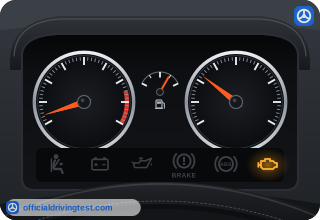
- Talk with your auto dealer for more information
- Keep driving until the light turns off by itself
- Disconnect the battery to reset it
- Ignore it unless the engine stalls
Show answer
Correct answer: Talk with your auto dealer for more information
The manual says that if the OBD light comes on, you should talk with your auto dealer for more information.
Source: Alaska Driver Manual (Revised October 2025), page 73 · Open this page in the manual (Manual page 73)
-
Which habit does the manual say you should NOT do, also called riding your brakes?
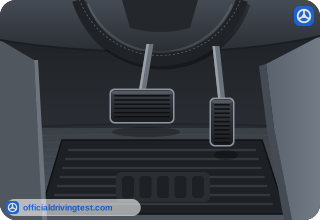
- Letting your foot rest on the brake pedal
- Pressing the brake firmly when you need to stop
- Slowing down before a curve
- Keeping extra distance from the vehicle ahead
Show answer
Correct answer: Letting your foot rest on the brake pedal
The manual says not to let your foot rest on the brake pedal, which is also called riding your brakes.
Source: Alaska Driver Manual (Revised October 2025), page 74 · Open this page in the manual (Manual page 74)
-
What does the manual say about pumping the brakes if your vehicle has antilock brakes?
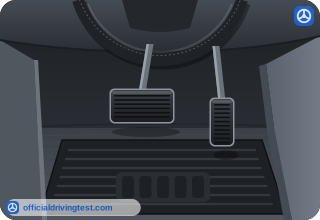
- Pump them rapidly whenever you brake
- Pump them when you need to stop quickly
- Never pump them
- Pump them once before every stop
Show answer
Correct answer: Never pump them
The manual says to never pump the brakes if your vehicle has antilock brakes.
Source: Alaska Driver Manual (Revised October 2025), page 74 · Open this page in the manual (Manual page 74)
-
According to the manual, what does an "ECO" setting on a vehicle do?
- Smooths out gas pedal inputs and optimizes transmission shift points
- Holds the engine at a higher idle speed to warm up faster
- Increases the impact of the air conditioner on the engine
- Switches the transmission to manual shifting only
Show answer
Correct answer: Smooths out gas pedal inputs and optimizes transmission shift points
The manual says an ECO setting smooths out your gas pedal inputs, optimizes transmission shift points, and decreases the impact of air conditioners on the engine.
Source: Alaska Driver Manual (Revised October 2025), page 74 · Open this page in the manual (Manual page 74)
-
What does the manual say about idling?
- It saves fuel in cold weather
- It is required before every drive
- It wastes fuel and may be prohibited
- It is always allowed
Show answer
Correct answer: It wastes fuel and may be prohibited
The manual says idling wastes fuel and may be prohibited.
Source: Alaska Driver Manual (Revised October 2025), page 74 · Open this page in the manual (Manual page 74)
-
If you need to idle, what does the manual say to do?
- Shift to park and press the gas lightly
- Shift to neutral
- Keep the vehicle in drive with your foot on the brake
- Turn on the air conditioner
Show answer
Correct answer: Shift to neutral
The manual says to shift to neutral so the engine is not working against your brake and consuming more fuel.
Source: Alaska Driver Manual (Revised October 2025), page 74 · Open this page in the manual (Manual page 74)
-
As a rule of thumb, the manual says to turn off your car for stops anticipated to be longer than how long?
- 5-10 seconds
- 2-3 minutes
- 10-15 minutes
- 30-60 seconds
Show answer
Correct answer: 30-60 seconds
The manual gives a rule of thumb of turning off your car for stops anticipated to be longer than 30-60 seconds.
Source: Alaska Driver Manual (Revised October 2025), page 74 · Open this page in the manual (Manual page 74)
-
When you need to make multiple stops, where does the manual say to go first to warm up your engine more quickly?
- Your farthest destination
- Your closest destination
- The busiest stop
- The stop with the most parking
Show answer
Correct answer: Your farthest destination
The manual says to go to your farthest destination first to warm up your engine more quickly for better fuel economy.
Source: Alaska Driver Manual (Revised October 2025), page 75 · Open this page in the manual (Manual page 75)
-
According to the manual, what do loose, damaged, or missing fuel tank caps cause?
- Tires to wear faster
- The engine to overheat
- Fuel to evaporate
- The oil to degrade
Show answer
Correct answer: Fuel to evaporate
The manual says loose, damaged, or missing fuel tank caps cause fuel to evaporate, so you should make sure the cap is tight.
Source: Alaska Driver Manual (Revised October 2025), page 75 · Open this page in the manual (Manual page 75)
-
What is the minimum tread depth the manual says tires must have?
- 1/32 inch
- 4/32 inch
- 6/32 inch
- 2/32 inch
Show answer
Correct answer: 2/32 inch
The manual says tires must have at least 2/32 inches of tread depth.
Source: Alaska Driver Manual (Revised October 2025), page 75 · Open this page in the manual (Manual page 75)
-
With the penny test, if you slide a penny into a tread groove and can see the top of Lincoln's head, what does it mean?
- Your tires are worn out
- Your tires are properly inflated
- Your tires need to be rotated
- Your tires have plenty of tread left
Show answer
Correct answer: Your tires are worn out
The manual says that if you can see the top of Lincoln's head, your tires are worn out.
Source: Alaska Driver Manual (Revised October 2025), page 75 · Open this page in the manual (Manual page 75)
-
Why does the manual say to remove unneeded items from the trunk and avoid using the roof rack?
- Roof racks and heavy trunks cause the tires to wear unevenly
- Added weight and air resistance cause more fuel to burn
- Extra items in the trunk can block your view to the rear
- A loaded trunk causes the brakes to overheat on long drives
Show answer
Correct answer: Added weight and air resistance cause more fuel to burn
The manual says added weight and air resistance will cause more fuel to burn.
Source: Alaska Driver Manual (Revised October 2025), page 75 · Open this page in the manual (Manual page 75)
-
Which items does the manual say to remove when not in use, because wind resistance can reduce mileage?
- Floor mats, seat covers, and the spare tire
- Side mirrors and windshield wipers
- Tow hooks, mud flaps, and bumper guards
- Luggage racks, roof-top carriers, and ski racks
Show answer
Correct answer: Luggage racks, roof-top carriers, and ski racks
The manual says wind resistance can reduce mileage, so luggage racks, roof-top carriers, and ski racks should be removed when not being used.
Source: Alaska Driver Manual (Revised October 2025), page 75 · Open this page in the manual (Manual page 75)
-
Which motor oil does the manual say to use in your vehicle?
- The type recommended in your vehicle's owner's manual
- The thickest grade of oil available at the store
- Whatever oil is cheapest at the auto shop
- Any oil, as long as you change it every year
Show answer
Correct answer: The type recommended in your vehicle's owner's manual
The manual says to use the type of motor oil recommended in your vehicle's owner's manual, which can improve fuel economy.
Source: Alaska Driver Manual (Revised October 2025), page 75 · Open this page in the manual (Manual page 75)
-
How clean does the manual say to keep the air filter?
- Replaced only when it is completely black
- Clean enough that no dust is visible on the outside
- Washed with water every time you refuel
- Clean to the point where light can be seen through it
Show answer
Correct answer: Clean to the point where light can be seen through it
The manual says to keep the air filter clean to the point where light can be seen through it.
Source: Alaska Driver Manual (Revised October 2025), page 75 · Open this page in the manual (Manual page 75)
-
According to the manual's Maintenance Safety Tips, how often should you check your tire tread and tire pressure?
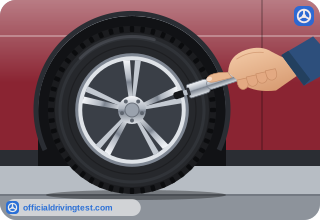
- At least once a year
- At least once every six months
- At least once every two years
- At least once a month
Show answer
Correct answer: At least once a month
The manual lists checking your tire tread and tire pressure among the things to do at least once a month.
Source: Alaska Driver Manual (Revised October 2025), page 77 · Open this page in the manual (Manual page 77)
-
When checking tire tread with a penny, how does the manual say to place the coin?
- Lincoln's head first into the deepest-looking groove
- Lincoln's head first into the shallowest groove
- Edge first across the full width of the tire
- Lincoln's head facing up on top of the tread
Show answer
Correct answer: Lincoln's head first into the deepest-looking groove
The manual says to place Lincoln's head first into the deepest-looking groove.
Source: Alaska Driver Manual (Revised October 2025), page 77 · Open this page in the manual (Manual page 77)
-
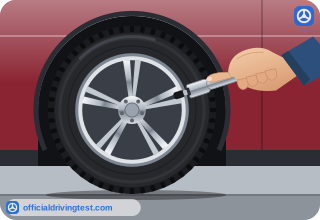
When should you check your tire pressure with a gauge?
- When the tires are hot from driving
- Right after a long highway drive
- When the tires are cold
- Only when the tires are warm
Show answer
Correct answer: When the tires are cold
The manual says to make sure you check the pressure when the tires are cold.
Source: Alaska Driver Manual (Revised October 2025), page 77 · Open this page in the manual (Manual page 77)
-
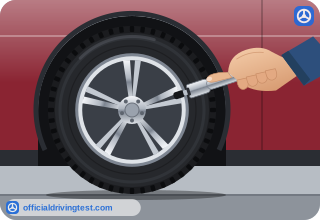
Where does the manual say to look for the sticker showing the tire pressure "PSI" number?
- On the inside of the glove box door
- On the inside jamb of the car door
- Under the hood near the radiator
- On the sidewall of the spare tire
Show answer
Correct answer: On the inside jamb of the car door
The manual says to open your car door and look on the inside jamb for a sticker with the PSI number.
Source: Alaska Driver Manual (Revised October 2025), page 77 · Open this page in the manual (Manual page 77)
-
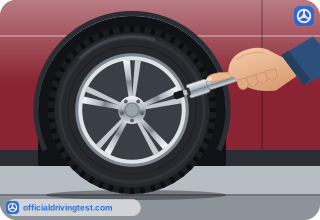
When checking tire pressure, if the gauge reading is above the number on the sticker, what should you do?
- Add more air
- Replace the tire
- Drive 10 miles and check again
- Let air out
Show answer
Correct answer: Let air out
The manual says to compare the gauge number to the sticker number and, if above, let air out.
Source: Alaska Driver Manual (Revised October 2025), page 77 · Open this page in the manual (Manual page 77)
-
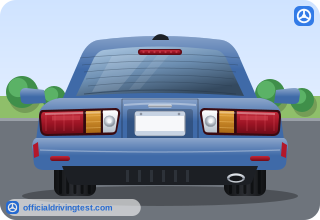
When your friend checks your brake lights and does not see both lights, what does the manual say to do?
- Replace the bulb or fuse
- Replace the brake pedal
- Add brake fluid
- Turn on your hazard lights
Show answer
Correct answer: Replace the bulb or fuse
The manual says that if your friend does not see both lights, you should replace the bulb or fuse.
Source: Alaska Driver Manual (Revised October 2025), page 77 · Open this page in the manual (Manual page 77)
-
How often does the manual say to replace windshield wiper blades if you live in a dusty or dry region?
- Once a year
- Once every two years
- Twice a year
- Once every month
Show answer
Correct answer: Twice a year
The manual says to replace wiper blades twice a year if you live in a dusty or dry region.
Source: Alaska Driver Manual (Revised October 2025), page 77 · Open this page in the manual (Manual page 77)
-
How often does the manual say to replace windshield wiper blades at the least if you live in a sunny/hot or cold region?
- Twice a year
- Yearly
- Every month
- Every three years
Show answer
Correct answer: Yearly
The manual says to replace wiper blades at least yearly if you live in a sunny/hot or cold region.
Source: Alaska Driver Manual (Revised October 2025), page 77 · Open this page in the manual (Manual page 77)
-
How does the manual say to clean wiper blades periodically?
- With a wire brush or sandpaper
- With gasoline on a cloth
- With motor oil on a sponge
- With a rag or alcohol wipe
Show answer
Correct answer: With a rag or alcohol wipe
The manual says to clean wiper blades periodically with a rag or alcohol wipe to maintain their performance.
Source: Alaska Driver Manual (Revised October 2025), page 77 · Open this page in the manual (Manual page 77)
-
When checking oil with the dipstick, what should you do if the film of oil does not reach the markings?
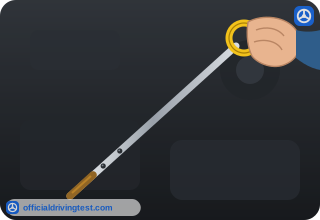
- Add more oil
- Replace the dipstick
- Drain the oil and start over
- Wait for the engine to cool and keep driving
Show answer
Correct answer: Add more oil
The manual says that if the film of oil does not reach the markings, you should add more oil.
Source: Alaska Driver Manual (Revised October 2025), page 78 · Open this page in the manual (Manual page 78)
-
After wiping down the oil dipstick, what does the manual say to do before pulling it out again?
- Hold it over the engine for one minute to air-dry
- Turn it a full turn in the tube before pulling it out
- Put it back, pushing it in as far as it will go
- Start the engine for ten seconds
Show answer
Correct answer: Put it back, pushing it in as far as it will go
The manual says to put the dipstick back and push it in as far as it will go, then pull it out again to read it.
Source: Alaska Driver Manual (Revised October 2025), page 78 · Open this page in the manual (Manual page 78)
-
Where is the coolant tank usually found, according to the manual?
- Beside the fuel tank cap
- Next to the radiator
- Behind the air filter housing
- Next to the battery
Show answer
Correct answer: Next to the radiator
The manual says to find the coolant tank, which is usually next to the radiator.
Source: Alaska Driver Manual (Revised October 2025), page 78 · Open this page in the manual (Manual page 78)
-
If the coolant does not reach the 'minimum' fill line, what does the manual say to fill it with?
- Plain water only
- Motor oil
- Windshield washer fluid
- A coolant/water solution
Show answer
Correct answer: A coolant/water solution
The manual says to fill it with a coolant/water solution, using the ratio given in your car's driver manual.
Source: Alaska Driver Manual (Revised October 2025), page 78 · Open this page in the manual (Manual page 78)
-
What does the manual's warning say about the radiator cap on a hot car?
- Never open it; wait until the car has cooled down
- Open it slowly to release the pressure
- Open it only after adding coolant
- Open it with a rag over the top to avoid burns
Show answer
Correct answer: Never open it; wait until the car has cooled down
The warning says never to open the radiator cap on a hot car and to wait until the car has cooled down first.
Source: Alaska Driver Manual (Revised October 2025), page 78 · Open this page in the manual (Manual page 78)