Alaska: Signals and vehicle controls — Part 5 Practice Test
Questions in this part include: “With the penny test, if you slide a penny into a tread groove and can see the top of Lincoln's head, what does it mean?” · “How often does the manual say to replace windshield wiper blades if you live in a dusty or dry region?”
Independent educational site · not affiliated with any government agency or DMV
Ready? Test yourself
- Instant feedback with an explanation
- Every answer cites its source in the manual
- Your best score is saved on this device
Questions are original and based on the official manual "Alaska Driver Manual" (Revised October 2025), Alaska Department of Administration, Division of Motor Vehicles (DMV).
All 19 questions in this practice test
Take the test above first, then use this list to study. Tap “Show answer” to see the correct answer and explanation.
Show the questions and answersHide the questions
-
With the penny test, if you slide a penny into a tread groove and can see the top of Lincoln's head, what does it mean?
- Your tires are worn out
- Your tires are properly inflated
- Your tires need to be rotated
- Your tires have plenty of tread left
Show answer
Correct answer: Your tires are worn out
The manual says that if you can see the top of Lincoln's head, your tires are worn out.
Source: Alaska Driver Manual (Revised October 2025), page 75 · Open this page in the manual (Manual page 75)
-
Why does the manual say to remove unneeded items from the trunk and avoid using the roof rack?
- Roof racks and heavy trunks cause the tires to wear unevenly
- Added weight and air resistance cause more fuel to burn
- Extra items in the trunk can block your view to the rear
- A loaded trunk causes the brakes to overheat on long drives
Show answer
Correct answer: Added weight and air resistance cause more fuel to burn
The manual says added weight and air resistance will cause more fuel to burn.
Source: Alaska Driver Manual (Revised October 2025), page 75 · Open this page in the manual (Manual page 75)
-
Which items does the manual say to remove when not in use, because wind resistance can reduce mileage?
- Floor mats, seat covers, and the spare tire
- Side mirrors and windshield wipers
- Tow hooks, mud flaps, and bumper guards
- Luggage racks, roof-top carriers, and ski racks
Show answer
Correct answer: Luggage racks, roof-top carriers, and ski racks
The manual says wind resistance can reduce mileage, so luggage racks, roof-top carriers, and ski racks should be removed when not being used.
Source: Alaska Driver Manual (Revised October 2025), page 75 · Open this page in the manual (Manual page 75)
-
Which motor oil does the manual say to use in your vehicle?
- The type recommended in your vehicle's owner's manual
- The thickest grade of oil available at the store
- Whatever oil is cheapest at the auto shop
- Any oil, as long as you change it every year
Show answer
Correct answer: The type recommended in your vehicle's owner's manual
The manual says to use the type of motor oil recommended in your vehicle's owner's manual, which can improve fuel economy.
Source: Alaska Driver Manual (Revised October 2025), page 75 · Open this page in the manual (Manual page 75)
-
How clean does the manual say to keep the air filter?
- Replaced only when it is completely black
- Clean enough that no dust is visible on the outside
- Washed with water every time you refuel
- Clean to the point where light can be seen through it
Show answer
Correct answer: Clean to the point where light can be seen through it
The manual says to keep the air filter clean to the point where light can be seen through it.
Source: Alaska Driver Manual (Revised October 2025), page 75 · Open this page in the manual (Manual page 75)
-
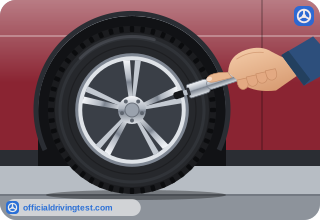
According to the manual's Maintenance Safety Tips, how often should you check your tire tread and tire pressure?
- At least once a year
- At least once every six months
- At least once every two years
- At least once a month
Show answer
Correct answer: At least once a month
The manual lists checking your tire tread and tire pressure among the things to do at least once a month.
Source: Alaska Driver Manual (Revised October 2025), page 77 · Open this page in the manual (Manual page 77)
-
When checking tire tread with a penny, how does the manual say to place the coin?
- Lincoln's head first into the deepest-looking groove
- Lincoln's head first into the shallowest groove
- Edge first across the full width of the tire
- Lincoln's head facing up on top of the tread
Show answer
Correct answer: Lincoln's head first into the deepest-looking groove
The manual says to place Lincoln's head first into the deepest-looking groove.
Source: Alaska Driver Manual (Revised October 2025), page 77 · Open this page in the manual (Manual page 77)
-
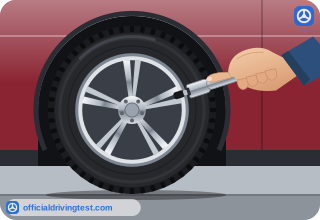
When should you check your tire pressure with a gauge?
- When the tires are hot from driving
- Right after a long highway drive
- When the tires are cold
- Only when the tires are warm
Show answer
Correct answer: When the tires are cold
The manual says to make sure you check the pressure when the tires are cold.
Source: Alaska Driver Manual (Revised October 2025), page 77 · Open this page in the manual (Manual page 77)
-
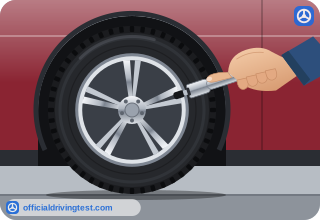
Where does the manual say to look for the sticker showing the tire pressure "PSI" number?
- On the inside of the glove box door
- On the inside jamb of the car door
- Under the hood near the radiator
- On the sidewall of the spare tire
Show answer
Correct answer: On the inside jamb of the car door
The manual says to open your car door and look on the inside jamb for a sticker with the PSI number.
Source: Alaska Driver Manual (Revised October 2025), page 77 · Open this page in the manual (Manual page 77)
-
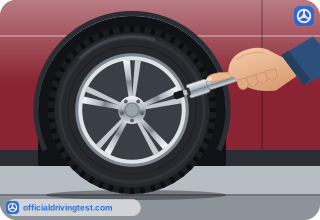
When checking tire pressure, if the gauge reading is above the number on the sticker, what should you do?
- Add more air
- Replace the tire
- Drive 10 miles and check again
- Let air out
Show answer
Correct answer: Let air out
The manual says to compare the gauge number to the sticker number and, if above, let air out.
Source: Alaska Driver Manual (Revised October 2025), page 77 · Open this page in the manual (Manual page 77)
-
When your friend checks your brake lights and does not see both lights, what does the manual say to do?
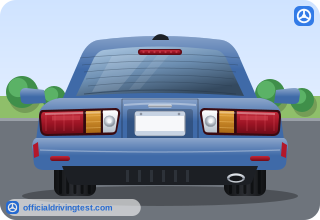
- Replace the bulb or fuse
- Replace the brake pedal
- Add brake fluid
- Turn on your hazard lights
Show answer
Correct answer: Replace the bulb or fuse
The manual says that if your friend does not see both lights, you should replace the bulb or fuse.
Source: Alaska Driver Manual (Revised October 2025), page 77 · Open this page in the manual (Manual page 77)
-
How often does the manual say to replace windshield wiper blades if you live in a dusty or dry region?
- Once a year
- Once every two years
- Twice a year
- Once every month
Show answer
Correct answer: Twice a year
The manual says to replace wiper blades twice a year if you live in a dusty or dry region.
Source: Alaska Driver Manual (Revised October 2025), page 77 · Open this page in the manual (Manual page 77)
-
How often does the manual say to replace windshield wiper blades at the least if you live in a sunny/hot or cold region?
- Twice a year
- Yearly
- Every month
- Every three years
Show answer
Correct answer: Yearly
The manual says to replace wiper blades at least yearly if you live in a sunny/hot or cold region.
Source: Alaska Driver Manual (Revised October 2025), page 77 · Open this page in the manual (Manual page 77)
-
How does the manual say to clean wiper blades periodically?
- With a wire brush or sandpaper
- With gasoline on a cloth
- With motor oil on a sponge
- With a rag or alcohol wipe
Show answer
Correct answer: With a rag or alcohol wipe
The manual says to clean wiper blades periodically with a rag or alcohol wipe to maintain their performance.
Source: Alaska Driver Manual (Revised October 2025), page 77 · Open this page in the manual (Manual page 77)
-
When checking oil with the dipstick, what should you do if the film of oil does not reach the markings?
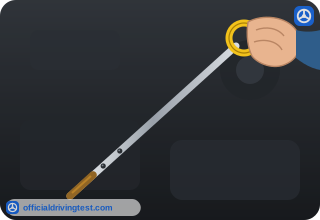
- Add more oil
- Replace the dipstick
- Drain the oil and start over
- Wait for the engine to cool and keep driving
Show answer
Correct answer: Add more oil
The manual says that if the film of oil does not reach the markings, you should add more oil.
Source: Alaska Driver Manual (Revised October 2025), page 78 · Open this page in the manual (Manual page 78)
-
After wiping down the oil dipstick, what does the manual say to do before pulling it out again?
- Hold it over the engine for one minute to air-dry
- Turn it a full turn in the tube before pulling it out
- Put it back, pushing it in as far as it will go
- Start the engine for ten seconds
Show answer
Correct answer: Put it back, pushing it in as far as it will go
The manual says to put the dipstick back and push it in as far as it will go, then pull it out again to read it.
Source: Alaska Driver Manual (Revised October 2025), page 78 · Open this page in the manual (Manual page 78)
-
Where is the coolant tank usually found, according to the manual?
- Beside the fuel tank cap
- Next to the radiator
- Behind the air filter housing
- Next to the battery
Show answer
Correct answer: Next to the radiator
The manual says to find the coolant tank, which is usually next to the radiator.
Source: Alaska Driver Manual (Revised October 2025), page 78 · Open this page in the manual (Manual page 78)
-
If the coolant does not reach the 'minimum' fill line, what does the manual say to fill it with?
- Plain water only
- Motor oil
- Windshield washer fluid
- A coolant/water solution
Show answer
Correct answer: A coolant/water solution
The manual says to fill it with a coolant/water solution, using the ratio given in your car's driver manual.
Source: Alaska Driver Manual (Revised October 2025), page 78 · Open this page in the manual (Manual page 78)
-
What does the manual's warning say about the radiator cap on a hot car?
- Never open it; wait until the car has cooled down
- Open it slowly to release the pressure
- Open it only after adding coolant
- Open it with a rag over the top to avoid burns
Show answer
Correct answer: Never open it; wait until the car has cooled down
The warning says never to open the radiator cap on a hot car and to wait until the car has cooled down first.
Source: Alaska Driver Manual (Revised October 2025), page 78 · Open this page in the manual (Manual page 78)