Alaska: Signals and vehicle controls — Part 2 Practice Test
Questions in this part include: “Which statement about glare recovery time is made in the manual?” · “Why must lights marked or intended for off-road use only not be used while traveling on the roadway?”
Independent educational site · not affiliated with any government agency or DMV
Ready? Test yourself
- Instant feedback with an explanation
- Every answer cites its source in the manual
- Your best score is saved on this device
Questions are original and based on the official manual "Alaska Driver Manual" (Revised October 2025), Alaska Department of Administration, Division of Motor Vehicles (DMV).
All 20 questions in this practice test
Take the test above first, then use this list to study. Tap “Show answer” to see the correct answer and explanation.
Show the questions and answersHide the questions
-
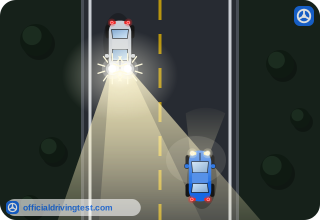
What does the glare from the headlights of oncoming vehicles cause the pupil of the eye to do?
- Dilate
- Contract
- Stay the same size
- Close completely
Show answer
Correct answer: Contract
The manual says glare from oncoming headlights causes the pupil of the eye to contract.
Source: Alaska Driver Manual (Revised October 2025), page 54 · Open this page in the manual (Manual page 54 · PDF 66)
-
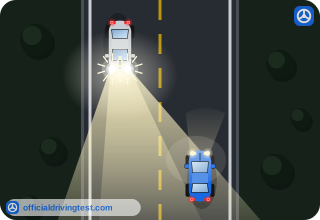
After an oncoming vehicle has passed, what is the interval of time the pupil needs to readjust to the less intense light called?
- Night adjustment period
- Visual acuity time
- Pupil reaction delay
- Glare recovery time
Show answer
Correct answer: Glare recovery time
The manual calls the time the pupil takes to readjust to less intense light glare recovery time.
Source: Alaska Driver Manual (Revised October 2025), page 54 · Open this page in the manual (Manual page 54 · PDF 66)
-
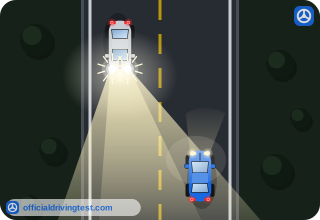
How does the manual describe your condition during the glare recovery period?
- Virtually driving blind
- Driving with sharper night vision
- Driving with a slight delay in reaction only
- Driving with normal vision but tired eyes
Show answer
Correct answer: Virtually driving blind
The manual says that during the recovery period you are virtually driving blind.
Source: Alaska Driver Manual (Revised October 2025), page 54 · Open this page in the manual (Manual page 54 · PDF 66)
-
Which statement about glare recovery time is made in the manual?
- It is based on visual acuity and is the same for everyone
- It is the same for all drivers regardless of age
- It is not based on visual acuity and varies from person to person
- It lasts only a fraction of a second for every driver
Show answer
Correct answer: It is not based on visual acuity and varies from person to person
The manual says glare recovery time is not based on visual acuity and varies from person to person.
Source: Alaska Driver Manual (Revised October 2025), page 54 · Open this page in the manual (Manual page 54 · PDF 66)
-
Where does the manual say you can check the high and low beams of your headlights?
- On the side of another parked vehicle
- Against a road sign at night
- On a mirror in your driveway
- On a garage wall
Show answer
Correct answer: On a garage wall
The night driving safety tips say to check the high and low beam on a garage wall.
Source: Alaska Driver Manual (Revised October 2025), page 54 · Open this page in the manual (Manual page 54 · PDF 66)
-
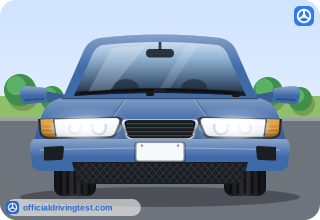
Which of these is a night driving safety tip in the manual?
- Be sure headlights are in working order and lenses are clean
- Use your high beams whenever you follow another vehicle closely
- Tint the windshield as dark as possible
- Look straight at oncoming headlights to judge distance
Show answer
Correct answer: Be sure headlights are in working order and lenses are clean
The manual tells night drivers to make sure headlights work and the lenses are clean.
Source: Alaska Driver Manual (Revised October 2025), page 54 · Open this page in the manual (Manual page 54 · PDF 66)
-
Why does the manual recommend wearing sunglasses in bright sunlight?
- To reduce the glare of oncoming headlights at night
- To protect night seeing ability
- To keep the windshield from fogging
- To make traffic signals easier to recognize
Show answer
Correct answer: To protect night seeing ability
The manual says to wear sunglasses in bright sunlight to protect night seeing ability.
Source: Alaska Driver Manual (Revised October 2025), page 54 · Open this page in the manual (Manual page 54 · PDF 66)
-
When does the manual say you should not wear sunglasses?
- In bright sunlight
- While driving in fog
- On a freeway
- In the dark
Show answer
Correct answer: In the dark
The manual says not to wear sunglasses in the dark.
Source: Alaska Driver Manual (Revised October 2025), page 54 · Open this page in the manual (Manual page 54 · PDF 66)
-
How do tinted windshields and front windows affect driving, according to the manual?
- They affect night vision and increase crash risk
- They reduce glare and make night driving safer
- They have no effect on night vision
- They improve night vision but reduce daytime vision
Show answer
Correct answer: They affect night vision and increase crash risk
The manual says tinted windshields and front windows affect night vision and increase crash risk.
Source: Alaska Driver Manual (Revised October 2025), page 54 · Open this page in the manual (Manual page 54 · PDF 66)
-
Why must lights marked or intended for off-road use only not be used while traveling on the roadway?
- They use too much electricity and drain the battery
- They are too dim to be seen by other drivers
- They could worsen the effects of glare for other road users
- They shine only to the side of the vehicle
Show answer
Correct answer: They could worsen the effects of glare for other road users
The manual says using off-road lights on the roadway could worsen the effects of glare for other road users.
Source: Alaska Driver Manual (Revised October 2025), page 54 · Open this page in the manual (Manual page 54 · PDF 66)
-
Under the lighting law, when must headlights be turned on?
- From sunset to sunrise
- From 1 hour after sunset to 1 hour before sunrise
- From 1/2 hour after sunset to 1/2 hour before sunrise
- From 1/2 hour before sunset to 1/2 hour after sunrise
Show answer
Correct answer: From 1/2 hour after sunset to 1/2 hour before sunrise
The lighting law requires headlights from 1/2 hour after sunset to 1/2 hour before sunrise.
Source: Alaska Driver Manual (Revised October 2025), page 55 · Open this page in the manual (Manual page 55 · PDF 67)
-
In the daytime, headlights must be turned on when visibility is reduced to how many feet or less by fog, rain, snow, smoke, or dust?

- 500 feet
- 1000 feet
- 200 feet
- 2000 feet
Show answer
Correct answer: 1000 feet
The lighting law requires daytime headlights when visibility is reduced to 1000 feet or less.
Source: Alaska Driver Manual (Revised October 2025), page 55 · Open this page in the manual (Manual page 55 · PDF 67)
-
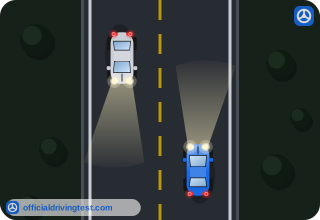
How far from an oncoming vehicle must you change your headlights to low beam (dim)?
- 100 feet
- 300 feet or more
- 1000 feet or more
- 500 feet or more
Show answer
Correct answer: 500 feet or more
The lighting law says to change to low beam 500 feet or more from an oncoming vehicle.
Source: Alaska Driver Manual (Revised October 2025), page 55 · Open this page in the manual (Manual page 55 · PDF 67)
-
How far from a vehicle going in the same direction must you change your headlights to low beam (dim)?
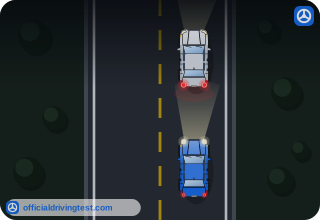
- 300 feet or more
- 500 feet or more
- 200 feet or more
- 100 feet or more
Show answer
Correct answer: 300 feet or more
The lighting law says to change to low beam 300 feet or more from a vehicle going in the same direction.
Source: Alaska Driver Manual (Revised October 2025), page 55 · Open this page in the manual (Manual page 55 · PDF 67)
-
What do parking lights denote?
- A vehicle that is slowing down
- A vehicle that is about to turn
- A parked vehicle
- A vehicle with a mechanical failure
Show answer
Correct answer: A parked vehicle
The lighting law says parking lights denote a parked vehicle.
Source: Alaska Driver Manual (Revised October 2025), page 55 · Open this page in the manual (Manual page 55 · PDF 67)
-
Which statement about using only parking lights is correct?
- They may be used alone at dusk if the road is well lit
- They must not be used alone while the vehicle is moving
- They may be used alone in fog if you drive slowly
- They may be used alone at night on roads with streetlights
Show answer
Correct answer: They must not be used alone while the vehicle is moving
The lighting law says not to use only parking lights, day or night, when the vehicle is in motion.
Source: Alaska Driver Manual (Revised October 2025), page 55 · Open this page in the manual (Manual page 55 · PDF 67)
-
As a safety suggestion, when should you turn on your headlights so the other driver sees you?
- Only after it is completely dark
- Only when other vehicles have their lights on
- Only when driving on a freeway
- At dusk and in daytime when visibility is poor
Show answer
Correct answer: At dusk and in daytime when visibility is poor
The manual suggests turning on headlights at dusk and in daytime when visibility is poor.
Source: Alaska Driver Manual (Revised October 2025), page 55 · Open this page in the manual (Manual page 55 · PDF 67)
-
Which headlight setting does the manual say to use when driving in rain, fog, snow, or dust?
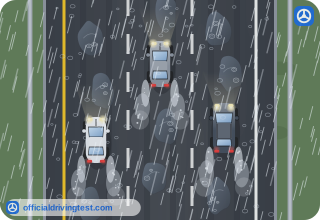
- Low beam (dim)
- High beam
- Parking lights only
- No lights during daytime
Show answer
Correct answer: Low beam (dim)
The manual suggests using low beam (dim) when driving in rain, fog, snow, or dust.
Source: Alaska Driver Manual (Revised October 2025), page 55 · Open this page in the manual (Manual page 55 · PDF 67)
-
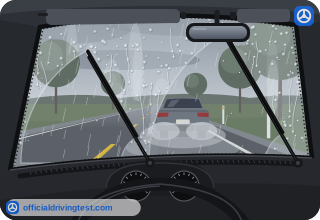
What does the manual say is especially hazardous on a rainy night?
- Wipers that are set on a slow speed
- A windshield cleaned with washer fluid
- Headlights set on low beam
- Windshield wipers that streak and skip
Show answer
Correct answer: Windshield wipers that streak and skip
The manual says wipers that streak and skip are especially hazardous on a rainy night.
Source: Alaska Driver Manual (Revised October 2025), page 59 · Open this page in the manual (Manual page 59 · PDF 71)
-
What does the manual suggest rubbing on the windshield when it begins to rain to cut the oil film?
- A small amount of detergent
- A small amount of motor oil
- A small amount of gasoline
- A small amount of antifreeze
Show answer
Correct answer: A small amount of detergent
The manual suggests carrying a small bottle of detergent and rubbing a small amount on the windshield when it begins to rain.
Source: Alaska Driver Manual (Revised October 2025), page 59 · Open this page in the manual (Manual page 59 · PDF 71)