Alabama: Sharing the road
Bicycles, motorcycles, large trucks and buses, No-Zones and school buses. Split into 4 shorter tests so you're not stuck in one long quiz.
Independent educational site · not affiliated with any government agency or DMV
Choose a part
Sharing the road — Part 1
Questions in this part include: “Where must a person on a bicycle on a roadway ride, in general?”
StartSharing the road — Part 2
Questions in this part include: “What do motorcycle accident statistics show?”
StartSharing the road — Part 3
Questions in this part include: “In a car and motorcycle accident, who usually ends up the loser, regardless of who is legally at fault?”
StartSharing the road — Part 4
Questions in this part include: “What do Shared Lane Markings (sharrows) tell road users?”
StartAll 74 Sharing the road questions with answers
Choose a part above to take a practice test, or study every question and answer here.
Show the questions and answersHide the questions
-
What rights and responsibilities do people on bicycles have on the road?
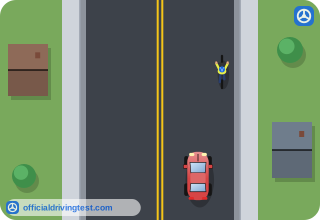
- Fewer rights than motor vehicles but the same responsibilities
- The same rights as motor vehicles but fewer responsibilities
- No rights on roads that have a bicycle lane marked on them
- The same rights and responsibilities as people in motor vehicles
Show answer
Correct answer: The same rights and responsibilities as people in motor vehicles
The manual says people on bicycles possess the same rights and responsibilities of the road as people in motor vehicles.
Source: Alabama Driver Manual (November 2024), page 23 · Open this page in the manual (Manual page 23)
-
Where must a person on a bicycle on a roadway ride, in general?
- In the center of the lane at all times
- As close as practicable to the right curb or edge of the roadway
- As close as practicable to the center line of the road
- On the sidewalk whenever one is available beside the road
Show answer
Correct answer: As close as practicable to the right curb or edge of the roadway
The manual says people on bicycles shall ride as close as practicable to the right curb or edge of the roadway, with exceptions.
Source: Alabama Driver Manual (November 2024), page 23 · Open this page in the manual (Manual page 23)
-
When may a person on a bicycle ride away from the right curb or edge of the roadway?
- When there is no other traffic on the road at that moment
- Whenever the rider prefers to ride near the center line
- When reasonably necessary to avoid debris, opening car doors, or pedestrians
- Whenever the rider is under 16 years of age and wearing a helmet
Show answer
Correct answer: When reasonably necessary to avoid debris, opening car doors, or pedestrians
The manual lists avoiding road or traffic conditions such as debris, opening car doors, and pedestrians as an exception.
Source: Alabama Driver Manual (November 2024), page 23 · Open this page in the manual (Manual page 23)
-
How many people on bicycles may ride abreast on a roadway?
- Two abreast, at all times
- Two abreast, but only on roads with a bicycle lane
- Single file only, at all times
- Two abreast, but only in daylight
Show answer
Correct answer: Two abreast, at all times
The manual says people on bicycles may ride two abreast at all times.
Source: Alabama Driver Manual (November 2024), page 23 · Open this page in the manual (Manual page 23)
-
In which direction must a person on a bicycle ride?
- Against the flow of traffic, to see oncoming vehicles
- Either way, if the rider stays near the curb
- With the flow of traffic
- Against the flow of traffic, but only on narrow roads
Show answer
Correct answer: With the flow of traffic
The manual says people on bicycles are required to ride with the flow of traffic.
Source: Alabama Driver Manual (November 2024), page 23 · Open this page in the manual (Manual page 23)
-
How must people on bicycles signal for turns, lane changes, or stops?
- With the same hand and arm signals as drivers of motor vehicles
- With a special set of hand signals made for bicycles only
- By ringing a bell or sounding a small horn
- Only by calling out to the nearby traffic
Show answer
Correct answer: With the same hand and arm signals as drivers of motor vehicles
The manual says they must use the same hand and arm signals as motor vehicle drivers.
Source: Alabama Driver Manual (November 2024), page 24 · Open this page in the manual (Manual page 24)
-
Where a bicycle lane is available, what must people on bicycles do?
- Ride on the adjacent sidewalk instead
- Ride in the nearest traffic lane
- Use it only when no motor vehicles are present
- Use it
Show answer
Correct answer: Use it
The manual says that where a bicycle lane is available, people on bicycles must use it.
Source: Alabama Driver Manual (November 2024), page 24 · Open this page in the manual (Manual page 24)
-
How does the manual define a bicycle lane?
- Any sidewalk or path alongside the road that people on bicycles may choose to use
- A part of the road designated by striping, signing, and markings for people on bicycles
- A multipurpose path next to the road that bicycles and walkers share
- The shoulder of any highway that has little or no other traffic
Show answer
Correct answer: A part of the road designated by striping, signing, and markings for people on bicycles
The manual defines a bicycle lane by striping, signing and markings and says sidewalks and multipurpose paths do not qualify.
Source: Alabama Driver Manual (November 2024), page 24 · Open this page in the manual (Manual page 24)
-
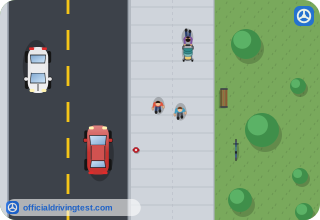
In Alabama, is it legal for people on bicycles to ride on the sidewalk?
- Yes, at any time
- No, it is illegal
- Yes, but only in daylight
- Yes, if no bicycle lane is available
Show answer
Correct answer: No, it is illegal
The manual says that in Alabama it is illegal for people on bicycles to ride on the sidewalk.
Source: Alabama Driver Manual (November 2024), page 24 · Open this page in the manual (Manual page 24)
-
People on bicycles under what age must wear a securely fastened protective helmet on public roadways?
- 12 years
- 14 years
- 18 years
- 16 years
Show answer
Correct answer: 16 years
The manual says people on bicycles under 16 must wear a securely fastened protective helmet.
Source: Alabama Driver Manual (November 2024), page 24 · Open this page in the manual (Manual page 24)
-
On a roadway with a bicycle lane, when may a motor vehicle driver enter the bicycle lane?
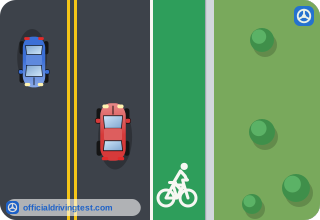
- To park where permitted, to enter or leave the highway, or to prepare for a turn
- To pass slower traffic on the right side of the roadway when it is safe
- Whenever the bicycle lane is empty of people on bicycles
- To avoid waiting behind other vehicles at a traffic signal
Show answer
Correct answer: To park where permitted, to enter or leave the highway, or to prepare for a turn
The manual says drivers shall not drive in the bicycle lane except to park where permitted, to enter or leave the highway, or to prepare for a turn.
Source: Alabama Driver Manual (November 2024), page 24 · Open this page in the manual (Manual page 24)
-
When turning across a bicycle lane, what should the driver do before making the turn?
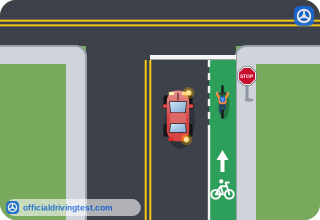
- Stay in the traffic lane and cut across the bicycle lane at the corner
- Stop in the traffic lane and wave the person on the bicycle through
- Drive into the bicycle lane first, if it does not endanger the person on the bicycle
- Move to the far side of the bicycle lane and turn from that position
Show answer
Correct answer: Drive into the bicycle lane first, if it does not endanger the person on the bicycle
The manual says the driver shall drive into the bicycle lane prior to the turn if this does not encroach on the safety of the person on the bicycle.
Source: Alabama Driver Manual (November 2024), page 24 · Open this page in the manual (Manual page 24)
-
What distance does Alabama state law require when you pass a person on a bicycle?
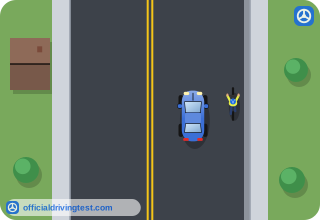
- Not less than three feet between your vehicle and the person on a bicycle
- Not less than two feet between your vehicle and the person on a bicycle
- Not less than four feet between your vehicle and the person on a bicycle
- Not less than five feet between your vehicle and the person on a bicycle
Show answer
Correct answer: Not less than three feet between your vehicle and the person on a bicycle
The manual says state law requires a distance of not less than three feet when passing a person on a bicycle.
Source: Alabama Driver Manual (November 2024), page 24 · Open this page in the manual (Manual page 24)
-
Why should you be especially cautious when passing a person on a bicycle at higher speeds?
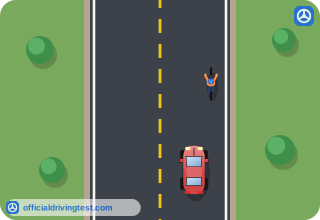
- The person on the bicycle is required to stop when passed at higher speed
- People on bicycles cannot hear the vehicles that are approaching from behind
- Motor vehicles create strong wind currents that can batter a person on a bicycle
- Higher speeds make the bicycle brake much more quickly than a motor vehicle
Show answer
Correct answer: Motor vehicles create strong wind currents that can batter a person on a bicycle
The manual warns that at higher speeds motor vehicles create strong wind currents that can batter a person on a bicycle.
Source: Alabama Driver Manual (November 2024), page 24 · Open this page in the manual (Manual page 24)
-
Where should you avoid passing a person on a bicycle?
- On any straight, level stretch of road
- Uphill or in a curve, where visibility is limited
- On a road that has a bicycle lane along it
- Only on roads with a posted limit above 45 mph
Show answer
Correct answer: Uphill or in a curve, where visibility is limited
The manual says to avoid passing when traveling uphill or in a curve, where visibility is limited or obstructed.
Source: Alabama Driver Manual (November 2024), page 24 · Open this page in the manual (Manual page 24)
-
When should you not pass a person on a bicycle?
- When the person on the bicycle is riding in a bicycle lane
- When the person on the bicycle is wearing a helmet
- When the person on the bicycle has signaled a turn
- When other vehicles are present in the lane you must use to pass
Show answer
Correct answer: When other vehicles are present in the lane you must use to pass
The manual says not to pass when other vehicles are present in the lane into which you must travel to pass the person on the bicycle.
Source: Alabama Driver Manual (November 2024), page 24 · Open this page in the manual (Manual page 24)
-
If the road is narrow and you cannot safely pass a person on a bicycle, what should you do?
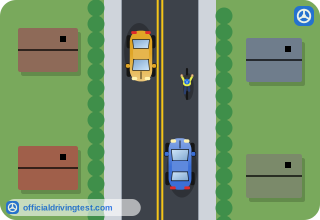
- Sound your horn repeatedly so the person on the bicycle moves to the curb
- Follow closely behind so the person on the bicycle knows you are there
- Pass on the right shoulder of the road as soon as you possibly can
- Stay behind at a safe interval, not following closely or honking, until you can pass
Show answer
Correct answer: Stay behind at a safe interval, not following closely or honking, until you can pass
The manual says not to follow too closely or blast the horn but to stay behind at a safe interval until you can pass.
Source: Alabama Driver Manual (November 2024), page 24 · Open this page in the manual (Manual page 24)
-
How does wet weather affect the braking ability of a bicycle?
- It is improved
- It is greatly reduced
- It is not affected
- It is only slightly reduced
Show answer
Correct answer: It is greatly reduced
The manual says the braking ability of a bicycle is greatly reduced in wet weather, so motorists should compensate.
Source: Alabama Driver Manual (November 2024), page 25 · Open this page in the manual (Manual page 25)
-
According to Alabama State Law, what should bicycles be equipped with for nighttime riding?
- A horn and a mirror
- A bell and a flag
- Lights or reflectors
- A license plate and a brake light
Show answer
Correct answer: Lights or reflectors
The manual says state law calls for bicycles to be equipped with lights or reflectors for nighttime riding.
Source: Alabama Driver Manual (November 2024), page 25 · Open this page in the manual (Manual page 25)
-
Why should a motor vehicle driver practice added care around people on bicycles?
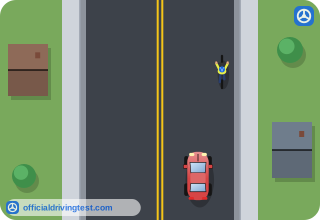
- The person on the bicycle is largely unprotected and could be seriously injured or killed
- The person on the bicycle always has the right of way over all motor vehicles
- The driver of a motor vehicle is always found at fault in a collision with a bicycle
- Bicycles can travel faster than motor vehicles on the streets of a town or city
Show answer
Correct answer: The person on the bicycle is largely unprotected and could be seriously injured or killed
The manual says the person on a bicycle is largely unprotected and a collision could very likely result in serious injury or even death.
Source: Alabama Driver Manual (November 2024), page 25 · Open this page in the manual (Manual page 25)
-
What do motorcycle accident statistics show?
- Most of the accidents involve riders with many years of experience
- Most of the accidents happen on interstate highways at night
- A substantial percentage of the accidents involve riders with limited experience
- Most of the accidents are caused by mechanical failure of the motorcycle
Show answer
Correct answer: A substantial percentage of the accidents involve riders with limited experience
The manual says a substantial percentage of motorcycle accidents involve riders with limited experience.
Source: Alabama Driver Manual (November 2024), page 25 · Open this page in the manual (Manual page 25)
-
What rights and responsibilities do motorcyclists have on public roadways?
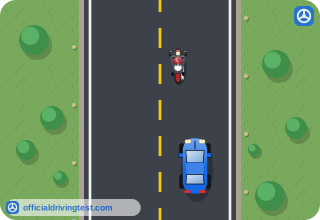
- The same as other highway users
- Fewer rights than drivers of cars
- The same rights but fewer duties
- Special rights to pass in a lane
Show answer
Correct answer: The same as other highway users
The manual says motorcyclists have the same rights and responsibilities on public roadways as other highway users.
Source: Alabama Driver Manual (November 2024), page 25 · Open this page in the manual (Manual page 25)
-
Why is it so important to be aware of motorcycles?
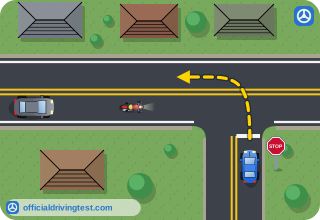
- They always travel faster than other traffic
- They are exempt from the traffic laws
- They must ride in the center of the lane
- They are not easily identified in traffic
Show answer
Correct answer: They are not easily identified in traffic
The manual says motorcycles are not easily identified in traffic.
Source: Alabama Driver Manual (November 2024), page 25 · Open this page in the manual (Manual page 25)
-
About how wide is a motorcycle compared with an automobile?
- About three feet, compared with six to seven feet for an automobile
- About two feet, compared with five to six feet for an automobile
- About one foot, compared with four to five feet for an automobile
- About four feet, compared with seven to eight feet for an automobile
Show answer
Correct answer: About two feet, compared with five to six feet for an automobile
The manual says motorcycles are about two feet wide compared with the five-to-six-foot width of an automobile.
Source: Alabama Driver Manual (November 2024), page 25 · Open this page in the manual (Manual page 25)
-
Which kind of accident accounts for a large percentage of car/cycle injury-producing accidents?
- Rear-end collisions at traffic signals
- Left turns in front of an oncoming motorcyclist
- Right turns in front of a parked motorcycle
- Passing a motorcycle on a straight road
Show answer
Correct answer: Left turns in front of an oncoming motorcyclist
The manual says left turns in front of an oncoming motorcyclist account for a large percentage of car/cycle injury-producing accidents.
Source: Alabama Driver Manual (November 2024), page 25 · Open this page in the manual (Manual page 25)
-
Before making a left turn when a motorcycle is approaching, what does the manual say to do?
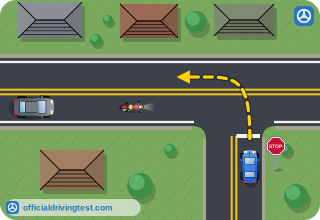
- Turn quickly, because motorcycles can stop easily
- Sound your horn so the rider slows down for you
- Assume the motorcycle will turn before you do
- Look and look again, and know the motorcycle's speed
Show answer
Correct answer: Look and look again, and know the motorcycle's speed
The manual says to look and look again and make sure you know the motorcycle's speed before turning left.
Source: Alabama Driver Manual (November 2024), page 25 · Open this page in the manual (Manual page 25)
-
You are about to turn in front of a motorcycle whose turn signal is blinking. What should you be sure of first?
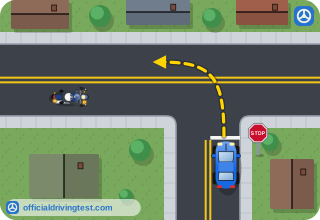
- That it is truly turning, not going straight with a forgotten signal
- That the rider has slowed down to below ten miles per hour
- That the rider has noticed your own turn signal and slowed
- That the motorcycle is riding in the center of its own lane
Show answer
Correct answer: That it is truly turning, not going straight with a forgotten signal
Riders sometimes forget to turn the signal off, so you must be sure the vehicle is turning before you turn in front of it.
Source: Alabama Driver Manual (November 2024), page 26 · Open this page in the manual (Manual page 26)
-
How much following distance should you give a motorcyclist in good conditions?
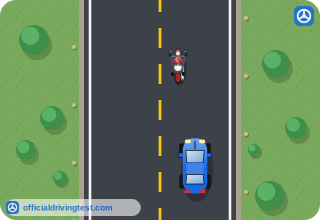
- A 4-second following distance, double that of cars
- Half of the distance you would give to any car
- A 2-second following distance, as for any other vehicle
- One car length for every 10 miles per hour of speed
Show answer
Correct answer: A 2-second following distance, as for any other vehicle
The manual says following distance behind a motorcyclist should be the same 2-second distance given any other vehicle.
Source: Alabama Driver Manual (November 2024), page 26 · Open this page in the manual (Manual page 26)
-
According to the manual, why can following a motorcyclist too closely be dangerous?
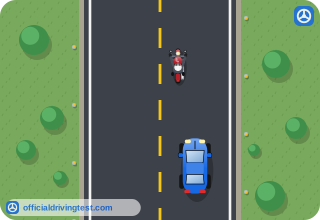
- It blocks the rider's view of the traffic signals ahead of him
- It may make the rider nervous and distract attention from the road
- It forces the rider to ride on the shoulder of the road
- It makes the motorcycle's brake light flash on and off
Show answer
Correct answer: It may make the rider nervous and distract attention from the road
Following too closely may make the rider nervous, drawing the rider's attention away from the road and traffic ahead.
Source: Alabama Driver Manual (November 2024), page 26 · Open this page in the manual (Manual page 26)
-
How much of a lane are motorcycles entitled to use?
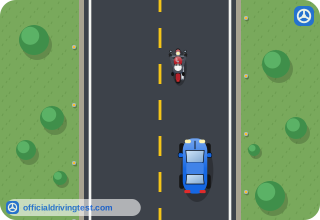
- Half of the lane width
- Only the center of the lane
- The lane width minus the width of one car tire
- The same full lane width as all other vehicles
Show answer
Correct answer: The same full lane width as all other vehicles
Motorcycles are entitled to the same full lane width as all other vehicles.
Source: Alabama Driver Manual (November 2024), page 26 · Open this page in the manual (Manual page 26)
-
Why does a skilled motorcycle operator constantly change positions within a lane?
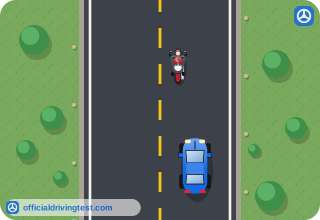
- To be seen better, see the road better, and adjust for road objects
- To make room for cars that want to share the same lane
- To signal to nearby drivers that the rider is about to stop
- To keep the tires warm and the engine cool in cold weather
Show answer
Correct answer: To be seen better, see the road better, and adjust for road objects
The manual says skilled riders change position to maximize being seen, to see the road better, and to deal with objects on or near the road.
Source: Alabama Driver Manual (November 2024), page 26 · Open this page in the manual (Manual page 26)
-
A motorcycle is riding far to one side of a wide lane. What should you do?
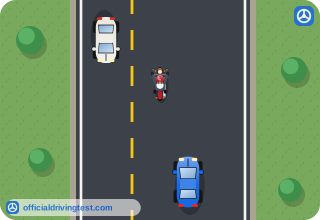
- Share the lane and pass slowly on the open side of it
- Move alongside it only if you signal first and slow down
- Never share the lane alongside it; this is illegal and hazardous
- Share the lane only when the road is dry and well lit
Show answer
Correct answer: Never share the lane alongside it; this is illegal and hazardous
Drivers should never move into the same lane alongside a motorcycle, even if the lane is wide; it is illegal and extremely hazardous.
Source: Alabama Driver Manual (November 2024), page 26 · Open this page in the manual (Manual page 26)
-
When the road is dark, raining, or wet and slippery, how should you adjust your distance behind a motorcycle?
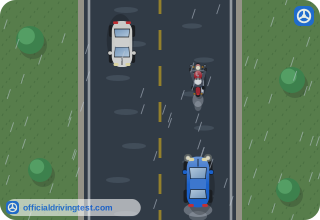
- Keep the same following distance as in dry weather
- Allow even more following distance for the motorcyclist
- Pass the motorcycle as soon as you can
- Follow closer so the rider can see your headlights
Show answer
Correct answer: Allow even more following distance for the motorcyclist
Inclement weather and slippery surfaces are real problems for motorcycles, so drivers should allow even more following distance.
Source: Alabama Driver Manual (November 2024), page 26 · Open this page in the manual (Manual page 26)
-
Which places should you watch for because cross winds can move a motorcycle out of its lane?
- Narrow residential streets and driveways
- Tunnels and underpasses
- School zones and parking lots
- Wide-open, long stretches of highway and bridges
Show answer
Correct answer: Wide-open, long stretches of highway and bridges
Windy conditions can move a motorcycle out of its lane, especially on wide-open, long stretches of highways and bridges.
Source: Alabama Driver Manual (November 2024), page 26 · Open this page in the manual (Manual page 26)
-
How can fast-moving large trucks affect a nearby motorcyclist?
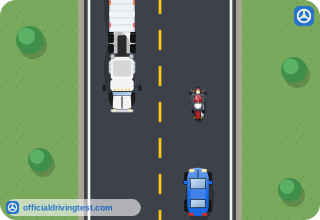
- They can create windblasts that startle the rider or move the bike
- They muffle the engine noise so riders cannot hear traffic
- They create a vacuum that pulls the rider closer to the truck's rear
- They force the rider to shift to a lower gear
Show answer
Correct answer: They can create windblasts that startle the rider or move the bike
Windblasts from fast-moving large trucks can startle a motorcyclist and, in some conditions, move the motorcycle out of its path of travel.
Source: Alabama Driver Manual (November 2024), page 26 · Open this page in the manual (Manual page 26)
-
Which of these road hazards can make a motorcyclist change speed or direction even though they do not normally affect other vehicles?
- Painted lane lines and reflectors set into the pavement
- Wide shoulders, bike lanes, and well-marked crosswalks
- Gravel, debris, pavement seams, small animals, manhole covers
- Traffic signs posted on the right side of the roadway
Show answer
Correct answer: Gravel, debris, pavement seams, small animals, manhole covers
Gravel, debris, pavement seams, small animals, and even manhole covers may cause a motorcyclist to change speed or direction.
Source: Alabama Driver Manual (November 2024), page 26 · Open this page in the manual (Manual page 26)
-
Why might a motorcyclist slow down or change direction at a railroad crossing that runs at an angle to the road?
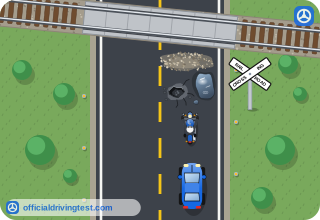
- To avoid the warning lights
- So the tracks can be crossed head on
- To let the rear tire pass the rail first
- To keep the headlight pointed at the train
Show answer
Correct answer: So the tracks can be crossed head on
Railroad crossings may be rough or angled, so the rider may change direction so the tracks can be crossed head on.
Source: Alabama Driver Manual (November 2024), page 26 · Open this page in the manual (Manual page 26)
-
What might a motorcyclist do to cushion the shock of a rough railroad crossing?
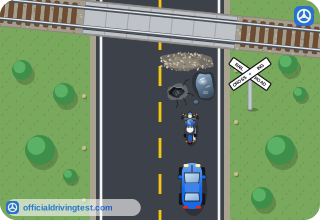
- Lean far to one side
- Turn off the engine
- Put both feet down on the pavement
- Rise off the seat
Show answer
Correct answer: Rise off the seat
The manual says the cyclist may rise off the seat to help cushion the shock of a rough crossing.
Source: Alabama Driver Manual (November 2024), page 26 · Open this page in the manual (Manual page 26)
-
Why might an inexperienced motorcyclist quickly change direction or slow down on a metal or grated bridge?
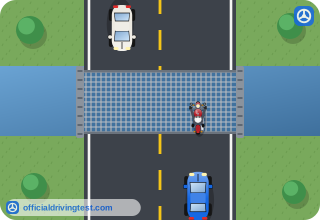
- A wobbling sensation in the front tire, more than in a car
- The grated surface makes the engine lose power quickly
- The surface throws sparks up from the motorcycle tires
- The surface pulls the motorcycle toward the center line
Show answer
Correct answer: A wobbling sensation in the front tire, more than in a car
Metal or grated bridges create a wobbling feeling in the motorcycle's front tire that is stronger than the feeling in a car.
Source: Alabama Driver Manual (November 2024), page 26 · Open this page in the manual (Manual page 26)
-
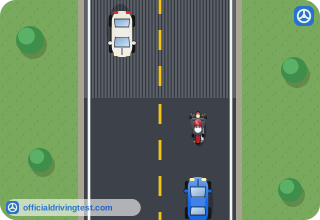
What effect can grooved pavement have when a motorcyclist first encounters it?
- It can make the rider's headlight turn off suddenly
- It can lock the motorcycle's rear brake without warning
- A wobbling sensation, so the rider may overcompensate
- It can lift the front wheel off the road surface
Show answer
Correct answer: A wobbling sensation, so the rider may overcompensate
Grooved pavement may create a wobbling sensation, and the rider may overcompensate by slowing down or changing lanes suddenly.
Source: Alabama Driver Manual (November 2024), page 26 · Open this page in the manual (Manual page 26)
-
In a car and motorcycle accident, who usually ends up the loser, regardless of who is legally at fault?
- The car driver
- The motorcyclist
- The driver who was following
- The owner of the vehicle that was not insured
Show answer
Correct answer: The motorcyclist
The manual says that regardless of who is at fault in car/cycle accidents, the motorcyclist usually is the loser.
Source: Alabama Driver Manual (November 2024), page 27 · Open this page in the manual (Manual page 27)
-
What are No-Zones around trucks and buses?
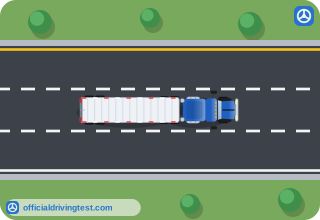
- Areas where trucks and buses are not permitted to drive at all
- Parts of the road reserved for passing large vehicles
- Lanes where the speed limit is lower for large vehicles
- Danger areas where crashes are more likely, some being blind spots
Show answer
Correct answer: Danger areas where crashes are more likely, some being blind spots
No-Zones are danger areas around trucks and buses where crashes are more likely, and some are blind spots.
Source: Alabama Driver Manual (November 2024), page 27 · Open this page in the manual (Manual page 27)
-
If you can't see a truck driver's face in the side-view mirror, what does that mean?
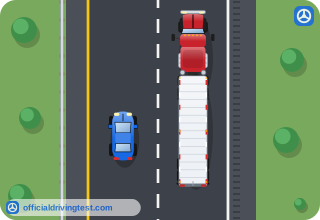
- The driver can't see you
- The driver is about to change lanes
- The truck is about to turn right
- You are at a safe passing distance
Show answer
Correct answer: The driver can't see you
The manual says that if you cannot see the driver's face in the side-view mirror, the driver cannot see you.
Source: Alabama Driver Manual (November 2024), page 27 · Open this page in the manual (Manual page 27)
-
When passing a truck or bus, how should you do it?
- Pass on the right and stay beside the truck for a short time
- Pass on either side while keeping pace with the truck
- Pass on the left and do it as quickly as possible
- Pass on the left but stay beside the cab so the driver sees you
Show answer
Correct answer: Pass on the left and do it as quickly as possible
The manual says to pass a truck or bus on the left, as quickly as possible, and get ahead so the driver can see you.
Source: Alabama Driver Manual (November 2024), page 27 · Open this page in the manual (Manual page 27)
-
How far behind a truck or bus can the rear No-Zone extend?
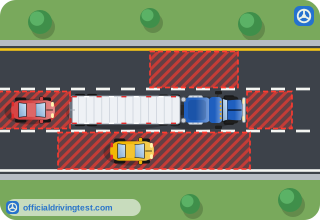
- As far as 50 feet
- As far as 200 feet
- As far as 100 feet
- As far as 500 feet
Show answer
Correct answer: As far as 200 feet
Trucks and buses have huge No-Zones directly behind them that may extend as far as 200 feet.
Source: Alabama Driver Manual (November 2024), page 27 · Open this page in the manual (Manual page 27)
-
What should you do with your headlights when following a large vehicle at night?
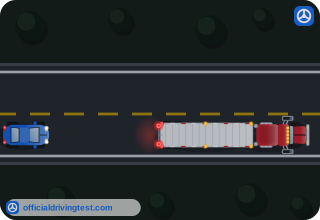
- Turn them off completely so the truck driver is not blinded
- Keep them on high beam so the driver can see you clearly
- Flash them repeatedly to warn the driver that you are there
- Dim them, because bright lights blind the driver in the mirrors
Show answer
Correct answer: Dim them, because bright lights blind the driver in the mirrors
Bright lights reflect off the side mirrors of a bus or truck and blind the driver, so you should dim your headlights.
Source: Alabama Driver Manual (November 2024), page 27 · Open this page in the manual (Manual page 27)
-
What should you see in your rear-view mirror before pulling in front of a large vehicle you have just passed?
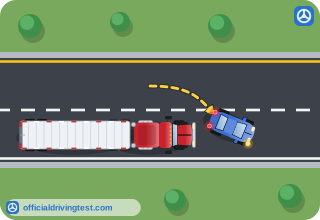
- The entire front of the vehicle
- The vehicle's rear wheels
- The driver's face
- Only the vehicle's headlights
Show answer
Correct answer: The entire front of the vehicle
The manual says to look for the entire front of the large vehicle in your rear-view mirror before pulling in front of it.
Source: Alabama Driver Manual (November 2024), page 28 · Open this page in the manual (Manual page 28)
-
Compared with a passenger car, how much room do truck and bus drivers need to stop?
- About the same room
- About half as much room
- Nearly two times more room
- Nearly ten times more room
Show answer
Correct answer: Nearly two times more room
Truck and bus drivers need nearly two times more room to stop.
Source: Alabama Driver Manual (November 2024), page 28 · Open this page in the manual (Manual page 28)
-
At 55 miles per hour, how many feet does a loaded truck need to stop, according to the National Safety Council study quoted in the manual?
- 193 feet
- 430 feet
- 300 feet
- 550 feet
Show answer
Correct answer: 430 feet
The study found that at 55 mph a passenger car needs 193 feet to stop safely and a loaded truck needs 430 feet.
Source: Alabama Driver Manual (November 2024), page 28 · Open this page in the manual (Manual page 28)
-
What should you never do around a truck or bus that is backing up?
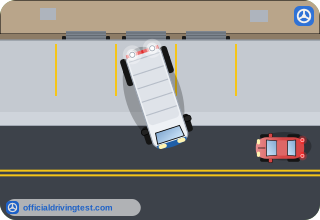
- Stop in front of it
- Pass it on the left
- Follow it at a distance
- Cross behind it
Show answer
Correct answer: Cross behind it
The manual says to never cross behind a truck or bus that is backing up, because the driver cannot see directly behind.
Source: Alabama Driver Manual (November 2024), page 28 · Open this page in the manual (Manual page 28)
-
To safely make a right turn, how does a truck or bus driver need to swing?
- Wide to the left
- Wide to the right
- Tightly to the right
- Straight, then sharply right
Show answer
Correct answer: Wide to the left
Truck and bus drivers need to swing wide to the left to safely make a right turn.
Source: Alabama Driver Manual (November 2024), page 28 · Open this page in the manual (Manual page 28)
-
A large truck's right turn signal is blinking. What should you NOT attempt to do?
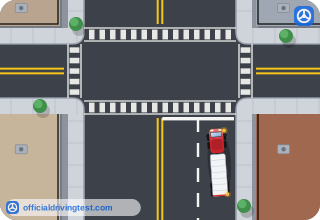
- Stay well back and let it finish the turn
- Slow down and wait
- Pass on the right
- Follow behind the truck
Show answer
Correct answer: Pass on the right
When the right turn signal is blinking, do not attempt to pass on the right: the driver cannot see you and you may be trapped.
Source: Alabama Driver Manual (November 2024), page 28 · Open this page in the manual (Manual page 28)
-
Why might a motorcycle's turn signal be blinking even though the rider is not turning?
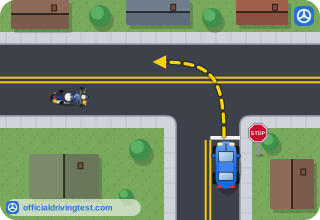
- Most motorcycle turn signals do not cancel by themselves
- Motorcycle signals blink all the time as a safety light
- Riders must signal for the whole length of every trip
- The signal shows the rider is about to slow down
Show answer
Correct answer: Most motorcycle turn signals do not cancel by themselves
The manual says turn signals are not automatically self-canceling on most motorcycles, and at times the rider may forget to turn the signal off.
Source: Alabama Driver Manual (November 2024), page 25 · Open this page in the manual (Manual page 25)
-
A person on a bicycle is sometimes difficult to see amid other traffic. Where does the manual say to be especially watchful?
- Only on highways that have four or more lanes
- At intersections, sidewalks, alleys and driveways
- Only on streets that have a marked bike lane
- Only at night or when it is raining hard
Show answer
Correct answer: At intersections, sidewalks, alleys and driveways
The manual says to be especially watchful at intersections, when crossing sidewalks, or when entering or leaving alleys or driveways.
Source: Alabama Driver Manual (November 2024), page 24 · Open this page in the manual (Manual page 24)
-
A yellow diamond sign shows the side view of a truck. What should you watch for?
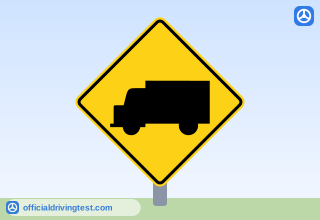
- Fire trucks entering the street
- Trucks entering the highway
- Trucks stopped on the shoulder
- Trucks that cannot stop quickly
Show answer
Correct answer: Trucks entering the highway
The manual says this truck crossing sign means to watch for trucks entering the highway.
Source: Alabama Driver Manual (November 2024), page 47 · Open this page in the manual (Manual page 47)
-
A yellow diamond sign shows a school bus with an up arrow and red lights. What does it mean?
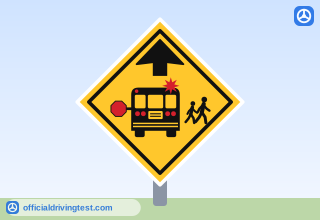
- A school bus stop is ahead
- A school crossing is ahead
- A school zone begins ahead
- School buses may not stop ahead
Show answer
Correct answer: A school bus stop is ahead
The manual says this sign means a school bus stop is ahead.
Source: Alabama Driver Manual (November 2024), page 49 · Open this page in the manual (Manual page 49)
-
A yellow diamond sign shows a bicycle with an arrow plate below it. What does it mean?
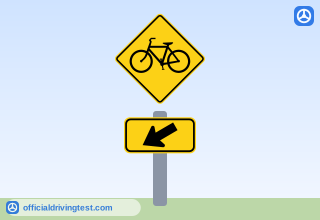
- A bike lane ends ahead
- Bicycles are not allowed ahead
- Bike crossing
- A school crossing is ahead
Show answer
Correct answer: Bike crossing
The manual says this sign means a bike crossing.
Source: Alabama Driver Manual (November 2024), page 49 · Open this page in the manual (Manual page 49)
-
What minimum clearance is required when you pass a bicyclist?
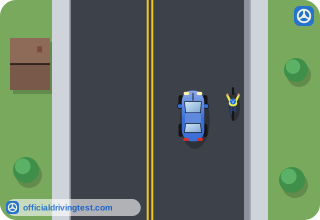
- 3 feet
- 2 feet
- 4 feet
- 5 feet
Show answer
Correct answer: 3 feet
The manual states a 3 foot minimum clearance is required when passing a cyclist.
Source: Alabama Driver Manual (November 2024), page 50 · Open this page in the manual (Manual page 50)
-
A white sign shows a bicycle above the words MAY USE FULL LANE. When may a cyclist use the full lane?
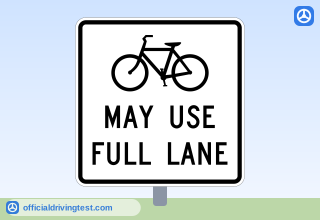
- Only when the road has a bike lane
- Only during daylight hours
- If the travel lane is narrow
- Only when no vehicle is behind the cyclist
Show answer
Correct answer: If the travel lane is narrow
The manual says a cyclist may use the full lane if the travel lane is narrow.
Source: Alabama Driver Manual (November 2024), page 50 · Open this page in the manual (Manual page 50)
-
What do Shared Lane Markings (sharrows) tell road users?
- Bicycles are prohibited from the travel lane
- People on bicycles might occupy the travel lane
- The lane is reserved for bicycles only
- Bicyclists must ride on the sidewalk
Show answer
Correct answer: People on bicycles might occupy the travel lane
Sharrows inform road users that people on bicycles might occupy the travel lane.
Source: Alabama Driver Manual (November 2024), page 50 · Open this page in the manual (Manual page 50)
-
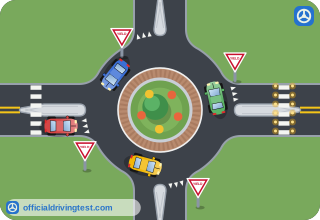
According to the one-lane roundabout diagram, how can bicyclists get through the roundabout?
- Only by dismounting and walking on the sidewalk
- Go through the roundabout or use the crosswalk
- Only by using the truck apron
- Only by using the crosswalk
Show answer
Correct answer: Go through the roundabout or use the crosswalk
The diagram says bicyclists can go through the roundabout or use the crosswalk.
Source: Alabama Driver Manual (November 2024), page 57 · Open this page in the manual (Manual page 57)
-
What is a truck apron?
- A paved lane outside the roundabout where trucks wait before entering
- A raised island in the center of the roundabout where trucks park
- A separate lane that lets trucks bypass the roundabout
- A paved area inside the roundabout for the rear wheels of large trucks
Show answer
Correct answer: A paved area inside the roundabout for the rear wheels of large trucks
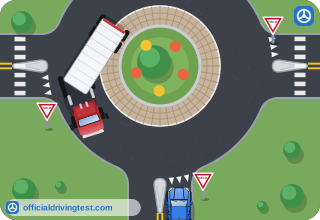
A truck apron is a paved area on the inside of the roundabout for the rear wheels of large trucks to use when turning.
Source: Alabama Driver Manual (November 2024), page 58 · Open this page in the manual (Manual page 58)
-
Truck aprons are not intended for which vehicles?
- Large vehicles with long trailers
- Motorcycles and mopeds only
- Cars, pickup trucks and SUVs
- Vehicles making a right turn
Show answer
Correct answer: Cars, pickup trucks and SUVs
Truck aprons are not intended to be used by cars, pickup trucks or SUVs.
Source: Alabama Driver Manual (November 2024), page 58 · Open this page in the manual (Manual page 58)
-
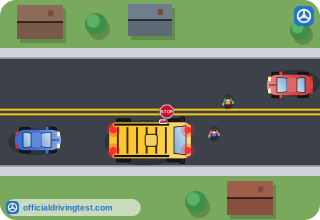
When you stop for a school bus or church bus, how long must you remain stopped?
- Until the bus driver signals that you may proceed
- Until the stop arm is retracted and the red lights are off
- Until the children are out of sight
- For at least 20 seconds
Show answer
Correct answer: Until the stop arm is retracted and the red lights are off
You remain stopped until the stop signal is retracted and the red lights are turned off.
Source: Alabama Driver Manual (November 2024), page 61 · Open this page in the manual (Manual page 61)
-
On which type of highway should you also stop when meeting or following a stopped school or church bus?
- A two-lane road only
- A divided highway with four or more lanes
- A one-way street only
- A four to six lane undivided highway
Show answer
Correct answer: A four to six lane undivided highway
You should also stop for a stopped bus on a four to six lane undivided highway.
Source: Alabama Driver Manual (November 2024), page 61 · Open this page in the manual (Manual page 61)
-
On which type of road is a stop NOT required when you meet a school or church bus stopped in the opposing roadway?
- A divided highway with four or more lanes
- A four to six lane undivided highway
- Any two-lane road with a center line
- Any one-way street with two lanes
Show answer
Correct answer: A divided highway with four or more lanes
A stop is not required on a divided highway with four or more lanes when meeting a bus stopped in the opposing roadway.
Source: Alabama Driver Manual (November 2024), page 61 · Open this page in the manual (Manual page 61)
-
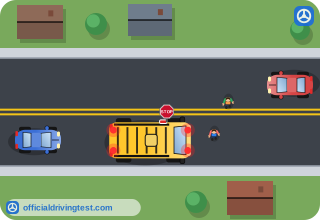
How close to a stopped school bus displaying its stop signals may you stop?
- No closer than 5 feet
- No closer than 10 feet
- No closer than 20 feet
- No closer than 50 feet
Show answer
Correct answer: No closer than 20 feet
The manual's school bus illustration says to stop at least 20 feet from the bus.
Source: Alabama Driver Manual (November 2024), page 62 · Open this page in the manual (Manual page 62)
-
What does it mean when a school bus has flashing amber lights?
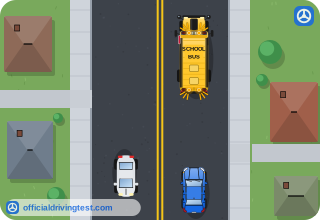
- The bus is stopped and children are about to cross
- The bus is preparing to stop to load or unload children
- The bus is broken down
- You may pass the bus freely
Show answer
Correct answer: The bus is preparing to stop to load or unload children
Flashing amber lights are a pre-warning that the bus is preparing to stop to load or unload children.
Source: Alabama Driver Manual (November 2024), page 62 · Open this page in the manual (Manual page 62)
-
In rural areas, how far before stopping do school buses use their flashing amber lights?
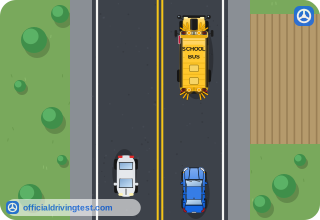
- At least 100 feet
- At least 200 feet
- At least 500 feet
- At least 300 feet
Show answer
Correct answer: At least 300 feet
In rural areas the amber lights are used at least 300 feet before stopping.
Source: Alabama Driver Manual (November 2024), page 62 · Open this page in the manual (Manual page 62)
-
In municipalities, how far before stopping do school buses use their flashing amber lights?
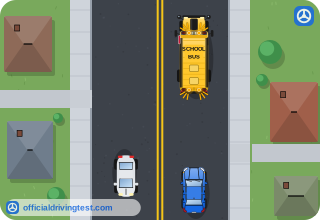
- At least 100 feet
- At least 20 feet
- At least 300 feet
- At least 500 feet
Show answer
Correct answer: At least 100 feet
In municipalities the amber lights are used at least 100 feet before stopping.
Source: Alabama Driver Manual (November 2024), page 62 · Open this page in the manual (Manual page 62)
-
What do flashing red lights and an extended stop arm on a school bus mean?
- The bus is about to start moving along the road
- The bus is warning of a hazard ahead
- The bus is stopped to load or unload school children
- The bus is preparing to stop
Show answer
Correct answer: The bus is stopped to load or unload school children
Flashing red lights and an extended stop arm mean the bus is stopped to load or unload children.
Source: Alabama Driver Manual (November 2024), page 62 · Open this page in the manual (Manual page 62)
-
Where are the majority of children injured or killed in pupil transportation?
- Inside the bus, in the aisle
- Outside the bus
- Inside the bus, in the rear seats
- Inside the bus, in the front seats
Show answer
Correct answer: Outside the bus
Most children injured or killed in pupil transportation are outside the bus, not on it.
Source: Alabama Driver Manual (November 2024), page 81 · Open this page in the manual (Manual page 81)
-
Most children hurt outside a school bus are struck by motorists who fail to stop for what?
- The flashing red lights and extended stop signs
- The school zone speed limit signs and crossing guards
- The crossing guard whistle and the school zone sign
- The caution lights and the bus driver’s horn
Show answer
Correct answer: The flashing red lights and extended stop signs
Most are struck by motorists who fail to stop for the flashing red lights and extended stop signs.
Source: Alabama Driver Manual (November 2024), page 81 · Open this page in the manual (Manual page 81)
-
What is the area around a stopped school bus referred to as?
- The “Safe Zone”
- The “Caution Area”
- The “DEATH ZONE”
- The “Bus Perimeter”
Show answer
Correct answer: The “DEATH ZONE”
The area around the stopped school bus is referred to as the death zone.
Source: Alabama Driver Manual (November 2024), page 81 · Open this page in the manual (Manual page 81)