Alabama: Sharing the road — Part 1 Practice Test
Questions in this part include: “Where must a person on a bicycle on a roadway ride, in general?” · “How does the manual define a bicycle lane?”
Independent educational site · not affiliated with any government agency or DMV
Ready? Test yourself
- Instant feedback with an explanation
- Every answer cites its source in the manual
- Your best score is saved on this device
Questions are original and based on the official manual "Alabama Driver Manual" (November 2024), Alabama Law Enforcement Agency (ALEA), Driver License Division.
All 19 questions in this practice test
Take the test above first, then use this list to study. Tap “Show answer” to see the correct answer and explanation.
Show the questions and answersHide the questions
-
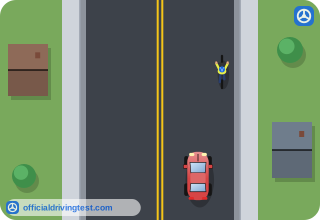
What rights and responsibilities do people on bicycles have on the road?
- Fewer rights than motor vehicles but the same responsibilities
- The same rights as motor vehicles but fewer responsibilities
- No rights on roads that have a bicycle lane marked on them
- The same rights and responsibilities as people in motor vehicles
Show answer
Correct answer: The same rights and responsibilities as people in motor vehicles
The manual says people on bicycles possess the same rights and responsibilities of the road as people in motor vehicles.
Source: Alabama Driver Manual (November 2024), page 23 · Open this page in the manual (Manual page 23)
-
Where must a person on a bicycle on a roadway ride, in general?
- In the center of the lane at all times
- As close as practicable to the right curb or edge of the roadway
- As close as practicable to the center line of the road
- On the sidewalk whenever one is available beside the road
Show answer
Correct answer: As close as practicable to the right curb or edge of the roadway
The manual says people on bicycles shall ride as close as practicable to the right curb or edge of the roadway, with exceptions.
Source: Alabama Driver Manual (November 2024), page 23 · Open this page in the manual (Manual page 23)
-
When may a person on a bicycle ride away from the right curb or edge of the roadway?
- When there is no other traffic on the road at that moment
- Whenever the rider prefers to ride near the center line
- When reasonably necessary to avoid debris, opening car doors, or pedestrians
- Whenever the rider is under 16 years of age and wearing a helmet
Show answer
Correct answer: When reasonably necessary to avoid debris, opening car doors, or pedestrians
The manual lists avoiding road or traffic conditions such as debris, opening car doors, and pedestrians as an exception.
Source: Alabama Driver Manual (November 2024), page 23 · Open this page in the manual (Manual page 23)
-
How many people on bicycles may ride abreast on a roadway?
- Two abreast, at all times
- Two abreast, but only on roads with a bicycle lane
- Single file only, at all times
- Two abreast, but only in daylight
Show answer
Correct answer: Two abreast, at all times
The manual says people on bicycles may ride two abreast at all times.
Source: Alabama Driver Manual (November 2024), page 23 · Open this page in the manual (Manual page 23)
-
In which direction must a person on a bicycle ride?
- Against the flow of traffic, to see oncoming vehicles
- Either way, if the rider stays near the curb
- With the flow of traffic
- Against the flow of traffic, but only on narrow roads
Show answer
Correct answer: With the flow of traffic
The manual says people on bicycles are required to ride with the flow of traffic.
Source: Alabama Driver Manual (November 2024), page 23 · Open this page in the manual (Manual page 23)
-
How must people on bicycles signal for turns, lane changes, or stops?
- With the same hand and arm signals as drivers of motor vehicles
- With a special set of hand signals made for bicycles only
- By ringing a bell or sounding a small horn
- Only by calling out to the nearby traffic
Show answer
Correct answer: With the same hand and arm signals as drivers of motor vehicles
The manual says they must use the same hand and arm signals as motor vehicle drivers.
Source: Alabama Driver Manual (November 2024), page 24 · Open this page in the manual (Manual page 24)
-
Where a bicycle lane is available, what must people on bicycles do?
- Ride on the adjacent sidewalk instead
- Ride in the nearest traffic lane
- Use it only when no motor vehicles are present
- Use it
Show answer
Correct answer: Use it
The manual says that where a bicycle lane is available, people on bicycles must use it.
Source: Alabama Driver Manual (November 2024), page 24 · Open this page in the manual (Manual page 24)
-
How does the manual define a bicycle lane?
- Any sidewalk or path alongside the road that people on bicycles may choose to use
- A part of the road designated by striping, signing, and markings for people on bicycles
- A multipurpose path next to the road that bicycles and walkers share
- The shoulder of any highway that has little or no other traffic
Show answer
Correct answer: A part of the road designated by striping, signing, and markings for people on bicycles
The manual defines a bicycle lane by striping, signing and markings and says sidewalks and multipurpose paths do not qualify.
Source: Alabama Driver Manual (November 2024), page 24 · Open this page in the manual (Manual page 24)
-
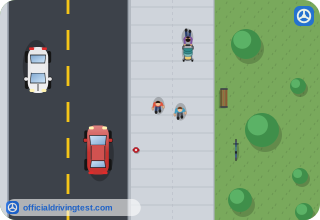
In Alabama, is it legal for people on bicycles to ride on the sidewalk?
- Yes, at any time
- No, it is illegal
- Yes, but only in daylight
- Yes, if no bicycle lane is available
Show answer
Correct answer: No, it is illegal
The manual says that in Alabama it is illegal for people on bicycles to ride on the sidewalk.
Source: Alabama Driver Manual (November 2024), page 24 · Open this page in the manual (Manual page 24)
-
People on bicycles under what age must wear a securely fastened protective helmet on public roadways?
- 12 years
- 14 years
- 18 years
- 16 years
Show answer
Correct answer: 16 years
The manual says people on bicycles under 16 must wear a securely fastened protective helmet.
Source: Alabama Driver Manual (November 2024), page 24 · Open this page in the manual (Manual page 24)
-
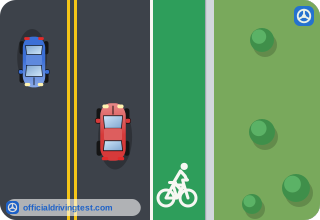
On a roadway with a bicycle lane, when may a motor vehicle driver enter the bicycle lane?
- To park where permitted, to enter or leave the highway, or to prepare for a turn
- To pass slower traffic on the right side of the roadway when it is safe
- Whenever the bicycle lane is empty of people on bicycles
- To avoid waiting behind other vehicles at a traffic signal
Show answer
Correct answer: To park where permitted, to enter or leave the highway, or to prepare for a turn
The manual says drivers shall not drive in the bicycle lane except to park where permitted, to enter or leave the highway, or to prepare for a turn.
Source: Alabama Driver Manual (November 2024), page 24 · Open this page in the manual (Manual page 24)
-
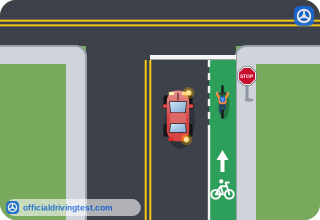
When turning across a bicycle lane, what should the driver do before making the turn?
- Stay in the traffic lane and cut across the bicycle lane at the corner
- Stop in the traffic lane and wave the person on the bicycle through
- Drive into the bicycle lane first, if it does not endanger the person on the bicycle
- Move to the far side of the bicycle lane and turn from that position
Show answer
Correct answer: Drive into the bicycle lane first, if it does not endanger the person on the bicycle
The manual says the driver shall drive into the bicycle lane prior to the turn if this does not encroach on the safety of the person on the bicycle.
Source: Alabama Driver Manual (November 2024), page 24 · Open this page in the manual (Manual page 24)
-
What distance does Alabama state law require when you pass a person on a bicycle?

- Not less than three feet between your vehicle and the person on a bicycle
- Not less than two feet between your vehicle and the person on a bicycle
- Not less than four feet between your vehicle and the person on a bicycle
- Not less than five feet between your vehicle and the person on a bicycle
Show answer
Correct answer: Not less than three feet between your vehicle and the person on a bicycle
The manual says state law requires a distance of not less than three feet when passing a person on a bicycle.
Source: Alabama Driver Manual (November 2024), page 24 · Open this page in the manual (Manual page 24)
-
Why should you be especially cautious when passing a person on a bicycle at higher speeds?
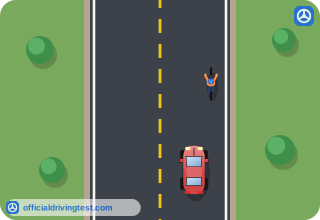
- The person on the bicycle is required to stop when passed at higher speed
- People on bicycles cannot hear the vehicles that are approaching from behind
- Motor vehicles create strong wind currents that can batter a person on a bicycle
- Higher speeds make the bicycle brake much more quickly than a motor vehicle
Show answer
Correct answer: Motor vehicles create strong wind currents that can batter a person on a bicycle
The manual warns that at higher speeds motor vehicles create strong wind currents that can batter a person on a bicycle.
Source: Alabama Driver Manual (November 2024), page 24 · Open this page in the manual (Manual page 24)
-
Where should you avoid passing a person on a bicycle?
- On any straight, level stretch of road
- Uphill or in a curve, where visibility is limited
- On a road that has a bicycle lane along it
- Only on roads with a posted limit above 45 mph
Show answer
Correct answer: Uphill or in a curve, where visibility is limited
The manual says to avoid passing when traveling uphill or in a curve, where visibility is limited or obstructed.
Source: Alabama Driver Manual (November 2024), page 24 · Open this page in the manual (Manual page 24)
-
When should you not pass a person on a bicycle?
- When the person on the bicycle is riding in a bicycle lane
- When the person on the bicycle is wearing a helmet
- When the person on the bicycle has signaled a turn
- When other vehicles are present in the lane you must use to pass
Show answer
Correct answer: When other vehicles are present in the lane you must use to pass
The manual says not to pass when other vehicles are present in the lane into which you must travel to pass the person on the bicycle.
Source: Alabama Driver Manual (November 2024), page 24 · Open this page in the manual (Manual page 24)
-
If the road is narrow and you cannot safely pass a person on a bicycle, what should you do?
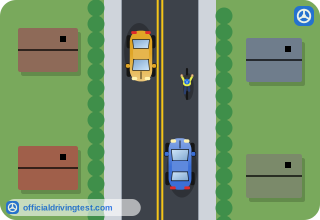
- Sound your horn repeatedly so the person on the bicycle moves to the curb
- Follow closely behind so the person on the bicycle knows you are there
- Pass on the right shoulder of the road as soon as you possibly can
- Stay behind at a safe interval, not following closely or honking, until you can pass
Show answer
Correct answer: Stay behind at a safe interval, not following closely or honking, until you can pass
The manual says not to follow too closely or blast the horn but to stay behind at a safe interval until you can pass.
Source: Alabama Driver Manual (November 2024), page 24 · Open this page in the manual (Manual page 24)
-
How does wet weather affect the braking ability of a bicycle?
- It is improved
- It is greatly reduced
- It is not affected
- It is only slightly reduced
Show answer
Correct answer: It is greatly reduced
The manual says the braking ability of a bicycle is greatly reduced in wet weather, so motorists should compensate.
Source: Alabama Driver Manual (November 2024), page 25 · Open this page in the manual (Manual page 25)
-
According to Alabama State Law, what should bicycles be equipped with for nighttime riding?
- A horn and a mirror
- A bell and a flag
- Lights or reflectors
- A license plate and a brake light
Show answer
Correct answer: Lights or reflectors
The manual says state law calls for bicycles to be equipped with lights or reflectors for nighttime riding.
Source: Alabama Driver Manual (November 2024), page 25 · Open this page in the manual (Manual page 25)