Alabama: Sharing the road — Part 4 Practice Test
Questions in this part include: “What do Shared Lane Markings (sharrows) tell road users?” · “What do flashing red lights and an extended stop arm on a school bus mean?”
Independent educational site · not affiliated with any government agency or DMV
Ready? Test yourself
- Instant feedback with an explanation
- Every answer cites its source in the manual
- Your best score is saved on this device
Questions are original and based on the official manual "Alabama Driver Manual" (November 2024), Alabama Law Enforcement Agency (ALEA), Driver License Division.
All 18 questions in this practice test
Take the test above first, then use this list to study. Tap “Show answer” to see the correct answer and explanation.
Show the questions and answersHide the questions
-
A yellow diamond sign shows a bicycle with an arrow plate below it. What does it mean?
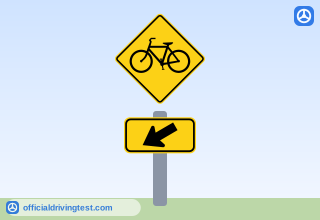
- A bike lane ends ahead
- Bicycles are not allowed ahead
- Bike crossing
- A school crossing is ahead
Show answer
Correct answer: Bike crossing
The manual says this sign means a bike crossing.
Source: Alabama Driver Manual (November 2024), page 49 · Open this page in the manual (Manual page 49)
-
What minimum clearance is required when you pass a bicyclist?
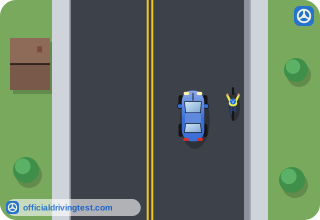
- 3 feet
- 2 feet
- 4 feet
- 5 feet
Show answer
Correct answer: 3 feet
The manual states a 3 foot minimum clearance is required when passing a cyclist.
Source: Alabama Driver Manual (November 2024), page 50 · Open this page in the manual (Manual page 50)
-
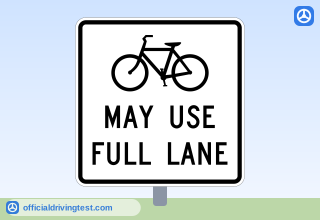
A white sign shows a bicycle above the words MAY USE FULL LANE. When may a cyclist use the full lane?
- Only when the road has a bike lane
- Only during daylight hours
- If the travel lane is narrow
- Only when no vehicle is behind the cyclist
Show answer
Correct answer: If the travel lane is narrow
The manual says a cyclist may use the full lane if the travel lane is narrow.
Source: Alabama Driver Manual (November 2024), page 50 · Open this page in the manual (Manual page 50)
-
What do Shared Lane Markings (sharrows) tell road users?
- Bicycles are prohibited from the travel lane
- People on bicycles might occupy the travel lane
- The lane is reserved for bicycles only
- Bicyclists must ride on the sidewalk
Show answer
Correct answer: People on bicycles might occupy the travel lane
Sharrows inform road users that people on bicycles might occupy the travel lane.
Source: Alabama Driver Manual (November 2024), page 50 · Open this page in the manual (Manual page 50)
-
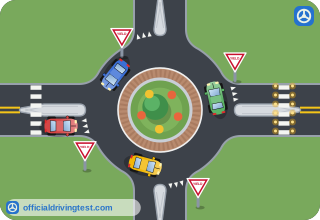
According to the one-lane roundabout diagram, how can bicyclists get through the roundabout?
- Only by dismounting and walking on the sidewalk
- Go through the roundabout or use the crosswalk
- Only by using the truck apron
- Only by using the crosswalk
Show answer
Correct answer: Go through the roundabout or use the crosswalk
The diagram says bicyclists can go through the roundabout or use the crosswalk.
Source: Alabama Driver Manual (November 2024), page 57 · Open this page in the manual (Manual page 57)
-
What is a truck apron?
- A paved lane outside the roundabout where trucks wait before entering
- A raised island in the center of the roundabout where trucks park
- A separate lane that lets trucks bypass the roundabout
- A paved area inside the roundabout for the rear wheels of large trucks
Show answer
Correct answer: A paved area inside the roundabout for the rear wheels of large trucks
A truck apron is a paved area on the inside of the roundabout for the rear wheels of large trucks to use when turning.
Source: Alabama Driver Manual (November 2024), page 58 · Open this page in the manual (Manual page 58)
-
Truck aprons are not intended for which vehicles?
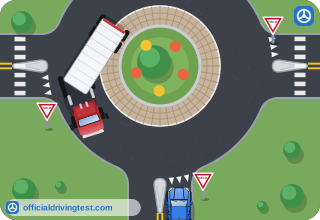
- Large vehicles with long trailers
- Motorcycles and mopeds only
- Cars, pickup trucks and SUVs
- Vehicles making a right turn
Show answer
Correct answer: Cars, pickup trucks and SUVs
Truck aprons are not intended to be used by cars, pickup trucks or SUVs.
Source: Alabama Driver Manual (November 2024), page 58 · Open this page in the manual (Manual page 58)
-
When you stop for a school bus or church bus, how long must you remain stopped?
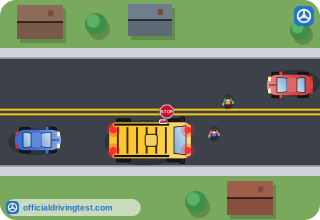
- Until the bus driver signals that you may proceed
- Until the stop arm is retracted and the red lights are off
- Until the children are out of sight
- For at least 20 seconds
Show answer
Correct answer: Until the stop arm is retracted and the red lights are off
You remain stopped until the stop signal is retracted and the red lights are turned off.
Source: Alabama Driver Manual (November 2024), page 61 · Open this page in the manual (Manual page 61)
-
On which type of highway should you also stop when meeting or following a stopped school or church bus?
- A two-lane road only
- A divided highway with four or more lanes
- A one-way street only
- A four to six lane undivided highway
Show answer
Correct answer: A four to six lane undivided highway
You should also stop for a stopped bus on a four to six lane undivided highway.
Source: Alabama Driver Manual (November 2024), page 61 · Open this page in the manual (Manual page 61)
-
On which type of road is a stop NOT required when you meet a school or church bus stopped in the opposing roadway?
- A divided highway with four or more lanes
- A four to six lane undivided highway
- Any two-lane road with a center line
- Any one-way street with two lanes
Show answer
Correct answer: A divided highway with four or more lanes
A stop is not required on a divided highway with four or more lanes when meeting a bus stopped in the opposing roadway.
Source: Alabama Driver Manual (November 2024), page 61 · Open this page in the manual (Manual page 61)
-
How close to a stopped school bus displaying its stop signals may you stop?
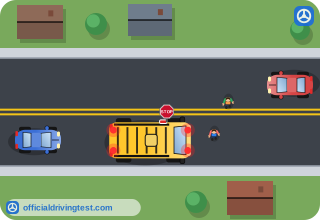
- No closer than 5 feet
- No closer than 10 feet
- No closer than 20 feet
- No closer than 50 feet
Show answer
Correct answer: No closer than 20 feet
The manual's school bus illustration says to stop at least 20 feet from the bus.
Source: Alabama Driver Manual (November 2024), page 62 · Open this page in the manual (Manual page 62)
-
What does it mean when a school bus has flashing amber lights?
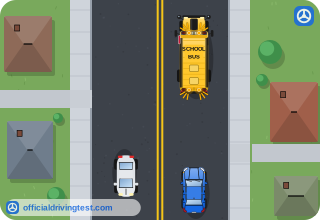
- The bus is stopped and children are about to cross
- The bus is preparing to stop to load or unload children
- The bus is broken down
- You may pass the bus freely
Show answer
Correct answer: The bus is preparing to stop to load or unload children
Flashing amber lights are a pre-warning that the bus is preparing to stop to load or unload children.
Source: Alabama Driver Manual (November 2024), page 62 · Open this page in the manual (Manual page 62)
-
In rural areas, how far before stopping do school buses use their flashing amber lights?
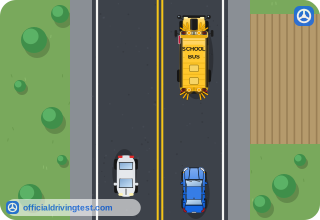
- At least 100 feet
- At least 200 feet
- At least 500 feet
- At least 300 feet
Show answer
Correct answer: At least 300 feet
In rural areas the amber lights are used at least 300 feet before stopping.
Source: Alabama Driver Manual (November 2024), page 62 · Open this page in the manual (Manual page 62)
-
In municipalities, how far before stopping do school buses use their flashing amber lights?
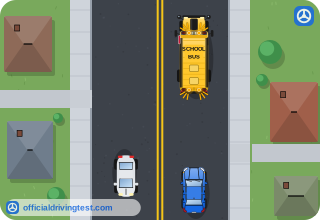
- At least 100 feet
- At least 20 feet
- At least 300 feet
- At least 500 feet
Show answer
Correct answer: At least 100 feet
In municipalities the amber lights are used at least 100 feet before stopping.
Source: Alabama Driver Manual (November 2024), page 62 · Open this page in the manual (Manual page 62)
-
What do flashing red lights and an extended stop arm on a school bus mean?
- The bus is about to start moving along the road
- The bus is warning of a hazard ahead
- The bus is stopped to load or unload school children
- The bus is preparing to stop
Show answer
Correct answer: The bus is stopped to load or unload school children
Flashing red lights and an extended stop arm mean the bus is stopped to load or unload children.
Source: Alabama Driver Manual (November 2024), page 62 · Open this page in the manual (Manual page 62)
-
Where are the majority of children injured or killed in pupil transportation?
- Inside the bus, in the aisle
- Outside the bus
- Inside the bus, in the rear seats
- Inside the bus, in the front seats
Show answer
Correct answer: Outside the bus
Most children injured or killed in pupil transportation are outside the bus, not on it.
Source: Alabama Driver Manual (November 2024), page 81 · Open this page in the manual (Manual page 81)
-
Most children hurt outside a school bus are struck by motorists who fail to stop for what?
- The flashing red lights and extended stop signs
- The school zone speed limit signs and crossing guards
- The crossing guard whistle and the school zone sign
- The caution lights and the bus driver’s horn
Show answer
Correct answer: The flashing red lights and extended stop signs
Most are struck by motorists who fail to stop for the flashing red lights and extended stop signs.
Source: Alabama Driver Manual (November 2024), page 81 · Open this page in the manual (Manual page 81)
-
What is the area around a stopped school bus referred to as?
- The “Safe Zone”
- The “Caution Area”
- The “DEATH ZONE”
- The “Bus Perimeter”
Show answer
Correct answer: The “DEATH ZONE”
The area around the stopped school bus is referred to as the death zone.
Source: Alabama Driver Manual (November 2024), page 81 · Open this page in the manual (Manual page 81)