Alabama: Sharing the road — Part 3 Practice Test
Questions in this part include: “In a car and motorcycle accident, who usually ends up the loser, regardless of who is legally at fault?” · “Compared with a passenger car, how much room do truck and bus drivers need to stop?”
Independent educational site · not affiliated with any government agency or DMV
Ready? Test yourself
- Instant feedback with an explanation
- Every answer cites its source in the manual
- Your best score is saved on this device
Questions are original and based on the official manual "Alabama Driver Manual" (November 2024), Alabama Law Enforcement Agency (ALEA), Driver License Division.
All 18 questions in this practice test
Take the test above first, then use this list to study. Tap “Show answer” to see the correct answer and explanation.
Show the questions and answersHide the questions
-
Why might an inexperienced motorcyclist quickly change direction or slow down on a metal or grated bridge?
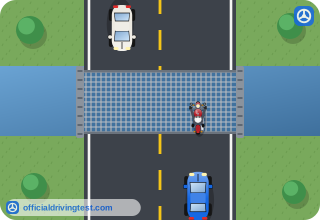
- A wobbling sensation in the front tire, more than in a car
- The grated surface makes the engine lose power quickly
- The surface throws sparks up from the motorcycle tires
- The surface pulls the motorcycle toward the center line
Show answer
Correct answer: A wobbling sensation in the front tire, more than in a car
Metal or grated bridges create a wobbling feeling in the motorcycle's front tire that is stronger than the feeling in a car.
Source: Alabama Driver Manual (November 2024), page 26 · Open this page in the manual (Manual page 26)
-
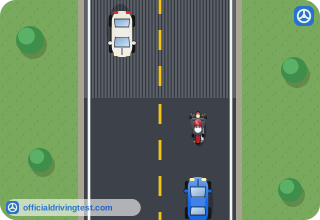
What effect can grooved pavement have when a motorcyclist first encounters it?
- It can make the rider's headlight turn off suddenly
- It can lock the motorcycle's rear brake without warning
- A wobbling sensation, so the rider may overcompensate
- It can lift the front wheel off the road surface
Show answer
Correct answer: A wobbling sensation, so the rider may overcompensate
Grooved pavement may create a wobbling sensation, and the rider may overcompensate by slowing down or changing lanes suddenly.
Source: Alabama Driver Manual (November 2024), page 26 · Open this page in the manual (Manual page 26)
-
In a car and motorcycle accident, who usually ends up the loser, regardless of who is legally at fault?
- The car driver
- The motorcyclist
- The driver who was following
- The owner of the vehicle that was not insured
Show answer
Correct answer: The motorcyclist
The manual says that regardless of who is at fault in car/cycle accidents, the motorcyclist usually is the loser.
Source: Alabama Driver Manual (November 2024), page 27 · Open this page in the manual (Manual page 27)
-
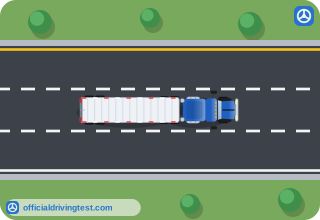
What are No-Zones around trucks and buses?
- Areas where trucks and buses are not permitted to drive at all
- Parts of the road reserved for passing large vehicles
- Lanes where the speed limit is lower for large vehicles
- Danger areas where crashes are more likely, some being blind spots
Show answer
Correct answer: Danger areas where crashes are more likely, some being blind spots
No-Zones are danger areas around trucks and buses where crashes are more likely, and some are blind spots.
Source: Alabama Driver Manual (November 2024), page 27 · Open this page in the manual (Manual page 27)
-
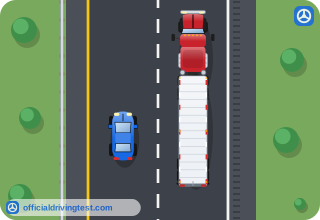
If you can't see a truck driver's face in the side-view mirror, what does that mean?
- The driver can't see you
- The driver is about to change lanes
- The truck is about to turn right
- You are at a safe passing distance
Show answer
Correct answer: The driver can't see you
The manual says that if you cannot see the driver's face in the side-view mirror, the driver cannot see you.
Source: Alabama Driver Manual (November 2024), page 27 · Open this page in the manual (Manual page 27)
-
When passing a truck or bus, how should you do it?
- Pass on the right and stay beside the truck for a short time
- Pass on either side while keeping pace with the truck
- Pass on the left and do it as quickly as possible
- Pass on the left but stay beside the cab so the driver sees you
Show answer
Correct answer: Pass on the left and do it as quickly as possible
The manual says to pass a truck or bus on the left, as quickly as possible, and get ahead so the driver can see you.
Source: Alabama Driver Manual (November 2024), page 27 · Open this page in the manual (Manual page 27)
-
How far behind a truck or bus can the rear No-Zone extend?
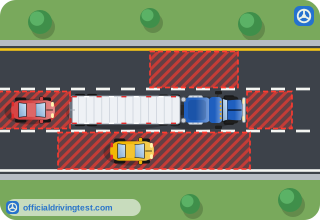
- As far as 50 feet
- As far as 200 feet
- As far as 100 feet
- As far as 500 feet
Show answer
Correct answer: As far as 200 feet
Trucks and buses have huge No-Zones directly behind them that may extend as far as 200 feet.
Source: Alabama Driver Manual (November 2024), page 27 · Open this page in the manual (Manual page 27)
-
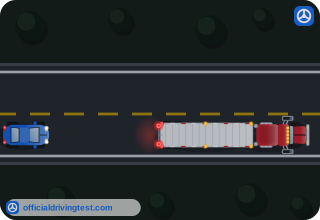
What should you do with your headlights when following a large vehicle at night?
- Turn them off completely so the truck driver is not blinded
- Keep them on high beam so the driver can see you clearly
- Flash them repeatedly to warn the driver that you are there
- Dim them, because bright lights blind the driver in the mirrors
Show answer
Correct answer: Dim them, because bright lights blind the driver in the mirrors
Bright lights reflect off the side mirrors of a bus or truck and blind the driver, so you should dim your headlights.
Source: Alabama Driver Manual (November 2024), page 27 · Open this page in the manual (Manual page 27)
-
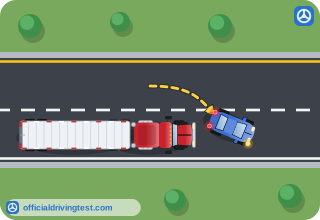
What should you see in your rear-view mirror before pulling in front of a large vehicle you have just passed?
- The entire front of the vehicle
- The vehicle's rear wheels
- The driver's face
- Only the vehicle's headlights
Show answer
Correct answer: The entire front of the vehicle
The manual says to look for the entire front of the large vehicle in your rear-view mirror before pulling in front of it.
Source: Alabama Driver Manual (November 2024), page 28 · Open this page in the manual (Manual page 28)
-
Compared with a passenger car, how much room do truck and bus drivers need to stop?
- About the same room
- About half as much room
- Nearly two times more room
- Nearly ten times more room
Show answer
Correct answer: Nearly two times more room
Truck and bus drivers need nearly two times more room to stop.
Source: Alabama Driver Manual (November 2024), page 28 · Open this page in the manual (Manual page 28)
-
At 55 miles per hour, how many feet does a loaded truck need to stop, according to the National Safety Council study quoted in the manual?
- 193 feet
- 430 feet
- 300 feet
- 550 feet
Show answer
Correct answer: 430 feet
The study found that at 55 mph a passenger car needs 193 feet to stop safely and a loaded truck needs 430 feet.
Source: Alabama Driver Manual (November 2024), page 28 · Open this page in the manual (Manual page 28)
-
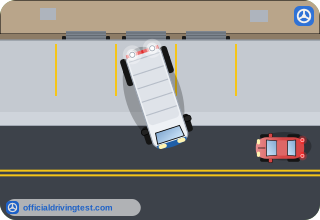
What should you never do around a truck or bus that is backing up?
- Stop in front of it
- Pass it on the left
- Follow it at a distance
- Cross behind it
Show answer
Correct answer: Cross behind it
The manual says to never cross behind a truck or bus that is backing up, because the driver cannot see directly behind.
Source: Alabama Driver Manual (November 2024), page 28 · Open this page in the manual (Manual page 28)
-
To safely make a right turn, how does a truck or bus driver need to swing?
- Wide to the left
- Wide to the right
- Tightly to the right
- Straight, then sharply right
Show answer
Correct answer: Wide to the left
Truck and bus drivers need to swing wide to the left to safely make a right turn.
Source: Alabama Driver Manual (November 2024), page 28 · Open this page in the manual (Manual page 28)
-
A large truck's right turn signal is blinking. What should you NOT attempt to do?
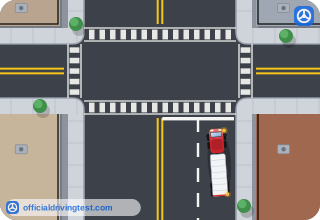
- Stay well back and let it finish the turn
- Slow down and wait
- Pass on the right
- Follow behind the truck
Show answer
Correct answer: Pass on the right
When the right turn signal is blinking, do not attempt to pass on the right: the driver cannot see you and you may be trapped.
Source: Alabama Driver Manual (November 2024), page 28 · Open this page in the manual (Manual page 28)
-
Why might a motorcycle's turn signal be blinking even though the rider is not turning?
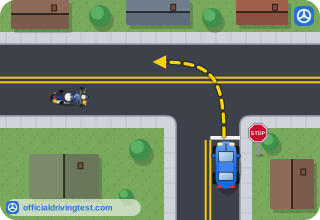
- Most motorcycle turn signals do not cancel by themselves
- Motorcycle signals blink all the time as a safety light
- Riders must signal for the whole length of every trip
- The signal shows the rider is about to slow down
Show answer
Correct answer: Most motorcycle turn signals do not cancel by themselves
The manual says turn signals are not automatically self-canceling on most motorcycles, and at times the rider may forget to turn the signal off.
Source: Alabama Driver Manual (November 2024), page 25 · Open this page in the manual (Manual page 25)
-
A person on a bicycle is sometimes difficult to see amid other traffic. Where does the manual say to be especially watchful?
- Only on highways that have four or more lanes
- At intersections, sidewalks, alleys and driveways
- Only on streets that have a marked bike lane
- Only at night or when it is raining hard
Show answer
Correct answer: At intersections, sidewalks, alleys and driveways
The manual says to be especially watchful at intersections, when crossing sidewalks, or when entering or leaving alleys or driveways.
Source: Alabama Driver Manual (November 2024), page 24 · Open this page in the manual (Manual page 24)
-
A yellow diamond sign shows the side view of a truck. What should you watch for?
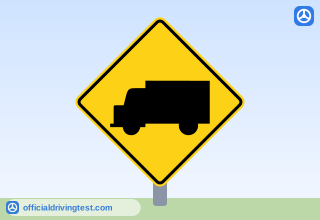
- Fire trucks entering the street
- Trucks entering the highway
- Trucks stopped on the shoulder
- Trucks that cannot stop quickly
Show answer
Correct answer: Trucks entering the highway
The manual says this truck crossing sign means to watch for trucks entering the highway.
Source: Alabama Driver Manual (November 2024), page 47 · Open this page in the manual (Manual page 47)
-
A yellow diamond sign shows a school bus with an up arrow and red lights. What does it mean?
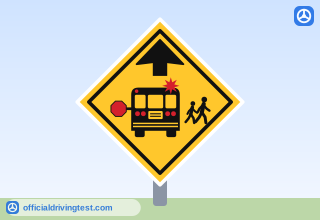
- A school bus stop is ahead
- A school crossing is ahead
- A school zone begins ahead
- School buses may not stop ahead
Show answer
Correct answer: A school bus stop is ahead
The manual says this sign means a school bus stop is ahead.
Source: Alabama Driver Manual (November 2024), page 49 · Open this page in the manual (Manual page 49)