Alabama: Sharing the road — Part 2 Practice Test
Questions in this part include: “What do motorcycle accident statistics show?” · “Which kind of accident accounts for a large percentage of car/cycle injury-producing accidents?”
Independent educational site · not affiliated with any government agency or DMV
Ready? Test yourself
- Instant feedback with an explanation
- Every answer cites its source in the manual
- Your best score is saved on this device
Questions are original and based on the official manual "Alabama Driver Manual" (November 2024), Alabama Law Enforcement Agency (ALEA), Driver License Division.
All 19 questions in this practice test
Take the test above first, then use this list to study. Tap “Show answer” to see the correct answer and explanation.
Show the questions and answersHide the questions
-
Why should a motor vehicle driver practice added care around people on bicycles?
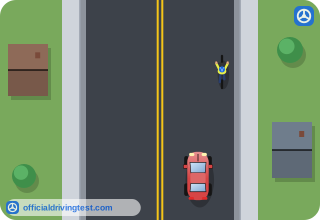
- The person on the bicycle is largely unprotected and could be seriously injured or killed
- The person on the bicycle always has the right of way over all motor vehicles
- The driver of a motor vehicle is always found at fault in a collision with a bicycle
- Bicycles can travel faster than motor vehicles on the streets of a town or city
Show answer
Correct answer: The person on the bicycle is largely unprotected and could be seriously injured or killed
The manual says the person on a bicycle is largely unprotected and a collision could very likely result in serious injury or even death.
Source: Alabama Driver Manual (November 2024), page 25 · Open this page in the manual (Manual page 25)
-
What do motorcycle accident statistics show?
- Most of the accidents involve riders with many years of experience
- Most of the accidents happen on interstate highways at night
- A substantial percentage of the accidents involve riders with limited experience
- Most of the accidents are caused by mechanical failure of the motorcycle
Show answer
Correct answer: A substantial percentage of the accidents involve riders with limited experience
The manual says a substantial percentage of motorcycle accidents involve riders with limited experience.
Source: Alabama Driver Manual (November 2024), page 25 · Open this page in the manual (Manual page 25)
-
What rights and responsibilities do motorcyclists have on public roadways?
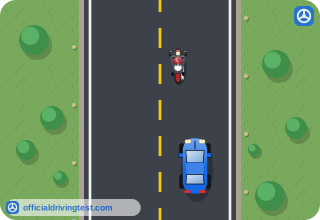
- The same as other highway users
- Fewer rights than drivers of cars
- The same rights but fewer duties
- Special rights to pass in a lane
Show answer
Correct answer: The same as other highway users
The manual says motorcyclists have the same rights and responsibilities on public roadways as other highway users.
Source: Alabama Driver Manual (November 2024), page 25 · Open this page in the manual (Manual page 25)
-
Why is it so important to be aware of motorcycles?
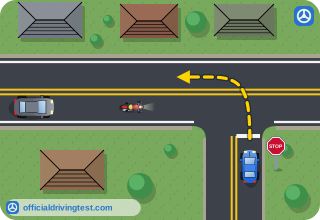
- They always travel faster than other traffic
- They are exempt from the traffic laws
- They must ride in the center of the lane
- They are not easily identified in traffic
Show answer
Correct answer: They are not easily identified in traffic
The manual says motorcycles are not easily identified in traffic.
Source: Alabama Driver Manual (November 2024), page 25 · Open this page in the manual (Manual page 25)
-
About how wide is a motorcycle compared with an automobile?
- About three feet, compared with six to seven feet for an automobile
- About two feet, compared with five to six feet for an automobile
- About one foot, compared with four to five feet for an automobile
- About four feet, compared with seven to eight feet for an automobile
Show answer
Correct answer: About two feet, compared with five to six feet for an automobile
The manual says motorcycles are about two feet wide compared with the five-to-six-foot width of an automobile.
Source: Alabama Driver Manual (November 2024), page 25 · Open this page in the manual (Manual page 25)
-
Which kind of accident accounts for a large percentage of car/cycle injury-producing accidents?
- Rear-end collisions at traffic signals
- Left turns in front of an oncoming motorcyclist
- Right turns in front of a parked motorcycle
- Passing a motorcycle on a straight road
Show answer
Correct answer: Left turns in front of an oncoming motorcyclist
The manual says left turns in front of an oncoming motorcyclist account for a large percentage of car/cycle injury-producing accidents.
Source: Alabama Driver Manual (November 2024), page 25 · Open this page in the manual (Manual page 25)
-
Before making a left turn when a motorcycle is approaching, what does the manual say to do?
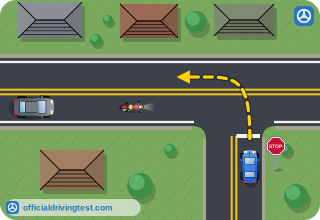
- Turn quickly, because motorcycles can stop easily
- Sound your horn so the rider slows down for you
- Assume the motorcycle will turn before you do
- Look and look again, and know the motorcycle's speed
Show answer
Correct answer: Look and look again, and know the motorcycle's speed
The manual says to look and look again and make sure you know the motorcycle's speed before turning left.
Source: Alabama Driver Manual (November 2024), page 25 · Open this page in the manual (Manual page 25)
-
You are about to turn in front of a motorcycle whose turn signal is blinking. What should you be sure of first?
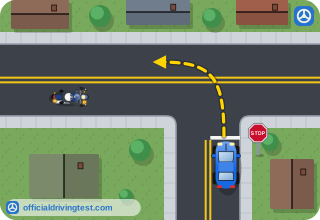
- That it is truly turning, not going straight with a forgotten signal
- That the rider has slowed down to below ten miles per hour
- That the rider has noticed your own turn signal and slowed
- That the motorcycle is riding in the center of its own lane
Show answer
Correct answer: That it is truly turning, not going straight with a forgotten signal
Riders sometimes forget to turn the signal off, so you must be sure the vehicle is turning before you turn in front of it.
Source: Alabama Driver Manual (November 2024), page 26 · Open this page in the manual (Manual page 26)
-
How much following distance should you give a motorcyclist in good conditions?
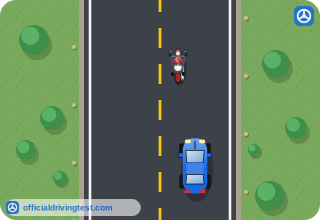
- A 4-second following distance, double that of cars
- Half of the distance you would give to any car
- A 2-second following distance, as for any other vehicle
- One car length for every 10 miles per hour of speed
Show answer
Correct answer: A 2-second following distance, as for any other vehicle
The manual says following distance behind a motorcyclist should be the same 2-second distance given any other vehicle.
Source: Alabama Driver Manual (November 2024), page 26 · Open this page in the manual (Manual page 26)
-
According to the manual, why can following a motorcyclist too closely be dangerous?
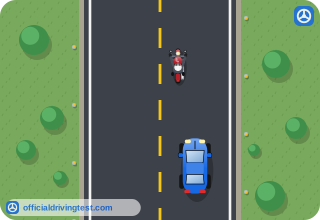
- It blocks the rider's view of the traffic signals ahead of him
- It may make the rider nervous and distract attention from the road
- It forces the rider to ride on the shoulder of the road
- It makes the motorcycle's brake light flash on and off
Show answer
Correct answer: It may make the rider nervous and distract attention from the road
Following too closely may make the rider nervous, drawing the rider's attention away from the road and traffic ahead.
Source: Alabama Driver Manual (November 2024), page 26 · Open this page in the manual (Manual page 26)
-
How much of a lane are motorcycles entitled to use?
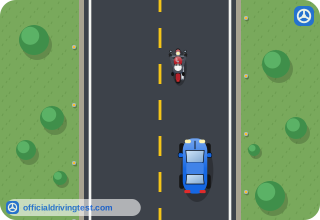
- Half of the lane width
- Only the center of the lane
- The lane width minus the width of one car tire
- The same full lane width as all other vehicles
Show answer
Correct answer: The same full lane width as all other vehicles
Motorcycles are entitled to the same full lane width as all other vehicles.
Source: Alabama Driver Manual (November 2024), page 26 · Open this page in the manual (Manual page 26)
-
Why does a skilled motorcycle operator constantly change positions within a lane?
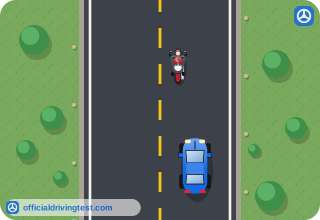
- To be seen better, see the road better, and adjust for road objects
- To make room for cars that want to share the same lane
- To signal to nearby drivers that the rider is about to stop
- To keep the tires warm and the engine cool in cold weather
Show answer
Correct answer: To be seen better, see the road better, and adjust for road objects
The manual says skilled riders change position to maximize being seen, to see the road better, and to deal with objects on or near the road.
Source: Alabama Driver Manual (November 2024), page 26 · Open this page in the manual (Manual page 26)
-
A motorcycle is riding far to one side of a wide lane. What should you do?
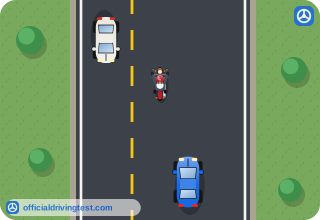
- Share the lane and pass slowly on the open side of it
- Move alongside it only if you signal first and slow down
- Never share the lane alongside it; this is illegal and hazardous
- Share the lane only when the road is dry and well lit
Show answer
Correct answer: Never share the lane alongside it; this is illegal and hazardous
Drivers should never move into the same lane alongside a motorcycle, even if the lane is wide; it is illegal and extremely hazardous.
Source: Alabama Driver Manual (November 2024), page 26 · Open this page in the manual (Manual page 26)
-
When the road is dark, raining, or wet and slippery, how should you adjust your distance behind a motorcycle?
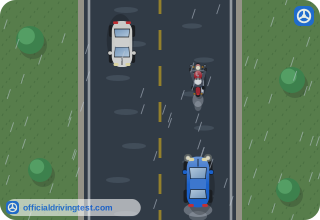
- Keep the same following distance as in dry weather
- Allow even more following distance for the motorcyclist
- Pass the motorcycle as soon as you can
- Follow closer so the rider can see your headlights
Show answer
Correct answer: Allow even more following distance for the motorcyclist
Inclement weather and slippery surfaces are real problems for motorcycles, so drivers should allow even more following distance.
Source: Alabama Driver Manual (November 2024), page 26 · Open this page in the manual (Manual page 26)
-
Which places should you watch for because cross winds can move a motorcycle out of its lane?
- Narrow residential streets and driveways
- Tunnels and underpasses
- School zones and parking lots
- Wide-open, long stretches of highway and bridges
Show answer
Correct answer: Wide-open, long stretches of highway and bridges
Windy conditions can move a motorcycle out of its lane, especially on wide-open, long stretches of highways and bridges.
Source: Alabama Driver Manual (November 2024), page 26 · Open this page in the manual (Manual page 26)
-
How can fast-moving large trucks affect a nearby motorcyclist?
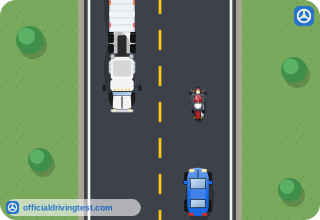
- They can create windblasts that startle the rider or move the bike
- They muffle the engine noise so riders cannot hear traffic
- They create a vacuum that pulls the rider closer to the truck's rear
- They force the rider to shift to a lower gear
Show answer
Correct answer: They can create windblasts that startle the rider or move the bike
Windblasts from fast-moving large trucks can startle a motorcyclist and, in some conditions, move the motorcycle out of its path of travel.
Source: Alabama Driver Manual (November 2024), page 26 · Open this page in the manual (Manual page 26)
-
Which of these road hazards can make a motorcyclist change speed or direction even though they do not normally affect other vehicles?
- Painted lane lines and reflectors set into the pavement
- Wide shoulders, bike lanes, and well-marked crosswalks
- Gravel, debris, pavement seams, small animals, manhole covers
- Traffic signs posted on the right side of the roadway
Show answer
Correct answer: Gravel, debris, pavement seams, small animals, manhole covers
Gravel, debris, pavement seams, small animals, and even manhole covers may cause a motorcyclist to change speed or direction.
Source: Alabama Driver Manual (November 2024), page 26 · Open this page in the manual (Manual page 26)
-
Why might a motorcyclist slow down or change direction at a railroad crossing that runs at an angle to the road?
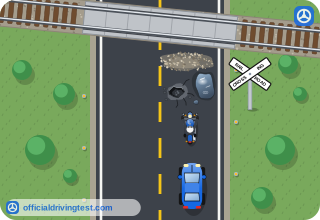
- To avoid the warning lights
- So the tracks can be crossed head on
- To let the rear tire pass the rail first
- To keep the headlight pointed at the train
Show answer
Correct answer: So the tracks can be crossed head on
Railroad crossings may be rough or angled, so the rider may change direction so the tracks can be crossed head on.
Source: Alabama Driver Manual (November 2024), page 26 · Open this page in the manual (Manual page 26)
-
What might a motorcyclist do to cushion the shock of a rough railroad crossing?
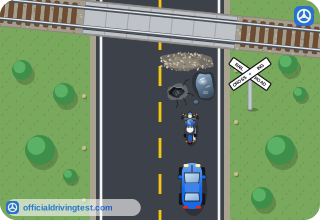
- Lean far to one side
- Turn off the engine
- Put both feet down on the pavement
- Rise off the seat
Show answer
Correct answer: Rise off the seat
The manual says the cyclist may rise off the seat to help cushion the shock of a rough crossing.
Source: Alabama Driver Manual (November 2024), page 26 · Open this page in the manual (Manual page 26)